
General information only, not legal, tax or regulatory advice. Requirements change and differ by country; confirm your obligations with a qualified advisor before acting.
GDPR-compliant AI automation tools face a hidden problem: the AI models powering them often fail basic compliance tests. The automation tools meant to keep you GDPR-compliant are often built on AI that isn’t compliant itself — a paradox that buyers rarely scrutinize before signing an annual contract.
GDPR compliant AI automation tools are software platforms that use artificial intelligence to automate data protection tasks — data mapping, consent management, DSAR processing, and breach reporting — while keeping personal data handling within EU regulatory boundaries. Vendors and industry publishers report large reductions in compliance workload; for example, SellAITool’s 2025 platform analysis states these tools reduce workload “by up to 97%,” and AIToolJournal documents privacy-cost reductions of roughly 60%. These are vendor- and publisher-reported figures rather than peer-reviewed measurements, so treat them as directional, not guaranteed. The gap between marketing and reality is wide, and SMEs frequently get caught in it.
This guide is written from a practitioner’s perspective on building and deploying AI automation. A note on bias: J. SERVO builds custom GDPR-compliant AI agents, so this article has a commercial interest in the “custom vs. off-the-shelf” comparison. We’ve flagged that openly throughout and have tried to give the off-the-shelf case its fair due. The goal here is to give you a decision framework you can apply regardless of who you ultimately hire.
Quick Summary: GDPR Compliant AI Automation Tools in 2026
- Workload reduction is reported, not independently proven: vendor and publisher analyses (SellAITool, AIToolJournal) cite up to 97% workload reduction and ~60% privacy-cost reduction. Methodology is not publicly detailed, so validate against your own baseline.
- Core use cases: data mapping, consent management, Data Subject Access Request (DSAR) processing, risk scoring, real-time monitoring, and automated breach reporting.
- Leading platforms: Secure Privacy, Sprinto, HyperComply (acquired by SecurityScorecard), and AppliedAI’s Opus are commonly cited in the enterprise tier.
- The hidden risk: the AI models powering these tools can fail GDPR tests themselves — privacy-by-design architecture matters more than the brand name.
- SMEs have a different option: custom-built GDPR compliant AI agents often fit cost and stack constraints better than enterprise subscription tools.
- Deterministic beats probabilistic: compliance workflows demand predictable, auditable outputs — not a chatbot that guesses.
Published: June 8, 2026. Last updated: September 20, 2026. This article reflects general topical expertise in AI automation and EU data-protection practice; it is not legal advice. For binding interpretations, consult a qualified data protection officer or legal counsel and verify against the primary regulatory sources cited below.
What Are GDPR Compliant AI Automation Tools?
GDPR compliant AI automation tools are platforms that apply artificial intelligence to automate data protection obligations under the General Data Protection Regulation — without violating those same rules in the process. The best ones handle data discovery, consent records, subject access requests, and audit evidence while keeping all processing lawful, transparent, and traceable.
The General Data Protection Regulation, enforced across the EU since 25 May 2018, governs how organizations collect, store, and process personal data. Under Article 83, non-compliance fines can reach up to 4% of global annual turnover or €20 million, whichever is higher. The European Data Protection Board publishes enforcement guidance and the EDPB-coordinated fine register, which is the authoritative place to verify cumulative penalty figures — a far better source than secondhand totals quoted by vendors.
Automation matters because manual GDPR compliance is labor-intensive. A single DSAR — a user’s legal right under Article 15 to access their data — can take a small team days to fulfill across scattered databases, spreadsheets, and SaaS tools. Multiply that by hundreds of requests and the operational cost compounds quickly. AI changes the math by automating the lookups and compilation that dominate that effort.
According to Secure Privacy’s compliance automation guide, intelligent technology “streamlines, accelerates, and enhances the accuracy of data protection” tasks that previously required dedicated compliance staff. The direction of travel is consistent across publishers: automation tends to reduce manual error, shorten audit cycles, and lower legal exposure — though the exact magnitude depends heavily on your starting point.
Here’s the catch most vendors skip: an AI tool that processes EU residents’ personal data is itself a data processor (or controller) under GDPR Article 4. If that tool sends your customers’ data to an unvetted model API outside approved regions, you may have created a compliance violation while trying to solve one. Building privacy-by-design AI agents isn’t optional — it’s the foundation.
The Core Functions Worth Automating
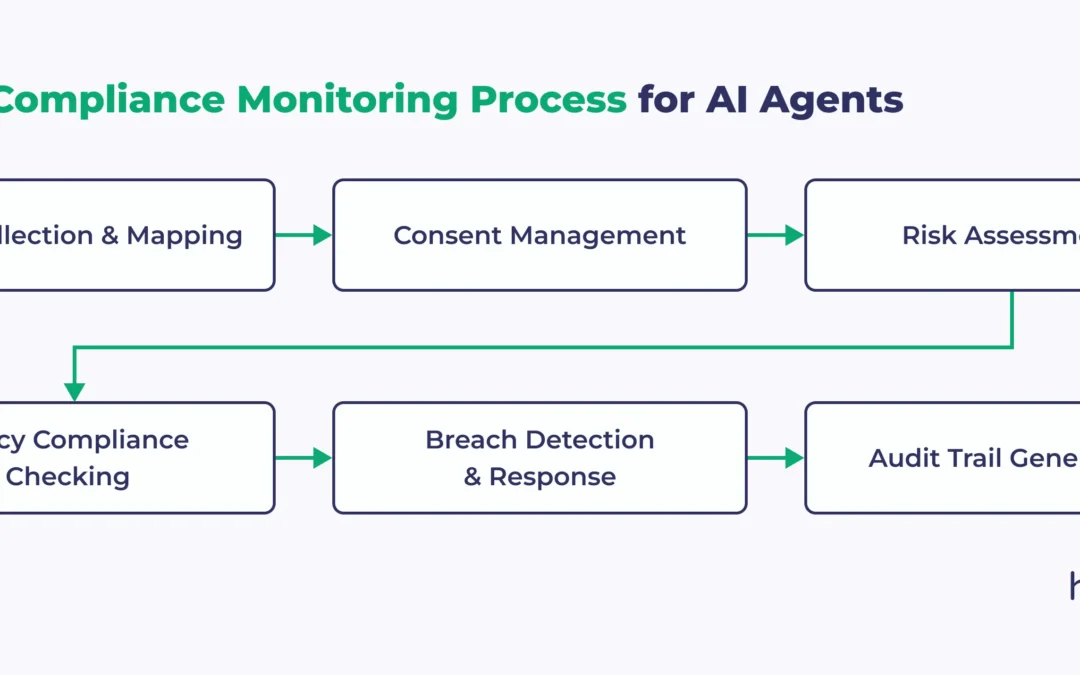
- Data mapping: AI scans your systems and builds a live inventory of where personal data lives — often the single hardest GDPR task to do manually.
- Consent management: automated capture, storage, and withdrawal of user consent with timestamped audit trails.
- DSAR processing: AI locates, compiles, and redacts personal data across systems to fulfill access requests in hours, not weeks.
- Risk scoring: continuous assessment that flags high-risk processing activities before they become violations.
- Breach detection and reporting: real-time monitoring that supports the mandatory 72-hour breach notification workflow under Article 33.
How Do GDPR Compliant AI Automation Tools Actually Work?
GDPR compliant AI automation tools work by combining data discovery engines, rule-based workflows, and machine learning classifiers that identify, categorize, and act on personal data automatically. The system connects to your databases and SaaS apps, maps personal data flows, and triggers compliance actions when specific conditions are met.
The architecture typically runs in three layers. First, a discovery layer crawls connected systems — CRMs, email platforms, databases, file storage — and identifies what counts as personal data under GDPR Article 4. Second, a classification layer tags that data by sensitivity (including special-category data under Article 9) and lawful basis (Article 6). Third, an action layer executes workflows: fulfilling DSARs, logging consent, or escalating breaches.
AI GDPR automation “automates manual GDPR tasks like data mapping, consent management, and risk assessments, reducing workload by up to 97%,” according to SellAITool’s 2025 platform analysis. That figure reflects the elimination of repetitive manual lookups that consume the bulk of compliance labor — but note it is a vendor-adjacent estimate without a published sample size or methodology. The honest way to use it: measure your own “hours per DSAR” before and after, and report your real reduction rather than the headline number.
A Worked Example: Automating a DSAR
To make this concrete, here is how a typical DSAR automation flows, step by step. This pattern is representative of how practitioners commonly scope a DSAR pipeline for a mid-sized SME — it is illustrative, not a claim about any specific named client:
- Intake: a user submits an access request through a form. The workflow logs a timestamp and a unique request ID for the audit trail.
- Identity verification: the agent confirms the requester’s identity using a deterministic rule set (e.g., matching email plus a one-time code) — never a probabilistic guess, because mis-disclosing data to the wrong person is itself a breach. Recital 64 of the GDPR explicitly requires controllers to use reasonable measures to verify the identity of a requester.
- Discovery: the agent queries each connected system for records tied to that identifier — CRM, support tickets, billing, marketing platform.
- Classification and redaction: AI classifies retrieved fields and flags third-party personal data that must be redacted before disclosure.
- Human checkpoint: a person reviews edge cases (e.g., whether an exemption applies) before release.
- Delivery and logging: the compiled package is delivered within the one-month statutory window (Article 12(3)), and every step is recorded for regulator review.
The trade-off practitioners generally weigh here: full automation is fastest but risks over-disclosure, while a human checkpoint adds hours but protects against the most expensive failure mode. Most defensible implementations keep the human in the loop for anything ambiguous. A lesson practitioners learn the hard way is that the discovery layer is the part that fails silently — an unconnected legacy spreadsheet or a regional SaaS tool that nobody mapped means the DSAR response is incomplete, and an incomplete response is itself a compliance gap, not a minor omission.
The smartest implementations use deterministic logic for anything legally binding. A consent record can’t be “probably” stored. A DSAR can’t “mostly” include the right data. A robust design lets the AI handle fuzzy tasks — like classifying ambiguous free-text fields — while hard rules govern every output that carries legal weight. That’s the difference between a tool you can defend in an audit and a liability.
Why Determinism Beats Probabilistic “Yes-Machines”
Deterministic AI architecture solves a problem that probabilistic models structurally cannot: verified accuracy. Most consumer AI is a probabilistic system — it generates plausible answers, not verified ones. An AI that classifies sensitive health data probabilistically doesn’t just occasionally fail; it manufactures regulatory risk every time it guesses wrong. Deterministic AI architecture constrains outputs to auditable, repeatable results — the appropriate standard when fines can reach €20 million.
Which GDPR Compliant AI Automation Tools Lead the Market in 2026?
The GDPR compliant AI automation tools most frequently cited in 2026 are Secure Privacy, Sprinto, HyperComply (now part of SecurityScorecard), and AppliedAI’s Opus. These platforms target the enterprise segment, and their pricing and complexity often make them a poor fit for smaller startups and SMEs.
Each platform targets a slightly different problem. Secure Privacy focuses on consent management and cookie compliance. Sprinto handles broader security and compliance frameworks including SOC 2 and ISO 27001 alongside GDPR. HyperComply specialized in security questionnaire automation before its acquisition. Opus from AppliedAI pushes into agentic compliance automation for regulated industries.
According to Cybernews’ review of GDPR software, the best tools “are powered by AI and automation, enabling them to report data breaches or issues that could lead to non-compliance with GDPR.” Real-time breach detection has become the baseline expectation, not a premium feature.
| Tool | Best For | Core Strength | SME Fit |
|---|---|---|---|
| Secure Privacy | Consent & cookies | Consent management automation | Moderate |
| Sprinto | Multi-framework compliance | SOC 2 + ISO + GDPR in one | Moderate |
| HyperComply / SecurityScorecard | Security questionnaires | Vendor risk automation | Low (enterprise) |
| AppliedAI Opus | Regulated industries | Agentic compliance workflows | Low (enterprise) |
| Custom-built agents | Startups & SMEs | Privacy-by-design, deterministic, stack-fit | High |
Note: this table reflects general market positioning from the sources cited above and includes the custom-build approach J. SERVO offers, which is a commercial interest of this site. Verify current pricing and features directly with each vendor before deciding.
The pattern is consistent. Off-the-shelf platforms are built for organizations with dedicated compliance teams and substantial annual budgets. A 12-person startup processing customer data may not need a 200-feature enterprise suite — it often needs a focused agent that handles its actual workflows. Paying for the former to use a fraction of it is the compliance equivalent of the Zapier tax: recurring fees for capacity you’ll never touch.
Why Do Off-the-Shelf Tools Fail Startups and SMEs?
Off-the-shelf GDPR compliant AI automation tools often fail startups and SMEs because they’re priced and engineered for enterprises — charging per-seat or per-record fees that scale punishingly, while bundling hundreds of features a small business never uses. The mismatch creates cost bloat without proportional compliance benefit.
Consider the math. Enterprise compliance platforms are commonly quoted in the range of roughly $15,000 to $50,000+ annually (figures vary widely by vendor and tier; confirm directly). For a startup with €2 million in revenue, that’s a significant line item — and much of the spend can cover modules for industries, jurisdictions, and data volumes the company doesn’t have. The roughly 60% privacy-cost reduction that AI GDPR automation can deliver, as documented by AIToolJournal, can evaporate when the tool itself costs more than the manual labor it replaces.
Integration is the second failure point. SMEs often run lean, idiosyncratic tech stacks — a mix of Notion, Airtable, WhatsApp Business, custom databases, and regional SaaS. Enterprise compliance tools tend to assume Salesforce, Workday, and a standardized data warehouse. When your stack doesn’t match their connectors, you’re left bridging gaps manually, which undermines the purpose. In a typical SME implementation, the connector mismatch is the single biggest reason a promising tool gets abandoned within the first quarter — the team ends up exporting CSVs by hand, which is exactly the manual toil the tool was supposed to eliminate.
Then there’s the compliance-of-the-tool-itself problem. Industry reporting in 2025 highlighted that major general-purpose AI models can struggle with GDPR requirements when handling personal data. If an off-the-shelf tool routes your EU customers’ data through a non-compliant model or stores it outside approved regions, the tool can become the violation. Custom AI agents built for SMEs let you control exactly where data lives and how it’s processed — a level of governance that subscription tools don’t always offer.
The SaaS Wrapper Problem
The SaaS wrapper problem refers to AI compliance products that are thin interface layers built on top of a general-purpose model (such as GPT-4 or Claude) with a dashboard added for branding. The underlying capability may be sound — but your data flows through their servers under their terms, and you inherit their data-processing posture. SaaS wrapper bloat is common in the compliance space precisely because GDPR sounds intimidating enough that buyers don’t always question the value or scrutinize the data-flow diagram. The practical test: ask the vendor for a sub-processor list and a data-flow diagram (which Articles 28 and 30 already require them to be able to produce). A vendor who can’t supply one quickly is a vendor who hasn’t done the work.
Custom AI Agents vs. Off-the-Shelf: Which Wins for GDPR Compliance?
For many startups and SMEs, custom AI agents are the stronger fit for GDPR compliance: they match your exact data flows, run on infrastructure you control, and can cost less over a multi-year horizon. Off-the-shelf tools tend to win when you need broad multi-framework coverage and have the budget to absorb the bloat. (As noted, J. SERVO offers custom builds — weigh this comparison accordingly.)
The decision comes down to fit, control, and total cost of ownership. A custom agent does what your business needs — no more, no less. A well-scoped compliance automation workflow is mapped to your real DSAR volume, your actual data locations, and your specific lawful bases. In that model there’s no per-record fee, no surprise tier upgrade, and no data leaving systems you’ve vetted.
| Factor | Off-the-Shelf Tools | Custom AI Agents |
|---|---|---|
| Upfront cost | Low | Moderate |
| 3-year total cost | Higher (recurring + scaling fees) | Often lower (one-time build + maintenance) |
| Data control | Vendor-controlled | You control (self-hosted option) |
| Stack fit | Generic connectors | Exact-match integration |
| Compliance of the tool itself | Often unverified | Privacy-by-design, auditable |
| Determinism | Varies | Enforced for legal outputs |
| Maintenance burden | Vendor handles updates | You (or your partner) handle updates |
The bottom two rows cut both ways: a vendor handling updates and regulatory changes for you is a genuine advantage of off-the-shelf tools, especially for teams with no internal technical owner. Custom builds trade that convenience for control.
Self-hosting is the underrated lever. Running automation on infrastructure you own — using open-source orchestration like n8n instead of a closed SaaS — means EU data can stay in EU regions, processing stays transparent, and you’re not one vendor acquisition away from a forced migration. When HyperComply was acquired by SecurityScorecard, customers faced exactly that kind of continuity uncertainty.
A pattern practitioners report repeatedly: the biggest GDPR risk for small businesses often isn’t the regulation itself — it’s adopting tools that handle data carelessly while promising compliance. Privacy-by-design (Article 25) isn’t a feature you bolt on later; it’s an architecture you start with.
When Off-the-Shelf Still Makes Sense
This isn’t an anti-tool argument. If you need SOC 2, ISO 27001, HIPAA, and GDPR coverage simultaneously, and you have the budget plus no in-house technical owner, a multi-framework platform like Sprinto can genuinely save time and reduce coordination overhead. The honest split: choose off-the-shelf for broad audit-framework coverage and hands-off maintenance; choose custom for focused, cost-sensitive, data-sovereign automation.
How Do You Make Sure the AI Tool Itself Is GDPR Compliant?
You make an AI tool GDPR compliant by enforcing privacy-by-design: minimize data collection, keep EU data in EU regions, log every processing action, restrict model access to personal data, and maintain a clear lawful basis for each operation. The tool that automates compliance must follow the same rules it enforces.
The 2025 reporting that major AI models can fail GDPR tests is a warning against deploying them blindly. A model that retains prompts, trains on submitted data, or processes EU residents’ information on servers outside approved regions can turn a compliance solution into a compliance breach. This concern is not merely a publisher talking point: the EDPB’s own Opinion 28/2024 on AI models and personal data examines when an AI model can be considered to process personal data and the conditions under which a legitimate-interest basis can apply — a useful primary reference for anyone evaluating whether a model genuinely meets GDPR requirements rather than just claiming to. The fix isn’t avoiding AI — it’s architecting it correctly and documenting that architecture.
Five non-negotiable controls govern compliant AI automation:
- Data minimization (Article 5): the AI receives only the data strictly necessary for the task, never the full dataset “just in case.”
- Regional data residency: personal data of EU subjects stays processed and stored within approved jurisdictions; cross-border transfers rely on a valid Chapter V mechanism.
- Audit logging: every action the agent takes is timestamped and traceable for regulator review.
- Human oversight: high-stakes decisions — like rejecting a DSAR — route to a human before execution.
- No model training on personal data: contractually and technically prevent your data from being used to train third-party models, and confirm this in the Data Processing Agreement.
How do you verify these in practice rather than taking them on faith? A workable verification approach practitioners use: run a small set of documented test cases against the tool before committing. For example, submit a synthetic personal record and then issue an erasure request (Article 17) to confirm the data is actually removed from every connected system; inspect the network egress to confirm EU data is not silently routed to a US region; and request the vendor’s sub-processor list and DPA to confirm there is no model-training clause. These are concrete, repeatable checks — the same logic the EDPB applies when assessing whether a processor’s claims hold up under scrutiny.
The EU AI Act, which entered into force in 2024 with obligations phasing in through 2026 and beyond, adds another layer. High-risk AI systems face transparency and human-oversight requirements that stack on top of GDPR. Tools that ignored the AI Act in 2024 face retrofitting work in 2026. Building for both from day one is generally far cheaper than retrofitting later.
For the legal foundation, the official GDPR text and guidance remains a useful reference, and the European Data Protection Board publishes the enforcement guidelines that shape how regulators interpret AI processing.
Your Action Plan: Implementing GDPR Compliant AI Automation
To implement GDPR compliant AI automation, audit your data flows first, automate the highest-volume task second, enforce privacy-by-design throughout, and measure workload reduction continuously. The fastest wins typically come from automating DSAR processing and data mapping, where manual effort is highest.
Here’s a practical sequence that works well for SMEs:
- Map your data (Week 1-2): identify every system holding personal data. You can’t automate compliance for data you can’t find.
- Pick the bleeding wound (Week 2): find the single most time-consuming compliance task — usually DSARs or consent tracking — and automate that first.
- Architect for determinism (Week 3-4): build workflows where legally binding outputs follow hard rules, and AI handles only classification and drafting.
- Lock down data residency (Week 4): ensure EU data never leaves approved regions; self-host orchestration where possible.
- Add human checkpoints (Week 5): route high-risk decisions through human approval before execution.
- Measure and expand (Week 6+): track hours saved and error rates, then automate the next workflow.
A realistic 90-day blueprint can take an SME from manual, error-prone compliance to a deterministic automated system covering data mapping, consent, and DSAR processing. The headline 85-97% workload reductions reported across 2025-2026 industry analyses aren’t reserved for enterprises — but remember those figures are vendor- and publisher-sourced, so set your own baseline and report the reduction you actually achieve. In a typical SME rollout, the first measurable win shows up in DSAR turnaround: a task that consumed a full working day per request often collapses to a review-and-approve step measured in minutes once discovery is automated. That single before-and-after metric is usually more persuasive to a sceptical founder than any vendor percentage.
Track the metrics that matter: hours per DSAR, time-to-breach-report, consent record accuracy, and audit-prep time. If you can’t measure the reduction, you can’t prove the ROI — and proving ROI is how compliance automation graduates from cost center to competitive advantage.
The Bottom Line on GDPR Compliant AI Automation Tools
The market for GDPR compliant AI automation tools is maturing fast, but it’s tilted toward enterprises with deep budgets. Startups and SMEs are often sold bloated subscriptions when a focused, privacy-by-design custom agent would serve them better and cheaper — though, as disclosed, that’s also the service J. SERVO sells, so weigh the recommendation accordingly. The reported 60-97% workload reductions appear real in direction; the open question is whether you capture that value or hand most of it back to a SaaS vendor.
The deeper issue is trust. An AI tool that mishandles data while promising compliance is worse than no tool at all. As regulators sharpen enforcement and the EU AI Act tightens through 2026, the businesses that win likely won’t be the ones with the flashiest compliance dashboard. They’ll be the ones whose AI was built to be trustworthy from the first line of code. Compliance isn’t a feature you buy — it’s an architecture you commit to.
Frequently Asked Questions
Are AI automation tools GDPR compliant by default?
No, AI automation tools are not GDPR compliant by default. Industry reporting in 2025 found that major general-purpose AI models frequently struggle with GDPR requirements when handling personal data, and the EDPB’s Opinion 28/2024 sets out the conditions under which an AI model’s processing of personal data can be lawful. Compliance depends on architecture — data minimization, EU data residency, audit logging, and preventing model training on personal data — not on the tool’s marketing claims.
How much can GDPR compliant AI automation tools save?
Vendor and publisher analyses report that GDPR compliant AI automation tools can reduce compliance workload by up to 97% (SellAITool) and cut privacy costs by roughly 60% (AIToolJournal). These figures are self-reported by vendor-adjacent sources without published methodology, so validate them against your own baseline. The largest savings typically come from automating data mapping and DSAR processing.
Should SMEs use off-the-shelf tools or build custom GDPR automation?
It depends on your needs. Custom-built automation often fits SMEs better because off-the-shelf enterprise tools are commonly quoted at roughly $15,000-$50,000+ annually and bundle features small businesses never use. Custom agents match your exact data flows and keep data on infrastructure you control. However, off-the-shelf tools win when you need broad multi-framework audit coverage or have no in-house technical owner to maintain a custom build.
What is the difference between deterministic and probabilistic AI for compliance?
Deterministic AI produces predictable, repeatable, auditable outputs governed by hard rules, while probabilistic AI generates plausible but variable answers. For GDPR compliance, deterministic logic is essential for any legally binding output — like consent records or DSAR fulfillment — because a hallucinated or misclassified result can manufacture regulatory risk worth up to €20 million in fines.
Does the EU AI Act affect GDPR compliance automation?
Yes, the EU AI Act, in force since 2024 with obligations phasing in through 2026, adds transparency and human-oversight requirements that stack on top of GDPR for high-risk AI systems. Compliance automation tools must satisfy both regulations, making privacy-by-design and human-in-the-loop architecture necessary rather than optional.
What should I ask a vendor to confirm their AI tool is GDPR compliant?
Ask for four specific artifacts before signing: a sub-processor list (required under Article 28), a Record of Processing Activities or data-flow diagram (Article 30), a Data Processing Agreement that explicitly bars model training on your data, and documented confirmation of EU data residency. Then run your own test — submit a synthetic record, issue an Article 17 erasure request, and verify the data is actually deleted across every connected system. A vendor who can’t produce these quickly hasn’t done the underlying compliance work.
Can free or open-source tools deliver GDPR compliant AI automation?
Yes — open-source orchestration platforms such as n8n, Activepieces, and Windmill can form the backbone of a GDPR compliant automation stack, and often more defensibly than closed SaaS. Because you self-host them, EU personal data can stay in EU regions, you control the sub-processor chain, and you can inspect exactly how data flows. The trade-off is that open-source tools shift the compliance responsibility onto you: there is no vendor DPA to lean on, so you must document data residency, audit logging, and lawful basis yourself. For SMEs with a technical owner, that control is usually an advantage, not a burden.
Sources & References
- Secure Privacy — GDPR Compliance Automation: Complete Guide & Tool Comparison
- SellAITool — AI GDPR Automation Tools: How to Choose the Right Platform in 2025
- AIToolJournal — AI GDPR Compliance Automation: Cut Privacy Costs by 60%
- Cybernews — Best GDPR Software in 2026: My Honest Review
- GDPR.eu — Official GDPR text and guidance
- European Data Protection Board — enforcement guidelines, Opinion 28/2024 on AI models, and fine register
Note on figures: statistics in this article (workload and cost-reduction percentages, pricing ranges) are drawn from the vendor and publisher sources above, which do not publish full methodologies. They are presented as directional industry estimates, not independently verified measurements. Regulatory points (Articles 5, 6, 9, 12, 15, 17, 25, 28, 30, 33, 83 and Recital 64) are sourced from the official GDPR text, and the AI-model compliance discussion references EDPB guidance rather than vendor blogs.
Beyond GDPR-specific requirements, organizations facing strict regulatory scrutiny should evaluate deterministic AI for compliance and audits to guarantee that every automated decision can be reproduced and defended before a regulator.
Beyond GDPR alone, organizations increasingly need to align privacy controls with new AI regulations, which is why dedicated platforms that combine GDPR workflows with AI Act reporting are becoming essential for compliance teams.
Beyond choosing compliant tools, it’s worth understanding the cost of GDPR compliance for AI chatbots so you can budget realistically for data residency, consent management, and conversation-data handling.
While GDPR governs the EU, organizations operating in the Gulf should review the AI automation compliance requirements in the UAE and Saudi Arabia, which are governed by their respective PDPL frameworks.
While GDPR governs the EU, businesses operating in Turkey must also learn how to comply with Turkey KVKK for AI chatbots 2026, which sets out its own consent flows and administrative fine schedule under Law No. 6698.
Beyond data protection rules, teams deploying autonomous systems also need to address agent compliance with regulations, which requires its own dedicated controls and monitoring approach.
When evaluating where to run your models, understanding the trade-offs of self-hosted AI vs cloud AI for data sovereignty is critical to keeping personal data under your direct control and avoiding GDPR exposure.
Beyond regulatory compliance, organizations deploying autonomous agents must also address AI agent security and data privacy for enterprises, since non-human identities now introduce new attack surfaces and governance gaps.
Beyond data protection rules, organizations deploying autonomous systems must also understand AI agent compliance with the EU AI Act 2026, which classifies high-risk applications and imposes obligations becoming fully applicable on August 2, 2026.
If you’re weighing up AI automation tools and want to make sure the compliance story holds up beneath the surface, we’d be glad to talk it through with you. Reach out whenever you’re ready to explore what a genuinely GDPR-sound setup looks like.
For regulated industries like finance, choosing automation that delivers auditable, reproducible outputs is critical — explore the deterministic AI use cases in banking and finance to understand where rule-bound logic outperforms probabilistic models.
While GDPR sets the European standard, organizations operating in the Gulf must also align with the UAE PDPL and its Executive Regulations, which introduce their own data protection requirements.
Beyond European regulations, organizations operating in the Gulf must also navigate region-specific frameworks such as AI agent compliance with Oman Personal Data Protection Law, which imposes its own consent and penalty requirements.
Compliance matters most in data-sensitive functions, which is why AI workflow automation for HR departments must handle employee records under strict GDPR controls.
Beyond GDPR, regional regulations matter too, and you can read how self-hosted AI chatbot data sovereignty for UAE businesses addresses the UAE Personal Data Protection Law and local data residency requirements.
Teams prioritizing compliance often start by evaluating open source AI automation tools 2026 like n8n, Activepieces, and Windmill, since self-hosting makes GDPR adherence far more straightforward.
Compliance doesn’t end at tool selection — pairing GDPR-compliant tools with AI agent governance best practices ensures autonomous systems handle personal data within defined, monitored boundaries.
Compliance doesn’t stop at data handling — organizations also need clear policies to govern AI agents in the enterprise so autonomous actions stay within regulatory boundaries.
Compliance does not stop at the model layer — governing autonomous AI agents that take real actions across your systems is essential for staying within GDPR boundaries.
Privacy-conscious businesses often pair GDPR compliance goals with a self-hosted alternative to Make.com for SMEs, keeping both data and automation entirely under their own control.
Compliance workflows often drift when an AI gives different answers each time, which is exactly why deterministic automation matters for producing reliable, audit-ready reports.
Compliance-sensitive industries that manage financial data, such as those exploring AI automation for accounting firms, must ensure their tools meet strict data protection standards.
If you want a fair-code platform you can self-host for full data control, n8n workflow automation offers over 400 integrations while keeping your data on your own server.
Beyond GDPR, businesses operating in the Gulf must also satisfy regional frameworks such as the Saudi NCA Essential Cybersecurity Controls, which treat AI systems as technical assets with documented control obligations.
Compliance does not stop at GDPR—an enterprise AI agent governance framework extends these controls to cover what autonomous agents are permitted to do and how their actions are audited.
Compliance-conscious organizations handling sensitive donor and beneficiary data, such as those exploring AI automation for nonprofits and NGOs, must weigh governance and data protection just as carefully as efficiency gains.
These compliance principles apply directly to finance use cases like AI invoicing automation, where sensitive vendor and payment data must be handled under GDPR.