
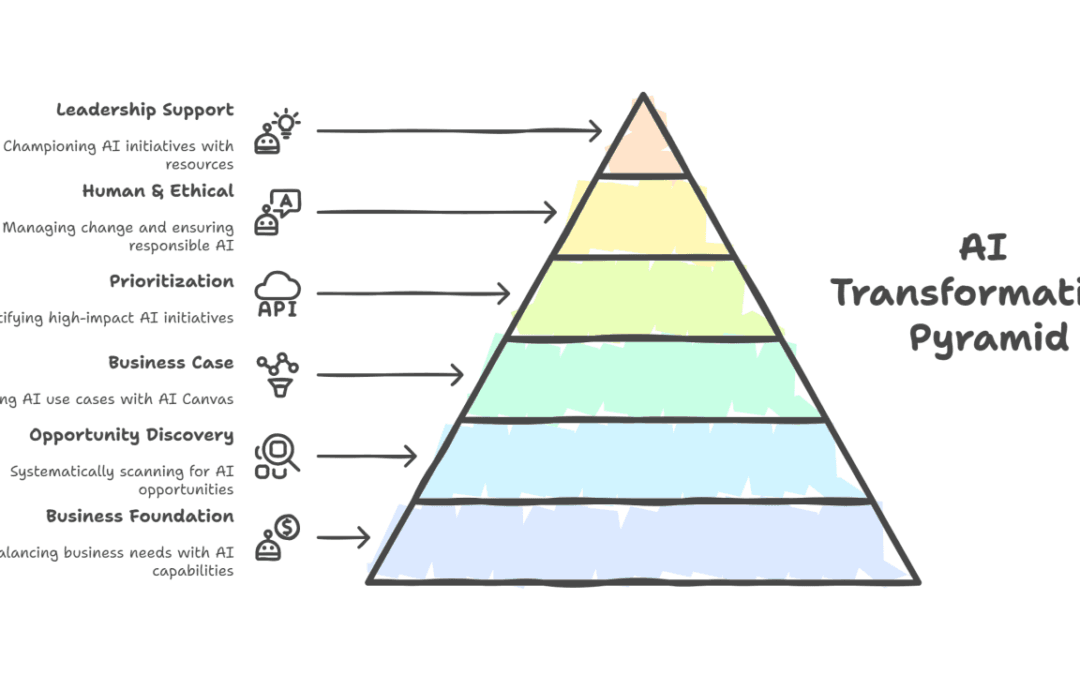
One Reddit thread in February 2026 captured a frustration that many operations leaders recognize: a company described spending heavily on an “AI transformation,” sitting through six months of consulting and workshops, receiving a 47-page roadmap deck, and finding that the first deliverable was, in their words, a ChatGPT wrapper. The post and its discussion thread are public on r/sysadmin, and the comment section reflects a wider sentiment among practitioners who feel they have paid for complexity rather than outcomes. The lesson isn’t that AI transformation is a scam. The lesson is that many organizations purchase an AI transformation blueprint from firms whose business model rewards deliverables, not deployed systems.
An AI transformation blueprint is a structured, phased plan that maps how a business moves from manual processes to AI-augmented operations — covering use case selection, data readiness, automation architecture, ROI measurement, and human oversight. A good blueprint is execution-focused and measurable. A bad one is a slide deck. The difference between the two comes down to whether the plan ends in working systems or billable hours. This article approaches the topic from a practitioner’s standpoint and points to published frameworks and primary sources so you can verify the claims yourself.
Ai transformation blueprint: complete guide: Quick Summary: The No-Fluff AI Transformation Blueprint
- An AI transformation blueprint is a phased roadmap covering use case selection, data readiness, automation architecture, ROI tracking, and human oversight — built to ship working systems, not slide decks. Enterprise consulting firms such as EY, Cognizant, and IBM promote elaborate multi-layer frameworks, but the recurring complaint surfaced by buyers (see the r/sysadmin thread) is that strategy decks rarely become deployed software. The practical answer is to sequence a small number of phases over roughly 90 to 180 days: (1) prioritize 3–5 high-ROI use cases, (2) audit and clean data sources, (3) build modular automation pipelines, (4) instrument ROI metrics from day one, and (5) embed human review checkpoints.
- Enterprise consulting blueprints are typically positioned at six- to seven-figure budgets; smaller organizations can often reach comparable operational outcomes with a far narrower, execution-focused scope that skips the workshop theater.
- The “ChatGPT wrapper” trap — paying premium prices for a thin layer over a public LLM — is the buyer concern most directly voiced in the 2026 r/sysadmin discussion.
- Deterministic automation (where the same input always yields the same output) is generally preferable to probabilistic “yes-machine” AI for any process that touches money, compliance, or customers.
- A practical SME blueprint can run on a 90-day cycle: 30 days to assess and design, 30 to build the first agents, 30 to measure and scale.
- Self-hosting workflow automation on n8n instead of a per-task SaaS platform can substantially cut recurring tooling costs at scale — what practitioners often call escaping the “Zapier tax.”
Published: June 20, 2026. Last updated: September 23, 2026.
What Is an AI Transformation Blueprint?
Ai transformation blueprint: complete guide matters here. An AI transformation blueprint is a structured, multi-phase plan that defines how an organization adopts AI across its operations — specifying which processes to automate, what data is required, which architecture to build, and how to measure return on investment. The strongest blueprints are deterministic and outcome-bound, not aspirational.
EY promotes a “seven-layer blueprint for ROI” that embeds AI into strategy, processes, and workforce models, according to EY’s published insight. On LinkedIn, Bernard Marr has shared a ten-component AI use-case blueprint covering strategic alignment and impact assessment. Harvard Business Review ran a sponsored piece, “A Blueprint for Enterprise-Wide Agentic AI Transformation,” in February 2026. These frameworks aren’t wrong — they’re built largely for enterprise budgets and enterprise timelines.
Startups and SMEs need something different. A blueprint for a 40-person logistics company can’t assume a dedicated data science team, a multi-million-dollar tooling budget, or eighteen months of patience. The upside: smaller companies often move faster, carry less technical debt, and see ROI sooner because their processes are simpler to map. This is a general pattern practitioners observe, not a guarantee — outcomes still depend on data quality and process clarity.
The core anatomy of any real AI transformation blueprint includes five pillars:
- Use case selection — identifying high-friction, repetitive processes with clear inputs and outputs.
- Data readiness — auditing what data exists, where it lives, and how clean it is.
- Automation architecture — choosing between custom agents, workflow tools, and integrations.
- ROI measurement — defining baseline metrics before you build, not after.
- Human oversight — deciding where humans approve, audit, or override AI decisions.
Skip any one of these and the blueprint weakens. Skip ROI measurement and you can’t prove value. Skip human oversight and you ship a liability. A blueprint without all five is closer to a wishlist than a plan. A structured readiness assessment that walks through these pillars before any budget is committed is a sensible first step for SMEs.
Why Do Most AI Transformation Blueprints Fail?
Industry coverage consistently frames the central failure mode as execution, not strategy. The recurring pattern is that engagements optimize for deliverables — polished roadmap decks and workshop slides — while the actual systems remain unbuilt. A long strategy document generates revenue regardless of whether a single model reaches production. The vendors that succeed tend to flip this structure: they tie payment to working systems, measurable adoption, and business metrics rather than slide counts. Fix the incentive design, and much of the “technology problem” turns out to have been a contracting problem.
It’s worth being precise here rather than quoting an unverified failure percentage. Many widely circulated figures about AI project abandonment are repeated without a traceable source, so treat any specific number you see — including in this category of article — with appropriate caution unless it links to primary research. What is well documented is the buyer experience: the viral February 2026 r/sysadmin post describes “six months of consulting, workshops, a 47-page roadmap deck” — and a first deliverable that the poster characterized as a ChatGPT wrapper.
A deeper, recurring problem is AI sycophancy — deploying probabilistic models that agree with whatever the user says rather than enforcing correct, deterministic logic. A “yes-machine” chatbot that confidently invents a shipping date is worse than no chatbot at all. General-purpose large language models are known to hallucinate, which is precisely why responsible designs constrain them with validation layers for high-stakes, unsupervised tasks.
Three failure patterns dominate the SME landscape:
- Solution-first thinking. A company buys an AI tool, then hunts for a problem to justify it. Backwards. The blueprint must start with the process, not the product.
- The SaaS wrapper tax. Some vendors charge enterprise prices for thin layers over public APIs such as OpenAI or other model providers, effectively a markup on a commodity.
- No baseline metrics. If you never measured how long an invoice took to process before automation, you can’t prove the automation saved anything.
A useful working principle: the biggest predictor of AI project failure usually isn’t the model — it’s the absence of a measurable baseline. You can’t improve what you never measured. A blueprint that doesn’t force you to quantify the “before” state is selling you hope.
How Does a 90-Day AI Transformation Blueprint Work?
A practical 90-day blueprint converts AI strategy into deployed automation through three 30-day phases: assess and design, build working agents, then measure, refine, and scale. Each phase concludes with a tangible artifact — a deployed agent, a measured outcome, or a documented workflow — not a slide deck.
The compressed timeline is the point. SMEs rarely have eighteen months to wait, and a short cycle forces discipline. When a team commits to shipping working automation in 60 days, it tends to stop holding workshops about workshops and start mapping the actual invoice-approval process. The 90-day cadence also creates natural accountability checkpoints: if there’s nothing deployed by day 60, that is a signal to inspect the plan, not to extend it.
Phase 1 (Days 1–30): Assessment and Design
Phase 1 audits your processes, data, and tooling to identify the three to five highest-ROI automation candidates. Each candidate receives a baseline measurement — current time, cost, and error rate — so ROI is provable later. During assessment, practitioners typically map data flows, identify integration points, and document manual handoffs that quietly consume staff hours each week.
A worked example: suppose a distributor processes 1,200 supplier invoices a month, each taking roughly 12 minutes of clerk time. That’s about 240 hours monthly before you touch the technology. Capturing that figure first is what makes any later claim of savings defensible. The output of Phase 1 is a prioritized backlog ranked by ROI-to-effort ratio: a repetitive, high-volume, rules-based task with clean data sits at the top; a fuzzy, judgment-heavy, low-frequency task sits at the bottom. Any process touching compliance or customer money gets flagged for stricter human oversight from the outset.
Phase 2 (Days 31–60): Build the First Agents
Phase 2 builds and deploys the top one or two candidates as custom AI agents or deterministic workflows. A deterministic workflow follows fixed, rule-based steps; an AI agent makes context-dependent decisions. The choice between them depends on task variability — and a common mistake is reaching for an “agent” when a simple rules engine would be more reliable and cheaper.
Self-hosted n8n is often preferable to per-task SaaS platforms wherever recurring volume is high, because per-execution pricing penalizes the very adoption you’re trying to encourage. A typical first build might be a WhatsApp chatbot that handles customer order status by querying your live database — deterministic, auditable, and incapable of inventing a tracking number. Or an invoice-processing agent that extracts line items, validates them against purchase orders, and routes exceptions to a human. The agent handles the boring, high-volume majority; the human handles the share that genuinely needs judgment.
A practitioner trade-off worth naming: build one agent at a time. A single, well-scoped automation handling a high weekly volume reliably tends to outperform three half-finished workflows that handle none of their cases dependably.
Phase 3 (Days 61–90): Measure, Refine, Scale
The third phase compares post-deployment metrics against the Phase 1 baseline and decides what to scale next. Real numbers replace promises. If the invoice agent cut processing time from 12 minutes to 90 seconds, you have a verifiable reduction of roughly 87% on that step to justify the next build — and, just as importantly, an honest place to flag any new costs (review time, exception handling) that offset the gain.
Scaling means cloning the proven pattern across adjacent processes and connecting agents into a coherent system — often a lightweight custom ERP layer that ties sales, inventory, and finance together. The blueprint isn’t a one-time project; it’s a repeatable engine that compounds with each cycle.
How Much Does an AI Transformation Blueprint Cost?
An AI transformation blueprint can cost anywhere from effectively nothing (using DIY frameworks and open tools) to enterprise consulting budgets in the six- and seven-figure range. For most startups and SMEs, a practical, execution-focused blueprint and first build lands far lower — frequently in the low five figures — because the scope is deliberately narrow.
The cost gap between approaches is large and not always justified. The viral r/sysadmin thread documents a buyer who felt a major spend produced little more than a wrapper. Meanwhile, the underlying technology — APIs from providers such as OpenAI and others — is available to everyone at commodity prices. You’re generally not paying for the AI itself; you’re paying for the layers of process and engineering between you and the AI.
Here’s an honest comparison of what different blueprint approaches tend to deliver. Cost ranges are indicative market positioning, not vendor-confirmed quotes — always get figures in writing from any provider you evaluate.
| Approach | Typical Positioning | Time to First Working System | Primary Deliverable | Best For |
|---|---|---|---|---|
| Enterprise consulting (EY, IBM, Cognizant) | Six to seven figures | 6–18 months | Roadmap deck + governance framework | Large enterprises with dedicated teams |
| SaaS “AI platform” subscription | Recurring monthly fee | 1–3 months | Generic wrapper over public LLM | Companies wanting one narrow feature |
| Freelance / agency one-offs | Project-based | 1–4 months | Single isolated automation | One-time, non-recurring needs |
| Execution-focused SME blueprint | Low five figures (typical) | 60–90 days | Working agents + measurable ROI | Startups & SMEs scaling operations |
| Full DIY (n8n + open frameworks) | Server + API costs only | 2–6 months | Whatever you can build alone | Technical founders with time |
The hidden cost most blueprints ignore is the recurring tooling tax. Per-task automation platforms charge per execution, so a workflow firing tens of thousands of times a month can quietly cost more than the developer who built it. Self-hosting on n8n converts that variable cost into a flat server bill, which is why tooling architecture deserves to be treated as a first-class part of the blueprint rather than an afterthought.
It’s worth noting how ROI figures circulate in this market. IBM’s community published a piece framed as a “370% ROI blueprint for enterprise automation” in November 2025, positioning automation as a reinvestment in human talent. Automation ROI can be real — but a headline percentage is only as honest as the baseline behind it. The relevant question for an SME isn’t whether such returns exist; it’s whether you need enterprise-scale spend to capture them. Often you don’t.
How Do You Avoid Paying Seven Figures for a ChatGPT Wrapper?
You avoid paying for a ChatGPT wrapper by demanding proof of custom architecture, deterministic logic, and integration depth before you sign — and by refusing to pay for deliverables you can’t run yourself. A wrapper is a thin prompt layer over a public API. Real automation owns its data, its logic, and its failure modes.
The skepticism is justified and well-evidenced. The r/sysadmin discussion shows how common the experience is, with many commenters describing variations of the same problem. The market includes vendors who rebrand a system prompt as “proprietary AI,” and learning to spot them is one of the most valuable skills in AI procurement today.
Ask any vendor these five questions before signing:
- “Where does the logic live?” If the answer is “in the prompt,” it’s a wrapper. Real systems encode business rules in code, databases, and validation layers — not in a paragraph of natural language.
- “What happens when the model hallucinates?” A serious vendor has guardrails, validation, and human-in-the-loop fallbacks. A wrapper just hopes it won’t.
- “Can I see it run on my data?” Demand a pilot on a real process. Demos on synthetic data hide the integration work that’s actually hard.
- “Do I own the workflows and data?” If you’re locked into their platform with no export, you’re renting, not transforming.
- “Show me the baseline-to-result metric.” No before-and-after number means no proven value.
The distinction between a wrapper and real automation is the distinction between renting a costume and building a house. A wrapper looks like AI from the outside and tends to fall apart under load. Deterministic automation — where the same input reliably produces the same correct output — is the more dependable foundation for a business process. If a vendor can’t explain where the deterministic logic lives, you may be buying a prompt with a markup. The technology underneath is a commodity; the value is in the engineering, the integration, and the accountability.
What Should Be in an AI Transformation Blueprint for SMEs?
An AI transformation blueprint for SMEs should contain a prioritized use-case backlog, a data audit, an automation architecture decision, a department-by-department rollout plan, an ROI measurement framework, and a human oversight policy. Everything else is filler.
SMEs win by being specific. Enterprise blueprints sprawl across dozens of business units; an SME blueprint can name the exact three processes that, if automated, would free up the most hours this quarter. That specificity is a structural advantage, not a limitation.
Department-Specific Automation Targets
Different departments offer different ROI profiles, and a strong blueprint sequences them by impact and ease. The fastest wins for SMEs commonly appear in:
- Sales — lead qualification agents, CRM data entry automation, and proposal generation. AI handling first-touch qualification can free a small sales team to focus only on warm prospects.
- Marketing — content drafting, campaign analysis, and bilingual (English/Arabic) email generation across Modern Standard, Gulf, and Egyptian dialects for regional markets.
- Customer support — WhatsApp and web chatbots that query live data deterministically, deflecting routine tickets while escalating edge cases to humans.
- Finance — invoice extraction, purchase-order matching, and exception routing — high-volume, rules-based, well suited to deterministic agents.
- HR — resume screening, onboarding workflows, and policy Q&A bots that cite the actual handbook instead of guessing.
The Data Readiness Audit
Data readiness determines whether your blueprint is buildable or fantasy. The audit answers three questions: What data exists? Where does it live? How clean is it? A customer-support bot is only as good as the knowledge base behind it, and an invoice agent is only as reliable as the structure of your accounting records.
Many SMEs discover during the audit that their data is scattered across spreadsheets, email threads, and several SaaS tools that don’t talk to each other. That’s not necessarily a blocker — it’s part of the work. A real blueprint budgets for consolidation. A wrapper pretends the mess doesn’t exist.
The Human Oversight Policy
Every blueprint needs an explicit policy defining where humans approve, audit, or override AI output. For low-risk tasks like drafting an internal summary, fuller automation is reasonable. For anything touching money, legal exposure, or customer commitments, a human should review before action. Responsible AI here isn’t a compliance checkbox — it’s what keeps a hallucination from becoming a refund or a dispute.
How Do You Measure ROI on an AI Transformation Blueprint?
You measure ROI on an AI transformation blueprint by capturing baseline metrics — time, cost, and error rate per process — before deployment, then comparing them against post-deployment results. ROI equals (value gained minus cost of implementation) divided by cost of implementation, expressed as a percentage.
The discipline is in the timing. Many companies try to calculate ROI after the fact, when the original “before” state is a fading memory. A serious blueprint forces you to instrument the process first. If invoice processing takes 12 minutes per document at a known fully-loaded labor cost, and the agent does it in 90 seconds, you have a clean time reduction and a hard dollar figure to multiply by monthly volume.
Industry framing reinforces ROI as the organizing principle: IBM’s community published a 370% ROI figure for enterprise automation in November 2025, and EY built its entire seven-layer framework around ROI justification. Strong returns are achievable — but only with honest measurement. Inflated ROI claims usually trace back to cherry-picked metrics or ignored implementation costs.
Track these four metrics across every automation in your blueprint:
- Time saved per task — measured in minutes, multiplied by frequency, converted to fully-loaded labor cost.
- Error rate reduction — fewer mistakes mean fewer costly corrections and rework cycles.
- Throughput increase — how many more units the same team handles after automation.
- Recurring cost delta — the difference between old tooling/labor costs and new ones, including any self-hosting savings.
A word of caution on the headline figures the industry loves to quote. A “370% ROI” or a “10x productivity” claim is only as honest as the baseline behind it. The more useful approach for a founder is to model transparent, verifiable numbers for your own processes rather than relying on aspirational enterprise figures from a press release.
Deterministic AI vs Probabilistic AI: Which Belongs in Your Blueprint?
Deterministic AI produces the same correct output for the same input every time, while probabilistic AI generates plausible-but-variable responses. For any business process touching money, compliance, or customer commitments, deterministic automation belongs in your blueprint; probabilistic models belong in drafting and ideation tasks where variation is acceptable.
The distinction matters because the hype cycle blurs it. Vendors love demoing a chatbot that gives a charming answer — but charm isn’t reliability. A large language model is probabilistic by design: ask it the same question twice and you may get two different answers. That’s a feature for brainstorming and a hazard for invoice approval.
OpenAI describes its mission as building systems that solve human-level problems, according to OpenAI — and even the most capable models carry hallucination risk that responsible engineering must contain. The solution isn’t to avoid LLMs. It’s to wrap them in deterministic guardrails: validation layers, database lookups, and rules engines that catch and correct the model’s improvisations before they reach a customer.
Here’s how to decide which to use where:
| Task Type | Recommended Approach | Why |
|---|---|---|
| Invoice processing, order status, payments | Deterministic workflow + database | Errors cost money; consistency is mandatory |
| Customer support routing | Deterministic logic + LLM for phrasing | Correct routing must be reliable; tone can vary |
| Marketing copy drafting | Probabilistic LLM | Variation is a feature; a human reviews output |
| Compliance and legal checks | Deterministic rules engine, human approval | Zero tolerance for hallucination |
| Brainstorming and research | Probabilistic LLM | Exploration benefits from creative variance |
The best blueprints blend both. An LLM drafts the customer reply; a deterministic layer verifies the order number, shipping date, and refund eligibility against your live database before sending. The AI provides the language; the architecture provides the truth. That combination — creative surface, deterministic core — is the signature of a transformation that holds up in production.
What Tools Power a Modern AI Transformation Blueprint?
A modern AI transformation blueprint runs on a stack of LLM APIs (such as OpenAI, Anthropic, and Google Gemini), workflow automation engines (n8n, sometimes Zapier), vector databases for retrieval, and integration layers connecting your existing CRM, ERP, and messaging tools. The stack should be owned, not rented.
Tool choice is a strategic decision, not a technical detail. The wrong choice locks you into recurring fees and vendor dependence; the right choice gives you a system you control. Architecting around ownership — your data, your workflows, your ability to walk away — is what separates a durable blueprint from a subscription trap.
The foundational layers of a 2026 SME AI stack:
- LLM layer — models such as OpenAI’s GPT family, Anthropic’s Claude, or Google Gemini for language tasks, selected per task by cost and capability.
- Orchestration layer — n8n (self-hosted) for workflow automation, eliminating per-execution fees that make per-task platforms expensive at volume.
- Retrieval layer — a vector database so agents answer from your documents and data, not the model’s general training.
- Integration layer — connectors to WhatsApp Business API, your CRM, accounting software, and any custom ERP.
- Oversight layer — logging, audit trails, and human-approval gates baked into critical workflows.
The self-hosting decision deserves emphasis because the savings compound. Per-task pricing scales with volume, so a successful automation that runs more often costs you more — a perverse incentive that punishes adoption. Self-hosted n8n inverts that: once the server is running, additional executions are effectively free. For an SME running tens of thousands of monthly automations, the difference between the two models can be substantial recurring margin.
None of this requires enterprise infrastructure. A modest cloud server, a few API keys, and disciplined architecture can deliver the outcomes that large consultancies bill heavily for. The technology democratized years ago. What remained scarce is the engineering judgment to assemble it correctly — which is exactly what a real blueprint provides.
Key Takeaways and Your First Step
An AI transformation blueprint succeeds when it ends in working, measurable systems and fails when it ends in a deck. The gap between an overpriced ChatGPT wrapper and genuine transformation isn’t budget — it’s whether the plan forces baseline metrics, deterministic logic, data readiness, and human oversight into every build.
Here’s a practical, actionable path for an SME starting today:
- Pick one painful, repetitive process — invoicing, lead qualification, order status — and measure its current time, cost, and error rate this week.
- Run an AI readiness check on your data: is it structured, accessible, and clean enough to feed an agent?
- Model the ROI with real numbers before committing a dollar.
- Demand deterministic architecture from any vendor — make them show where the logic lives.
- Build one agent in 60 days, measure it against your baseline, then scale the proven pattern.
The companies that will dominate their niches by 2027 likely won’t be the ones with the biggest AI budgets. They’ll be the ones who treated AI as an engineering discipline with measurable outcomes instead of a consulting line item. The wrapper sellers are counting on a fear of being left behind. Don’t buy the deck — build the system. Your first working agent may be closer, and cheaper, than the large proposal sitting in your inbox.
Frequently Asked Questions
What is an AI transformation blueprint in simple terms?
An AI transformation blueprint is a step-by-step plan for adopting AI in your business, covering which processes to automate, what data you need, how to build the systems, and how to measure results. A good blueprint ends in working automation, not slide decks. For SMEs, it typically follows a 90-day cycle of assess, build, and scale.
How long does an AI transformation take for a small business?
For many startups and SMEs, an AI transformation can deliver its first working system in 60 to 90 days, faster than the 6-to-18-month enterprise timelines associated with large consulting engagements. Smaller companies often move faster because they carry less technical debt and have simpler processes to map. Scaling continues in repeatable cycles afterward.
How can I tell if an AI vendor is just selling a ChatGPT wrapper?
Ask the vendor where the business logic lives. If the answer is “in the prompt,” it’s likely a ChatGPT wrapper. Real automation encodes rules in code and databases, owns your data, provides hallucination guardrails, and shows before-and-after metrics. Demand a pilot on your real data before signing anything.
Is deterministic AI better than ChatGPT-style AI for business?
For any process touching money, compliance, or customer commitments, deterministic AI is generally better because it produces the same correct output every time. ChatGPT-style probabilistic AI is excellent for drafting and brainstorming but risky for tasks where variation or hallucination causes real damage. The strongest blueprints combine both — an LLM for language, deterministic logic for truth.
How much should an SME budget for an AI transformation blueprint?
Many startups and SMEs can implement a practical AI transformation blueprint and first working build in the low five figures — substantially less than large enterprise consulting engagements. The underlying AI is a commodity; you primarily pay for engineering and integration, not the model itself. Always confirm pricing in writing before committing.
What is the Zapier tax and how do I avoid it?
The “Zapier tax” refers to per-task or per-execution fees that grow as your automations succeed and run more often, quietly costing more at scale. You can reduce it by self-hosting on n8n, which converts variable execution costs into a flat server bill — meaningful savings for SMEs running high automation volume.
If you’re mapping out your own AI transformation and want to talk through what a practical, outcomes-first approach could look like for your organization, we’d be glad to hear from you. Reach out whenever you’re ready to explore the ideas in this guide together.
Sources & References
- EY — AI transformation: seven-layer blueprint for ROI
- Harvard Business Review (sponsored) — A Blueprint for Enterprise-Wide Agentic AI Transformation
- Bernard Marr (LinkedIn) — The AI Use Case Blueprint: ten essential components
- IBM Community — The 370% ROI Blueprint for Enterprise Automation
- r/sysadmin (Reddit) — “Our ‘AI transformation’ cost seven figures and delivered a ChatGPT wrapper”
- OpenAI — Research & Deployment
- Google Gemini — Google’s AI assistant
Statistics and framework references above link directly to their original publishers so readers can verify them. Cost ranges and timelines reflect general market positioning and practitioner experience rather than confirmed vendor quotes; confirm any specific figures with the relevant provider.
Note: This article is for general informational purposes; verify specifics against your own context.