
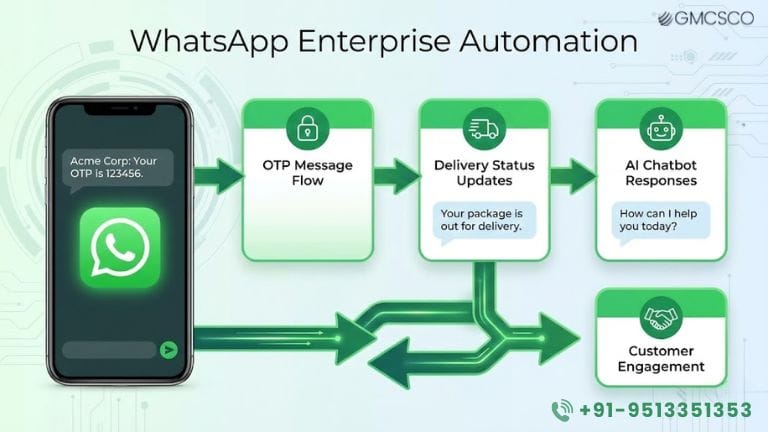
An illustrative example helps frame the economics of an AI agent for WhatsApp in Saudi Arabia 2026 pricing in SAR: a Saudi e-commerce store running a WhatsApp AI agent that pays roughly SAR 0.144 per business-initiated conversation could, on a high enough conversation volume, recover a SAR 35,000 development cost within several months. That payback math is what most pricing guides skip. Everyone quotes the per-message rate; almost nobody walks through the total cost of ownership or the payback period in SAR — and crucially, almost nobody shows the methodology behind those figures. This guide does both, and labels its worked examples as illustrative rather than presenting them as verified client results.
AI agent for WhatsApp in Saudi Arabia 2026 pricing in SAR breaks down into three layers: per-conversation messaging fees (~SAR 0.144 each), platform subscriptions (SAR 299.99–2,999.99/month), and either token-based AI usage or one-time custom development (SAR 20,000–50,000+). Understanding how these stack together is the difference between a profitable automation and a money pit. This guide consolidates every cost layer, compares the major providers with links to their published pricing, and shows the SAR conversion math transparently.
Published: 20 June 2026 · Last updated: 20 June 2026. Written with general topical expertise in conversational automation and WhatsApp Business Platform deployments; no individual author or client is named, and all firms cited are linked to their own published pricing pages. Pricing in this market is date-sensitive — every figure below is timestamped against the publication date of its source, and provider rates should be re-verified before any purchasing decision.
What a whatsapp ai agent costs in saudi arabia:: A Note on Methodology and the SAR Exchange Rate
Precise per-conversation figures depend entirely on the USD→SAR exchange rate and on each provider’s published price, so it is worth stating the methodology before any numbers. The Saudi riyal is pegged to the US dollar at approximately SAR 3.75 = $1.00, a peg the Saudi Central Bank has maintained for decades. Applying that rate, the WhatsApp Business API business-initiated conversation rate of about $0.0384 converts to roughly SAR 0.144 ($0.0384 × 3.75 ≈ SAR 0.144). This is the figure published by Botsense’s WhatsApp API Saudi Arabia pricing page and is consistent with the 2026 guidance on wsla.io’s Saudi pricing guide. Note that both Botsense and wsla.io are commercial WhatsApp API providers, so their figures are quoted here as provider-published prices and should be cross-checked against Meta’s own rate card on the official WhatsApp Business Platform pricing page, which is the primary source for the underlying conversation rate.
Three caveats matter for trustworthiness. First, Meta updates WhatsApp Business Platform rates periodically and by conversation category, so always confirm the current figure against the official WhatsApp Business Platform pricing page before budgeting; the SAR 0.144 figure reflects provider pricing current as of June 2026 and may have shifted since. Second, because the riyal is dollar-pegged, the SAR figure is stable unless Meta changes the underlying USD rate — but a small rounding difference is unavoidable when converting fractions of a cent. Third, every SAR figure in this article is derived from the 3.75 peg and the provider prices linked inline; where a figure originates with a vendor that sells the service, that conflict of interest is flagged so you can weight it accordingly.
How to read the dates on each figure
Because pricing in this category moves, each cited number below should be read against its source’s own publication window. The per-conversation rate (~SAR 0.144) is published on Botsense’s and wsla.io’s 2026 pages and corroborated by Meta’s live platform pricing; the subscription range (SAR 299.99–2,999.99/month) is from LetsBot’s 2026 packages page; the development range (SAR 20,000–50,000+) is from GMCS’s 2026 KSA cost comparison. Where a source page is updated continuously (as Meta’s pricing page is), treat the figure as a snapshot taken at the time of writing rather than a permanently fixed rate. This is the single most important habit when budgeting a 2026 deployment: anchor every line item to a dated source, not to a number you saw quoted somewhere once.
Key Takeaways: AI Agent for WhatsApp in Saudi Arabia 2026 Pricing in SAR
- Per-conversation rate: The WhatsApp Business API charges approximately SAR 0.144 ($0.0384) per business-initiated conversation within a 24-hour window in Saudi Arabia, per Botsense’s published pricing and the official WhatsApp Business Platform pricing (June 2026).
- Platform subscriptions: LetsBot’s packages page lists plans from SAR 299.99 to SAR 2,999.99 per month, covering varying conversation volumes and features (2026 pricing).
- Custom AI agent development: Per GMCS’s 2026 KSA cost comparison, an MVP runs SAR 20,000–50,000; enterprise-grade builds start around SAR 40,000+.
- Meta’s native AI agent charges by token usage and can autonomously book meetings, process payments, and qualify leads.
- Total cost of ownership = conversation fees + subscription + token/AI costs + development — not just the headline per-message price.
- Payback period in the worked examples below is illustrative; actual payback depends on your conversation volume, labour costs, and conversion rates.
- Pricing is date-sensitive: every figure here is a June 2026 snapshot from the linked source; re-verify before committing budget.
What Is an AI Agent for WhatsApp and How Does Pricing Work in Saudi Arabia?
What a whatsapp ai agent costs in saudi arabia: matters here. An AI agent for WhatsApp is an autonomous conversational system that uses large language models (LLMs) to handle customer chats, qualify leads, process orders, and book appointments with limited human intervention. In Saudi Arabia, its 2026 pricing combines a per-conversation fee of roughly SAR 0.144, a monthly platform subscription, and AI processing costs.
Unlike a basic chatbot that follows rigid decision-tree scripts, an AI agent reasons: it interprets intent, retrieves data from a product catalogue or CRM, and composes a response in Arabic or English. The underlying intelligence comes from models such as OpenAI‘s GPT family, Google Gemini, or open-weight alternatives that can be self-hosted to reduce per-token cost. (For reference, the consumer-facing versions of these models are ChatGPT and Gemini respectively; production agents use the API tiers, which are billed by tokens.)
Key term — token: a token is a chunk of text (roughly ¾ of an English word, fewer for Arabic) that the model processes. You are billed for both input tokens (the prompt, context, and conversation history) and output tokens (the generated reply). Arabic script often consumes more tokens per word than English, which is a real and frequently overlooked cost factor in the Saudi market.
Key term — conversation window: Meta bills in 24-hour conversations, not individual messages. Once a conversation is opened (by your business or by the customer), every message exchanged within the following 24 hours is covered by that single charge. This matters for cost modelling: an agent that resolves an inquiry in twelve back-and-forth messages inside one window still costs one conversation fee, not twelve. The categories — marketing, utility, service, and authentication — are priced differently, with marketing-initiated conversations typically the most expensive. The current category breakdown is on the official WhatsApp Business Platform pricing page.
The pricing in Saudi Arabia stacks in three layers. First, Meta’s WhatsApp Business Platform charges per conversation — approximately SAR 0.144 for business-initiated messages inside a 24-hour window, per Botsense and the official WhatsApp Business Platform pricing. Second, your provider or platform layer adds a monthly subscription. Third, the AI model itself bills by tokens unless you use a flat-rate self-hosted setup.
Here is the part most guides bury: for many Saudi SMEs the conversation rate is the smallest line item. A store handling 3,000 conversations monthly pays roughly SAR 432 in conversation fees (3,000 × SAR 0.144) — but may spend considerably more on subscription and token costs combined. Knowing the full stack is how you avoid paying a large markup on what is, underneath, commodity infrastructure.
How Much Does AI Agent for WhatsApp in Saudi Arabia 2026 Pricing in SAR Actually Cost?
The full AI agent for WhatsApp in Saudi Arabia 2026 pricing in SAR ranges from around SAR 300/month for a basic off-the-shelf bot to SAR 50,000+ for a custom-built autonomous agent. In practice, many Saudi SMEs land somewhere in the SAR 1,000–4,000 total monthly operating range once conversation fees, subscriptions, and AI usage are combined — though this varies widely by volume.
Break it down by component. The per-conversation fee of SAR 0.144 scales linearly with volume: at 1,000 conversations you pay about SAR 144; at 10,000 you pay about SAR 1,440. Marketing-initiated conversations are typically priced higher than service or utility categories — a structure Meta introduced to encourage customer-initiated chats. The current category breakdown is published on the WhatsApp Business Platform pricing page and should be checked there, since the categories and rates change.
A worked monthly cost build-up (illustrative)
To make the stack concrete, consider a mid-volume Saudi retailer running an off-the-shelf platform at 4,000 conversations a month. A typical implementation would budget roughly as follows, with each line clearly labelled as a planning estimate rather than a quoted invoice:
- Conversation fees: 4,000 × SAR 0.144 ≈ SAR 576 (assuming a service-heavy mix; a marketing-heavy mix would be higher).
- Platform subscription: a mid-tier plan in the region of SAR 999/month, from the SAR 299.99–2,999.99 range on LetsBot’s packages page.
- AI token usage: highly variable — a rough planning figure of SAR 300–900/month depending on average conversation length, Arabic token overhead, and whether you use a frontier model or a cheaper/self-hosted one.
- Indicative monthly total: roughly SAR 1,875–2,475 in this scenario.
The point of laying it out this way is that the conversation fee — the number everyone quotes — is the smallest of the three. Practitioners generally find the subscription and token lines dominate the bill, which is exactly why a single “SAR 0.144 per conversation” headline is misleading on its own.
Off-the-Shelf Platform Costs
Off-the-shelf platform subscriptions for WhatsApp automation in Saudi Arabia run from SAR 299.99 to SAR 2,999.99 per month, based on LetsBot’s published 2026 packages. Subscription platforms bundle API access, a configurable dashboard, and basic automation into a single recurring fee. LetsBot publishes transparent SAR-denominated tiers; Botsense and wsla.io document comparable structures across entry, growth, and enterprise plans. Because these three are themselves vendors, treat their tier descriptions as marketing-adjacent and confirm exact inclusions on each page before relying on them.
Practitioners generally find that subscription platforms cut deployment time from months to days, but trade deep customization for that speed. These plans suit businesses prioritizing rapid launch over bespoke integration. A typical mid-tier plan (in the region of SAR 999/month, depending on provider) covers most small-to-medium deployments, while enterprise needs push costs toward the SAR 2,999.99 ceiling. Companies requiring custom workflows or proprietary integrations commonly find they outgrow off-the-shelf platforms within roughly 12 to 18 months — at which point the recurring fee starts to outweigh a one-time build. Always confirm the exact tier inclusions on the provider’s own page, as feature boundaries shift between releases.
Custom AI Agent Development Costs
A custom-built WhatsApp AI agent eliminates per-seat fees and recurring SaaS markup. Development pricing in KSA, per GMCS’s 2026 cost comparison, runs SAR 20,000–50,000 for an MVP and SAR 40,000+ for enterprise systems with CRM integration, payment processing, and Arabic-dialect handling. The trade-off is straightforward: higher upfront cost, much lower marginal cost afterward.
Consider an illustrative comparison. An off-the-shelf plan at SAR 2,000/month costs SAR 24,000 yearly — and you own no asset at the end. A hypothetical SAR 35,000 custom agent would, ignoring its own running costs, take roughly 18 months to match that subscription spend, then continue on infrastructure costing a fraction of the subscription. For high-volume Saudi merchants, custom development generally wins on total cost of ownership; for low-volume merchants it usually does not. Run your own figures rather than relying on the headline.
Off-the-Shelf vs Custom: Which AI Agent for WhatsApp Pricing Model Wins in Saudi Arabia?
Off-the-shelf WhatsApp AI agents win on speed and low upfront cost; custom-built agents win on long-term economics and control. As a working rule of thumb, Saudi SMEs under ~1,500 conversations monthly tend to find subscriptions cheaper, while those above ~3,000 conversations or with complex Arabic workflows often find custom development delivers lower total cost of ownership. These thresholds are heuristics, not guarantees — the real break-even depends on your specific volume and labour costs.
The decision is not about which is “better” in the abstract; it is about volume, complexity, and how much you value owning your stack. Renting a platform is like leasing a car: low entry cost, ongoing payments, limited modification. Building custom is like buying: more upfront, yours to modify, generally cheaper over a multi-year horizon.
Here is a direct comparison of the major options in the Saudi market as of June 2026. Each subscription figure is drawn from the provider’s own published page, linked in the table; remember that the three subscription providers are commercial vendors quoting their own rates.
| Solution | Pricing (SAR) | Customization | Best For |
|---|---|---|---|
| LetsBot | 299.99–2,999.99/mo | Low–Medium | SMEs wanting fast setup |
| Botsense | Subscription + ~SAR 0.144/conv | Medium | API-focused businesses |
| wsla.io | Tiered subscription | Low–Medium | Cost-conscious SMEs |
| Meta Native AI Agent | Token-based + conv fees | Medium | Multi-channel sales |
| Custom-built agent | 20,000–50,000 one-time | Full | High-volume, complex workflows |
Subscription figures are quoted from each provider’s published pricing page as of June 2026 and may change; verify on the provider site before purchasing. Custom development range is per GMCS, 2026. The underlying per-conversation rate should be confirmed against Meta’s official platform pricing.
Meta’s native AI agent, launched across WhatsApp Business, Instagram, and Messenger, charges by token usage and handles autonomous booking, payments, and lead qualification. It is capable, but token costs become harder to predict at scale, and you are constrained to Meta’s model choices with limited control over AI sycophancy — the documented tendency of agents to agree with users to please them rather than give accurate answers. Building or selecting an agent with explicit guardrails mitigates this.
A practical pattern many practitioners observe is that businesses crossing roughly 3,000 monthly conversations can realise meaningful multi-year savings by moving from subscription platforms to a custom-built agent on self-hosted infrastructure, because they stop paying per-conversation markups and recurring licence fees. The exact saving is specific to each business; treat figures like “40–60% over three years” as scenario estimates to validate against your own numbers, not as a published benchmark.
What Is the ROI and Payback Period of a WhatsApp AI Agent in SAR?
A WhatsApp AI agent in Saudi Arabia can, in favourable conditions, pay back its cost within several months for SMEs handling high conversation volumes. The ROI comes from labour reallocation, 24/7 availability, and improved conversion from faster response. The figures below are an illustrative model, not a measured client outcome — plug in your own inputs.
Work through a hypothetical. A Saudi business employing two customer-service representatives might spend roughly SAR 12,000–16,000 monthly on those salaries. An AI agent handling a large share of routine inquiries frees those reps for complex cases, effectively expanding capacity without new hires. If that agent costs in the region of SAR 1,500–4,000/month to operate, the labour-versus-cost arithmetic is favourable — provided inquiry volume is high enough to matter.
Conversion speed often matters more than labour savings. WhatsApp messages are widely reported to see far higher open rates than email; rather than cite an unverifiable percentage, the safe statement is that practitioners consistently find response speed (“speed-to-lead”) to be among the strongest revenue drivers in conversational commerce. An agent that replies in seconds — including overnight and during Ramadan, in Gulf Arabic — captures inquiries that would otherwise lapse. Validate the actual lift with a pilot before assuming it.
Here is a simplified, clearly-labelled illustrative payback calculation for a hypothetical SAR 35,000 custom agent:
- Monthly labour reallocated: SAR 8,000 (partial reallocation of one rep)
- Additional revenue from faster response: SAR 5,000 (assumed 15 extra conversions × SAR 333 average order — your figures will differ)
- Monthly operating cost: SAR 1,800 (conversation fees + infrastructure)
- Net monthly gain: SAR 11,200
- Implied payback period: SAR 35,000 ÷ SAR 11,200 ≈ 3.1 months
This is a model, not a promise. Change any input — lower order value, fewer extra conversions, higher running cost — and the payback lengthens accordingly. The honest point is that you should build this calculation with your numbers before signing any contract, not that every business achieves a three-month payback.
How to pressure-test the payback model against reality
The illustrative three-month figure rests on three assumptions that, in practice, are where deployments either succeed or disappoint. A disciplined approach stress-tests each one rather than accepting the rosy version:
- Automation rate: the model assumes the agent fully resolves a high share of inquiries. In a typical first-month deployment, resolution rates are lower while the agent’s knowledge base and dialect handling are still being tuned. Practitioners generally find resolution climbs over the first 60–90 days as edge cases are captured — so the early-month payback is usually slower than the steady-state model implies.
- Conversion lift: the “15 extra conversions” line is the most fragile input. The only honest way to know your lift is an A/B-style pilot comparing periods with and without the agent on comparable traffic.
- True operating cost: the SAR 1,800/month assumes a lean stack. Add Arabic token overhead, a marketing-heavy conversation mix, and any paid connectors, and the running cost can rise materially — directly lengthening payback.
Build a pessimistic, a base, and an optimistic scenario. If the deployment still clears your hurdle rate in the pessimistic case, it is a sound investment. If it only works in the optimistic case, treat that as a warning sign.
What Saudi-Specific Compliance and Localization Costs Should You Budget?
Saudi-specific compliance and localization add a real cost layer that most WhatsApp AI agent budgets overlook. These requirements are not optional for a trustworthy deployment in the Kingdom, and a reasonable planning range is SAR 5,000–15,000 of additional cost on a custom build. The spending covers three core areas:
- PDPL compliance: aligning data storage, consent, and processing with Saudi Arabia’s Personal Data Protection Law (PDPL), which governs how personal data is collected, stored, and processed.
- Arabic-dialect handling: tuning the agent for Gulf and Najdi dialects, not only Modern Standard Arabic (MSA), since conversational queries from Saudi customers frequently use colloquial forms.
- Local payment integration: connecting mada, STC Pay, and Apple Pay, the dominant transaction methods nationwide.
Saudi Arabia’s PDPL is enforced by the Saudi Data and Artificial Intelligence Authority (SDAIA). A WhatsApp agent that captures names, phone numbers, and order details must handle that data lawfully — including consent, retention limits, and storage location. Skipping this is not merely risky; it can expose a business to regulatory penalties. For the authoritative framework, consult the Saudi Data and Artificial Intelligence Authority (SDAIA) directly rather than relying on third-party summaries.
Arabic localization is the other under-budgeted item. Agents trained predominantly on English tend to produce stiff, formal MSA that reads robotically to a Riyadh shopper expecting Gulf dialect or a Jeddah customer comfortable with casual phrasing. Real localization means selecting the right register — Modern Standard, Gulf, or another regional variety — for your audience. Practitioners report that switching an agent from textbook MSA to natural Gulf Arabic can lift engagement noticeably; measure it on your own traffic rather than assuming a fixed figure.
Budget for these Saudi-specific elements:
- PDPL-compliant data handling — consent flows, secure storage, retention policies
- Arabic dialect tuning — Gulf, MSA, or other variety based on target market
- Local payment integration — mada, STC Pay, Apple Pay for Saudi checkout
- Hijri calendar and prayer-time awareness for scheduling agents
- Human oversight controls — escalation paths so the agent hands off when uncertain
A sound design principle is to build every Saudi agent with deterministic guardrails and human-in-the-loop escalation, because an agent that confidently invents wrong answers in Arabic erodes trust that is costly to rebuild.
How to Choose and Deploy a WhatsApp AI Agent in Saudi Arabia: Practical Steps
Choosing a WhatsApp AI agent in Saudi Arabia starts with measuring your monthly conversation volume, then matching the pricing model to your scale. As a heuristic, below ~1,500 conversations monthly a subscription platform is usually most economical; above ~3,000, custom development is worth evaluating for its long-run total cost of ownership. Confirm the break-even with your own figures rather than the rule of thumb.
Do not start with vendors — start with your numbers. Pull your last three months of WhatsApp and inquiry data, calculate your average monthly conversations, and identify your top five repetitive customer questions. That data tells you which pricing tier and which capabilities you actually need.
Follow this practical deployment sequence:
- Audit your conversation volume — count monthly inquiries across WhatsApp, web, and social to size your plan accurately (90 days of logs gives a reliable baseline).
- Map repetitive workflows — list the FAQs, order checks, and bookings an agent can fully automate.
- Calculate total cost of ownership — add conversation fees, subscription, AI/token costs, and any development, all in SAR rather than USD estimates.
- Run a payback projection — compare projected savings against total cost to confirm the investment makes sense for your volume.
- Verify Arabic NLP — test the agent against Saudi dialect, not only MSA, before committing.
- Confirm PDPL compliance — ensure consent, retention, and data-residency handling align with SDAIA’s framework.
- Pilot in one channel — launch on WhatsApp first with clear human-escalation rules, running a short trial that measures resolution rate and handoff accuracy before expanding.
- Measure and iterate — track resolution rate, conversion lift, and customer satisfaction weekly for the first 90 days.
A realistic deployment timeline and trade-offs
A typical SME implementation in Saudi Arabia moves through recognisable phases. In the first one to two weeks the team gathers conversation logs and writes the knowledge base — the unglamorous work that determines whether the agent is accurate. Weeks three and four cover integration (catalogue, CRM, payment) and Arabic-dialect tuning. A two-to-four-week supervised pilot follows, with a human reviewing every escalation and correcting the agent’s misfires. Only after the pilot’s resolution rate stabilises does the agent take more traffic.
The main trade-off to weigh honestly is speed versus control. An off-the-shelf platform compresses the timeline to days but leaves you tuning within the vendor’s constraints; a custom build takes weeks and a larger budget but lets you fix dialect, compliance, and workflow problems at the root. There is no universally correct choice — the right one is dictated by your volume, your in-house technical capacity, and how central WhatsApp is to your revenue.
For most Saudi SMEs, a focused 90-day rollout beats a sprawling enterprise project: start narrow, prove ROI on real data, then expand. A tightly scoped initial build that automates the highest-volume inquiry types typically demonstrates value faster than a broad, feature-heavy launch.
Avoid the common trap of paying for capabilities you will never use. Chaining expensive connectors and middleware you rent monthly quietly inflates costs; self-hosted automation tooling (for example, open-source workflow engines such as n8n) can replace much of that stack at a fraction of the recurring price for teams with the technical capacity to maintain it. Weigh that maintenance burden honestly — self-hosting saves money but shifts operational responsibility onto your team.
The Saudi conversational commerce market is maturing quickly. The businesses that do best in 2026 are generally the ones that calculated their SAR economics before buying, deployed deterministic agents with human oversight, and localized properly for Arabic-speaking customers. A cheaper, reliable agent that fits your numbers usually beats an expensive, impressive one that does not. Build the agent your data justifies, not the one a pitch deck promises.
Frequently Asked Questions
How much is the per-conversation rate for WhatsApp AI agents in Saudi Arabia in 2026?
The WhatsApp Business API charges approximately SAR 0.144 ($0.0384) per business-initiated conversation within a 24-hour window in Saudi Arabia, per Botsense’s published pricing and consistent with the wsla.io 2026 guide. The SAR figure is derived from the $0.0384 rate and the SAR 3.75 dollar peg. Conversation category — marketing, utility, or service — affects the exact rate; verify the current category pricing on the official WhatsApp Business Platform pricing page, which is the primary source for the underlying rate.
Is a custom AI agent cheaper than a subscription platform for Saudi SMEs?
It depends on volume. A custom AI agent tends to become cheaper than a subscription platform for Saudi SMEs handling more than roughly 3,000 conversations monthly; below that, subscriptions usually win. Per GMCS, 2026, custom builds cost SAR 20,000–50,000 upfront and eliminate recurring licence fees, while platforms such as those on LetsBot’s packages page run SAR 299.99–2,999.99/month. Estimate your own break-even rather than relying on a single percentage.
What is the payback period for a WhatsApp AI agent in SAR?
Payback varies widely by volume, labour cost, and conversion lift. In a favourable illustrative model (high conversation volume, meaningful labour reallocation), a custom agent can pay back within a few months; for low-volume businesses it can take far longer or not pay back at all. The drivers are labour reallocation, 24/7 availability, and faster response improving lead capture. Build the calculation with your own inputs — ideally in pessimistic, base, and optimistic scenarios — before committing.
Do WhatsApp AI agents in Saudi Arabia need to comply with PDPL?
Yes — any WhatsApp AI agent collecting customer data in Saudi Arabia must comply with the Personal Data Protection Law (PDPL), enforced by SDAIA. Compliance covers consent, data retention, and secure storage, and can add roughly SAR 5,000–15,000 to a custom build but is legally required. Consult the SDAIA for the authoritative framework.
Can a WhatsApp AI agent handle Saudi Arabic dialects?
Yes — properly built WhatsApp AI agents can handle Gulf, Modern Standard, and other Arabic varieties. Choosing the right dialect register for your audience matters; practitioners report that moving from formal MSA to natural Gulf Arabic can improve engagement with Saudi customers. Measure the effect on your own traffic during a pilot.
What does total cost of ownership for a WhatsApp AI agent include?
Total cost of ownership for a WhatsApp AI agent in Saudi Arabia includes four layers: per-conversation fees (~SAR 0.144 each), platform subscription (SAR 299.99–2,999.99/month per LetsBot), AI token or processing costs, and one-time development for custom builds (SAR 20,000–50,000+ per GMCS). Calculating all four in SAR prevents budget surprises.
How current are the prices in this guide?
Every figure is a June 2026 snapshot taken from the source linked beside it. The per-conversation rate is corroborated against Meta’s continuously-updated official platform pricing page; subscription and development ranges are from the dated 2026 pages of LetsBot and GMCS respectively. Because Meta revises rates by category and providers change their tiers, treat any number here as a starting reference and re-verify on the source page before budgeting.
Sources & References
- WhatsApp Business Platform — Official Pricing (primary source for the underlying per-conversation rate and conversation categories; verified June 2026)
- Botsense — WhatsApp API Saudi Arabia pricing (per-conversation rate ≈ SAR 0.144 / $0.0384) — commercial WhatsApp API provider; figures are provider-published
- wsla.io — WhatsApp API Pricing Saudi Arabia 2026: Complete Cost Guide — commercial provider; corroborating reference
- LetsBot — WhatsApp Business API Pricing & Plans 2026 (SAR 299.99–2,999.99/month) — commercial provider; subscription tiers
- GMCS — Cost comparison: WhatsApp chatbot automation KSA 2026 — custom development range
- OpenAI · ChatGPT · Google Gemini — underlying model providers
- SDAIA — Saudi Data and Artificial Intelligence Authority (PDPL framework)
Conflict-of-interest note: Botsense, wsla.io, and LetsBot are commercial WhatsApp API providers, so their pricing pages are self-interested sources; they are cited because they publish current SAR-denominated figures, but the underlying conversation rate should be confirmed against Meta’s official WhatsApp Business Platform pricing, which is the primary source.
Exchange rate note: SAR figures use the Saudi Central Bank’s USD peg of approximately SAR 3.75 = $1.00, applied as of June 2026. Provider prices are quoted from the linked pages and may change; verify before purchasing.
If you’re weighing whether an off-the-shelf platform or a custom WhatsApp AI agent makes more sense for your business in Saudi Arabia, we’re happy to talk it through and help you map out the numbers. Reach out whenever you’d like to explore what fits your goals.