
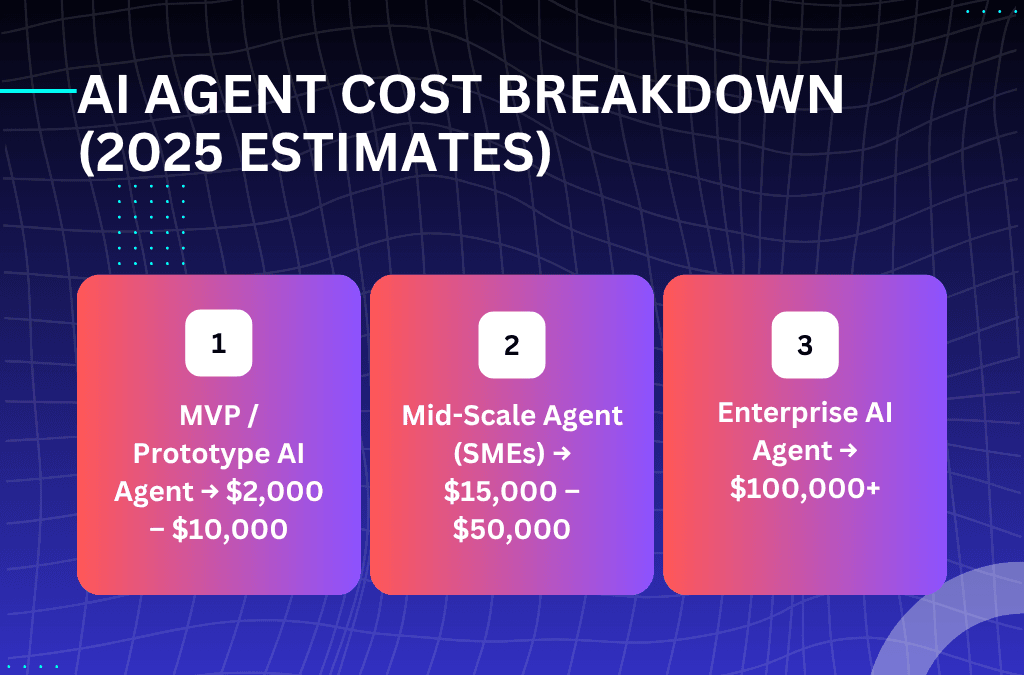
A customer support agent that costs $25,000 a year to staff with a human can be replaced by an AI agent for roughly $2,500 annually — a 90% saving, according to a widely-cited OpenAI Community discussion (October 2023). So when founders ask how much it costs to build a custom AI agent, the honest answer is: less than you fear, and more than a Zapier subscription.
Custom AI agent costs in 2026 range from $8,000 for a basic FAQ chatbot to $400,000+ for full multi-agent orchestration systems. Most startups and SMEs land between $15,000 and $60,000 for a production-grade agent that actually moves a metric. The number you pay depends on three things: how many systems it touches, how reliable it must be, and whether you’re renting someone else’s SaaS wrapper or owning the code.
Published: June 6, 2026. Last updated: June 6, 2026.
How We Compiled These Figures (Methodology)
Transparency matters when you’re quoting prices, so here is exactly where these numbers come from. The pricing ranges in this guide are synthesised from publicly published market rates and practitioner discussions, not from a single proprietary dataset. Specifically:
- The four-tier structure ($8K–$400K+) mirrors the publicly published cost breakdowns used across the industry and is cross-checked against developer-agency pricing shared in community forums such as the r/AI_Agents agency-pricing thread.
- The human-vs-AI cost comparison is drawn directly from the OpenAI Community pricing discussion (2023).
- MVP and startup budgeting guidance reflects the framing in ProductCrafters’ cost-estimation guide and questions raised in a January 2025 r/AI_Agents MVP-cost thread.
Where a figure reflects a published third-party source, we attribute it inline. Where a figure reflects general market observation rather than a single citable study, we describe it as a typical range — and we flag the difference so you can weigh the evidence yourself. Prices vary by region, vendor, and scope; treat these as planning ranges, not quotes.
Quick Summary: AI Agent Cost at a Glance
- Basic FAQ chatbot: $8,000–$20,000 to build, $50–$300/month to run.
- Workflow automation agent: $15,000–$50,000 to build, $100–$800/month to run.
- Custom ERP or multi-system agent: $50,000–$150,000 to build.
- Full multi-agent orchestration: $150,000–$400,000+ for enterprise-grade systems.
- Build cost and run cost are separate — token usage, tool calls, and looping drive ongoing expense.
- ROI beats sticker price: adoption is rising fast, but turning a deployed agent into measurable savings is the harder, more valuable problem.
How Much Does It Cost to Build a Custom AI Agent in 2026?
Building a custom AI agent costs between $8,000 and $400,000 in 2026, with most SME and startup projects landing in the $15,000–$60,000 range. Price scales with the number of integrations, the required reliability, and whether the agent simply answers questions or executes multi-step actions across your stack.
A custom AI agent is a software system that perceives context, makes decisions, and takes actions toward a goal — often calling external tools, querying databases, and looping until a task completes. The term agent specifically implies autonomy: the ability to choose which step to take next rather than following a fixed script. Unlike a static chatbot that returns canned replies, an agent reasons over steps. That autonomy is exactly what drives the cost curve: every tool it can call, every system it integrates with, and every decision branch it handles adds engineering hours.
ProductCrafters advises buyers to stop fixating on a single number and instead weigh ROI and future-proofing — solid advice worth echoing. A $30,000 agent that recovers $200,000 in annual labour is cheaper than a $10,000 one that breaks every Tuesday. The cheapest agent is the one that works reliably, not the one with the lowest invoice.
Practitioners generally find that the biggest cost surprise for founders isn’t the build — it’s the hidden “Zapier tax” of stitching together subscription tools that quietly inflate to four figures per month. Owning the automation logic outright often pays for itself within the first year, particularly once per-task SaaS fees scale with volume.
What Factors Determine How Much It Costs to Build a Custom AI Agent?
The cost to build a custom AI agent is driven by five factors: integration count, reliability requirements, model choice, tool-use complexity, and whether the agent loops autonomously. Each factor compounds — a single-integration FAQ bot and a five-system ERP orchestrator are different animals entirely.
Think of agent pricing like building a house. A studio apartment and a multi-story home both have walls and plumbing, but square footage, wiring complexity, and finish quality determine the final bill. Here’s what moves the needle:
- Integrations: Each system the agent touches — Slack, HubSpot, WhatsApp, your SQL database — adds API work, authentication, and error handling. Three integrations cost meaningfully more than one.
- Reliability tier: A demo that works 80% of the time is cheap. A production agent that must work 99.5% of the time needs testing, guardrails, and fallback logic — often 40% of total build hours.
- Model choice: GPT-4o, Claude Sonnet, or a self-hosted open-weight model like Llama 3 each carry different per-token costs and capabilities.
- Tool use and looping: Agents that call tools and loop until success consume more tokens and need more orchestration logic than single-shot responders.
- Determinism requirements: Finance and compliance agents need deterministic, auditable outputs — not a probabilistic “yes-machine” that hallucinates a refund policy.
A Worked Example: Pricing an Invoice-Matching Agent
To make the factors concrete, consider a typical workflow agent that matches incoming supplier invoices against purchase orders. A practitioner scoping this would generally break the estimate down roughly as follows:
- Discovery and data mapping (10–15% of build): understanding the PO format, edge cases, and approval thresholds.
- Two integrations (accounting system + email inbox): authentication, data extraction, and write-back logic — the single largest line item.
- Reasoning and matching logic: the LLM reads the invoice, extracts fields, and compares to the PO; a deterministic rules layer handles exact-match cases without calling the model at all (a cost-saving design choice).
- Reliability engineering (~40% of hours): handling mismatches, partial deliveries, and a human-in-the-loop escalation path for anything below a confidence threshold.
That kind of project typically lands in the $15,000–$35,000 build range with a $100–$500/month run cost — comfortably tier two. The trade-off worth noting: pushing the same agent to handle every exception autonomously (rather than escalating odd cases to a human) can double the engineering cost for marginal benefit. Scoping where automation stops is often where the real budget discipline lives.
The push toward deterministic AI over probabilistic yes-machines is the single most underrated cost factor. Cheap agents cut corners on validation; reliable agents bake it in from day one.
What Are the AI Agent Pricing Tiers by Complexity?
AI agent pricing falls into four distinct tiers in 2026, each defined by technical complexity rather than vendor markup. The tiers run from basic chatbots ($8K–$20K) through to full multi-agent orchestration ($150K–$400K+). Complexity — not vendor markup — explains the spread.
The table below breaks down each tier with build cost, monthly run cost, and a typical use case. These figures reflect 2026 planning ranges for SME and startup projects, anchored to publicly published industry benchmarks and the methodology described above.
| Agent Tier | Build Cost | Monthly Run Cost | Typical Use Case |
|---|---|---|---|
| Basic FAQ Chatbot | $8,000–$20,000 | $50–$300 | Website support, lead qualification |
| Workflow Automation Agent | $15,000–$50,000 | $100–$800 | Invoice processing, CRM updates, email triage |
| Custom ERP / Multi-System Agent | $50,000–$150,000 | $500–$2,500 | Inventory, finance, and operations orchestration |
| Multi-Agent Orchestration | $150,000–$400,000+ | $2,000–$10,000+ | Enterprise-wide autonomous workflows |
Most startups don’t need tier four. A WhatsApp customer support agent or an automated invoice-matching workflow lives comfortably in tiers one and two. Practitioners routinely deliver intelligent WhatsApp chatbots and workflow agents in this range that pay for themselves within months.
Published enterprise pricing guides position a comparable range — roughly $10,000 for a basic FAQ chatbot up to $400,000+ for full orchestration — which closely mirrors this structure. The practical difference for an SME is honesty about scope: most businesses need tier one or two, not the enterprise bloat they’ll never use.
What Is the Difference Between Build Cost and Run Cost?
Build cost is the one-time fee to design, develop, and deploy your AI agent. Run cost is the ongoing monthly expense — primarily LLM token usage, tool-call fees, and hosting. A $30,000 build might cost $400/month to run, and ignoring run cost is the most common budgeting mistake founders make.
Run cost scales with usage in ways build cost never does. Every conversation, every tool call, every reasoning loop consumes tokens — the chunks of text (roughly ¾ of a word each) that a model bills by — which get charged by your model provider. Agents that loop autonomously — reasoning, calling a tool, evaluating the result, and trying again — can multiply token consumption several times over compared to a single-shot chatbot.
Here’s where it gets sharp. A poorly designed agent that loops 12 times to answer a question it should solve in two burns through your token budget and your patience. Deterministic design and tight prompt engineering aren’t just quality concerns — they’re cost controls.
Run cost components break down as follows:
- LLM tokens: Input and output tokens billed per million. GPT-4o and Claude Sonnet pricing varies; high-volume agents add up fast.
- Tool-call fees: Some APIs (search, enrichment, payment) charge per call.
- Hosting and infrastructure: Self-hosting n8n on a $20/month VPS versus paying Zapier’s per-task pricing is a recurring cost decision.
- Maintenance: Models update, APIs change, and prompts need tuning — budget 10–20% of build cost annually.
A common cost move in 2026 is self-hosting n8n instead of paying the Zapier tax. SMEs frequently cut recurring automation spend substantially by owning their orchestration layer instead of renting it task-by-task — though this trade-off carries its own cost: you become responsible for uptime, updates, and security patching, which is real work, not free.
Why Is an AI Agent Cheaper Than Hiring a Human Employee?
An AI agent is cheaper than a human employee because it eliminates salary, benefits, and onboarding while operating 24/7. A customer support role costing $25,000/year to staff can be automated for roughly $2,500/year — a 90% reduction, per the OpenAI Community pricing discussion (2023).
The math is favourable to the agent for repetitive, rules-based work. A human support rep handles maybe 40–60 tickets a day, takes vacation, sleeps, and needs management. An AI agent handles thousands of conversations concurrently, never forgets your policy doc, and costs the same whether it answers 10 queries or 10,000.
But the comparison deserves nuance — and it’s worth being transparent about this. AI agents excel at high-volume, structured tasks: FAQ answering, invoice matching, appointment booking, lead qualification. They struggle with ambiguous judgment calls, emotional escalations, and edge cases no one anticipated. The winning model in 2026 isn’t replacement; it’s augmentation. The $2,500 figure also assumes a relatively low-volume, low-complexity workload — a high-traffic agent calling premium tools can cost considerably more to run, narrowing the saving.
A broader pattern worth noting: adoption of generative AI has climbed steeply across organisations, yet only a small fraction report capturing meaningful, scaled value from it. The gap between adoption and impact tells the real story — buying AI is easy, but building agents that reliably deliver ROI requires deterministic engineering and human oversight, not hype.
A useful guiding principle: the companies winning with AI generally aren’t the ones spending the most — they’re the ones measuring ROI carefully and keeping humans in the loop. An agent that saves 90% on labour but hallucinates 5% of the time isn’t a 90% win; it’s a liability.
How Should Startups and SMEs Budget for a Custom AI Agent?
Startups should budget $15,000–$40,000 for their first production AI agent and reserve 15–20% of build cost annually for run and maintenance. Start with a single high-impact use case, prove ROI in 90 days, then expand — rather than committing to a $150,000 multi-agent system on day one.
The MVP approach wins for cash-conscious founders, and it’s a question that comes up constantly — founders openly asking in developer communities how much an agent MVP will actually cost. Pick the one workflow eating the most hours — invoice processing, support tickets, lead routing — and automate it first. A focused MVP agent costs a fraction of a sprawling platform and gives you real data on token usage and ROI before you scale.
Here’s a practical budgeting framework many practitioners use:
- Quantify the pain: How many hours per week does the manual process cost? At what hourly rate? That’s your savings ceiling.
- Run the ROI numbers: Use a calculator to compare build cost against annual labour saved. If payback is under 12 months, build it.
- Choose tier-appropriate scope: Don’t buy orchestration when a workflow agent solves 90% of the problem.
- Plan for run cost: Estimate monthly token volume and tool calls before signing.
- Demand a 90-day blueprint: A real partner delivers a deployment roadmap, not a vague “AI transformation” pitch.
This is exactly the gap most pricing guides ignore — they target $400K enterprise budgets and leave SMEs guessing. Run your own numbers with the J. SERVO ROI Calculator to see whether a custom agent beats your current process before you spend a dollar. The organisations capturing real value are consistently those that scope tightly and measure relentlessly.
Off-the-Shelf Tools vs. Custom-Built Agents: Which Costs Less?
Off-the-shelf AI tools cost less upfront ($20–$500/month) but accumulate recurring fees and lock you into someone else’s roadmap. Custom-built agents cost more initially ($15,000+) but eliminate per-task fees and give you full ownership — often cheaper within 18 months for high-volume use cases.
Off-the-shelf wins when your needs are generic and low-volume. Intercom’s AI, a HubSpot chatbot, or a ChatGPT plugin can solve a narrow problem fast. The catch: SaaS wrapper bloat. Many “AI tools” are thin layers over the same models you could call directly, marked up with per-seat pricing that punishes growth.
Custom wins when volume is high, integrations are specific, or determinism matters. If you’re processing 50,000 transactions a month, paying per-task fees to a SaaS platform becomes expensive fast. Owning the agent — and self-hosting the orchestration — can flip the economics in your favour.
The honest trade-off: custom builds require upfront capital and a competent partner. Off-the-shelf requires neither but caps your control. For most SMEs in 2026, the sweet spot is a hybrid — off-the-shelf for commodity tasks, custom agents for the workflows that define your competitive edge.
Key Takeaways and Next Steps
The question isn’t just how much does it cost to build a custom AI agent — it’s whether the agent returns more than it costs. Here’s what to act on:
- Budget realistically: $15,000–$60,000 covers most SME production agents in 2026.
- Separate build from run cost before you sign anything.
- Start with one MVP use case and prove ROI in 90 days.
- Demand determinism and human oversight — reliability is a cost factor, not a luxury.
- Self-host orchestration to dodge the Zapier tax — but budget for the maintenance burden it adds.
- Run the numbers with a real ROI calculator before committing capital.
By 2027, the AI agent market won’t reward the companies that spent the most — it’ll reward the ones who treated agents like engineering investments instead of magic. The cheapest custom AI agent is the one that works every single time, ships in 90 days, and quietly saves you a salary. Everything else is hype with an invoice attached.
Frequently Asked Questions
How much does it cost to build a custom AI agent for a small business?
Custom AI agents for small businesses cost $8,000–$50,000 to build in 2026, depending on complexity and integrations. Basic FAQ chatbots typically run $8,000–$12,000, while workflow agents that integrate with your CRM or accounting tools range from $15,000 to $50,000.
What is the monthly cost to run an AI agent?
Monthly costs to run an AI agent range from $50 for a low-volume customer-service chatbot to $2,500 or more for a multi-system enterprise agent processing thousands of tasks daily. Run cost is driven by LLM token usage, tool-call fees, and hosting — not your build price. Agents that loop autonomously consume significantly more tokens.
Is it cheaper to build a custom AI agent or use off-the-shelf tools?
Off-the-shelf tools are cheaper upfront ($20–$500/month) but custom agents are often cheaper within 18 months for high-volume use cases. Custom builds eliminate per-task SaaS fees and give you full ownership, while off-the-shelf tools lock you into recurring pricing and someone else’s roadmap.
How long does it take to build a custom AI agent?
A production-grade custom AI agent typically takes 4–12 weeks to build, depending on complexity. Basic chatbots can ship in 2–4 weeks, while multi-system ERP or orchestration agents require 8–12 weeks for integration, testing, and reliability engineering.
Why do AI agent costs vary so much?
AI agent costs vary based on integration count, reliability requirements, model choice, and tool-use complexity. A single-integration FAQ bot is a fraction of the cost of a multi-system agent that loops autonomously and demands deterministic, auditable outputs for finance or compliance use cases.
Sources & References
- OpenAI Community — How much are consumers/businesses willing to pay for custom AI services? (October 2023) — source of the $25K human vs. $2.5K AI (90% saving) comparison.
- ProductCrafters — How do I estimate cost and time to build a custom AI agent? — ROI-over-single-number framing and MVP guidance.
- r/AI_Agents — Pricing of dev agencies for AI agent development — practitioner agency-pricing reference.
- r/AI_Agents — Cost to create an AI Agent MVP (January 2025) — startup MVP-cost context.
Note: This article is for general informational purposes; verify specifics against your own context.