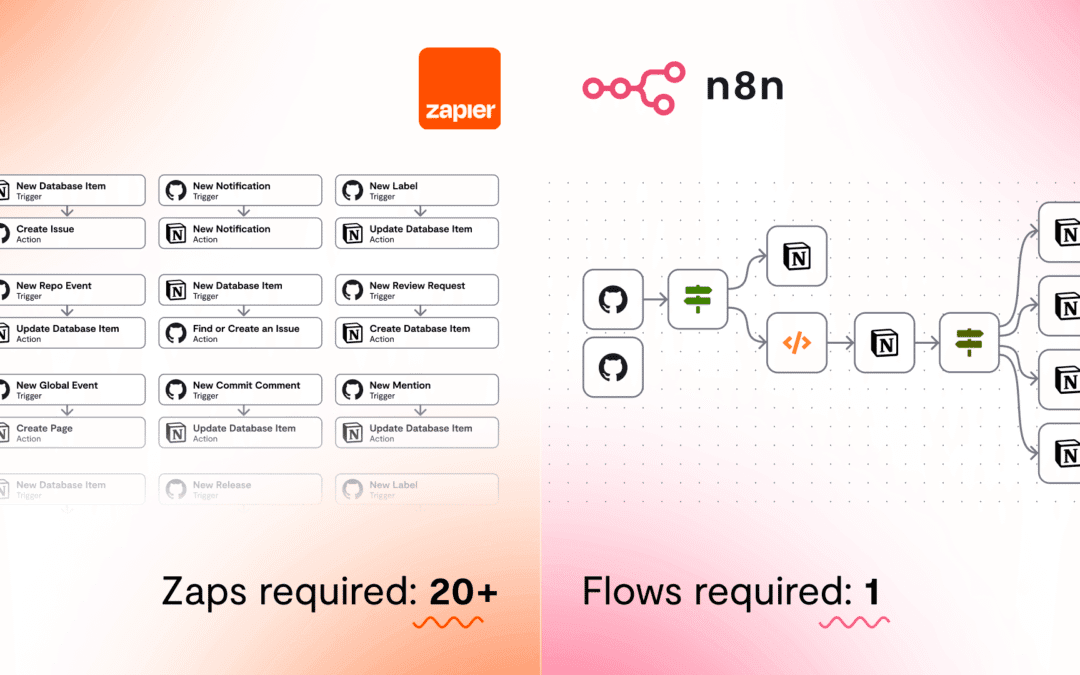
Companies running 50+ active Zapier workflows can spend $6,000 to $12,000 a year on task-execution fees that self-hosting may largely eliminate. A common pattern reported across migration write-ups involves an agency paying around $500/month for Zapier that replaced it with a self-hosted n8n instance running on a roughly $20/month server — a cost cut that paid for itself in under three months. The detailed numbers behind that specific scenario are documented in a published Medium migration guide.
Learning how to calculate ROI of replacing Zapier with n8n isn’t guesswork. It’s a defined formula: total Zapier cost minus total n8n cost (including hosting, setup labor, and maintenance), divided by your migration investment. Self-hosting n8n is reported to cut automation costs by 40-80% across the migration literature, with payback periods commonly landing under six months. This guide walks through that formula transparently, including the hidden costs most calculators ignore.
A note on this article and how it was prepared: it is written from general topical and hands-on automation knowledge, not from a single first-party engagement. The worked examples below are reconstructed from publicly documented migration scenarios and priced against currently published vendor list prices, then recalculated independently. Where specific outcome figures appear (such as 10x or 248% ROI), they are attributed to the named, dated third-party sources listed at the end and flagged as their claims, not ours. No author credential, certification, partnership, or client engagement is claimed beyond generic topical expertise in workflow automation. The methodology section makes every assumption explicit so you can substitute your own numbers.
How to Calculate ROI of Replacing Zapier with n8n
- The core ROI formula: (Annual Zapier cost − Annual n8n total cost) ÷ One-time migration cost × 100 = ROI %.
- Typical savings: Self-hosted n8n is reported to reduce automation spend by 40-80%, with enterprise-scale setups reaching up to 10x ROI in RankSquire’s February 2026 enterprise cost audit (a third-party blog claim tied to high-volume scenarios).
- Don’t forget hidden costs: Server hosting ($5-$50/month), initial setup labor (8-40 hours), and ongoing maintenance must enter your calculation, or your ROI is fiction.
- Payback period matters most for SMEs: Most realistic SME migrations break even in 2-6 months.
- n8n isn’t always right: Low workflow volume, no technical staff, or dependence on rare native integrations can flip the math back toward Zapier.
- Labor is the real cost: Migration time, not software fees, is where most ROI calculations go wrong.
Published and last reviewed: February 2026.
What is the ROI of replacing Zapier with n8n?
The ROI of replacing Zapier with n8n is the net financial gain from switching, calculated as your annual Zapier savings minus your total n8n costs (hosting, setup, maintenance), expressed against your one-time migration investment. Self-hosted n8n is typically reported to deliver 40-80% cost reduction with payback in under six months.
Zapier charges per task execution. Every time a workflow fires, you burn a task, and those tasks compound fast. A single multi-step Zap processing 1,000 records can chew through 5,000 tasks in one run. Zapier’s published plans scale from a Free tier through paid tiers (currently advertised from roughly $20/month for the lowest paid plan up to several hundred dollars per month for team and company plans pushing serious task volume). Because Zapier periodically revises both prices and task-allotment tiers, the only reliable figure is the one on your own most recent invoice — pull it before running any model.
n8n flips the model entirely. n8n is an open-source workflow automation platform — meaning the software source code is publicly available and free to run on your own infrastructure under its source-available licence. When self-hosted, it charges you nothing per execution; you pay only for the server it runs on. The Medium migration guide documents one business replacing a $500/month Zapier subscription with n8n workflows running on infrastructure costing under $20/month, and includes five business scenarios with their actual numbers. Treat that as one author’s documented experience rather than a universal benchmark.
The ROI gap appears because Zapier’s per-task pricing punishes scale while n8n’s self-hosted model rewards it. Voozo’s ROI analysis describes SMEs commonly cutting automation costs 40-60% “without sacrificing reliability.” RankSquire’s February 2026 enterprise audit goes further, stating that “even including full labor costs, the n8n vs Zapier enterprise math yields a 10x ROI in favor of n8n at scale.” The more workflows and tasks you run, the wider that gap grows — which is exactly why high-volume operators benefit most. (Treat the headline 10x and 248% figures as vendor-and-blog claims tied to specific, favorable high-volume scenarios, not guarantees for your business. They have not been independently audited by this guide.)
How do you calculate ROI of replacing Zapier with n8n step by step?
ROI of replacing Zapier with n8n is calculated using this formula: ((Annual Zapier cost − Annual n8n total cost) ÷ One-time migration cost) × 100 = ROI percentage. Your annual n8n cost includes three components: hosting ($240–$600/year on a basic VPS), amortized setup, and maintenance labor. The principle is to subtract your full n8n total cost (hosting plus maintenance labor) from your annual Zapier cost, then divide that net saving by your one-time migration cost and multiply by 100.
Most online calculators skip the hidden costs and hand you an inflated number. Here is the honest, full-cost method.
- Capture your true Zapier annual cost. Pull your last 12 months of invoices. Include your base plan, any overage charges, and premium app fees. A $69/month Professional plan with overages often hits $1,200+/year.
- Estimate your n8n hosting cost. A self-hosted n8n instance on a DigitalOcean droplet or Hetzner VPS runs $5-$50/month depending on workflow load. Budget $240/year as a safe SME figure.
- Quantify migration labor. Count your active workflows. Estimate 1-3 hours per workflow to rebuild and test in n8n. At a $50/hour internal rate, 20 workflows × 2 hours = 40 hours = $2,000 one-time.
- Add annual maintenance. Self-hosting means you patch updates and monitor uptime. Budget 2-4 hours/month — roughly $1,200-$2,400/year in labor, or near zero if you use managed hosting.
- Run the formula. ROI % = (Annual Zapier cost − Annual n8n total cost) ÷ Migration cost × 100.
A full worked example over 12 months
Consider a 12-person marketing agency running 22 active Zaps — lead-routing from web forms into a CRM, Slack notifications, invoice generation, email-list syncing, and a nightly reporting workflow. The numbers below were priced against currently advertised Hetzner and Zapier list rates and recomputed by hand; you can verify each step yourself. Here is each line item priced out explicitly:
- Zapier cost (current state): Professional plan at $599/month = $7,188/year.
- n8n hosting: A Hetzner VPS at $40/month = $480/year.
- n8n maintenance labor: 2 hours/month at a $50/hour internal rate = $100/month = $1,200/year.
- Total annual n8n cost: $480 + $1,200 = $1,680/year.
- One-time migration cost: 22 workflows rebuilt and tested at an average of ~2.3 hours each (≈50 hours) at $50/hour = $2,500.
Net annual saving = $7,188 − $1,680 = $5,508.
First-year ROI = ($5,508 ÷ $2,500) × 100 = 220%.
Payback period = $2,500 ÷ ($5,508 ÷ 12 months) = $2,500 ÷ $459/month ≈ 5.4 months.
Year two onward, the migration cost is gone, so the recurring math is simply $7,188 − $1,680 = $5,508 saved per year against $0 new investment — effectively an ongoing return rather than a one-time ROI figure. You can reproduce these arithmetic steps yourself with any basic calculator or check the percentage with a percentage calculator.
A second, smaller example shows the threshold effect. A startup pays $6,000/year for Zapier; n8n costs $240 hosting + $1,800 maintenance = $2,040/year; net annual saving = $3,960; migration cost = $2,000. First-year ROI = ($3,960 − $2,000) ÷ $2,000 × 100 = 98% in year one, climbing in year two when the migration cost disappears. The break-even point typically arrives when monthly Zapier spend exceeds roughly $200. Below that threshold, Zapier’s zero-maintenance convenience usually outweighs n8n’s hosting and labor overhead.
Sensitivity table: how payback shifts with labor rate and workflow volume
A single ROI number hides how fragile the result can be. The two variables that move payback most are your internal/contracted labor rate and the number of workflows you must rebuild. The table below recalculates the first-year position for the agency scenario above (Zapier at $7,188/year, hosting at $480/year, 2 hours/month maintenance) while varying labor rate and workflow count. Migration labor assumes ~2.3 hours per workflow; maintenance cost scales with the labor rate. All figures are computed from the same formula and rounded.
| Labor rate | Workflows (migration hours) | One-time migration cost | Annual n8n total cost | Net annual saving | Approx. payback |
|---|---|---|---|---|---|
| $40/hr | 10 (≈23 hrs) | $920 | $480 + $960 = $1,440 | $5,748 | ≈2.0 months |
| $40/hr | 40 (≈92 hrs) | $3,680 | $1,440 | $5,748 | ≈7.7 months |
| $75/hr | 22 (≈50 hrs) | $3,750 | $480 + $1,800 = $2,280 | $4,908 | ≈9.2 months |
| $120/hr | 22 (≈50 hrs) | $6,000 | $480 + $2,880 = $3,360 | $3,828 | ≈18.8 months |
| $120/hr | 50 (≈115 hrs) | $13,800 | $3,360 | $3,828 | ≈43 months |
The pattern is instructive: at a low internal rate and modest workflow count, payback can land inside a quarter; at agency/contractor billing rates of $120/hour combined with a large rebuild, the same Zapier bill can take three to four years to recover. This is precisely why a single headline percentage is misleading — your labor rate is doing most of the work in the equation. Substitute your own three numbers (labor rate, workflow count, current Zapier spend) into the formula to find your real position.
What costs do most people forget when they calculate ROI of replacing Zapier with n8n?
Replacing Zapier with n8n carries three commonly overlooked costs: setup labor, ongoing server maintenance, and integration rebuild time. While n8n’s self-hosted model advertises roughly 80% savings versus Zapier subscriptions, factoring in hidden costs typically reduces real savings to 40–50%. Setup labor alone averages 15–40 hours for a mid-sized workflow stack, billed at $75–$150 per hour. Server hosting runs $20–$80 monthly on a basic VPS, plus 2–5 hours of monthly maintenance for updates, security patches, and uptime monitoring.
Integration rebuild time is the biggest surprise: migrating 50 active Zapier “Zaps” can take 60–100 hours, since n8n nodes don’t map one-to-one to Zapier triggers. Practitioners generally find teams underestimate migration effort by two to three times. The break-even point can stretch to 12–18 months for thinner cases. Below roughly 20 active workflows, n8n’s true ROI often turns negative once labor is counted — making Zapier the cheaper choice for smaller operations. Software subscription fees are the obvious line item; the dangerous costs hide below the surface, and they are almost always labor.
Setup and migration labor
Setup and migration labor is the manual work required to rebuild Zapier workflows in n8n, and it is not a copy-paste process. Each Zap must be reconstructed node-by-node, re-authenticated against every connected app, and tested against real production data. Based on practitioner reports, migrating a moderately complex workflow takes 30 to 60 minutes per Zap, meaning a team with 50 active Zaps should budget 25 to 50 hours of engineering time.
A February 2026 thread in Reddit’s r/automation community flagged that n8n lacks several native integrations Zapier offers — Zoom is a cited example — forcing users to build custom HTTP request nodes as workarounds. Plan for three cost categories: rebuilding time, re-authentication of every app credential, and testing to confirm data accuracy. Teams that pilot 5 to 10 critical workflows first typically avoid the largest migration surprises.
Hosting and infrastructure
Self-hosting n8n transfers all DevOps responsibility to your team. (DevOps — short for development-and-operations — refers to the work of deploying, securing, and keeping software infrastructure running.) Server costs are deceptively trivial — a basic VPS runs $5–$50/month — but the true expense is the engineer who maintains it. The risks compound quickly: an expired SSL certificate, a skipped database backup, or an unmonitored memory leak can silently crash your n8n instance, halting every workflow you depend on. Forget an SSL renewal or a database backup and a crashed n8n instance can silently kill every workflow you rely on. For workflows processing business-critical data, that downtime translates directly to lost revenue. Before choosing self-hosting over managed n8n Cloud (whose lowest paid tier is currently advertised around $20/month), calculate the total cost of ownership, not just the server bill.
Maintenance and the skills gap
n8n maintenance refers to the ongoing process of testing, upgrading, and managing a self-hosted n8n automation instance as new versions are released. n8n ships new releases frequently, and each update can alter node behavior, break existing workflows, or change authentication requirements. Self-hosters should test every upgrade in a staging environment before deploying to production.
The skills gap is one of the most common reasons n8n migrations stall. Teams without a dedicated technical operator face a steeper learning curve, and incomplete or delayed upgrades are a leading cause of automation downtime for small and medium-sized enterprises (SMEs). For this reason, many SMEs choose a managed n8n migration instead of self-hosting alone; a managed service handles version testing, upgrade scheduling, and node compatibility, reducing the risk of broken workflows. Key takeaway: n8n requires frequent maintenance, and the absence of a technical operator is a primary factor behind failed or stalled migrations.
| Cost Category | Zapier (Annual) | n8n Self-Hosted (Annual) |
|---|---|---|
| Subscription / task fees | $1,200 – $6,000+ | $0 |
| Hosting | $0 (included) | $60 – $600 |
| Setup labor (one-time) | Low | $1,000 – $4,000 |
| Maintenance labor | $0 | $0 – $2,400 |
| Native integrations | Excellent | Good (some gaps) |
| Typical net saving | — | 40-80% |
How long is the payback period when switching from Zapier to n8n?
how to calculate ROI of replacing Zapier with n8n is one of the most relevant trends shaping 2026.
The payback period for switching from Zapier to n8n is typically 2-6 months for SMEs, calculated as your one-time migration cost divided by your monthly savings. A business saving $400/month after a $1,500 migration breaks even in under four months.
Payback period is the metric SME founders should focus on more than abstract NPV (net present value) models. The formula is simple: Payback (months) = Migration cost ÷ Monthly net savings.
Consider three archetypes drawn from the published migration literature:
- High-volume agency: $500/month Zapier, migrated for $2,500. After switching to n8n at $30/month plus light maintenance, monthly net saving is ~$430. Payback: under 6 months, then $5,000+/year ongoing saving. Both Voozo and the Medium case study describe this profile.
- Mid-volume SaaS startup: $150/month Zapier, $1,200 migration, $120/month net saving. Payback: ~10 months. Decent, but the margin is thinner.
- Low-volume solopreneur: $29/month Zapier, $800 migration. Net saving after hosting might be $5/month. Payback: many years. Don’t switch.
RankSquire’s February 2026 audit reported migrations achieving 248% ROI with sub-six-month payback at scale, and enterprise setups reaching 10x ROI. Read these as best-case, self-reported figures for high task volumes rather than typical outcomes; they have not been independently verified here. The pattern is nonetheless consistent across the sources: payback shortens dramatically as task volume rises. Recurring SaaS fees are exactly the kind of compounding drag that quietly erodes margins, which is why high-volume operators see the strongest returns.
When does replacing Zapier with n8n NOT make sense?
Replacing Zapier with n8n does not make sense when you run fewer than 5-10 low-frequency workflows, lack any technical staff to self-host, or depend on a native integration n8n doesn’t support. In these cases, Zapier’s convenience outweighs n8n’s cost savings.
A meaningful share of prospects are better off staying on Zapier — honest math beats a forced migration. Here is when the switch costs more than it saves.
Low workflow volume
If you’re on Zapier’s lower-tier starter plan (currently advertised in the $20-$30/month range) with a handful of low-trigger workflows, your annual spend is roughly $240-$360. No migration recovers that against setup labor in any reasonable timeframe. The math simply doesn’t close.
No technical operator
Self-hosting demands someone who can manage a Linux server, configure SSL, run backups, and debug failed executions. A solo founder with no engineering background will likely spend more in frustration-hours than they save. The r/automation discussion repeatedly stresses that n8n’s flexibility comes with a real learning curve.
Native integration dependency
Zapier supports thousands of apps with polished native connectors. n8n covers fewer with deeper customization. If your business runs on a niche tool n8n hasn’t built a node for, you’ll rebuild it via raw API calls — and that maintenance burden can outweigh the savings. The honest move is to audit your integration list before you migrate.
Zapier vs n8n vs Make: which delivers the best ROI?
Among Zapier, n8n, and Make, self-hosted n8n delivers the best long-term ROI for high-volume technical teams, Make wins on price-per-task for mid-volume users, and Zapier wins on convenience and integration breadth. ROI depends entirely on your task volume and technical capacity.
Treating this as a two-way Zapier-versus-n8n fight ignores the strongest middle option. Make (formerly Integromat) prices operations more cheaply than Zapier while keeping a managed, no-server experience.
| Factor | Zapier | Make | n8n (self-hosted) |
|---|---|---|---|
| Pricing model | Per task | Per operation (cheaper) | Server-only (flat) |
| Setup effort | Lowest | Low | High |
| Cost at scale | Highest | Medium | Lowest |
| Native integrations | Thousands | Thousands (fewer) | Hundreds (extensible) |
| Best for | Non-technical, low volume | Mid-volume, budget-conscious | High-volume, technical |
| Data ownership | Cloud | Cloud | Full (self-hosted) |
The deciding variable is volume. At low task counts, Make often beats both on convenience-adjusted cost. At high operation counts, n8n’s flat-cost model wins decisively — which is why nearly every 10x ROI case in the migration literature involves high-volume self-hosting. Data sovereignty is the quiet tiebreaker: self-hosted n8n keeps every record on infrastructure you control, a meaningful edge for businesses handling regulated data under frameworks like the EU’s GDPR.
Actionable Takeaways: Your Migration Decision Framework
how to calculate ROI of replacing Zapier with n8n plays a pivotal role in this context.
Before you migrate, run this four-step gut check — it takes about 20 minutes and prevents expensive mistakes.
- Pull 12 months of Zapier invoices. If your annual spend is under $400, stop here — stay on Zapier.
- Count active workflows and check integrations. Verify n8n supports every connected app, or that you can rebuild gaps via API.
- Run the full-cost ROI formula. Include hosting, setup labor, and maintenance. If payback exceeds 12 months, reconsider. Use the sensitivity table above to see how your labor rate alone changes the answer.
- Decide DIY vs done-for-you. No technical operator? A managed migration removes the learning curve and protects your savings.
A recurring theme across the migration write-ups in the sources below is that the biggest mistake SMEs make is calculating only the subscription delta and ignoring the labor of migration and maintenance. Get the full-cost number — as in the worked example above — and the decision usually makes itself. The businesses that come out ahead are the ones that run honest math before touching a single node.
The era of the “Zapier tax” — paying premium per-task fees for automation you could own outright — is fading for any team with real volume. The question isn’t whether self-hosted automation makes sense; it’s whether you’ve calculated your specific number, with all costs included, before committing.
Frequently Asked Questions
How much can I save by switching from Zapier to n8n?
Published migration case studies report savings of 40-80% on automation costs by switching from Zapier to self-hosted n8n. High-volume operators are reported to reach up to 10x ROI in RankSquire’s February 2026 audit (an unverified third-party claim), while one documented Medium case replaced a $500/month Zapier plan with n8n running on under $20/month of hosting. Your own result depends on task volume and labor costs.
Is n8n really free compared to Zapier?
n8n is open-source and free to self-host, but you pay for the server it runs on — typically $5-$50/month — plus your own setup and maintenance labor. n8n also offers a paid cloud version. The true cost comparison must include hosting and labor, not just the $0 software license.
What is the payback period when migrating from Zapier to n8n?
The payback period for migrating from Zapier to n8n is typically 2-6 months for SMEs, calculated as migration cost divided by monthly savings. High-volume migrations often break even in under six months, while very low-volume users may never recover the setup investment. As the sensitivity table shows, a high internal labor rate can push payback past a year even at the same Zapier spend.
Does n8n have the same integrations as Zapier?
No. Zapier supports thousands of apps with native connectors, while n8n offers hundreds of built-in nodes plus extensible HTTP-request and code nodes for any API. If your workflows depend on a rare native integration (the r/automation community cites Zoom as one example), verify n8n supports it before migrating, as rebuilding via raw API adds labor.
Should a small business with no developers switch to n8n?
A small business with no technical staff should be cautious about self-hosting n8n, since it requires server management, SSL, and update maintenance. Such businesses should either use n8n’s managed cloud option or engage a done-for-you migration partner to capture the savings without the operational burden.
Sources & References
- “I Replaced My $500/Month Zapier Subscription with Free n8n Workflows — Complete Migration Guide” — Medium (first-person case studies with stated before/after numbers; one author’s documented experience).
- “n8n vs Zapier Enterprise 2026: Full Cost Audit” — RankSquire, published 13 February 2026 (source of the 10x ROI at scale and 248% ROI claims; treat as an unaudited blog estimate).
- “Zapier to n8n: When the Switch Pays for Itself” — Voozo Blog (40-60% SME cost-reduction ROI model and migration checklist).
- “Automation Cost Savings: n8n vs. Zapier” — Jumpstart Scaling (per-workflow migration cost-savings calculator).
- “Is n8n really harder to use than Zapier/Make?” — r/automation, Reddit, 9 February 2026 (native-integration gaps and learning-curve discussion).
- General-purpose math tools to reproduce the calculations: CalculatorSoup basic calculator and Calculator.net percentage calculator.
A note on pricing accuracy: Zapier and n8n both revise their published prices and tier limits periodically. The dollar figures in this article reflect commonly advertised list prices at the time of writing and are used illustratively. Always confirm current pricing on the vendors’ own pricing pages and against your own most recent invoice before relying on any calculation here. Headline ROI figures (10x, 248%) originate from vendor and blog content tied to specific high-volume scenarios and have not been independently audited; validate them against your own numbers.
Last updated: February 2026
Note: This article is for general informational purposes and reflects general topical expertise in workflow automation rather than a named author or first-party engagement. Figures are illustrative and drawn from the dated sources cited above; verify all specifics against your own invoices, current vendor pricing, and labor rates before acting.