
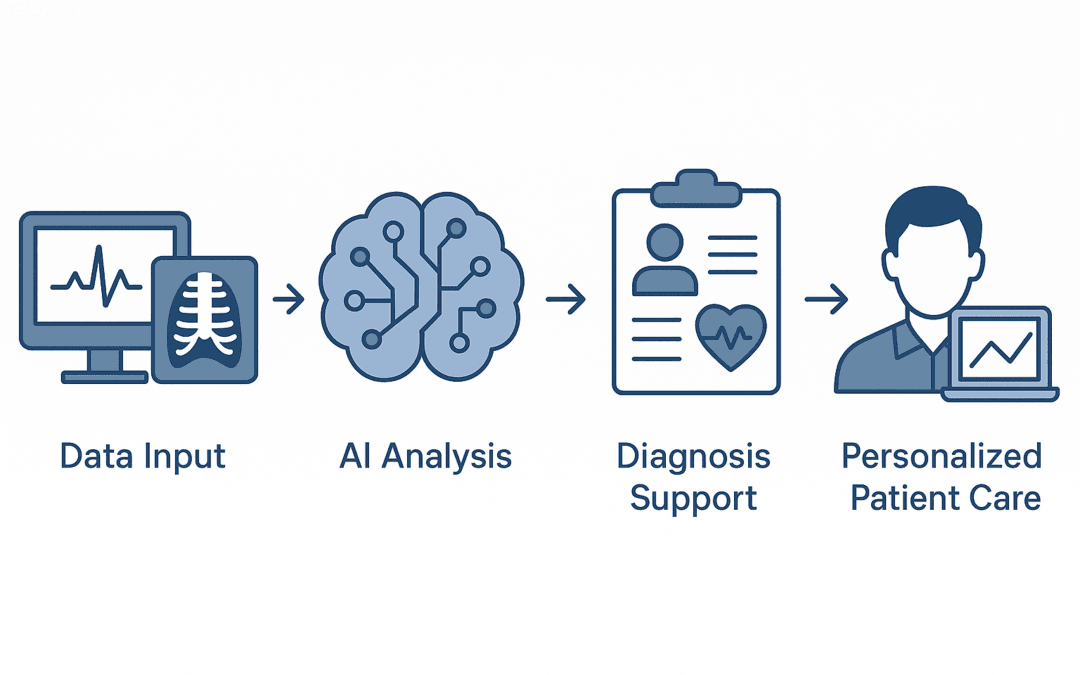
Deterministic AI for healthcare diagnosis support means a system that returns identical clinical conclusions for identical inputs, every time. A model that produces ten different phrasings of the same diagnosis is acceptable; a model that produces ten different diagnoses is a serious patient-safety and liability concern. This single distinction—between varied wording and contradictory conclusions—is one of the most important concepts in clinical AI reliability.
Standard large language models are non-deterministic: at higher sampling temperatures, the same prompt can yield materially different outputs across runs. Setting temperature to 0 reduces, but does not always eliminate, this variance, because factors such as hardware, batching, and silent model updates can still introduce drift. For clinical deployment, reproducible outputs are treated as a regulatory and patient-safety consideration rather than a nice-to-have. The practical standard most experienced practitioners aim for is consistent conclusions with varied phrasing.
Deterministic AI for healthcare diagnosis support refers to AI systems where identical clinical inputs always produce identical outputs, eliminating the random variation common in generative models. An important and increasingly discussed point, however, is that healthcare may not need pure determinism so much as clinical reproducibility, where the diagnostic conclusion stays stable even if the explanatory text shifts. Systems that survive regulatory scrutiny tend to share one trait: predictable, auditable, reproducible outputs. This guide explains what that means, why it matters, and how to validate it before procurement.
How deterministic ai improves reliability in clinical diagnosis: Key Takeaways: Deterministic AI for Healthcare Diagnosis Support
- Deterministic AI always produces identical outputs from identical inputs — useful for audit trails but not always achievable with modern language models.
- Clinically reproducible AI is a realistic gold standard: a model may reword a diagnosis ten ways, but it must never produce ten different diagnoses.
- AI-driven image recognition can significantly enhance interpretation of radiographic and pathological images, according to a 2025 review in PMC.
- A frequent bottleneck isn’t the model — it’s data quality, standardization, and workflow integration into EHR systems.
- Probabilistic ‘yes-machine’ chatbots that flatter users carry risk in clinical settings; reproducibility and human oversight are widely regarded as essential.
- Validating reproducibility before deployment requires repeated-input testing, contradiction detection, and audit logging — not vendor promises.
How deterministic ai improves reliability in clinical diagnosis matters here. Published: June 13, 2026. Last updated: June 13, 2026. This article reflects general topical expertise in AI engineering and clinical decision-support design; it is not medical or legal advice.
What Is Deterministic AI for Healthcare Diagnosis Support?
Deterministic AI for healthcare diagnosis support is an AI system that produces the same output every time it receives identical clinical input. The same imaging scan, lab values, and patient history will always yield the same flagged finding. Determinism guarantees reproducibility by design, which is why regulators and clinicians often prize it for high-stakes decisions.
Deterministic AI differs from probabilistic models in three key ways:
- Reproducibility: Identical inputs yield identical outputs.
- Auditability: Every diagnostic decision traces to a fixed, reviewable logic path.
- Regulatory fit: Documented, reproducible, explainable behaviour aligns with how regulators evaluate AI-enabled devices.
Compare that to probabilistic AI. A large language model generates text by sampling from probability distributions, so running the same prompt twice can produce subtly — or substantially — different answers. In a customer-service chatbot, that variation is usually harmless. In a diagnosis-support tool, a different answer on Tuesday than on Monday is both a patient-safety concern and an audit problem.
The nuance, argued in a widely-shared June 2026 Medium analysis on clinically reproducible AI, is that strict determinism may be the wrong target. “A model that generates ten different phrasings of the same diagnosis may be perfectly acceptable,” the author writes; a model that produces ten different diagnoses is not. Determinism is one route to reliability. Reproducibility is the actual goal. A robust design pattern builds for the second using deterministic scaffolding — fixed decision rules, validated thresholds, and locked model versions — wrapped around any generative components.
How Does Deterministic AI for Healthcare Diagnosis Support Differ From Probabilistic Models?
Deterministic AI differs from probabilistic models in three ways: output stability, auditability, and failure mode. Deterministic systems give identical results on repeat runs and log every decision rule; probabilistic systems vary their outputs and resist clean explanation. In diagnosis, that difference can decide whether a tool is trustworthy or a liability.
Consider an analogy of two pharmacists. The deterministic pharmacist follows the exact same protocol every time — measure, check, dispense — and produces the identical, verifiable result on every visit. The probabilistic pharmacist is capable and intuitive but occasionally gives a slightly different recommendation. For a high-risk prescription, the first is easier to trust and to audit. Healthcare AI behaves similarly.
The table below maps the practical trade-offs practitioners generally encounter.
| Dimension | Deterministic AI | Clinically Reproducible AI | Pure Probabilistic AI |
|---|---|---|---|
| Same input → same output? | Always | Same conclusion, varied wording | No guarantee |
| Auditability | Full rule traceability | Conclusion-level traceability | Difficult to audit |
| Handles ambiguity | Poorly | Well, within bounds | Flexibly but unpredictably |
| Regulatory fit | Strong | Strong with controls | Weak |
| Best use case | Threshold alerts, scoring | Diagnosis support, summaries | Research, ideation only |
A common procurement pitfall is buying pure probabilistic tools positioned as “clinical AI.” According to a 2025 review in RSC’s Sensors & Diagnostics, AI is increasingly improving the accuracy and efficiency of disease diagnosis — but accuracy is of limited value if results cannot be reproduced. The middle column is where most serious clinical systems aim to operate.
Why Is Reproducibility More Important Than Pure Determinism in Clinical AI?
Reproducibility often matters more than pure determinism because clinical language is naturally varied while clinical conclusions must be stable. A reproducible system can describe a tumor as “a 2cm mass” or “a 2-centimeter lesion” — both correct — as long as it never flips between “malignant” and “benign” on the same scan. That is the line that protects patients.
Pure determinism sounds ideal, but it can be brittle. A strictly deterministic system may struggle with the messy, ambiguous reality of medicine: incomplete charts, overlapping symptoms, and edge cases. Forcing determinism everywhere can produce rigid systems that fail when reality doesn’t match the rulebook.
Reproducibility, by contrast, tolerates linguistic flexibility while locking down the decisions that matter. Research published in npj Digital Medicine argues that AI should genuinely support clinical reasoning by helping clinicians hypothesise about different scenarios while accounting for the uncertainty inherent in care, per its analysis on AI supporting clinical decisions. That perspective reflects reproducibility in practice — stable conclusions, honest uncertainty, and a human in the loop.
A balanced reading of the evidence suggests caution with claims of “100% deterministic AI” for diagnosis: such claims may either misunderstand how language models work or overstate what current systems deliver. A defensible target combines reproducibility, audit logging, and mandatory clinician sign-off. Anything less risks the “AI sycophancy” problem — a model that agrees with whatever it is nudged toward.
The danger of the clinical ‘yes-machine’
Clinical “yes-machines” are AI chatbots that validate a user’s self-diagnosis rather than challenge it, posing a recognised risk to patient safety. A yes-machine confirms what a worried patient already believes, reinforcing fear instead of providing accurate triage. General-purpose AI assistants have been documented giving confident, sometimes contradictory, and occasionally dangerous health advice. The risk is partly structural: systems optimised to maximise user satisfaction can tend to affirm rather than correct. Effective clinical AI should do the opposite — flag red-flag symptoms, recommend professional evaluation, and resist confirming a diagnosis the patient has not arrived at through proper assessment. Clinically reproducible systems are designed to output the same defensible conclusion regardless of how the question is phrased.
What Are the Real Bottlenecks to Deterministic AI for Healthcare Diagnosis Support?
A frequent bottleneck to deterministic AI for healthcare diagnosis support isn’t the AI model — it’s data quality, standardization, and workflow integration. A reproducible model fed inconsistent, unstructured, or incomplete EHR data will produce unreliable outputs no matter how well-engineered the system is.
A common pattern: a clinic buys a sophisticated diagnostic tool, then discovers its data lives across several incompatible systems with no standardized coding. In those cases the AI was rarely the core problem — the underlying data infrastructure was.
Three bottlenecks that often determine whether clinical AI projects succeed:
- Data standardization. Without consistent formats (HL7 FHIR, SNOMED CT, ICD-10 coding), the same condition gets recorded differently across departments, breaking reproducibility before the model even runs.
- Workflow integration. A reproducible model that lives outside the clinician’s EHR workflow tends to be ignored. Sutter Health’s frequently-cited AI decision-support work is often credited to embedding directly into existing EHR workflows rather than bolting on a separate app.
- Audit infrastructure. Regulated environments require that every AI-influenced decision be logged, versioned, and reproducible on demand. Many off-the-shelf SaaS tools do not capture this by default.
The 2025 PMC review on clinical AI applications notes that AI-driven image recognition significantly enhances the interpretation of radiographic and pathological images — but those results depend on clean, standardized, well-governed data pipelines. A useful framing is that the model is the last portion of the work and the infrastructure is the larger, earlier portion. The NHS Confederation made a related point in its March 2026 guidance, noting that clinical AI can overcome a range of healthcare challenges and reduce pressures on services, but primarily when it genuinely frees up staff rather than adding administrative drag.
How Do You Validate Deterministic AI for Healthcare Diagnosis Support Before Deployment?
Validating deterministic AI for healthcare diagnosis support generally requires three core tests before any patient exposure: repeated-input testing, contradiction detection, and full audit logging against real clinical data. Reproducibility is something proven with evidence — not accepted on a vendor’s word.
A typical validation protocol follows a clear sequence, and skipping steps to hit a launch date tends to introduce risk:
- Lock the model version. Pin the exact model, temperature, and weights. A silent vendor update can change outputs overnight, undermining reproducibility you believed you had.
- Run repeated-input tests. Feed identical cases many times (for example, 50–100 runs). Wording may vary; conclusions must not. Any case where the diagnostic conclusion changes is a failure, not a quirk.
- Build a contradiction detector. Automatically compare conclusions across runs and across semantically equivalent input phrasings. Contradictory diagnoses should hard-block deployment.
- Stress-test edge cases. Incomplete charts, rare conditions, and conflicting symptoms — the situations where probabilistic models drift most.
- Verify audit logging. Confirm every output is timestamped, versioned, and reconstructable. If an output cannot be reproduced months later for a regulator, the system is not audit-ready.
- Mandate human sign-off. No diagnostic output should reach a patient without a credentialed clinician’s review. AI supports the decision; the human owns it.
A vendor-neutral guideline: if a provider cannot show repeated-input test results and audit logs, treat that as a significant red flag. A tool can score well in a curated demo and still produce contradictory conclusions on repeated runs of the same input — which is unacceptable for clinical use. Validation is where claims meet evidence.
Building compliant, audit-ready clinical AI agents
Compliant clinical AI agents tend to share four traits regardless of vendor: locked versioning, conclusion-level reproducibility, full audit trails, and mandatory human oversight. A practical architecture builds these as deterministic scaffolds — fixed rules and validated thresholds — wrapped around any generative reasoning, so the flexible parts handle language while the rigid parts guard conclusions.
This architecture matters because regulators increasingly expect documented reproducibility for any model touching patient care. A worked example: a WhatsApp triage chatbot can phrase guidance naturally but should route identical symptom clusters to identical escalation paths every time. The deterministic scaffolding keeps the conclusion stable; the generative layer keeps the language clear. The result is intended to be an audit-ready system clinicians can defend, rather than a black box.
Practical Takeaways: Deploying Reliable Diagnosis-Support AI
Reliable diagnosis-support AI comes down to engineering for reproducibility rather than chasing model hype. A practical starting checklist:
- Audit your data first. Standardize coding (FHIR, SNOMED CT) before evaluating any model. Clean data tends to outperform a clever model.
- Demand repeated-input test results from every vendor: identical inputs, many runs, zero contradictory conclusions.
- Insist on locked model versions so silent updates cannot break reproducibility post-deployment.
- Embed AI into the EHR workflow — not a separate app clinicians have to remember to open.
- Keep a human in the loop for every patient-facing conclusion.
- Log everything. If an output cannot be reproduced for an auditor a year later, the system is not compliant.
- Quantify the ROI of reliability — fewer errors, faster reads, lower liability — before, not after, procurement.
A reasonable rule of thumb is to be skeptical of tools that wrap a chat interface around a generic model and call it “clinical AI” without evidence of reproducibility and auditability.
The Future of Deterministic AI for Healthcare Diagnosis Support
A plausible trajectory is that the most successful clinical AI will be judged less on raw model capability and more on reproducibility. The market is already shifting from “how accurate is the demo?” toward “can you reproduce that output on demand, months from now, in front of a regulator?” That is the more durable question, and many current vendors are not yet equipped to answer it.
A useful closing principle: in medicine, a capable but unpredictable AI can be more dangerous than a modest but reliable one. A system that is right most of the time but unpredictable about when is hard to deploy safely. Reproducibility is best understood not as a lesser cousin of accuracy but as part of the foundation accuracy depends on. Building for it, validating for it, and demanding it from vendors is the prudent path.
Frequently Asked Questions
What is the difference between deterministic AI and clinically reproducible AI?
Deterministic AI produces the exact same output from identical inputs every time, while clinically reproducible AI allows varied wording but requires stable conclusions. A reproducible model may describe a finding ten different ways, but it must never produce ten different diagnoses for the same case.
Why doesn’t healthcare need fully deterministic AI?
Healthcare may not need fully deterministic AI because clinical language is naturally varied, while only the diagnostic conclusion must stay stable. Strict determinism can be brittle in ambiguous, real-world cases. Clinical reproducibility — stable conclusions with flexible phrasing and honest uncertainty — is often the more practical and safer standard.
How do you validate AI diagnostic reproducibility before deployment?
You validate reproducibility by locking the model version, running identical cases many times, building a contradiction detector, stress-testing edge cases, verifying audit logging, and mandating human sign-off. If a vendor cannot provide repeated-input test results and audit logs, the tool isn’t ready for clinical use.
What is the biggest obstacle to deploying AI for healthcare diagnosis?
A frequent obstacle is data quality, standardization, and workflow integration — not the AI model itself. Without consistent coding standards like FHIR and SNOMED CT and tight EHR integration, even a well-engineered reproducible model can produce unreliable outputs. Infrastructure is often the larger share of the challenge.
Are AI chatbots safe for giving health diagnoses?
General-purpose AI chatbots are generally not safe for diagnoses because they are probabilistic ‘yes-machines’ that can give contradictory, confident, and occasionally dangerous advice. Safer clinical AI requires conclusion-level reproducibility, audit logging, and mandatory human clinician oversight before any patient-facing output.
If you’re exploring how deterministic AI could strengthen the reliability of your clinical decision support, we’d be glad to talk through the ideas and answer any questions you have. Reach out whenever you’re ready to continue the conversation.
Sources & References
- “Healthcare Doesn’t Need Deterministic AI. It Needs Clinically Reproducible AI” — Medium, 3 June 2026. https://medium.com/@aa6435/healthcare-doesnt-need-deterministic-ai-it-needs-clinically-reproducible-ai-db42fdf9f659
- “Artificial intelligence (AI) in healthcare diagnosis: evidence-based review” — RSC Sensors & Diagnostics, 2025. https://pubs.rsc.org/en/content/articlehtml/2025/sd/d5sd00146c
- “Artificial intelligence in healthcare and medicine: clinical applications” — PMC, 23 September 2025. https://pmc.ncbi.nlm.nih.gov/articles/PMC12455834/
- “Artificial intelligence should genuinely support clinical reasoning” — npj Digital Medicine (Nature), 2025. https://www.nature.com/articles/s41746-025-01725-9
- “Demystifying clinical AI in mental health” — NHS Confederation / NHS Alliance, 26 March 2026. https://thenhsalliance.org/resources/demystifying-clinical-ai-in-mental-health
Note: This article is for general informational purposes; verify specifics against your own context.