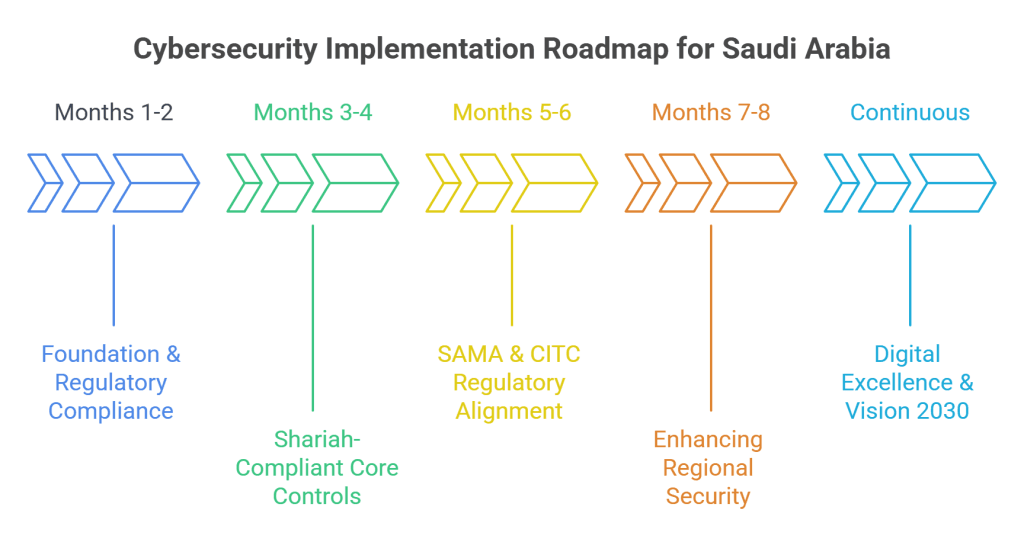
Understanding how to comply with Saudi NCA cybersecurity controls for AI agents is essential for organizations operating in the Kingdom. Every deployed agent should be mapped to the Essential Cybersecurity Controls (ECC) before processing Saudi data, because the National Cybersecurity Authority—the government entity overseeing cybersecurity in Saudi Arabia—treats AI systems as technical assets that inherit existing control obligations. An AI agent that is not mapped to a control framework is, from an assessor’s standpoint, an ungoverned asset with no documented owner, no data-flow boundary, and no audit trail.
A note on scope and accuracy: the precise wording of penalty regimes, classification tiers, and “private-sector” obligations varies by document edition. Rather than restate second-hand penalty figures, this guide points you to the primary NCA documents and quotes them where possible. The NCA’s broader cybersecurity mandate is established on its official site (National Cybersecurity Authority), and the full controls library is the authoritative reference for what actually applies to you (NCA Regulations Documents).
Unsanctioned AI tool usage — commonly called “shadow AI” — has become a leading concern for Saudi enterprises, prompting tighter governance expectations. The Saudi Compliance Institute, a private compliance-advisory publisher (not a government body), frames uncontrolled AI use as a direct data-leakage threat under the emerging 2026 NCA private-sector compliance commentary (Saudi Compliance Institute). Treat its analysis as informed secondary commentary, and verify any specific control claim against the NCA’s own published documents.
To comply, organizations generally complete four steps:
- Inventory every AI agent and classify its data access level.
- Map each agent to the relevant ECC domains, including identity, access, and data protection controls.
- Document human oversight and audit logging for all autonomous actions.
- Review periodically to maintain alignment with current guidance.
The framing many practitioners adopt is simple: an unmapped AI agent is a compliance gap, not a productivity gain. Teams that embed ECC mapping into deployment from day one tend to avoid the more expensive remediation that follows a failed audit or a data-export incident.
How to comply with Saudi NCA cybersecurity controls for AI agents means mapping each AI deployment — chatbots, automation workflows, custom agents — to the NCA’s Essential Cybersecurity Controls (ECC) across access management, data residency, audit logging, and risk governance, then documenting human oversight at every decision point. Compliance is achievable for SMEs, but typically only when AI is governed by design rather than bolted on after launch.
Across many AI deployments the pattern is consistent: teams ship a slick WhatsApp bot first, then scramble on compliance when their first enterprise client demands an ECC attestation. The more reliable approach reverses that order. Below is the practical playbook, grounded in the NCA’s published frameworks.
Quick Summary: NCA AI Compliance at a Glance
- The ECC is the baseline. The NCA’s Essential Cybersecurity Controls define the minimum cybersecurity requirements for organizations operating in Saudi Arabia, and any entity deploying AI agents inherits those obligations. The NCA publishes the full set of controls and policies in its official regulatory library (NCA Regulations Documents).
- Shadow AI is a leading emerging risk in current private-sector commentary — unsanctioned tools like public chatbots can move sensitive data outside Saudi jurisdiction with no audit trail (Saudi Compliance Institute).
- Data residency is non-negotiable — sensitive Saudi data processed by AI must stay within Kingdom borders or NCA-approved environments.
- Audit logging and human oversight are expected for any AI making or influencing business decisions.
- Custom, sanctioned AI agents are generally easier to make ECC-compliant than off-the-shelf SaaS wrappers you cannot inspect.
- SMEs can comply without enterprise budgets by building compliant-by-design from day one.
Published: June 27, 2026 · Last reviewed: June 27, 2026
What are the Saudi NCA cybersecurity controls for AI agents?
The Saudi NCA cybersecurity controls are mandatory frameworks issued by the National Cybersecurity Authority that define minimum security requirements for organizations in the Kingdom. The flagship framework is the Essential Cybersecurity Controls (ECC). For AI agents, these controls govern data handling, access management, residency, logging, and risk governance across the full deployment lifecycle.
The National Cybersecurity Authority is the government entity in charge of cybersecurity in Saudi Arabia, serving as the national authority on the matter (National Cybersecurity Authority). The NCA publishes several stacked documents: the ECC as the baseline, the Implementation Guides for Cybersecurity Controls (IGCC) for practical execution, and sector-specific controls layered on top.
Defining the terms you will meet repeatedly:
- ECC (Essential Cybersecurity Controls): the baseline control framework all in-scope organizations must satisfy.
- IGCC (Implementation Guides for Cybersecurity Controls): the companion guidance the NCA publishes to explain how to operationalize each control (NCA IGCC).
- Data residency: the requirement that specified categories of data be stored and processed within Saudi Arabia or an NCA-approved environment.
- Control mapping: the document linking each applicable control to the specific technical or procedural measure that satisfies it in your deployment.
The ECC is organized around main domains (such as Cybersecurity Governance, Cybersecurity Defence, Cybersecurity Resilience, and Third-Party and Cloud Computing Cybersecurity), each subdivided into subdomains and individual controls expressed in the familiar dotted numbering style (for example, the access-management and event-logging subdomains that any AI agent will touch). Because the NCA periodically revises the ECC, you should download the current edition and read the exact control identifiers yourself rather than trusting any blog’s transcription — including this one (NCA Regulations Documents).
For AI agents, the relevant control intent generally covers:
- Data residency: Sensitive and government data must be stored and processed inside Saudi Arabia or NCA-approved environments.
- Access management: Multi-factor authentication and least-privilege access for the systems an agent can reach.
- Logging and monitoring: Activity logs retained according to the retention requirements in the applicable controls.
- Data handling: AI inputs and outputs aligned with the organization’s data classification and encryption standards.
A note on exact versions: The NCA maintains and updates its control documents over time, and the precise control count and version number depend on the edition you are working against. Rather than relying on a number quoted second-hand, download the current ECC and IGCC PDFs directly from the NCA’s regulatory library and confirm the version and effective date before you build your mapping. The official library is the single authoritative source (NCA Regulations Documents).
Compliance is not optional. NCA controls apply to government entities, critical national infrastructure, and many private-sector organizations. Non-compliance can result in regulatory consequences and lost procurement opportunities. The exact enforcement and sanction language belongs to the official documents — quote it from the source rather than from summaries when you need to cite it formally.
AI agents complicate this picture. A chatbot answering customer questions, an automation workflow moving invoices between systems, or a custom sales agent qualifying leads — each one touches data, integrates with systems, and makes decisions. The NCA does not currently publish a separate “AI rulebook.” Instead, your AI inherits the same control obligations as any other technical asset, plus newer governance expectations around Shadow AI in private-sector commentary.
Private-sector commentary in 2026 specifically highlights Shadow AI risk — unsanctioned AI usage that can leak sensitive data (Saudi Compliance Institute). That shift matters: an employee pasting a customer contract into a public AI tool moves from “bad habit” to a documented governance failure.
Regulativ AI, a compliance-tooling vendor, summarizes the ECC as defining “minimum cybersecurity requirements for organizations in Saudi Arabia” (Regulativ AI) — and “minimum” is the operative word. Treat the ECC as your floor, not your ceiling.
How to comply with Saudi NCA cybersecurity controls for AI agents step by step
Complying with Saudi NCA cybersecurity controls for AI agents follows a repeatable sequence anchored in the ECC: map each control domain to your AI deployment, enforce data residency, implement role-based access and audit logging, govern model behavior with human oversight, and document every decision. Compliance is a continuous process, not a one-time checkbox.
Below is the sequence many practitioners use on Kingdom deployments. Follow it in order — skipping ahead is how teams end up retrofitting security onto a live agent.
- Inventory your AI footprint. List every AI agent, chatbot, and automation workflow in use — sanctioned and shadow. You cannot secure what you cannot see. A typical first inventory surfaces several unsanctioned tools nobody formally approved.
- Classify the data each agent touches. Map inputs and outputs against your data sensitivity tiers. A marketing copy generator and an HR payroll agent carry very different risk.
- Enforce data residency. Confirm that sensitive data stays within Kingdom borders or NCA-approved cloud regions. Self-hosting an orchestration tool such as n8n inside a Saudi-resident environment sidesteps the data-export problem for the workflow layer.
- Apply role-based access control (RBAC). Restrict who can configure, prompt, and retrain agents. Tie every action to an authenticated identity.
- Enable audit logging. Capture every prompt, response, and data access with timestamps. Logs are your evidence during an NCA assessment.
- Insert human oversight gates. Any AI decision with financial, legal, or customer impact needs a human checkpoint. Deterministic logic beats a probabilistic “yes-machine” where a wrong answer carries real cost.
- Document and review. Produce a control mapping document, then review it periodically against updated NCA guidance.
A worked example: mapping a customer-service chatbot to the ECC
To make this concrete, consider a typical SME deployment — an Arabic/English WhatsApp support agent that answers questions and looks up order status. Here is how the steps play out in practice:
- Inventory & classification: The agent reads customer names, phone numbers, and order references — personal data that must be classified accordingly and kept out of any uncontrolled external tool.
- Residency boundary: The conversation orchestration, customer database, and logs sit in a Kingdom-resident environment. If the agent calls an external language model, the design tokenizes or strips identifying fields before the request leaves that boundary.
- Access control: Only two named administrators can edit prompts or change the agent’s tool permissions; each change is attributable to an individual identity with MFA.
- Logging: Every prompt, model response, and database lookup is written to an append-only log with a timestamp, so an assessor can reconstruct exactly what the agent did.
- Human gate: The agent can answer questions and check status, but a refund or account change is routed to a human queue rather than executed autonomously.
That single example touches at least four ECC domains — identity, data protection, logging, and third-party/cloud — which is why a per-agent mapping is more useful than a generic policy statement.
A second worked example: an internal finance automation workflow
Consider a different pattern practitioners encounter: an automation agent that reads incoming supplier invoices from a shared mailbox, extracts line items, and stages them for approval in an accounting system. The trade-offs differ from the chatbot case:
- Data classification skews higher: invoices often contain commercially sensitive pricing and bank details, so the residency and encryption requirements are stricter than for public-facing chat.
- The model-call boundary is the failure point: if invoice text is sent verbatim to a foreign OCR or LLM endpoint, sensitive data leaves the Kingdom. A common mitigation is to run extraction inside the resident environment, or to redact account numbers before any external call.
- The human gate is a hard stop, not a queue: the agent stages a payment but never releases it; release requires an authenticated approver, and that approval event is logged alongside the agent’s extraction.
- Audit reconstruction matters most here: in a finance context an assessor will want to follow a single invoice from arrival to approval, so the log schema should correlate the source document, the agent’s extracted fields, and the human decision.
The honest trade-off in both examples is latency and convenience versus control. Stripping and tokenizing fields, or self-hosting extraction, adds engineering effort and can reduce model quality on edge cases. Teams generally accept that cost because the alternative — an undocumented cross-border data flow discovered during an audit — is far more expensive to unwind.
The Implementation Guides for Cybersecurity Controls (IGCC) published by the NCA give you the granular “how” for each control (NCA IGCC). Read them alongside your control mapping — they translate abstract requirements into concrete configuration steps. For a deeper architectural view, see our guide on custom AI agent architecture.
Which ECC control domains apply most to AI agents?
The ECC control domains most relevant to AI agents are those that govern how agents authenticate, process data, log activity, and rely on external models. Identity and data domains tend to carry the heaviest weight for autonomous systems, because AI agents can take actions and make access decisions without a human reviewing each one.
Below is a practical mapping you can adapt during a compliant AI build. Confirm the exact control identifiers against the current ECC edition in the NCA regulatory library.
| ECC Control Area | What It Means for AI Agents | Practical Implementation |
|---|---|---|
| Identity & Access Management | Who can configure, prompt, or retrain the agent | RBAC, MFA, least-privilege API keys per agent |
| Data Protection | How sensitive data flows through prompts and outputs | Data classification, encryption, PII masking before model calls |
| Cybersecurity Resilience | Agent uptime and recovery after incidents | Failover workflows, backups, deterministic fallback logic |
| Cybersecurity in IT | Secure configuration of the hosting environment | Hardened servers, patched dependencies, network segmentation |
| Third-Party & Cloud | Reliance on external LLM providers and APIs | Vendor due diligence, data processing agreements, residency checks |
| Logging & Monitoring | Traceability of every AI action | Immutable audit logs, anomaly alerts, retention policies |
The Third-Party and Cloud domain trips up the most SMEs. When your chatbot calls a foreign LLM API, sensitive Saudi data may leave the Kingdom in milliseconds. That single integration can violate data residency requirements without anyone noticing until an audit.
The fix is not to abandon powerful models. It is to architect the boundary deliberately — mask or tokenize sensitive fields before they ever hit an external endpoint, and keep raw data inside Kingdom-resident infrastructure. The NCA’s full regulatory document library lists every applicable control set (NCA Regulations Documents). Cross-reference it against your stack before you ship.
Why is Shadow AI the biggest compliance risk for Saudi SMEs?
Shadow AI is a leading compliance risk because employees use unsanctioned AI tools — public chatbots, browser plugins, free image generators — that move sensitive Saudi data outside your control and outside Kingdom jurisdiction. Current 2026 private-sector commentary treats this as a primary data-leakage vector.
Shadow AI refers to any AI tool adopted by staff without IT approval or security review. An accountant drafting a reply in a public chatbot. A marketer feeding the customer list into a free analytics tool. Each action feels harmless and saves ten minutes — but it can export regulated data and create an invisible breach surface.
“Managing Shadow AI risk is now central to private-sector compliance under the new 2026 NCA controls,” argues the Saudi Compliance Institute, a private advisory publisher that frames uncontrolled AI use as a direct threat of data leakage (Saudi Compliance Institute). Because that source is secondary commentary rather than the regulator itself, confirm the underlying obligation in the NCA’s own documents before treating any specific claim as binding.
Here is the balanced view most consultants skip: banning AI outright tends to push usage further underground, while an unmanaged “approve everything” posture re-creates the leakage problem. The pragmatic middle path is sanctioned, governed AI agents that are good enough that employees do not feel the need to reach for the public tools they were sneaking around to use.
- Shadow AI — uncontrolled, unlogged, data may leave the Kingdom, no audit trail, a likely NCA violation.
- Sanctioned custom AI — governed, logged, data-resident, human-supervised, ECC-mapped, and demonstrably compliant.
When a custom WhatsApp or internal agent is built inside the compliance boundary, employees get a faster, sharper tool that is already governed — and approved-tool adoption tends to rise while shadow usage falls. Explore our approach to intelligent chatbot solutions built compliant from the first line of code.
How do you prove compliance during an NCA assessment?
You prove NCA compliance by producing evidence: a documented control mapping, immutable audit logs, data residency confirmations, access control records, and a maintained risk register. Assessors generally want artifacts, not assurances — every claim should be backed by a verifiable record.
The NCA assessment model rewards documentation discipline. An organization that says “our AI is secure” struggles. An organization that hands over a control-by-control mapping, months of audit logs, and a signed data processing agreement is far better positioned. Treat compliance as an evidence-generation exercise from day one.
Core artifacts to maintain:
- Control mapping document — each relevant ECC control linked to a specific technical or procedural measure in your AI deployment.
- Audit log exports — timestamped records of prompts, responses, configuration changes, and data access.
- Data flow diagrams — visual proof of where data lives and travels, confirming residency.
- Access review records — periodic proof that only authorized identities can touch each agent.
- Risk register — identified AI risks, severity ratings, and mitigation status.
- Incident response runbook — what happens when an agent misbehaves or a breach is suspected.
A common audit outcome practitioners describe: the technical controls are present, but the evidence is not. The agent enforces RBAC, yet there is no exported access-review record; logs exist, yet they are mutable and stored without retention guarantees. In those cases the finding is rarely “insecure system” — it is “unable to demonstrate the control,” which is a documentation gap rather than an engineering one. Designing the evidence trail in advance is what turns a tense assessment into a routine one.
Think of audit logs as the flight recorder for your AI. When something goes wrong, the log tells you — and the assessor — exactly what the agent did and when. Without it, you are flying blind through an investigation.
SMEs often assume this level of documentation requires an enterprise security team. It does not. With the right automation, log capture and control mapping happen automatically as the agent runs. Our 90-day AI implementation blueprint bakes evidence generation into the build itself, so compliance documentation becomes a byproduct rather than a scramble.
Actionable Takeaways: Your NCA AI Compliance Checklist
Complying with Saudi NCA cybersecurity controls for AI agents comes down to disciplined execution across several fronts. Use this as your working checklist before any Kingdom deployment.
- ✅ Inventory all AI — sanctioned and shadow. Eliminate or replace unapproved tools.
- ✅ Classify data by sensitivity before letting any agent touch it.
- ✅ Confirm data residency — keep sensitive data inside Kingdom-resident or NCA-approved environments.
- ✅ Enforce RBAC and MFA on every agent configuration interface and API key.
- ✅ Enable immutable audit logging for every prompt, response, and data access event.
- ✅ Insert human oversight gates on any decision with financial, legal, or customer impact.
- ✅ Maintain a control mapping against the current ECC and the IGCC, reviewed regularly.
- ✅ Choose deterministic over probabilistic design wherever a wrong answer carries real cost.
The single highest-leverage move is to build compliant-by-design. Retrofitting security and audit trails onto a live agent is consistently more expensive and slower than designing them in from the start, because the system was never built to produce the evidence an assessor needs. Start with the architecture, not the demo.
Frequently Asked Questions
Do NCA cybersecurity controls apply to small businesses using AI?
Yes, where the business is in scope. The NCA Essential Cybersecurity Controls apply to organizations operating in Saudi Arabia, and 2026 private-sector commentary extends Shadow AI governance expectations to the private sector, including SMEs. Small businesses still need to classify data, enforce residency, and maintain audit logs — though the implementation can be far leaner with the right automation. Always confirm exact applicability and scope against the current documents in the NCA regulatory library.
Can I use ChatGPT or other foreign AI tools and still be NCA compliant?
Only with strict controls. Using foreign AI tools risks exporting sensitive Saudi data outside Kingdom jurisdiction, which can violate data residency requirements. To stay compliant, mask or tokenize sensitive fields before they reach any external model, keep raw data on Kingdom-resident infrastructure, and document the data flow. Many SMEs find self-hosted or sanctioned custom agents simpler to govern.
What is the difference between Shadow AI and sanctioned AI under NCA rules?
Shadow AI is unsanctioned, unlogged AI use that moves data outside your control and breaches NCA expectations. Sanctioned AI is a governed, audited, data-resident agent mapped to ECC controls with human oversight. The Saudi Compliance Institute, a private advisory publisher, describes Shadow AI as a primary leakage risk under the 2026 NCA commentary, which makes sanctioned custom agents the more defensible path.
How long does it take to make an AI agent NCA compliant?
A compliant-by-design AI agent can typically be built in roughly 90 days, including control mapping, residency setup, logging, and documentation. This is a planning estimate, not a guarantee — scope, data sensitivity, and the number of integrations all move the timeline. Retrofitting compliance onto an existing agent usually takes longer, because security and audit trails have to be re-engineered into a system that was not designed for them.
Where can I find the official NCA controls and implementation guides?
The official NCA Essential Cybersecurity Controls, Implementation Guides for Cybersecurity Controls (IGCC), and full regulatory document library are published on the National Cybersecurity Authority website. Start from the NCA homepage or go directly to the IGCC guidelines. Always reference the latest version and confirm the effective date before building your mapping.
The regulatory window is closing fast. Saudi Arabia is moving from “adopt AI quickly” to “adopt AI responsibly” — and the gap between those two stances is exactly where uncompliant deployments get caught. Build your agents inside the compliance boundary now, while it is a competitive advantage, before it becomes the price of entry. The teams that treat NCA compliance as architecture rather than paperwork will be the ones still standing when enforcement tightens.
Sources & References
- National Cybersecurity Authority (NCA) — official site: https://nca.gov.sa/en/
- NCA — Regulations Documents (Controls and Policies): https://nca.gov.sa/en/regulatory-documents/?documentType=controls-list
- NCA — Implementation Guides for Cybersecurity Controls (IGCC): https://nca.gov.sa/en/regulatory-documents/guidelines-list/igcc/
- Saudi Compliance Institute (private advisory publisher) — Managing Shadow AI Risk Under the New 2026 NCA Controls: Read the analysis
- Regulativ AI (compliance-tooling vendor) — Regulations overview (NCA ECC summary): https://www.regulativ.ai/regulations
Methodology & transparency note: This guide summarizes publicly available NCA frameworks and reputable secondary commentary listed above. The NCA documents (cited via nca.gov.sa) are primary regulatory sources; the Saudi Compliance Institute and Regulativ AI are private third parties whose summaries should be cross-checked against the NCA originals. Exact ECC control counts, version numbers, retention periods, classification tiers, and penalty details vary by document edition and should be verified against the current PDFs in the official NCA regulatory library before you rely on them. Tracking parameters have been removed from external links where present. Where this article describes implementation patterns, they are presented as common practitioner approaches and worked illustrations, not first-party project claims and not legal advice. Consult a qualified compliance professional for your specific obligations.
Last updated: 2026-06-27