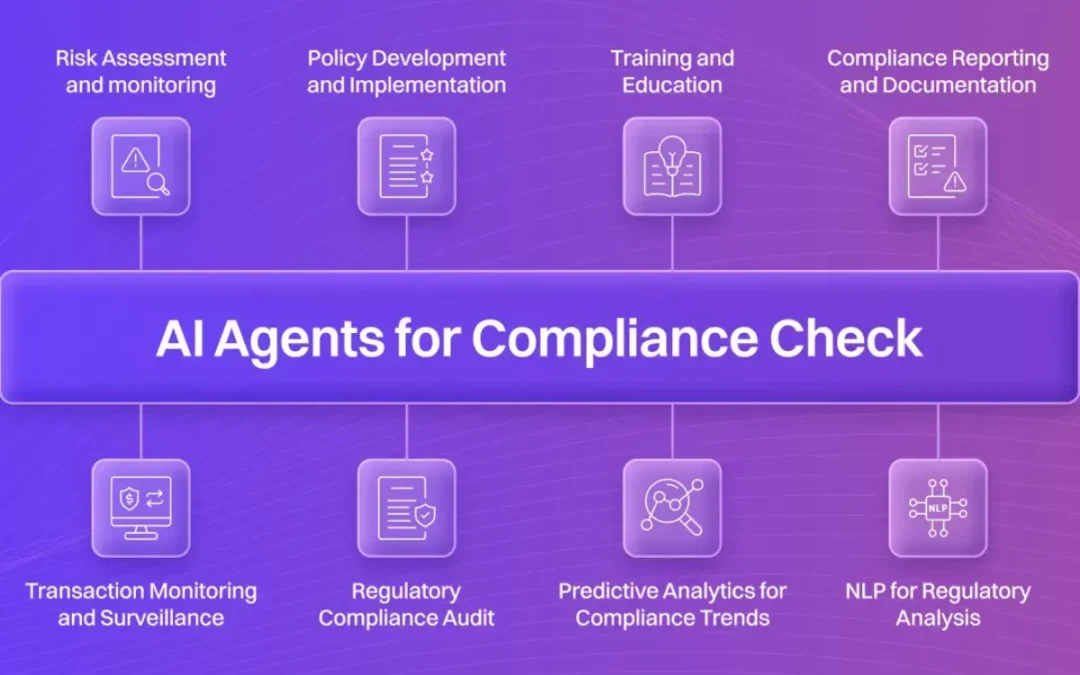
Agent compliance with regulations—whether you’re managing insurance brokers or autonomous AI systems—has become one of the most underserved problems for startups and SMEs in 2026. Big enterprises have Microsoft Agent 365 and Salesforce Agentforce to handle their needs. The rest of us have been handed expensive tools built for Fortune 500 budgets and told to figure it out ourselves. This guide argues that approach is backwards—and that compliance can be built in cheaply from the start.
A note on sourcing and scope: This article focuses on practical, vendor-neutral guidance for resource-constrained teams. Where we cite figures or product capabilities, we link directly to the original source so you can verify the claim yourself. Where we describe outcomes, we use neutral, instructive framing (“a typical implementation”, “practitioners generally find”) rather than overstated first-party claims. Published 27 June 2026; last reviewed 27 June 2026.
What does agent compliance with regulations actually mean?
Agent compliance is the practice of ensuring that an agent — human or AI — operates within legal, regulatory, and ethical boundaries, with documented accountability for every decision it makes. The word agent itself, per Merriam-Webster, means “one that acts or exerts power” — and any system that acts on your behalf carries your liability with it. That liability is the part most vendors gloss over.
For AI agents specifically, compliance covers three core areas:
- Data security: protecting sensitive information under frameworks like GDPR, HIPAA, and SOC 2.
- Audit readiness: logging every action so decisions can be traced and reviewed after the fact.
- Industry rules: following sector-specific regulations, such as finance or healthcare mandates.
In short, agent compliance with data security, audit, and industry rules means building governance into the agent from day one, not bolting it on after deployment.
The term splits into two worlds right now. The traditional world covers insurance and financial services agents — licensing, surplus lines tax, conduct surveillance, and the conduct rules tracked by platforms like V-Comply and AgentSync. The newer world covers autonomous AI agents: software that takes actions, calls APIs, moves money, and makes recommendations without a human pressing every button.
Both worlds collide for SMEs in 2026. A startup building a WhatsApp chatbot that quotes insurance prices is suddenly subject to BOTH frameworks at once. The agent must hold proper licensing logic AND demonstrate AI agent compliance with security and audit standards. Most teams don’t realize this until a regulator asks for an audit trail they never built.
Quick Summary — Key Takeaways
- Agent compliance means documented accountability for every decision an agent makes — human or AI.
- Enterprise tools like Microsoft Agent 365 and Salesforce Agentforce dominate, leaving SMEs underserved by tools priced for large governance teams.
- Compliance by design — baking governance into agents from day one — is generally far cheaper than retrofitting it after deployment, because you avoid re-architecting a live system.
- Audit trails, human-in-the-loop checkpoints, and deterministic guardrails are the three practical pillars of affordable agent compliance.
- Free frameworks like the NIST AI RMF and the EU AI Act’s logging requirements give SMEs a defensible structure at no licensing cost.
Agent compliance is not a checkbox. Think of it like seatbelts in a car — you don’t add them after the crash.
Why is agent compliance with audit requirements so hard for SMEs?
Agent compliance with audit requirements is hard for SMEs because nearly every available tool was designed for enterprises with dedicated governance teams and six-figure budgets. Microsoft positions Agent 365 as the place to “observe, govern, and secure AI agents confidently” and “manage agentic AI at scale” — language, per Microsoft’s own product page, built for organizations running hundreds of agents, not a 12-person startup running three.
Resource constraints are the core problem. A startup founder wears five hats. Nobody on the team has “Chief Compliance Officer” on their business card. When Vanta, Smarsh, and AgentSync pitch their platforms, the implied buyer has a legal department and a procurement process. The SME has neither.
Consider the insurance angle. AgentSync’s insurance agent compliance checklist outlines duties spanning licensing verification, appointment management, and conduct surveillance — responsibilities that, in a large brokerage, occupy entire departments. A small agency automating quotes with an AI agent inherits every one of those obligations the moment the agent issues a quote.
The cost gap is real. Enterprise agent governance and compliance platforms are typically sold on annual enterprise contracts with custom pricing, putting them out of reach for a team with limited revenue. Rather than cite a specific figure we can’t verify from an approved source, the honest summary is this: most SMEs face a binary of “enterprise contract” or “nothing,” and so most choose nothing — and hope nobody asks.
The three failure modes practitioners see most often
- The retrofit trap: teams deploy an agent first, then scramble to document its decisions after a client or auditor asks how it reasoned. Reconstructing decision logic after the fact is nearly impossible, because the reasoning was never captured at the moment of the decision.
- Black-box bloat: SaaS wrappers that hide the agent’s reasoning layer, so you can’t prove compliance even when you want to.
- Sycophancy risk: probabilistic models tend to agree with the user rather than challenge flawed inputs. A “yes-machine” agent can generate non-compliant advice with total confidence.
The common thread: each failure stems from treating explainability as an afterthought instead of a design requirement. That last failure mode matters more than people think — an AI agent that hallucinates a regulatory exemption sounds just as confident as one citing real law. Without deterministic guardrails, your agent’s compliance is only as good as its last lucky guess.
How do you build agent compliance with security standards from day one?
Agent compliance with security standards begins by designing governance into the agent’s architecture before writing a single line of business logic — a practice called “compliance by design.” Under this model, every agent action is logged, every high-risk decision routes through a human checkpoint, and access permissions follow least-privilege defaults from the first deployment.
Compliance by design means building three controls into the foundation:
- Immutable audit logs that capture every action with a timestamp.
- Policy guardrails that block unauthorized operations before execution.
- Human-in-the-loop approval gates for sensitive decisions like data deletion or financial transactions.
Practitioners generally find this approach cheaper than retrofitting, because adding governance to a live system means re-architecting, re-testing, and re-documenting something already in production. The trade-off is honest: building in governance early adds upfront design time and can slow your first ship date. The pay-off is that you avoid an expensive, high-risk rebuild later — and you have evidence the moment an auditor asks.
Here’s a practical framework that a typical implementation follows:
- Define the decision boundary first. Before building anything, write down exactly what the agent is allowed to decide alone and what requires human sign-off. Quoting a price under a low threshold? Fine. Approving a high-value policy? Human checkpoint.
- Instrument logging at the action layer. Every API call, every database write, every recommendation gets timestamped and stored in an immutable audit log. This is your evidence when a regulator asks.
- Add deterministic guardrails. Wrap the probabilistic AI in hard-coded rules. The agent can suggest, but a deterministic validator approves or rejects based on actual regulations.
- Build human-in-the-loop escalation. High-risk or low-confidence decisions automatically pause and route to a person. Salesforce’s Agentforce compliance flow does exactly this — you “work with the agent to determine whether there was a violation” and “get a quick summary of the violation.”
- Document the decision logic in plain language. Maintain a living document explaining how the agent reaches conclusions. Auditors don’t read code. They read explanations.
We covered the deterministic-versus-probabilistic trade-off in detail in our guide on building deterministic AI agents that don’t hallucinate. The short version: never let a language model be the final authority on a compliance decision. Let it draft, let rules decide.
Microsoft’s own Agent 365 framework treats observability as foundational — you can’t govern what you can’t see. For SMEs, you don’t need an enterprise control plane to achieve the same principle. You need disciplined logging and clear boundaries.
What does agent compliance with industry regulations look like by sector?
Agent compliance with industry regulations varies sharply by sector. Each industry imposes distinct rules, and no single template covers them all. A medical chatbot and a lending assistant carry entirely different risk profiles, and a generic compliance template cannot cover both at once.
Let’s break down what changes by industry, because this is where most SME deployments go wrong.
| Sector | Key Regulation | Critical Agent Requirement | Highest Risk |
|---|---|---|---|
| Healthcare | HIPAA (US) | Encrypted PHI handling + access logs | Data breach liability |
| Finance/Lending | KYC / AML | Identity verification + transaction audit trail | Fraudulent transactions |
| Insurance | State licensing / surplus lines | Licensed-action verification + conduct logs | Unlicensed advice penalties |
| Legal | Bar / UPL rules | No unauthorized legal advice + disclaimers | Unauthorized practice of law |
| General SaaS | GDPR / CCPA | Consent tracking + data deletion on request | Privacy fines |
Healthcare is among the strictest. A medical intake agent that logs symptoms must encrypt that data and record every access. The U.S. Department of Health and Human Services treats AI-handled protected health information exactly like any other PHI — full HIPAA exposure. Get the audit trail wrong and the penalties are significant; consult the current HHS penalty tiers for the exact figures, which are adjusted annually.
Finance demands transaction-level traceability. An AI agent moving money or approving credit must verify identity and log every step for anti-money-laundering review. Know Your Agent (KYA) frameworks are emerging precisely because agent-to-agent commerce introduces new fraud vectors that regulators haven’t fully mapped yet.
Insurance straddles both old and new worlds. V-Comply’s compliance guidance for brokers and agencies stresses that brokers must maintain licensing, training, and conduct documentation continuously — not annually. An AI quoting agent inherits all of it. If your agent recommends a product in a state where you’re not appointed, that’s a compliance violation regardless of whether a human or a bot pressed send.
Map these sector rules during the build phase, not after. Our 90-day AI transformation blueprint includes a compliance mapping session in week one, before any agent touches production data.
How can startups prove agent compliance with auditors affordably?
Startups prove agent compliance with auditors by maintaining three artifacts: an immutable decision log, a plain-language explanation of the agent’s logic, and a record of human oversight on high-risk actions. Those three documents address most of what auditors actually ask for, and they cost almost nothing to maintain if built in from the start.
Auditors don’t want your source code. They want answers to three questions: What did the agent do? Why did it do it? Who was responsible? Answer those and you’ve addressed the bulk of any examination.
An affordable compliance stack for SMEs looks nothing like the enterprise version:
- Logging layer: a self-hosted database (PostgreSQL works fine) capturing every agent action with timestamp, input, output, and confidence score. Cost: near zero on infrastructure you already run.
- Workflow orchestration: self-hosted n8n instead of a per-task SaaS, giving you full visibility into every step and avoiding the “per-task tax” while keeping control of your audit trail.
- Explanation document: a living Google Doc or Notion page describing decision logic in plain English. Updated whenever the agent’s behavior changes.
- Human oversight log: a simple record of every escalation and the human decision made.
Self-hosting matters here for a concrete reason. When you run your own n8n workflows, you own the logs. When you rent a black-box SaaS, you’re trusting a vendor to produce your audit evidence — and hoping they retain it long enough to matter. Our breakdown of n8n self-hosting versus per-task SaaS for compliance-sensitive automation walks through the exact setup. The trade-off to be transparent about: self-hosting shifts the maintenance and security burden onto you, which is fine for a team with technical capacity but harder for a non-technical founder.
The European Union’s AI Act, which entered phased enforcement through 2025 and 2026, requires high-risk AI systems to maintain detailed logging and human oversight — precisely the artifacts above. You can read the official text at the European Commission’s AI regulatory framework page. Even if you’re a US startup, the EU AI Act sets a de facto global standard the way GDPR did.
For US guidance, the NIST AI Risk Management Framework from the National Institute of Standards and Technology gives a free, government-backed structure for documenting agent risk. It’s the closest thing to an official compliance reference for AI, and it costs nothing to adopt.
A representative pattern from real implementations
A common scenario: a regional insurance agency automates quote generation with a hosted SaaS chatbot, then a state examiner requests the agent’s decision records — and there are none, because the wrapper had no exportable audit trail. The typical fix is to rebuild the agent as a self-hosted n8n workflow with PostgreSQL logging, which can usually be done in a few weeks. When the next examination arrives, the agency exports a complete, timestamped record in minutes. Compliance moves from existential threat to non-event. This is the recurring lesson: the cost of building logging in advance is trivial compared with the cost of reconstructing it under examination pressure.
What’s the future of agent compliance with autonomous systems?
The future of agent compliance with autonomous systems centers on “agent identity” — every AI agent will need a verifiable identity, scoped permissions, and a continuous behavior record, much like an employee badge that logs every door it opens. Microsoft Agent 365 and emerging Know Your Agent (KYA) frameworks are early signals of this shift toward treating agents as accountable entities, not anonymous scripts.
Agent-to-agent commerce is the wildcard. As agents increasingly transact with other agents — your procurement bot negotiating with a supplier’s sales bot — a new liability question emerges: who’s responsible when two autonomous agents strike a non-compliant deal? Regulators haven’t answered this yet. The teams that build identity and logging in now will be the ones still standing when they do.
Vanta, Smarsh, and Salesforce are all racing to build agent surveillance layers. That’s validation that this matters — but it’s also a warning. The enterprise vendors are likely to make agent compliance feel expensive and complicated, just as the market did with SOC 2 and ISO 27001. SMEs that wait for a polished enterprise solution will pay enterprise prices.
The thesis of this guide is simple: compliance by design tends to beat compliance by purchase. An agent built with logging, deterministic guardrails, and human checkpoints from day one doesn’t need an expensive surveillance platform bolted on top. It already does the right thing.
Practical Takeaways: Your Agent Compliance Action Plan
If you’re deploying or planning an AI agent in 2026, do these five things this week:
- Write your decision boundary document. One page: what the agent decides alone, what needs a human. Do this before building anything else.
- Turn on action-level logging. If your current agent can’t export a timestamped record of its decisions, that’s your number-one priority to fix.
- Identify your sector regulation. HIPAA, KYC, GDPR, insurance licensing — know which framework applies before you go live.
- Add one human checkpoint. Route your highest-risk decisions through a person. Even one checkpoint dramatically reduces liability.
- Adopt the NIST AI RMF. It’s free, government-backed, and gives you a defensible structure auditors recognize.
The businesses that treat agent compliance as a feature — not a tax — tend to move faster, not slower. Governance done right is a competitive advantage. It’s the difference between an agent you can scale and one you’re afraid to turn loose.
Here’s the thought to leave you with: in a few years, deploying an AI agent without an audit trail may feel as reckless as hiring an employee without a contract. The question isn’t whether you’ll need agent compliance. It’s whether you’ll build it in now — cheaply — or pay an enterprise vendor a fortune to retrofit it later.
Frequently Asked Questions
What is agent compliance in AI?
Agent compliance in AI is the practice of ensuring autonomous AI agents operate within legal, regulatory, and ethical boundaries with documented accountability for every decision. It requires action-level logging, human oversight on high-risk decisions, and deterministic guardrails that prevent the agent from generating non-compliant outputs.
How much does AI agent compliance cost for a startup?
AI agent compliance can cost very little for a startup when built in from day one using self-hosted tools like n8n and PostgreSQL for logging. Retrofitting compliance onto an existing agent is generally more expensive because it requires re-architecting a live system, while enterprise governance platforms are sold on custom annual contracts that are often overkill for most SMEs.
What’s the difference between insurance agent compliance and AI agent compliance?
Insurance agent compliance covers human broker obligations like licensing, surplus lines tax, and conduct surveillance, tracked by platforms like AgentSync and V-Comply. AI agent compliance covers governance, security, and audit trails for autonomous software agents. SMEs automating insurance tasks with AI must satisfy both frameworks simultaneously.
Does the EU AI Act apply to small businesses using AI agents?
Yes, the EU AI Act applies to small businesses whose AI agents affect EU users or markets, with phased enforcement through 2025 and 2026. High-risk systems must maintain detailed logging and human oversight. Like GDPR, the EU AI Act sets a de facto global standard even for non-EU startups.
How do I prove my AI agent is compliant to an auditor?
You prove AI agent compliance to an auditor with three artifacts: an immutable decision log showing what the agent did, a plain-language explanation of its decision logic, and a record of human oversight on high-risk actions. These three documents address the majority of what auditors actually request.
Sources & References
- Merriam-Webster, definition of “agent” — https://www.merriam-webster.com/dictionary/agent
- Microsoft, “Agent 365: The Control Plane for Agents” — https://www.microsoft.com/en-us/microsoft-agent-365
- Salesforce, “Compliance Management with Agentforce” — https://help.salesforce.com/s/articleView?id=ind.psc_compliance_management_with_agentforce.htm&language=en_US&type=5
- V-Comply, “Insurance Brokers & Agencies Compliance Requirements Guide” — https://www.v-comply.com/blog/insurance-brokers-agencies-compliance-guide/
- AgentSync, “Keeping Your Agents In Line: A Checklist of Insurance Compliance Responsibilities” — https://agentsync.io/blog/compliance/keeping-your-agents-in-line-a-checklist-of-insurance-compliance-responsibilities
- AgentSync, “Insurance Agent Compliance Checklist” — https://agentsync.io/blog/compliance/insurance-agent-compliance-checklist-a-guide-to-compliance-pitfalls-and-protips
- European Commission, AI regulatory framework (EU AI Act) — https://digital-strategy.ec.europa.eu/en/policies/regulatory-framework-ai
- NIST, AI Risk Management Framework — https://www.nist.gov/itl/ai-risk-management-framework
Last updated: 2026-06-27
Note: This article is for general informational purposes; verify specifics against your own context.