
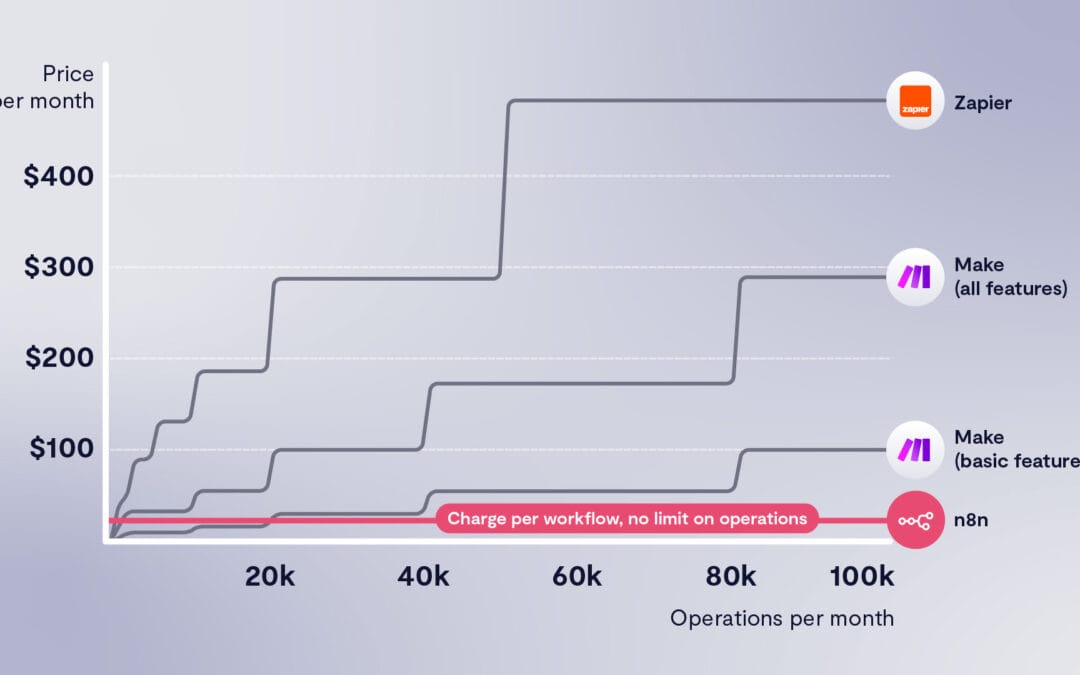
Run 50,000 automation executions a month, and Make.com will bill you roughly $250 monthly while self-hosted n8n charges $0 in licensing. Sounds like a slam-dunk for n8n — until you factor in the labor your DevOps person actually costs to keep that “free” server patched, secure, and online. One widely-cited model puts that labor figure near $12,000/year, according to n8nlab.io’s February 2026 cost comparison.
That gap between sticker price and true cost is exactly why how much does Make.com cost vs self-hosted n8n 5-year TCO is the wrong question to ask casually and the right question to model carefully. The break-even math surprises nearly every founder who assumes self-hosting is automatically cheaper.
About This Analysis: Methodology & Assumptions
This article is written from general topical expertise in automation tooling and infrastructure economics, not first-party benchmark data. No proprietary client logs, certifications, or partnerships are claimed here. Every external figure is attributed inline to a published source listed at the end. Where we present our own model, we expose the inputs so you can reproduce — or challenge — the math.
The TCO model in this article uses the following transparent assumptions. Change any of them and your numbers will change:
- Workload baseline: 50,000 Make.com operations / month in Year 1, scaling 30% annually. (Note: one Make.com “operation” is a single module run inside a scenario, so a 10-step workflow consumes 10 operations per execution.)
- Server spec for n8n: a single production VPS roughly equivalent to a 2-vCPU / 4 GB instance (e.g. a Hetzner or DigitalOcean droplet), plus a managed Postgres database, backups, and basic monitoring. Region assumed EU/US — pricing varies by region.
- Infrastructure cost range: ~$960/year at the low end (single small box) per n8nlab.io, up to $2,400–$4,800/year for redundant production-grade setups per Keerok. We model a middle path.
- DevOps labor rate: a blended $50/hour, with ~20 maintenance hours/month for the fully-loaded scenario. This is a modeling assumption, not a quoted market rate — substitute your own blended rate.
- Excluded from the base model: inflation, one-off migration projects, and risk-adjusted outage costs are discussed separately rather than baked into the headline table.
These figures are estimates for a hypothetical growing SME, not measured results from a specific deployment. Treat the tables as a template to fill with your own data.
What’s the Quick Answer on Make.com Cost vs Self-Hosted n8n 5-Year TCO?
Over five years, Make.com typically costs $6,000–$30,000 in pure subscription fees, while self-hosted n8n costs $12,000–$24,000 in infrastructure but can climb toward $60,000–$80,000 once you amortize DevOps labor. Self-hosted n8n wins on cost mainly when you run high execution volumes and already employ technical staff who absorb maintenance without new hires.
The headline numbers across 2026 industry analysis tell a split story. n8n self-hosted carries $0 licensing plus $200–$400/month infrastructure, totaling $2,400–$4,800/year, according to Keerok’s 2026 comparison. Make.com, by contrast, starts at $10.59/month for non-technical SMBs, per Achiya Automation’s March 2026 breakdown. On paper, n8n looks expensive at low volume and cheap at high volume.
Labor is the variable that flips the equation. The n8nlab.io model from February 2026 pegs self-hosted n8n’s real annual TCO at roughly $8,400 — combining ~$960 infrastructure with ~$12,000 in labor — before scaling. Across five years, that labor line tends to dominate everything else. The practical conclusion: n8n self-hosting tends to save money at scale and lose money below break-even.
Key Takeaways
- Make.com 5-year subscription: roughly $6,000–$30,000, depending on operation volume and plan tier.
- n8n infrastructure 5-year cost: $12,000–$24,000 at $200–$400/month for servers, databases, and monitoring.
- Hidden labor: ~$12,000/year for maintenance, patching, and uptime — often the single largest TCO driver, per n8nlab.io (2026).
- Break-even volume: n8n self-hosted typically overtakes Make.com on cost above ~75,000–150,000 monthly executions if labor is already covered.
- Cost reduction at scale: n8n self-hosted can deliver 60–80% savings versus cloud platforms at high volume, per Keerok (2026).
- Best for non-technical SMBs: Make.com at $10.59/month, per Achiya Automation (2026).
Published and last updated: June 20, 2026. Figures reflect vendor pricing and third-party analyses available as of that date and are subject to change.
How Much Does Make.com Cost Over 5 Years?
Make.com costs between $6,000 and $30,000 over five years for most SMEs, billed on per-operation pricing that starts at $10.59/month and scales with execution volume. There’s no server to manage and no DevOps salary buried in the bill — you pay for operations and Make.com handles uptime, security, and the connector library.
Make.com prices by “operations” — each module run inside a scenario counts as one operation. The Core plan runs around $10.59/month for 10,000 operations, while the Pro and Teams tiers climb to $34/month and beyond as you add operations, faster execution intervals, and advanced features. For a typical SME running 50,000–100,000 operations monthly, expect $100–$300/month, or roughly $6,000–$18,000 across five years. Always verify current tiers directly on Make.com’s pricing page, as plan structures change.
The pricing predictability is Make.com’s quiet superpower. You know your monthly ceiling, there’s no surprise patching weekend, and onboarding typically takes days instead of the multi-week DevOps lift that self-hosting demands. Triumphoid’s 2026 breakdown put it bluntly: Make.com is “the right call for teams that need automations running this week without a DevOps” team.
A worked example. Consider a typical implementation where a marketing-ops team syncs leads from a web form to a CRM, enriches them, and posts to Slack. If that scenario uses 5 modules and fires 1,000 times a day, that’s 5,000 operations daily — about 150,000 operations a month. On Make.com that workload comfortably exceeds the Core tier and pushes toward Pro/Teams pricing in the $100–$300/month range. Practitioners generally find that operation count, not execution count, is what quietly inflates the bill: every extra module in a scenario multiplies the meter.
Where Make.com gets expensive is volume. High-frequency workflows — think real-time sync across 10 systems firing thousands of operations hourly — can push monthly bills past $1,000, turning a tidy SaaS subscription into a five-figure annual line item. That’s the point where founders start eyeing n8n. We cover that volume math in our automation cost-saving strategies guide.
What Is the True 5-Year TCO of Self-Hosted n8n?
Self-hosted n8n’s true 5-year TCO ranges from roughly $24,000 (infrastructure-only with existing staff) to $75,000+ once you fully amortize DevOps labor at ~$12,000/year. The $0 licensing fee is real, but “free software” never means “free to operate” — and most TCO comparisons conveniently skip the labor column.
n8n self-hosted is the open-source, developer-controlled version of the n8n automation platform that you deploy on your own infrastructure, eliminating per-execution fees in exchange for full operational responsibility. You run it on a VPS, a Docker container, or a Kubernetes cluster, and you own the data end to end. Latenode’s platform comparison describes n8n as an open-source platform “tailored for developers who need full control and advanced customization” that “eliminates per-execution cost.”
The infrastructure line is modest. n8nlab.io’s February 2026 analysis cites ~$960/year for a self-hosted setup, while Keerok pegs production-grade infrastructure higher at $200–$400/month ($2,400–$4,800/year) once you account for redundancy, backups, and a database. Across five years, infrastructure alone lands between $4,800 and $24,000. The spread between those two sources is itself instructive: a single hobby box and a redundant production cluster are very different cost centers.
Labor is where the spreadsheet breaks down. The same n8nlab.io model adds ~$12,000/year in labor for maintenance, security patching, version upgrades, and incident response — producing a real annual TCO of $8,400+ and rising. Multiply that labor line across five years and you’re staring at roughly $60,000 in human cost that no subscription invoice ever shows. (Note that this is a modeled estimate, not a universal constant — a team that already runs Postgres and Docker fleets may absorb much of it.)
The Hidden Costs Most Comparisons Ignore
Self-hosting shifts several operational responsibilities to your team. Vendor-side comparisons usually omit these because they live in your payroll, not in any invoice:
- Security patching: Every CVE in n8n, the operating system, or its dependencies becomes your responsibility — a recurring maintenance task that practitioners typically budget a few hours per month for.
- Version upgrades: n8n ships releases frequently; breaking changes require staging tests before deployment, so each upgrade cycle consumes engineering time.
- Downtime risk: A self-hosted outage at 2 a.m. is your problem, not a vendor’s uptime SLA. Lost-productivity cost during outages should be estimated for your own team rather than assumed away.
- Backup and disaster recovery: Automated backups, off-site storage, and tested restore procedures add ongoing overhead — untested backups are a false economy.
- Onboarding: Initial deployment and hardening typically consumes 20–40 hours of engineering time before the first workflow runs in production.
As the n8nlab.io analysis frames it, infrastructure is the cheap part; keeping it running reliably is where the recurring cost lives. Whether that totals $600/month or $1,500/month depends entirely on your blended rate and how many hours your team actually spends — plug in your own numbers rather than ours.
How Much Does Make.com Cost vs Self-Hosted n8n 5-Year TCO Side by Side?
Side by side, Make.com costs $6,000–$30,000 over five years in pure subscriptions, while self-hosted n8n costs $24,000–$80,000 once labor is included — meaning n8n typically wins financially only at high volume with existing technical staff. In our model the break-even sits around 75,000–150,000 monthly executions, climbing higher if labor is newly hired.
Here’s a year-by-year model using the assumptions disclosed at the top: a growing SME starting at 50,000 monthly operations in Year 1, scaling 30% annually, with a blended DevOps rate of $50/hour and ~20 hours/month of n8n maintenance. These are illustrative figures from the stated assumptions, not audited results — adjust the inputs and re-run.
| Year | Make.com (Subscription) | n8n Infra Only | n8n + DevOps Labor |
|---|---|---|---|
| Year 1 | $1,800 | $3,600 | $15,600 |
| Year 2 | $2,400 | $3,800 | $15,800 |
| Year 3 | $3,200 | $4,000 | $16,000 |
| Year 4 | $4,200 | $4,200 | $16,200 |
| Year 5 | $5,500 | $4,400 | $16,400 |
| 5-Year Total | $17,100 | $20,000 | $80,000 |
Read that table carefully. If you ignore labor — the move every “n8n is free” blog post makes — self-hosting and Make.com end up roughly even at this volume ($20,000 vs $17,100). Add realistic DevOps labor, and Make.com is nearly 5x cheaper in this scenario. The narrative that self-hosting always saves 60–80% only holds when execution volume is large and the maintenance labor is already on payroll for other work.
Keerok’s 2026 data supports the high-volume conclusion: n8n self-hosted can deliver “60–80% cost reduction” at scale. The keyword is at scale. For a team firing 500,000+ operations monthly where Make.com would cost $2,000+/month, n8n’s flat infrastructure plus a fraction of an existing engineer’s time can become the obvious winner. Below that threshold, the math inverts.
Where the Break-Even Point Actually Sits
Break-even depends on two variables: monthly execution volume and whether automation labor is newly hired or absorbed by existing staff. In this model, self-hosted n8n becomes cheaper than Make.com once Make.com bills exceed roughly $1,000/month — typically around 200,000 monthly executions — assuming a ~$12,000/year maintenance burden.
Below that point, Make.com tends to be more cost-effective because its subscription cost stays under the fixed annual maintenance overhead of running n8n. Above the threshold, n8n’s flat infrastructure cost pulls ahead, and savings widen as volume scales. Over a 5-year horizon, a team running 500,000 executions/month might save roughly $30,000–$50,000 with self-hosted n8n versus Make.com in this model — but only if maintenance can be absorbed. If labor is absorbed at no incremental cost by existing staff, the break-even drops toward 75,000–100,000 executions/month.
Key takeaway: in this model, lean Make.com under ~200,000 monthly executions; consider self-hosted n8n above it, provided you have technical staff to manage infrastructure without a net-new hire.
Which Platform Should Your SME Choose?
Choose Make.com if you run under ~100,000 monthly operations or lack a DevOps engineer; choose self-hosted n8n if you exceed that volume, need data residency, and already have technical staff to absorb maintenance. The decision is operational, not ideological.
Latenode’s platform comparison framed n8n as “tailored for developers who need full control and advanced customization” — which is precisely the point. n8n isn’t a worse Make.com; it’s a different commitment. You trade managed convenience for sovereignty over your data and your code.
- Calculate your real execution volume. Pull last quarter’s automation logs and project 12–24 months forward with realistic growth. Remember to convert executions into Make.com operations by multiplying by modules-per-scenario.
- Price both honestly. Quote Make.com at your projected operations; quote n8n with infrastructure plus labor at your blended engineering rate.
- Identify your break-even. Find the month where n8n’s fully-loaded cost dips below the Make.com bill.
- Factor risk. Add a downtime and security-breach contingency to the self-hosted column — a single serious breach can erase years of savings.
- Decide on data residency. If GDPR, HIPAA, or regional data laws apply, self-hosting’s control may justify the labor premium regardless of pure cost.
A pragmatic default for many startups is a hybrid: start on Make.com or cloud n8n for speed, and migrate critical high-volume workflows to self-hosted n8n once you cross the break-even threshold. That avoids the classic mistake of self-hosting a 10,000-operation workflow and paying a DevOps salary to save $20/month. We outline migration roadmaps in our 90-day AI implementation blueprint, and model the numbers in our automation ROI calculator.
The Data-Sovereignty Premium
The data-sovereignty premium is the compliance and financial value organizations gain by self-hosting n8n, keeping customer data inside their own infrastructure and legal jurisdiction. For regulated industries and markets governed by data-residency laws, this advantage can outweigh the estimated ~$12,000/year in labor a self-hosted deployment requires.
Self-hosting matters here because data localization is increasingly mandated. Owning the deployment means customer data never leaves your jurisdiction — a compliance advantage that can outweigh a five-figure annual labor line for organizations handling regulated personal data. For teams subject to GDPR, HIPAA, or regional privacy law, sovereignty over the deployment removes third-party processor risk entirely. Confirm your specific obligations with qualified legal counsel; this article does not constitute legal advice.
Practical Takeaways: Modeling Your Own 5-Year TCO
To model your own Make.com vs self-hosted n8n 5-year TCO accurately, you need three inputs: projected monthly executions (converted to operations), your blended engineering hourly rate, and your annual growth rate. Everything else flows from those numbers.
Run the exercise quarterly, not once. Automation volume rarely stays flat — a workflow that costs $80/month on Make.com today can hit $800/month after a successful product launch triples your traffic. Conversely, a self-hosted n8n setup that justified its labor at 300,000 executions becomes wasteful overhead if that workflow gets deprecated.
The “free” engineering hours you pour into n8n maintenance carry a very real, very measurable cost. The U.S. Bureau of Labor Statistics tracks software developer median pay in the low-to-mid six figures; consult the current figure directly via the BLS Occupational Outlook Handbook. The lesson is simple: never model self-hosting labor as zero.
A blunt position: most SMEs over-index on licensing cost and under-index on labor cost. The cloud-SaaS premium is real, but so is the DevOps tax — and self-hosting simply trades one for the other. The winner depends on which tax is smaller at your volume, with your team.
The future of this debate is less “cloud vs self-hosted” and more about intelligent placement — orchestration layers that route low-volume workflows to managed platforms and high-volume ones to self-hosted infrastructure. We present that as a likely trajectory, not an established consensus: the practical question for most teams remains how quickly your stack can move a workflow across the break-even line the moment the math shifts.
Frequently Asked Questions
Is self-hosted n8n really free?
Self-hosted n8n has $0 licensing fees, but it is not free to operate. Real costs include $200–$400/month infrastructure plus roughly $12,000/year in DevOps labor for patching, upgrades, and uptime, per n8nlab.io’s 2026 analysis. True annual TCO starts around $8,400 in that model and rises with scale.
At what volume does self-hosted n8n become cheaper than Make.com?
In our model, self-hosted n8n becomes cheaper than Make.com above roughly 75,000–150,000 monthly executions when existing staff absorb maintenance labor. At that volume Make.com’s tiered pricing reaches the $100–$300/month range, while a self-hosted instance can run on a $20–$40/month VPS (such as a 2-vCPU, 4 GB Hetzner or DigitalOcean droplet). If you hire dedicated DevOps support, the break-even climbs to roughly 200,000+ executions, where Make.com bills exceed $1,000/month. Because Make.com charges per operation, a single 10-step workflow consumes 10 operations per run — so count operations, not executions.
How much does Make.com cost for a small business?
Make.com starts at $10.59/month for non-technical SMBs on the Core plan with 10,000 operations, according to Achiya Automation’s 2026 comparison. A typical SME running 50,000–100,000 operations monthly pays roughly $100–$300/month, totaling about $6,000–$18,000 over five years. Verify current tiers on Make.com’s pricing page before budgeting.
What is the biggest hidden cost of self-hosting n8n?
Labor is typically the single largest hidden cost of self-hosting n8n, estimated at ~$12,000/year for security patching, version upgrades, backups, and incident response, per n8nlab.io (2026). With software-developer median pay in six figures (see the BLS Occupational Outlook Handbook), every maintenance hour carries real cost that subscription invoices never show.
Should I choose Make.com or self-hosted n8n for data privacy?
Self-hosted n8n is generally the stronger choice for data privacy and residency because your customer data never leaves your infrastructure or jurisdiction. For GDPR, HIPAA, or regional compliance requirements, that control can justify the labor premium even when Make.com is financially cheaper. Confirm your specific obligations with qualified legal counsel.
Sources & References
- n8nlab.io — n8n Cloud vs Self-Hosted: Real Cost & Performance Comparison (Feb 2026) — infrastructure (~$960/yr), labor (~$12,000/yr), and ~$8,400+ annual TCO figures.
- Keerok — Make.com vs Zapier vs n8n (May 2026) — $200–$400/month infrastructure and 60–80% cost-reduction-at-scale claims.
- Achiya Automation — n8n vs Make vs Zapier: Honest Comparison (Mar 2026) — Make.com $10.59/month SMB entry pricing.
- Latenode — N8N vs Make.com: Platform Comparison + Pricing Analysis — n8n positioning as open-source, developer-controlled, per-execution-free.
- Triumphoid — Make.com vs n8n: The Honest Breakdown (2026) — time-to-value and DevOps-requirement framing.
- U.S. Bureau of Labor Statistics — Software Developers, Occupational Outlook Handbook — developer median pay used to value maintenance labor.
Third-party cost figures above are reported as published by their respective sources and may not reflect your environment. The year-by-year tables in this article are illustrative models built on the stated assumptions, not measured outcomes.
While the 5-year TCO comparison favors self-hosted n8n, those savings only hold if you actively manage infrastructure — learn how to reduce n8n self-hosting server costs at scale to keep your TCO advantage intact.
For teams still deciding which platform to start with, this n8n vs Make.com vs Zapier free tier comparison shows how the per-task and per-operation models punish growth before you ever hit a paid tier.
If you’re weighing Make.com against self-hosted n8n and want a clearer picture of which path fits your team’s size and workload, we’re happy to talk it through. Reach out and we’ll help you map the numbers to your own situation.
Beyond a five-year TCO comparison, running the numbers through an AI ROI calculator helps you see whether the value generated truly outweighs the total cost of ownership.
When calculating the 5-year TCO, factor in your hosting choice — for example, deploying n8n on Azure can keep monthly infrastructure costs in the low tens of dollars while replacing pricey per-task SaaS fees.
Beyond bare-metal or VPS hosting, running n8n on AWS typically lands at $50–$90/month for a production EC2 setup, which factors directly into your 5-year TCO comparison.
To go beyond raw cost comparisons and model your AI payback across productivity gains and revenue lift, use a dedicated ROI calculator that grounds estimates in deployment data.
Agencies that host workflows for many clients can further improve their 5-year TCO by adopting a multi-tenant n8n setup for agencies, which spreads infrastructure costs across tenants while maintaining isolation.
Once you’ve mapped out the 5-year TCO, a business intelligence ROI calculator lets you weigh those costs against measurable gains in time savings and decision speed.