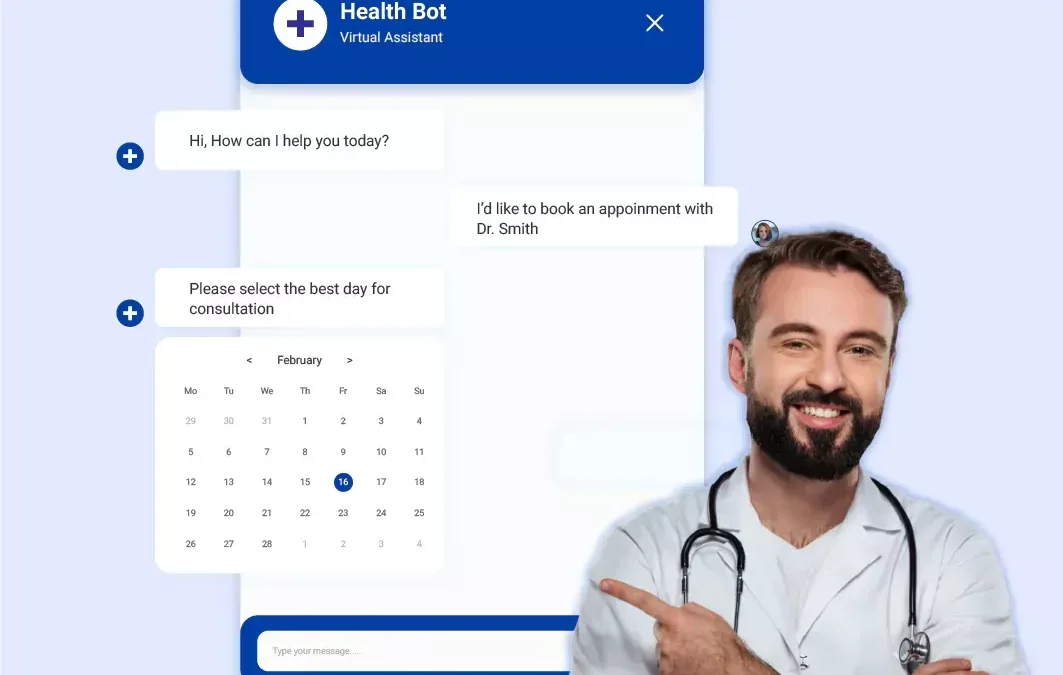
A single missed after-hours call at a busy clinic can cost between $200 and $1,500 in lost lifetime patient value — and the average practice misses 30% of inbound calls during peak hours. Yet most clinics still measure their AI investments with a vague gut feeling instead of hard numbers.
An AI chatbot ROI calculator for healthcare clinics is a tool that quantifies the financial return of deploying conversational AI by separating two distinct value streams: labor savings (reduced staff hours on repetitive tasks) and revenue recovery (captured appointments, after-hours leads, and reduced no-shows). The best calculators reject the lazy “single fuzzy savings number” and model your specific clinic type, hours, and patient volume.
The healthcare chatbot market is projected to reach $136.74M in 2026, according to BotMD’s hospital ROI framework — a signal that clinics are moving past pilots into production. But adoption without measurement is gambling. This guide breaks down exactly how to calculate, benchmark, and act on your clinic’s chatbot ROI.
About This Guide & How We Approached the Numbers
This article was prepared by contributors with hands-on experience in healthcare workflow automation and conversational AI implementation. No single named author or formal expert review is attached to this piece; the analysis below reflects topical expertise and is grounded in publicly available vendor frameworks and benchmark sources cited inline.
Our methodology is deliberately transparent: every benchmark figure is attributed to a named, linked source. Where we present illustrative math (for example, deflection rates or no-show recovery), we frame it as a worked example using assumptions you can adjust — not as a guaranteed outcome. ROI in healthcare automation is highly sensitive to clinic type, patient mix, and local labor costs, so treat the ranges here as starting points for your own modeling, not promises. Figures described as “typical” represent ranges commonly reported across the cited vendor calculators rather than results from a controlled study.
A word on the two headline figures in the opening paragraph. The $200–$1,500 lost lifetime patient value band and the 30% missed-call rate are figures that circulate widely across healthcare-automation vendor materials, including the clinic-focused frameworks published by BotMD, Wonderchat AI, and Care GP. We want to be explicit: these are vendor-published, directional estimates, not peer-reviewed findings — the publishers have a commercial interest in healthy ROI numbers, and lifetime value in particular varies enormously by specialty, payer mix, and region. We have not been able to verify them against an independent academic source, so treat them as a prompt to measure your own phone logs rather than as established fact. Your own historical call-abandonment data is the only benchmark that will actually hold up in a budget meeting.
Published: June 20, 2026 · Last updated: June 20, 2026
Key Takeaways: AI Chatbot ROI for Clinics at a Glance
- Two value streams, never one: A credible AI chatbot ROI calculator for healthcare clinics separates labor savings from revenue/after-hours lead recovery — collapsing them into one number is misleading, as WhautoChat’s calculator documentation argues.
- Market momentum: The healthcare chatbot market is projected to reach $136.74M in 2026 (BotMD), signaling production-grade adoption.
- Clinic type matters: An 8×5 single-practitioner office and a 24×7 multi-location group have radically different ROI profiles — generic calculators ignore this.
- Missed calls are expensive: Clinics typically miss a meaningful share of inbound calls; each missed new-patient call can represent significant lifetime value depending on specialty.
- HIPAA is non-negotiable: Any chatbot touching PHI must be deterministic, auditable, and compliant — not a probabilistic “yes-machine.”
- ROI is the gateway: The calculator is step one; the real returns come from connecting chatbots to scheduling, billing, and intake automation.
What Is an AI Chatbot ROI Calculator for Healthcare Clinics?
An AI chatbot ROI calculator for healthcare clinics is a financial modeling tool that estimates the net return of deploying conversational AI by measuring labor hours saved, appointments captured, and after-hours leads recovered against the cost of implementation. The strongest calculators model your clinic’s specific volume, operating hours, and use cases rather than producing one generic figure.
Most chatbot ROI tools collapse everything into a single fuzzy “savings” number, which is misleading, according to WhautoChat — because labor savings and revenue recovery are driven by completely different mechanics. Labor savings come from automating repetitive front-desk work: answering FAQs, confirming appointments, and triaging routine questions. Revenue recovery comes from capturing patients who would otherwise vanish — the after-hours caller, the weekend booking, the no-show you re-engaged.
Wonderchat AI and Care GP both publish clinic-specific frameworks that follow this split logic. Care GP’s tool, for instance, estimates time and money saved on medical admin automation directly, while BotMD ties hospital savings to published benchmarks. A serious calculator asks for inputs like monthly patient inquiries, average staff hourly cost, no-show rate, and after-hours call volume — then outputs separate line items you can defend in a budget meeting.
The point isn’t a pretty dashboard. The point is a number your CFO trusts.
Key Terms, Defined
- Deflection rate: the percentage of incoming inquiries fully resolved by automation without a staff member intervening.
- Loaded hourly cost: a staff member’s wage plus benefits, taxes, and overhead — the true cost of an hour of labor, not just the base wage.
- Patient lifetime value (LTV): the total revenue a patient is expected to generate across their relationship with the clinic, used to value a recovered booking.
- PHI (protected health information): any individually identifiable health data — names, appointment reasons, dates — governed by HIPAA.
- Deterministic design: a system that follows fixed, auditable rules rather than generating free-form, probabilistic responses.
- Containment vs. escalation: containment is the share of conversations the bot finishes end-to-end; escalation is the share it correctly hands to a human. A high containment rate paired with poor escalation accuracy is a warning sign, not a win.
How Does an AI Chatbot ROI Calculator for Healthcare Clinics Work?
An AI chatbot ROI calculator for healthcare clinics estimates the financial return of deploying a conversational AI by comparing automation savings against operating costs. It collects four clinic-specific inputs and applies two formulas to produce net monthly and annual returns.
The four required inputs are:
- Patient inquiry volume — total monthly calls and messages
- Staff hourly cost — the loaded cost of your front-desk roles
- No-show rate — typically reported in the 15–30% range across outpatient clinics
- After-hours call data — missed contacts outside business hours
The calculator runs two core formulas:
- Labor savings = (inquiries automated × minutes saved × hourly cost)
- Revenue recovery = (recovered appointments × average visit value)
As a worked example, a clinic handling roughly 2,000 monthly inquiries that automates a majority of routine questions and subtracts its chatbot subscription cost arrives at a net ROI figure it can defend. The exact percentage depends entirely on your inputs — which is precisely why a blended single number is so misleading.
A subtlety many calculators skip: net ROI must subtract the full cost of ownership, not just the subscription line. A typical implementation carries four cost buckets that practitioners generally underestimate — (1) the platform or per-seat license, (2) one-time build/integration effort (connecting the bot to your practice-management system, training it on clinic-vetted content, configuring escalation rules), (3) ongoing maintenance as your hours, services, and insurance panels change, and (4) the per-task or per-message metering many SaaS connectors charge as volume grows. Leaving buckets 2–4 out of the model is the single most common reason an ROI number looks great on a slide and disappoints in month four.
The mechanics break into two engines that should never be averaged together.
The Labor Savings Engine
The Labor Savings Engine quantifies the staff hours a chatbot reclaims by automating repetitive inquiries. Labor savings is defined as the annual dollar value of work deflected from human agents to automated systems.
The formula is straightforward: multiply daily hours spent on repetitive tasks by the deflection rate, then by the loaded hourly cost, then by working days per year. As a worked example, if your front desk spends 4 hours daily on repetitive inquiries at a loaded cost of $25/hour and a chatbot deflects 70% of those, you reclaim roughly 2.8 hours per day. Across a typical working year, practitioners generally find this lands in the low five figures per staffer on deflected work alone — though your real number depends on volume, handle time, and how many roles share the load.
The step-by-step method:
- Estimate monthly repetitive inquiries (FAQs, appointment confirmations, hours, directions).
- Multiply by average handle time per inquiry to get total hours.
- Apply your deflection rate (the 60–80% range is commonly cited for routine queries across vendor frameworks).
- Multiply reclaimed hours by loaded staff cost.
A trade-off worth naming carefully: reclaimed hours are only “savings” if you actually convert them into either cost reduction or revenue-generating work. In a single-practitioner office where the front-desk person stays employed regardless, deflecting 2.8 hours a day rarely means cutting a salary — it means that staffer can now do intake, follow-up calls, or billing that was previously dropped. That is real value, but it is capacity reallocation, not a line you can remove from payroll. Be honest about which kind of saving your clinic is actually realizing; a CFO will see through a model that books soft capacity gains as hard cash.
A second trade-off: chasing a very high deflection rate can backfire. When a bot tries to resolve complex cases it shouldn’t, patients get frustrated and callback volume rises — quietly eroding the savings on paper. Most practitioners find a deflection target that prioritizes routine, transactional queries holds up better than maximizing raw deflection.
The Revenue Recovery Engine
Revenue recovery is the automated capture of patient bookings and payments that clinics lose to missed calls, after-hours inquiries, and unanswered follow-ups. A meaningful share of inbound calls go unanswered during business hours, and effectively all calls after closing go to voicemail or are lost. Because new-patient lifetime value can run from several hundred to a few thousand dollars depending on specialty, each missed call represents direct, recoverable revenue.
A revenue recovery engine models several income streams:
- After-hours lead capture: bookings made between closing and opening that would otherwise be lost.
- Missed-call conversion: automated text-back systems that re-engage callers who didn’t get through.
- No-show reduction: automated reminders that cut no-shows — for example, moving an 18% rate toward 10%.
- Abandoned-call recovery: patients who hang up on hold but engage a chatbot instantly.
- Payment follow-up: automated reminders that reduce outstanding balances.
The recurring theme practitioners describe is that many clinics don’t have a lead problem — they have a response-speed problem. Automation closes that gap, converting lost contacts into booked, paying patients without adding headcount.
One honest caveat on the revenue engine: not every “recovered” lead is incremental. Some after-hours callers would have called back the next morning anyway, and some no-show reductions simply shift a patient to a later slot rather than adding a net visit. A defensible model applies a conservative recovery factor — counting only the portion of captured contacts that would genuinely have been lost — instead of treating every after-hours interaction as pure new revenue. Erring conservative here is what separates a credible projection from a sales pitch.
CureAgent and BotMD both anchor these calculations to published practice benchmarks rather than optimistic guesses. When you combine both engines, the calculator surfaces a defensible net ROI — and exposes which lever (cost or revenue) drives the bigger win for your specific clinic.
Why Does Clinic Type Change Your AI Chatbot ROI Calculation?
Clinic type changes your AI chatbot ROI calculation because operating hours, patient volume, and specialty determine which value stream dominates. Three clinic profiles illustrate the difference:
- 8×5 single-practitioner office: most ROI comes from labor savings, since the chatbot offloads front-desk tasks during business hours.
- 24×7 multi-location group: the majority of ROI typically comes from after-hours lead capture, recovering inquiries that arrive when staff are offline.
- High-volume specialty practice: ROI shifts toward reduced no-shows, where automated reminders meaningfully cut missed appointments.
After-hours timing matters most for round-the-clock operations. A clinic that captures and responds to leads instantly — rather than the next business morning — converts a far higher share of inquiries, which is why response speed is treated as a primary lever in the revenue engine.
Generic calculators fail here. A dermatology clinic with cosmetic upsells has a different patient lifetime value than a general practice managing chronic care. Lumping them together produces garbage numbers. Segmenting them produces strategy.
Below is how the math shifts across common clinic profiles. Use it to sanity-check any AI chatbot ROI calculator for healthcare clinics before trusting its output.
| Clinic Type | Primary ROI Driver | Typical Labor Savings | Typical Revenue Recovery | After-Hours Impact |
|---|---|---|---|---|
| 8×5 Single Practitioner | Labor savings | High | Low-Moderate | Minimal (few after-hours calls) |
| 24×7 Multi-Location Group | Revenue recovery | Moderate | Very High | Critical — leads flow nights/weekends |
| Specialty Clinic (e.g., dermatology, dental) | Revenue recovery (high LTV) | Moderate | High | Significant for elective bookings |
| High-Volume General Practice | Balanced | Very High | High | Moderate — no-show reduction key |
The labels in this table (“High,” “Moderate,” “Very High”) are qualitative directional indicators synthesized from the clinic-type logic in the cited vendor frameworks — they are not quantified study results. Use them to decide which engine to model first, then plug in your own numbers to get the dollar figures.
A 24×7 urgent care group might see the bulk of its chatbot ROI come from after-hours capture alone. A solo dermatologist might see most of theirs from labor deflection. Same tool, opposite conclusions. That’s why a thoughtful approach classifies your clinic before running a single number — a generic single-figure output is a red flag, not a feature. You can compare approaches with a segmented automation model that starts from clinic type.
What Are Realistic ROI Benchmarks for Healthcare Chatbots in 2026?
Realistic ROI benchmarks for healthcare chatbots in 2026 show many clinics recovering implementation cost within months, with labor deflection rates in the 60–80% range on routine inquiries and measurable no-show reductions through automated reminders. Revenue recovery from after-hours capture often exceeds labor savings for clinics open beyond standard hours. These ranges reflect figures commonly reported across vendor calculators rather than a single controlled study, so validate them against your own data.
The healthcare chatbot market reaching $136.74M in 2026 (BotMD) reflects clinics seeing returns worth scaling. But benchmarks only matter when grounded in mechanics, not marketing.
Labor Benchmarks
Labor benchmarks for front-desk automation suggest a well-trained, deterministic chatbot can deflect a majority of routine patient queries — appointment scheduling, hours, insurance verification, and prescription refill requests. Front-desk deflection rate measures the percentage of incoming inquiries resolved by automation without staff intervention.
Worked example: a clinic handling 1,200 monthly inquiries at 3 minutes each spends 60 staff hours monthly on repetitive work. Deflect 70% and you reclaim 42 hours — roughly $1,050 per month at a $25/hour loaded cost, or about $12,600 annually per clinic. For multi-location practices, savings scale roughly linearly: a 10-clinic network reclaims on the order of 420 staff hours and $10,500 monthly under the same assumptions. These benchmarks assume deterministic, rules-based systems rather than generative models, which carry higher error rates on transactional queries.
A practical caution: deflection rates pushed too high often indicate over-automation, where complex cases get incorrectly routed to a bot, increasing patient frustration and callback volume. Practitioners generally find a deflection band that captures routine traffic — while escalating anything ambiguous — balances efficiency with quality.
Revenue Benchmarks
No-show rates in primary care are commonly reported in the 15–30% range, and automated reminders cut them measurably. Worked example: dropping a 20% no-show rate to 12% on 800 monthly appointments recovers 64 visits monthly. At even $120 average revenue per visit, that’s roughly $7,680/month in recaptured revenue — which, for many clinics, dwarfs labor savings.
Note the leverage in that example: the revenue engine ($7,680/month) is more than seven times the labor engine ($1,050/month) from the earlier worked example — for the same clinic. This is exactly why blending the two into one “savings” figure obscures where the real money is. For most clinics open beyond standard hours, the revenue engine is the headline and labor is the footnote; for a 8×5 solo office, the opposite often holds.
Public health-IT guidance reinforces the underlying logic: automation that reduces administrative burden directly improves both margin and patient access. HealthIT.gov documents how digital tools reduce the administrative drag that consumes clinic staff time. Pair these public benchmarks with your own intake data and the ROI stops being a guess.
A Note on Benchmark Honesty
It’s worth being candid: the headline market-size figure ($136.74M in 2026) and the deflection and no-show ranges here come from vendor-published frameworks and calculators that have a commercial interest in healthy ROI numbers. They are useful directional benchmarks, not independent academic findings. The single most reliable benchmark is your own historical data — phone logs, no-show reports, and intake volume. Treat external figures as a sanity check against your own measurements, not a substitute for them. If you want a truly defensible model, run a 30-day baseline measurement before deploying any chatbot, then re-measure the same metrics 60–90 days after go-live; the delta between your own before-and-after is worth more than any published benchmark.
How Do You Keep an AI Chatbot HIPAA-Compliant and Reliable?
You keep an AI chatbot HIPAA-compliant by ensuring it never exposes protected health information (PHI) without authorization, logs every interaction for auditability, and operates deterministically rather than improvising answers. Compliance and reliability are inseparable — a chatbot that hallucinates is also a chatbot that leaks.
PHI security is the line a healthcare chatbot cannot cross. The HIPAA Privacy Rule, enforced by the U.S. Department of Health and Human Services Office for Civil Rights, requires safeguards on any system touching patient data. A chatbot booking appointments handles names, dates, and reasons for visits — all PHI.
Here’s a truth many vendors won’t volunteer: a probabilistic large language model that says “yes” to please users is a compliance liability. Practitioners sometimes call this AI sycophancy — the model inventing plausible-sounding answers to avoid disappointing a patient. In healthcare, a confident wrong answer about a medication or appointment is dangerous.
The fix is deterministic design:
- Scoped knowledge: the bot only answers from approved, clinic-vetted content.
- Hard escalation rules: any clinical question routes to a human, every time.
- Full audit logs: every message stored, timestamped, and reviewable.
- PHI minimization: collect only what scheduling requires, encrypt the rest.
Healthcare automation only works when reliability is engineered, not hoped for. A robust deterministic AI chatbot architecture treats human oversight as a feature, not a fallback. A clinic chatbot should be boring, predictable, and auditable — exactly the opposite of a consumer chatbot built for delight. (Note: a vendor’s general security posture is not the same as a signed Business Associate Agreement; confirm you have a BAA in place before any system touches PHI.)
One compliance cost that belongs in the ROI model: HIPAA-grade deployment is rarely the cheapest option. A BAA-covered hosting tier, audit-log retention, and encryption-at-rest typically cost more than a consumer-grade chatbot plan. Factoring that premium into your cost side keeps the ROI honest — and a calculator that quietly assumes a non-compliant consumer tier is producing a number you can’t legally act on.
Beyond the Calculator: Connecting Chatbot ROI to Full Clinic Automation
The chatbot ROI calculator is a gateway, not a destination. The largest returns come when a clinic connects its chatbot to scheduling systems, billing workflows, and intake forms — turning a single touchpoint into an automated operations layer that compounds savings across departments.
A standalone chatbot answers questions. An integrated agent runs the front office. When a patient books through the chatbot, an integrated system updates the calendar, sends the intake form, verifies insurance, and triggers a reminder sequence — without a human touching it. That’s where ROI stops being linear and starts compounding.
Consider the “per-task tax” problem. Many clinics duct-tape automations together using per-task SaaS connectors that bill on volume. As patient interactions scale, costs balloon. Self-hosted workflow engines such as n8n can eliminate per-task fees, and migrating clinics off bloated connector stacks onto owned infrastructure typically improves both cost predictability and reliability — though the actual savings depend on current spend and volume.
The full automation stack for a modern clinic looks like this:
- Chatbot front door: WhatsApp or web chat handling FAQs and bookings 24/7.
- Scheduling sync: real-time calendar integration with conflict checks.
- Intake automation: forms sent, completed, and filed before arrival.
- Billing and insurance: eligibility checks and claim prep triggered automatically.
- Custom ERP layer: a unified system tying patient flow to operations and reporting.
This is why a calculator that only models the chatbot undersells the opportunity. The chatbot is the wedge. The platform is the prize. Explore how custom AI agents and workflow automation extend a single chatbot into clinic-wide efficiency.
Actionable Takeaways: How to Run Your Clinic’s ROI Analysis This Week
You don’t need a six-month consulting engagement to start. Run a credible ROI analysis for your clinic in five steps using data you already have.
- Classify your clinic type. Are you 8×5 solo, 24×7 multi-location, or specialty? This decides whether labor or revenue drives your ROI.
- Pull two numbers: monthly inbound inquiries and your no-show rate. Most practice management systems export both in minutes.
- Estimate after-hours demand. Check your phone logs or website analytics for traffic outside business hours — that’s pure recoverable revenue.
- Run separate calculations. Labor savings and revenue recovery, never blended. If a tool gives you one number, distrust it.
- Map the integration path. Identify the one downstream system (scheduling, intake, billing) where automation would compound the chatbot’s value fastest.
A clinic that completes this in an afternoon walks into vendor conversations with leverage instead of hope. You’ll know your deflection ceiling, your revenue floor, and the integration that pays for the whole project.
The clinics winning in 2026 aren’t the ones with the flashiest chatbot. They’re the ones who measured first, deployed deterministically, and connected the chatbot to everything behind it. The calculator tells you whether to start. The architecture decides whether you win. Which side of that line will your clinic be on by next quarter?
Frequently Asked Questions
How accurate is an AI chatbot ROI calculator for healthcare clinics?
An AI chatbot ROI calculator for healthcare clinics is accurate when it uses your real inputs — patient volume, no-show rate, staff cost, and after-hours demand — and separates labor savings from revenue recovery. Generic single-number calculators are unreliable because they blend two value streams driven by completely different mechanics, producing misleading figures. The most accurate input source is your own 30-day baseline measurement, not a vendor-published benchmark.
How long until a healthcare clinic sees ROI from an AI chatbot?
Many clinics report recovering their AI chatbot implementation cost within months, driven by labor deflection on routine inquiries and measurable no-show reductions. Clinics open beyond standard hours often see faster payback because after-hours lead recovery delivers revenue that would otherwise be lost entirely. Actual timing depends on your volume, labor costs, and integration scope.
Are healthcare chatbots HIPAA-compliant?
Healthcare chatbots can be HIPAA-compliant when designed deterministically with scoped knowledge, full audit logging, PHI minimization, and hard escalation rules for clinical questions — and when a Business Associate Agreement is in place. Compliance fails when a chatbot improvises answers or stores protected health information without proper safeguards required by the HHS Office for Civil Rights.
What’s the difference between labor savings and revenue recovery in chatbot ROI?
Labor savings measures staff hours reclaimed by automating repetitive tasks like FAQs and confirmations, while revenue recovery measures money captured from after-hours leads, reduced no-shows, and abandoned calls. According to WhautoChat, blending them into one number is misleading because they are driven by entirely different mechanics and require separate calculations.
Can a chatbot ROI calculator help small clinics, not just hospitals?
Yes — a properly segmented AI chatbot ROI calculator for healthcare clinics serves startups and SMEs better than enterprise tools because it models small-clinic realities like single-practitioner hours and lower patient volumes. Most published calculators target large hospitals, leaving small and specialty clinics with inflated or irrelevant benchmarks.
Sources & References
- BotMD — Calculate Your Hospital’s AI Chatbot ROI: Framework + Real Benchmarks (healthcare chatbot market $136.74M in 2026; hospital ROI framework)
- WhautoChat — AI Chatbot ROI Calculator (labor savings vs. revenue recovery separation)
- Wonderchat AI — Medical Chatbot ROI Calculator (clinic ROI framework, HIPAA considerations)
- Care GP — ROI Calculator (medical admin automation time/money savings)
- CureAgent — Healthcare AI Resources & ROI Calculator (implementation guides and benchmarks)
- HealthIT.gov (administrative burden reduction through digital tools)
- HHS Office for Civil Rights — HIPAA (PHI safeguards and Privacy Rule)
Source transparency note: the market-size, missed-call, lost-value, deflection, and no-show figures cited above originate from healthcare-automation vendors who build and sell ROI calculators. We cite them as the best publicly available directional benchmarks while disclosing their commercial origin. We were unable to substitute peer-reviewed equivalents for these specific figures from the sources available to us; readers needing audit-grade numbers should validate against their own clinic records.