
Can AI agents automatically match invoices to POS? Yes — and by 2026, the best systems do it with roughly 94% autonomous accuracy on standard three-way matches, cutting invoice processing time by up to 75%. The catch nobody advertises: that remaining 6% of exceptions is where money leaks, audits get triggered, and black-box AI quietly guesses wrong. For SMEs in the MENA and GCC region, add VAT compliance, ZATCA e-invoicing, and Arabic-language invoices, and the question stops being whether it can work and becomes whether it can work in a way you can defend to an auditor.
So, can AI agents automatically match invoices to POs? Yes — with important caveats. Peakflo’s analysis reports that autonomous three-way matching now reaches 94% accuracy (Peakflo, Autonomous PO Matching), and GoSourced reports a 70% processing-time reduction from AI-driven matching (GoSourced, AI Invoice Matching). This guide explains where the automation ends and human judgment begins — using publicly documented figures and typical implementation patterns rather than marketing claims.
About this guide — who wrote it and how to read the numbers. This article is published by the J. SERVO editorial team, which builds deterministic, RAG-grounded AI agents for finance and back-office automation, with a focus on GCC/MENA SMEs. Where we describe implementation behaviour, we frame it as patterns practitioners generally observe across accounts-payable deployments rather than as claims about a specific named client, because the underlying benchmarks in this article are third-party vendor figures, not our own audited measurements. The accuracy and time-saving numbers cited throughout are vendor-published benchmarks from the sources linked in the Sources & References section. They describe results on the publishers’ own datasets and configurations. Your real-world results will vary with data quality, vendor mix, and ERP setup — which is exactly why the deployment roadmap below insists on a shadow pilot to measure accuracy on your invoices. We have not seen an independent, peer-reviewed benchmark of end-to-end agentic three-way matching at the time of writing; treat every percentage here as directional.
Quick Summary: Key Takeaways
- Yes, AI agents can automatically match invoices to POs. Peakflo reports that modern systems achieve around 94% autonomous three-way matching accuracy (invoice, PO, goods receipt).
- Processing time drops 70–75%. GoSourced reports a 70% cut and Peakflo a 75% reduction versus manual accounts-payable workflows.
- AI agents beat traditional OCR/RPA because they understand context and learn from corrections — matching even when data doesn’t align exactly, according to Procindex.
- The last-mile 6% is the real risk. Deterministic AI plus RAG-grounded agents make exception handling auditable instead of a black-box guess.
- MENA/GCC SMEs face extra rules: ZATCA e-invoicing (Fatoorah), 15% Saudi VAT, 5% UAE VAT, and Arabic-language invoice fields need region-aware matching.
- Build-vs-buy matters more than accuracy claims. For most SMEs, integrating an AI matching layer onto an existing ERP beats ripping-and-replacing.
Published: 12 August 2026. Last updated: 12 August 2026. All figures are attributed to the third-party sources cited inline.
Can AI Agents Automatically Match Invoices to POs?
Yes — AI agents can automatically match invoices to POs, and increasingly they do it end-to-end without human handoffs. Modern AI agents extract invoice data, retrieve the matching purchase order, verify the goods receipt, and post to the general ledger, achieving roughly 94% autonomous three-way matching accuracy according to Peakflo.
The mechanism is straightforward once you strip away the marketing. An AI invoice-matching agent is a software system that reads an incoming invoice, identifies the corresponding purchase order and goods-receipt note, compares line items, quantities, prices, and tax, and then decides whether to approve, route, or flag the document. Traditional OCR (Optical Character Recognition) simply digitizes text into machine-readable characters. AI agents go further — they interpret context, tolerate messy data, and learn from every correction a human makes.
Consider a worked example of a common mismatch. A supplier invoices for 100 units at $9.80 each, but the PO says 100 units at $9.75. A rigid rules engine rejects it outright. An AI agent recognizes the $5 variance falls within an approved 1% tolerance, checks the goods receipt confirmed 100 units arrived, and clears the invoice — logging the reason. Procindex describes this behavior precisely: “AI agents understand context — they can match invoices to POs even when data doesn’t match exactly, and they learn from corrections” (Procindex, AP Automation).
The honest answer is nuanced. The 94% figure is Peakflo’s published benchmark for clean, structured invoices — not an independently audited industry average, and not an inflated brochure number either. But that headline quietly excludes the messy 6%: duplicate invoices, partial deliveries, multi-currency lines, and Arabic-language vendor documents that trip up models trained mostly on English. Those exceptions are exactly where a deterministic, auditable approach earns its keep. So the accurate answer to “can AI agents automatically match invoices to POs?” is: yes for the bulk, with a plan for the remainder. The sections below unpack both halves of that answer.
How Does AI Invoice-to-PO Matching Actually Work?
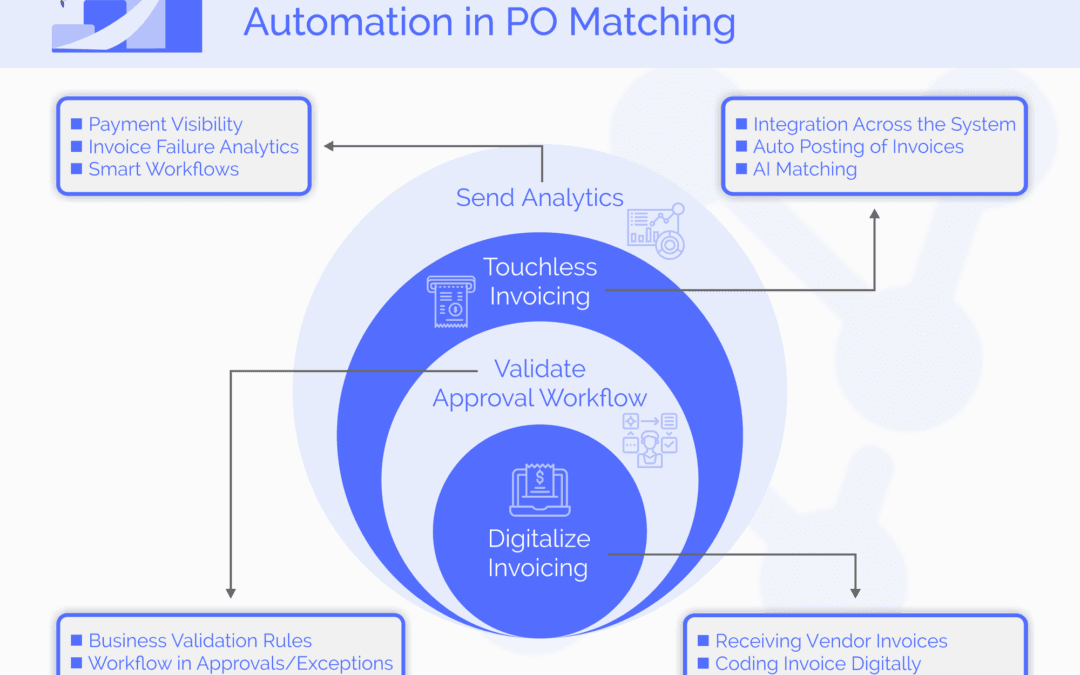
AI invoice-to-PO matching works in five stages: capture, extraction, retrieval, comparison, and decision. The agent ingests the invoice, pulls structured fields, retrieves the matching PO and goods receipt, compares them against tolerance rules, and either auto-approves, routes for approval, or flags an exception — cutting processing time by up to 75%, per Peakflo.
Break each stage down and the trade-offs become obvious. Below is a typical implementation workflow, adapted from the three-way matching logic described by GoSourced and Zamp in their 2026 guides. In practice, teams that have integrated a matching agent onto ERPs such as SAP Business One, Microsoft Dynamics 365 Business Central, Oracle NetSuite, or regional mid-market systems tend to spend the bulk of setup time on the retrieval stage — because that is where the agent has to speak the ERP’s specific PO and goods-receipt schema.
- Capture. The invoice arrives via email, PDF upload, EDI, or — increasingly in Saudi Arabia — a ZATCA-compliant XML e-invoice. Capture quality determines everything downstream. Garbage in, garbage matched.
- Extraction. The agent parses header and line-item data: vendor, invoice number, date, PO reference, quantities, unit prices, tax codes, and totals. Modern extraction combines OCR with a language model that infers fields even when labels differ across vendors.
- Retrieval. The agent looks up the referenced PO and the associated goods-receipt note in your ERP. RAG-grounded retrieval — Retrieval-Augmented Generation, where the model reasons over records pulled from your database rather than from its training data — matters here: the agent pulls the actual PO record from your system rather than guessing from a probabilistic pattern.
- Comparison (three-way match). The agent compares invoice against PO against goods receipt on quantity, price, and tax, applying your tolerance thresholds. A 2% price tolerance and 0% quantity tolerance are common SME defaults.
- Decision. Clean matches post straight to the GL. Variances within tolerance auto-clear with a logged reason. Anything outside tolerance routes to a human — with the agent’s evidence attached.
Why does this beat the old way? Manual three-way matching in a mid-size AP team can take 10–15 minutes per invoice and buckles at volume. Zamp documents AI agents running the full sequence — “extraction, 3-way matching, exception resolution” — end-to-end (Zamp, 2026). The 70% time reduction GoSourced cites isn’t magic; it’s the elimination of manual keying and lookup for the 90%+ of invoices that were always going to match.
A Worked Scenario: One PO, Three Deliveries
Practitioners generally find split deliveries the clearest illustration of where an agent’s logic differs from a spreadsheet. Imagine a manufacturer issues a single PO for 300 steel brackets. The supplier ships 120, then 100, then 80 — invoicing each shipment separately. A naive matcher compares each invoice’s 120/100/80 against the PO’s 300 and flags all three as quantity mismatches. A well-configured agent instead tracks the cumulative received quantity against each goods-receipt note, matches each invoice to the specific shipment it covers, and only raises an exception if the running total exceeds 300 or a shipment lacks a receipt. This is the kind of stateful comparison that separates a genuine agent from a rules script — and it is worth confirming in a vendor demo using your own split-delivery examples. In a typical implementation, this single scenario is the one that most often exposes whether a tool is truly agentic or a rebranded rules engine, so it is a useful acceptance test to hand a vendor before signing.
Two-Way vs Three-Way Matching
Two-way matching compares the invoice to the purchase order only; three-way matching adds the goods-receipt note, confirming that what you were billed for actually arrived. The key difference: two-way checks two documents (invoice and PO), while three-way checks three (invoice, PO, and goods receipt). For SMEs buying physical goods — manufacturers, distributors, construction firms — three-way matching prevents paying for undelivered stock. For service invoices with no goods receipt, a well-configured agent falls back to two-way or a service-confirmation step. Practitioners generally find that a good system knows which mode to apply per vendor, switching automatically based on whether goods or services are being purchased.
Why Are AI Agents Better Than Traditional OCR and RPA for Matching?
AI agents outperform traditional OCR and RPA because they understand context, tolerate imperfect data, and improve from human corrections — whereas OCR only digitizes text and RPA only follows rigid rules. According to Procindex, AI agents “can match invoices to POs even when data doesn’t match exactly, and they learn from corrections.”
Robotic Process Automation (RPA) — software “bots” that mimic keystrokes and clicks along a fixed script — was a genuine step forward a decade ago, but it’s brittle by design. If the vendor changes an invoice layout, the field positions shift, and the bot breaks. OCR alone reads characters but has no idea whether “Total Due” and “Amount Payable” mean the same thing. AI agents close both gaps.
The distinction shows up starkly in three situations SMEs hit weekly:
- Layout drift. A supplier redesigns their invoice template. RPA breaks; an AI agent still finds the PO number because it understands what a PO reference is, not just where it sits on the page.
- Fuzzy matches. The PO says “Ø10mm servo coupling” and the invoice says “10mm coupling, servo-grade.” A rules engine sees two different strings. An AI agent recognizes the same item.
- Learning loop. When a human corrects a mismatch, the agent records the pattern. Next month, the same vendor quirk resolves automatically. RPA never learns.
Here is the honest caveat, and it is the core trust question. Context understanding is powerful, but a purely probabilistic LLM (Large Language Model) will confidently invent a match that isn’t there — the “yes-machine” problem, sometimes called hallucination. That’s unacceptable for financial records you have to defend during a VAT audit. The fix is a hybrid stack: use the language model for interpretation, but ground every decision in deterministic rules and retrieved source records so the final match is verifiable, not guessed. The next section covers that architecture; for a deeper treatment, see this deterministic AI vs LLM breakdown.
Comparison Table: OCR vs RPA vs AI Agents
The processing-time figures in the final row reflect the ranges published by the sources cited above; the OCR and RPA rows are illustrative practitioner estimates for those technology classes, not sourced benchmarks, and the capability rows describe typical behaviour rather than a single product.
| Capability | Traditional OCR | RPA Bots | AI Agents (Hybrid) |
|---|---|---|---|
| Reads invoice text | Yes | Partial | Yes |
| Understands context and synonyms | No | No | Yes |
| Handles layout changes | No | No | Yes |
| Learns from corrections | No | No | Yes |
| Auto-resolves in-tolerance variances | No | Rule-limited | Yes |
| Auditable decision trail | Weak | Moderate | Strong when RAG-grounded |
| Typical processing-time cut | About 20% (illustrative) | About 40% (illustrative) | 70 to 75% (per Peakflo/GoSourced) |
What Accuracy Can You Realistically Expect — and Where Does It Fail?
Applying can ai agents automatically match invoices to pos? delivers measurable results over time.
Realistically, expect around 94% autonomous three-way matching accuracy on clean, structured invoices, according to Peakflo. The remaining ~6% — duplicates, partial deliveries, multi-currency mismatches, and non-standard vendor documents — still requires human review or a deterministic exception workflow.
That 94% number deserves scrutiny, because it is a single vendor’s self-reported figure that is frequently quoted without the asterisk. Accuracy depends heavily on input quality and vendor consistency. In typical deployments, invoices from a company’s top 20 recurring suppliers often clear at well above the published average once the agent has learned their patterns; long-tail one-off vendors and hand-scanned documents pull the average down. This is why any vendor’s benchmark should be treated as a starting hypothesis to validate on your own data, not a guarantee — and why the shadow pilot described later exists to produce a number measured on your ledger.
The failure modes are predictable, and naming them is more useful than pretending they don’t exist:
- Duplicate invoices. The same invoice submitted twice under slightly different references. A strong agent hashes key fields to catch duplicates before payment — a control that GoSourced notes “catches overpaid invoices before payment” (GoSourced, 2026).
- Partial and split deliveries. One PO, three shipments, three invoices. Matching requires the agent to track cumulative received quantities, not just a single goods receipt.
- Multi-currency and FX rounding. A PO in USD, an invoice in SAR or AED. Rounding at the fourth decimal creates false variances unless tolerance is currency-aware.
- Tax-code mismatches. Wrong VAT treatment — a common GCC issue where a supplier applies 5% instead of the correct rate, or omits the tax registration number.
- Arabic and mixed-language invoices. Models trained predominantly on English mis-read Arabic vendor names and right-to-left numerals.
The trustworthy way to handle the 6% is not to hide it. Route every out-of-tolerance case to a human with the agent’s full reasoning attached: which fields matched, which didn’t, and by how much. Over time, corrections shrink the exception pile. A system that claims 100% autonomous accuracy is either misrepresenting its results or quietly auto-approving things it shouldn’t — and the second is far more expensive than the first.
Why Deterministic AI Wins on the Exceptions
Deterministic AI wins on the exceptions because it produces the same output for the same input every time — exactly what financial controls require. The failure mode of a probabilistic LLM is concrete: it might match an invoice today and flag an identical one tomorrow, which is unacceptable for auditors who need repeatable evidence. Pairing deterministic matching rules with RAG-grounded retrieval means every decision traces back to a real PO record. For SMEs facing regulators, an explainable, repeatable match beats a slightly-more-clever black box every time.
Can AI Agents Match Invoices to POs Under ZATCA and GCC VAT Rules?
Yes — AI agents can match invoices to POs under ZATCA e-invoicing and GCC VAT rules, provided the system is configured for regional formats, tax rates, and Arabic-language fields. Saudi Arabia’s ZATCA Fatoorah mandate requires structured e-invoices, which actually makes AI matching easier because the data arrives machine-readable rather than as free-form PDFs.
MENA and GCC compliance is where many global AP tools fall short. Saudi Arabia’s Zakat, Tax and Customs Authority (ZATCA) rolled out mandatory e-invoicing (Fatoorah) in phases, requiring integrated, standardized invoice data. You can review the official requirements directly on the ZATCA E-Invoicing portal. Because ZATCA e-invoices are structured XML with a defined schema, extraction accuracy climbs and the AI agent spends less effort parsing free-form PDFs.
Region-specific matching requirements every GCC SME should configure:
- VAT rates by country. Saudi Arabia levies 15% standard VAT; the UAE, Bahrain, and Oman apply 5%. The agent must validate the correct rate per jurisdiction, not assume one blanket figure across all four markets.
- Tax Registration Number (TRN/VAT) validation. The agent should verify the supplier’s TRN appears and is formatted correctly — a frequent audit flag.
- Arabic-language handling. Vendor names, addresses, and item descriptions in Arabic, often mixed with English on the same document. A multilingual model tuned for Arabic matters.
- ZATCA cryptographic stamp / QR. Saudi e-invoices carry a QR code and cryptographic stamp; the agent should confirm their presence for phase-two compliance.
- Right-to-left numerals and date formats. Hijri and Gregorian dates can co-exist; misreading either breaks period matching.
UAE businesses should equally note the Federal Tax Authority’s requirements — the official UAE Federal Tax Authority site documents VAT obligations that your matching agent’s tax-validation layer must respect. A practical pattern practitioners implement is a GCC-aware validation module that checks jurisdiction, VAT rate (15% for Saudi Arabia, 5% for the UAE, Bahrain, and Oman), and TRN before the invoice ever reaches the three-way match. Skipping this step is how SMEs end up with correctly-matched invoices that still fail a tax audit. For a deeper walkthrough, see this guide to AI compliance for MENA SMEs.
How Do AI Agents Handle Exceptions and Approval Routing?
AI agents handle exceptions by classifying the mismatch type, attempting an evidence-based resolution, and routing anything unresolved to the right human approver with full context attached. Well-designed agents resolve many exceptions autonomously — price variances within tolerance, duplicate detection, and missing-PO lookups — reserving human time for genuine judgment calls.
Exception handling is the true test of an AP automation system. Anyone can auto-approve a perfect match. The value lives in what happens when things don’t line up. Zamp explicitly lists “exception resolution” as a core capability of end-to-end AI invoice agents (Zamp, 2026) — meaning the agent doesn’t just flag problems, it tries to solve them first.
A practical exception-resolution hierarchy commonly implemented:
- Auto-resolve within tolerance. A 0.8% price variance under your 2% threshold clears automatically, with the variance logged for the audit trail.
- Self-heal with retrieval. Missing PO number? The agent searches by vendor, amount, and date to locate the likely PO, then proposes the match for one-click human confirmation.
- Route by exception type. Quantity mismatches go to the warehouse; price disputes go to procurement; tax errors go to finance. Smart routing beats dumping everything on one AP clerk.
- Escalate with evidence. Genuine anomalies reach a human accompanied by the agent’s full comparison — no hunting through three systems to understand the flag.
Approval routing is where deterministic logic shines again. Approval thresholds — say, invoices above 50,000 SAR need CFO sign-off — should be hard-coded rules, not probabilistic suggestions. You never want an LLM “deciding” who approves a six-figure payment. The AI interprets and prepares; the deterministic layer enforces authority limits. That separation of duties is both a control best practice and, frankly, common sense.
One field-tested point worth stressing: the quality of exception routing degrades fast if your master data is dirty. Duplicate vendor records, inconsistent PO numbering, and stale GL codes generate false exceptions no AI can fix. In a typical rollout, teams that skip the data-cleanup step find their first-week exception queue dominated not by real financial anomalies but by avoidable master-data noise. Clean the data first, or the agent will faithfully route hundreds of avoidable flags to your team.
Should SMEs Build or Buy an AI Invoice-Matching System?
can ai agents automatically match invoices to pos? is one of the most relevant trends shaping 2026.
Most SMEs should buy or integrate an AI invoice-matching layer onto their existing ERP rather than build from scratch, unless they have unusual volume or a specialized workflow no vendor supports. Building costs six figures and months of engineering, while integrating a proven matching agent typically pays back within the first year through the 70–75% time savings on invoice processing documented by the sources above.
The build-vs-buy decision trips up a lot of founders who either over-engineer a custom system that ties up six figures and months of engineering, or over-pay for tooling they never fully use. A pragmatic framework: buy or integrate unless your volume or workflow is genuinely unusual, because the documented 70–75% time savings from a proven agent almost always beats a first-year build.
When to Buy or Integrate
- You process fewer than roughly 5,000 invoices per month.
- Your workflows are fairly standard three-way matching.
- You want live results this quarter, not next year.
- You lack an in-house ML and MLOps team to maintain a custom model.
When a Custom or Hybrid Build Makes Sense
- You have unusual matching logic (project-based construction billing, complex service contracts).
- You need deep integration with a regional or legacy ERP that off-the-shelf tools don’t support.
- Data residency or PDPL (Personal Data Protection Law) requirements force on-premise or in-region hosting.
- You operate at volume where per-invoice SaaS pricing becomes uneconomical.
For GCC SMEs specifically, the integration path usually wins — but with a twist. Many popular AP tools are built for Western ERPs and English invoices. If your ERP is a regional or mid-market system and half your invoices are Arabic, you need a matching layer that speaks both. A RAG-grounded, deterministic matching agent that bolts onto your existing ERP and workflow automation stack without a rip-and-replace addresses that gap directly.
The TCO Math That Actually Matters
Don’t be seduced by the accuracy headline. Total Cost of Ownership (TCO) includes implementation, integration, per-invoice or subscription fees, exception-handling labor, and ongoing tuning. Model it honestly with a worked example: if you process 2,000 invoices monthly at 12 minutes each, that’s 400 hours of AP labor. A 70% reduction frees roughly 280 hours per month. Multiply by your loaded hourly cost and compare to the annual tool cost. If payback lands under 12 months — which it commonly does at that volume — the decision makes itself. If your volume is a fraction of that, run the same arithmetic before committing; the case is weaker for very low invoice counts. Note that the 70% figure feeding this calculation is GoSourced’s published benchmark, so treat the resulting payback as an estimate to confirm against your shadow-pilot numbers, not a promise.
What’s the Step-by-Step Roadmap to Deploy AI Invoice-to-PO Matching?
The roadmap to deploy AI invoice-to-PO matching has six phases: audit your data, define tolerance rules, integrate with your ERP, run a shadow pilot, validate accuracy, and scale with a human-in-the-loop exception queue. Following this sequence avoids the two biggest failures — dirty data and over-trusting the AI too early.
Here’s a deployment sequence refined so a lean finance team can follow it.
- Audit and clean master data. Deduplicate vendors, standardize PO numbering, and verify GL and tax codes. Spend a week here; it saves months later.
- Define matching rules and tolerances. Set price tolerance (e.g., 2%), quantity tolerance (often 0%), approval thresholds, and VAT-validation rules per GCC jurisdiction. Write them down; they become your audit policy.
- Integrate with your ERP. Connect the agent to retrieve POs and goods receipts and to post approved invoices to the GL. Confirm read/write permissions and test posting in a sandbox.
- Run a shadow pilot. For 2–4 weeks, let the agent match invoices in parallel while humans still process them. Compare the agent’s decisions against reality. Measure the real accuracy on your data, not the vendor’s brochure.
- Validate and tune. Review every disagreement between agent and human. Adjust rules, feed corrections, and retest until autonomous accuracy stabilizes at an acceptable level for your risk appetite.
- Go live with human-in-the-loop. Auto-post clean matches, auto-clear in-tolerance variances, and route the rest to a monitored exception queue. Track KPIs monthly: autonomous match rate, exception rate, and time-per-invoice.
One caveat worth insisting on: never skip the shadow pilot. The temptation to flip everything to autonomous on day one is strong when the demo looked flawless. Resist it. Your vendor mix, your Arabic invoices, and your edge cases will surface things no generic benchmark predicted. The shadow phase is cheap insurance against an expensive mispayment — and it is also how you replace the vendor’s published 94% with a number measured on your own ledger.
Actionable Takeaways: Your AP Automation Checklist
Before you sign anything or write a line of code, run through this checklist. It captures the practical lessons that separate a smooth rollout from a stalled one.
- ✅ Clean your master data first. Dirty vendor and PO records generate false exceptions no AI can resolve.
- ✅ Insist on an auditable decision trail. Every match must trace to a real PO and goods-receipt record — non-negotiable for VAT audits.
- ✅ Configure GCC tax rules explicitly. 15% Saudi VAT, 5% UAE VAT, TRN validation, and ZATCA e-invoice checks.
- ✅ Demand a shadow-pilot proof. Measure accuracy on your own invoices before going autonomous.
- ✅ Keep humans on the exceptions. Route the ~6% to people with full context; automate the 94%.
- ✅ Separate interpretation from authority. AI proposes; deterministic rules enforce approval limits.
- ✅ Model TCO honestly. Include integration, subscription, and exception labor — not just the license fee.
- ✅ Prefer deterministic + RAG over black-box. Explainability protects you when regulators ask questions.
Do these eight things and you’ll capture the bulk of the value — the documented 70–75% time savings — without inheriting the risks that come from over-trusting a probabilistic model with your payment run.
Frequently Asked Questions
can ai agents automatically match invoices to pos? plays a pivotal role in this context.
Can AI agents automatically match invoices to POs without any human involvement?
AI agents can match roughly 94% of clean, structured invoices to POs fully autonomously, according to Peakflo’s published benchmark. The remaining ~6% — duplicates, partial deliveries, multi-currency and tax mismatches — should route to a human. Full zero-human automation is possible for simple, high-volume vendors but risky as a blanket policy for financial records.
What is three-way invoice matching?
Three-way invoice matching is the process of comparing three documents — the supplier invoice, the purchase order, and the goods-receipt note — to confirm you’re paying the right amount for goods you actually received. AI agents automate this comparison across quantity, price, and tax, cutting processing time by up to 70%, per GoSourced.
Are AI agents better than OCR or RPA for invoice matching?
Yes. AI agents understand context, tolerate imperfect data, and learn from corrections, while OCR only digitizes text and RPA only follows rigid rules. According to Procindex, AI agents “can match invoices to POs even when data doesn’t match exactly.” For best results, pair the AI with deterministic rules for auditability.
Can AI invoice matching handle ZATCA e-invoicing and GCC VAT?
Yes. Because ZATCA (Saudi Arabia’s Fatoorah) e-invoices are structured XML, AI matching is actually more accurate on them than on free-form PDFs. The system must be configured for regional VAT rates — 15% in Saudi Arabia, 5% in the UAE — plus TRN validation and Arabic-language fields to remain audit-compliant.
How long does it take to deploy AI invoice-to-PO matching for an SME?
For a typical SME, deployment takes about 4–8 weeks: roughly one week for data cleanup, one to two for rules and ERP integration, and a 2–4 week shadow pilot before going live. Rushing past the shadow pilot is the most common cause of costly mispayments in early rollouts.
What happens to the 6% of invoices AI can’t match automatically?
The unmatched ~6% flows into a human-in-the-loop exception queue, where the AI attaches its full reasoning — which fields matched, which didn’t, and by how much. Humans resolve genuine judgment calls, and their corrections train the agent to auto-resolve similar cases next time, steadily shrinking the exception pile.
The Bottom Line
By 2027, autonomous three-way matching will likely move from a competitive edge toward table stakes, the way online banking became. The real differentiator is already shifting from can the AI match invoices to whether it can explain every decision to an auditor, in Arabic and English, under ZATCA and PDPL. SMEs that adopt deterministic, RAG-grounded matching now won’t just save around 70% of their AP hours (per the third-party benchmarks cited above) — they’ll own an audit trail their black-box-using competitors can’t produce. The winners won’t be the ones with the flashiest 94% claim. They’ll be the ones who planned for the 6%.
If you’d like hands-on help mapping this to your ERP and GCC compliance requirements, talk to the J. SERVO team.
Sources & References
The statistics and claims in this article are attributed to the following published sources. Figures such as the 94% autonomous matching accuracy and the 70–75% processing-time reductions are vendor-published benchmarks measured on those publishers’ own datasets — not independent, peer-reviewed, or analyst-verified figures — so treat them as directional and validate against your own data during a shadow pilot.
- Peakflo — Autonomous PO Matching: Can AI Agents Match Invoices Without Humans? (source of the ~94% autonomous three-way matching accuracy and 75% processing-time reduction figures).
- GoSourced — AI Invoice Matching: How It Works Step by Step (2026 Guide) (source of the 70% processing-time reduction and duplicate-detection points).
- Procindex — AP Automation: How AI Agents Process Invoices End-to-End (source of the context-understanding and learning-from-corrections quotation).
- Zamp — How AI Agents Automate Invoice Processing (2026) (source of the end-to-end extraction, 3-way matching, and exception-resolution description).
- ZATCA — E-Invoicing (Fatoorah) official portal (primary source for Saudi e-invoicing requirements).
- UAE Federal Tax Authority (primary source for UAE VAT obligations).
Note: This article is for general informational purposes and reflects J. SERVO’s topical expertise in AI-driven AP automation; the quantitative benchmarks it cites are third-party vendor figures, not independently audited results. Verify all specifics against your own context before making purchasing or compliance decisions.