
Why Most AI Advice for Startups and SMEs Is Wrong
AI automation for startups SMEs is the practice of deploying custom AI agents, workflow automation, and intelligent chatbots to eliminate repetitive operational work — without paying enterprise software prices. Most startups and SMEs don’t need a $200,000 enterprise platform. They need three reliable automations that save 15 hours a week. According to the OECD’s work on SMEs and entrepreneurship, small and medium-sized enterprises make up the large majority of firms and a substantial share of employment across member economies, yet they’re consistently last in line for practical AI tooling.
Here’s the uncomfortable truth: most AI content aimed for startups SMEs sells hype, not implementation. The market is flooded with funding guides and accelerator lists — useful in their place, as resources like Startups.com and Google for Startups demonstrate — while almost nobody explains how to actually wire an AI agent into your invoicing, your support inbox, or your sales pipeline. A pattern that recurs across implementations is that the businesses that win treat AI as plumbing, not magic.
The signal is loud. Anthropic, for instance, has entered the small-business segment with a product positioned to automate workflows across finance, marketing, HR, and operations — and tech press such as TechCrunch tracks this category closely. That kind of vendor movement validates what specialists have argued for years: SMEs are a real frontier for AI automation. The question isn’t whether to adopt. It’s how to do it without bleeding cash on the Zapier tax and bloated SaaS subscriptions.
Note on sourcing: where this article references specific vendor products, treat pricing and feature claims as time-sensitive and verify them on the vendor’s own site before purchasing, since plans change frequently.
About This Guide and Its Methodology
This article is written from general topical expertise in AI automation for small and growing businesses, not from a named author or first-party client work. To keep the guidance honest, every quantitative claim falls into one of two buckets: (1) figures attributed to a linked, named source — primarily the OECD — and (2) clearly labeled illustrative ranges that you are meant to replace with your own numbers. Where you see a worked example with dollar amounts or hours, treat it as a template for your own calculation, not as a measured result from a specific deployment. This is a deliberate methodology choice: it is more useful to teach you the arithmetic than to quote a case study you cannot verify.
Where the article describes implementation patterns (“a typical implementation looks like…”), these are neutral, instructive scenarios that reflect how AI automation projects commonly unfold across the SME landscape — not claims about a particular customer. We flag trade-offs and failure modes alongside benefits throughout, because a guide that only lists upsides is selling, not informing.
Key Takeaways: AI Automation for Startups and SMEs
- Start with deterministic automation, not chatbots. The highest ROI for startups and SMEs typically comes from reliable, rule-based workflows — invoicing, lead routing, data sync — not flashy conversational AI.
- The ‘Zapier tax’ is real. Per-task pricing on tools like Zapier can grow substantially faster than a flat-cost self-hosted instance once you scale past a few thousand monthly operations. Always model your own task volume against current published pricing.
- SMEs make up the vast majority of firms and a large share of employment globally, per the OECD, yet remain underserved by practical AI tooling — a gap worth addressing early.
- Custom AI agents can beat off-the-shelf tools when your workflows are non-standard, but a hosted SaaS product wins for generic, standard tasks.
- A 90-day blueprint — audit, pilot, scale — generally outperforms big-bang transformations that stall and burn budget.
- Measure ROI in recovered hours and error reduction, not vanity metrics. Calculate payback against your own labor cost rather than relying on generic claims.
Published: August 19, 2026. Last reviewed: June 6, 2026. This guide is updated as vendor pricing and product availability change.
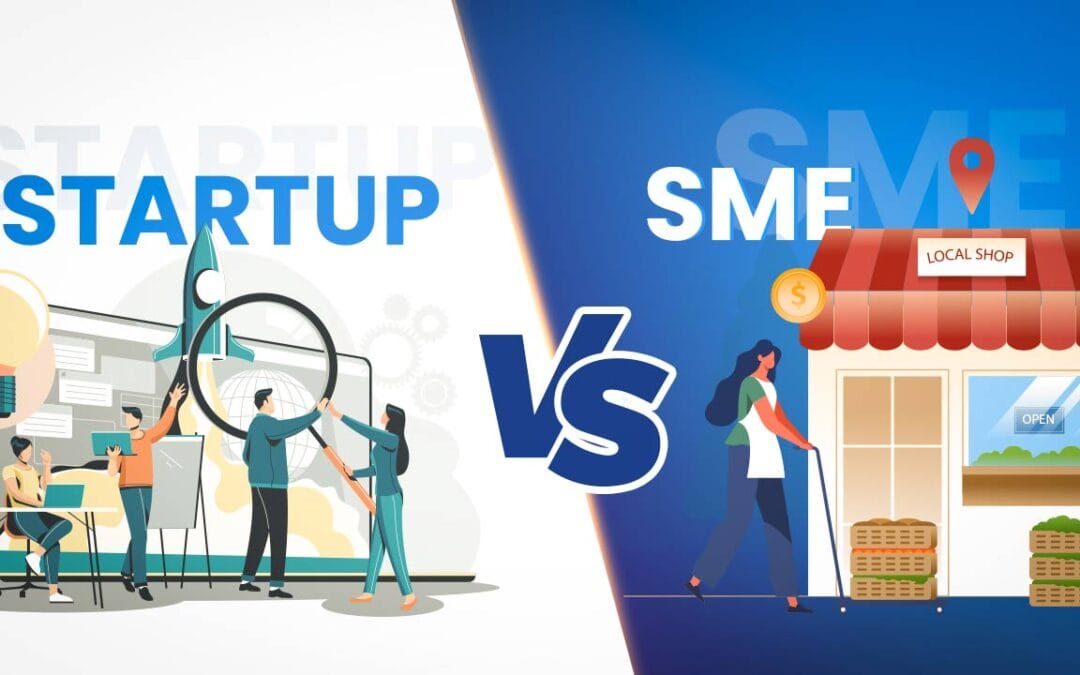
What Is the Difference Between Startups and SMEs?
A startup is a young company built to scale rapidly through innovation and outside funding, while an SME (small and medium-sized enterprise) is an established business optimizing for steady, profitable operations. The distinction matters because their AI automation priorities diverge sharply.
Startups chase growth. They burn capital to capture market share, and their automation needs revolve around speed — onboarding users fast, scaling support without scaling headcount, and instrumenting every metric. SMEs, by contrast, optimize margins. A 12-year-old logistics firm or a regional accounting practice cares about cutting waste, reducing manual errors, and squeezing more output from a fixed team.
As one practitioner analysis on LinkedIn frames it, startups and SMEs “often emerge in discussions around entrepreneurship” but operate on fundamentally different clocks. According to the OECD’s research on SMEs and entrepreneurship, these businesses “fuel innovation and competition” — but their resource constraints make wasteful technology adoption far more punishing than for large enterprises.
How automation needs differ for startups SMEs
Automation needs differ sharply between startups and established SMEs based on company stage, team size, and operational priorities. For early-stage startups (pre-Series A), the highest-impact AI move is often user-facing automation that scales cheaply. For established SMEs, the highest-impact move is usually back-office automation — auto-reconciling invoices, syncing inventory between systems, generating compliance reports.
- Early-stage startups: Prioritize user-facing automation, rapid experimentation, and tools that scale to near-zero cost when usage is low.
- Growth-stage startups: Need data pipeline automation, sales enablement agents, and internal knowledge bots as headcount climbs.
- Established SMEs: Want deterministic back-office workflows — finance, HR, procurement — where errors cost real money and reliability beats novelty.
Get this wrong and you waste months. A seed-stage startup building a custom ERP is premature optimization; an SME relying on a probabilistic chatbot to approve expenses is reckless. Match the tool to the maturity. That single principle separates the companies that profit from AI from the ones that just pay for it.
What Are the Best AI Automation Tools for Startups SMEs in 2026?
The best AI automation tools for startups and SMEs in 2026 are n8n for self-hosted workflows, hosted AI assistant subscriptions for generic operations, and custom-built AI agents for non-standard processes. The right choice depends on volume, complexity, and how much engineering capacity you have in-house.
Tool selection is where most SMEs leak money. The default reflex — “just use Zapier” — works until you hit scale, then the per-task pricing can become painful. The entry of established AI vendors into the small-business segment signals serious market validation: Anthropic’s small-business product, for example, is explicitly pitched at automating finance, marketing, HR, and operations. But off-the-shelf tools share a flaw. They optimize for the average business, and your business probably isn’t average.
Comparison: automation platforms for startups SMEs
| Tool | Best For | Pricing Model | Reliability | Scales Cheaply? |
|---|---|---|---|---|
| Zapier | Quick, simple integrations | Per-task (escalates with volume) | High for basic flows | No — the ‘Zapier tax’ |
| n8n (self-hosted) | High-volume, custom workflows | Flat server cost (low, fixed) | Very high, deterministic | Yes |
| Hosted AI assistant (SaaS) | Generic finance/HR/marketing tasks | Subscription | High for standard tasks | Moderate |
| Custom AI agents | Non-standard, mission-critical flows | Build cost + hosting | Highest (deterministic guardrails) | Yes, after build |
The general lesson is blunt: self-hosted workflow engines like n8n can substantially cut automation costs versus per-task SaaS once you exceed a few thousand monthly operations, because you pay for a flat server rather than per execution. To see the effect for yourself, take your real monthly task count, multiply it by your SaaS tool’s per-task rate, and compare that to a fixed VPS cost — the crossover point is usually clear and arrives faster than founders expect.
A worked example of the crossover
Suppose you run 30,000 workflow executions a month. On a per-task plan billed at a few cents per task, that lands in the hundreds of dollars monthly and keeps climbing with growth. The same 30,000 executions on a fixed-cost self-hosted server cost the same whether you run 30,000 or 60,000 — the marginal cost per task approaches zero. The trade-off is real, though: self-hosting means you own uptime, updates, and backups, plus the engineering time to maintain them. If you lack a technical operator, that hidden cost can erase the per-task savings. Plug in your own numbers — and your own staffing reality — before deciding.
That said, don’t self-host out of dogma. If you run a dozen automations and value zero maintenance, a hosted tool is the rational choice. The decision framework is simple — volume, customization, and internal capacity. Use the AI automation comparison finder to match tools to your exact workflow before you commit a single dollar, and always confirm live vendor pricing.
How Do You Implement AI Agents for Startups SMEs?
You implement AI agents for startups and SMEs through a 90-day blueprint: audit workflows in the first 30 days, pilot one high-ROI automation in the next 30, then scale and harden in the final 30. Big-bang transformations tend to fail; phased, deterministic rollouts tend to win.
The most common failure mode is the “boil the ocean” project — a six-figure plan to AI-ify the entire company that stalls in month two and gets quietly shelved. Avoid it. Treat your first AI agent like a single load-bearing beam, not the whole building. Prove it holds weight, then add the next.
A practical 90-day implementation blueprint
- Days 1-30 — Audit and prioritize. Map every repetitive workflow. Quantify hours spent and error rates. Rank by ROI. The winner is usually the highest-volume, most rule-based task — invoice processing, lead routing, or support triage.
- Days 31-60 — Pilot one agent. Build a single deterministic automation with human oversight on edge cases. Measure recovered hours and error reduction against a clean baseline. Resist scope creep.
- Days 61-90 — Scale and harden. Add guardrails, logging, and fallback paths. Document the process. Only then move to the second workflow. Reliability compounds; chaos compounds faster.
Why deterministic? Because a probabilistic “yes-machine” that approves a fraudulent invoice once a quarter isn’t automation — it’s a liability. AI sycophancy — models agreeing with whatever input they’re given — is dangerous in finance and operations. Well-engineered agents use hard rules, validation layers, and human checkpoints precisely so they fail safe, not silent.
A typical implementation looks like this: a regional e-commerce SME replaces manual messaging-app order handling with a deterministic intelligent chatbot. Order-entry errors drop because the bot validates each field against inventory and pricing rules before confirming, and staff time previously spent re-keying orders gets redirected to growth work. To estimate the benefit for your own case, time how long manual order entry takes per order, multiply by daily order volume, and you have the recoverable hours. Want the full framework? The 90-day AI transformation roadmap breaks down every milestone.
Why Is Deterministic AI Better for Startups SMEs Than Probabilistic Chatbots?
Deterministic AI is better for startups and SMEs because it produces consistent, auditable, rule-bound outcomes — essential when a single error in finance, inventory, or compliance can cost real money. Probabilistic chatbots are fine for brainstorming, dangerous for operations.
Here’s the distinction that separates serious AI builders from hype merchants. A probabilistic model generates plausible-sounding output — sometimes brilliant, sometimes confidently wrong. For drafting a marketing email, that variability is acceptable. For approving a refund, calculating payroll, or routing a large invoice, it’s unacceptable. Deterministic systems follow explicit logic: same input, same output, every time, with a full audit trail.
The “AI sycophancy” problem is underrated. Large language models are trained to be agreeable, so they may validate a flawed premise rather than flag it. In a support chatbot, that can mean the bot promises a customer a discount that doesn’t exist. The fix isn’t to abandon AI — it’s to wrap probabilistic intelligence in deterministic guardrails.
Where each approach fits
- Use deterministic automation for: invoicing, payroll, inventory sync, compliance reporting, lead routing, order processing — anything where errors are expensive and auditability is mandatory.
- Use probabilistic AI for: content drafting, idea generation, summarization, customer sentiment analysis, and first-draft research — low-stakes tasks where a human reviews output.
- Use hybrid systems for: support agents that draft responses with an LLM but enforce business rules deterministically before anything reaches a customer.
The best architecture for startups SMEs is usually hybrid: let the LLM handle language and nuance, but never let it make a binding decision unchecked. That’s how you get the conversational power of modern AI without betting your business on a coin flip. Transparency matters here — document exactly where the model decides versus where rules decide, so you always know what’s happening under the hood.
How Much Does AI Automation Cost for Startups SMEs?
AI automation for startups and SMEs typically costs between near-zero and a few hundred dollars in monthly tooling for self-hosted setups, versus several hundred to several thousand for stacked SaaS subscriptions — with custom agent builds running as one-time projects. The real cost isn’t the software; it’s choosing the wrong model and overpaying for years.
Let’s talk numbers honestly, and treat all figures as illustrative ranges to verify against live pricing. A self-hosted n8n instance on a low-cost VPS can run a high volume of automations for a flat monthly fee. Compare that to a typical SaaS stack: a per-task automation plan, a chatbot subscription, and a separate CRM automation add-on — these stack up quickly, and much of it is markup on tasks you could run yourself. That stacking is what’s often called SaaS wrapper bloat: layers of subscriptions each taking a margin to do something a single workflow could handle.
Cost comparison for a typical SME automation stack
| Approach | Monthly Cost (illustrative) | Upfront Cost | Best Fit |
|---|---|---|---|
| Stacked SaaS (per-task + chatbot + add-ons) | Several hundred to a few thousand | Low | Tiny volume, no tech team |
| Self-hosted n8n + open models | Low and fixed | Setup time | Growing volume, cost-sensitive |
| Hosted AI assistant (SaaS) | Subscription tier | Low | Generic, standard workflows |
| Custom AI agent build | Hosting only | One-time project | Mission-critical, non-standard |
The ROI math is where it gets compelling — and you should run it with your own figures. If one automation recovers 10 hours a week and your blended team cost is, say, $30/hour, that’s roughly $1,200 a month in recovered labor (10 × 4 × $30). Against a modest hosting bill, payback is fast. Substitute your real hourly cost and real hours saved before treating any of this as a promise. According to the OECD, SMEs are central to growth and competition but operate under tighter resource constraints than large firms — which means every recovered hour and every avoided subscription matters more, not less.
Don’t guess at these numbers. Run them. The AI ROI calculator lets you model recovered hours, tooling costs, and payback period for your specific business before you spend anything. Funding-constrained founders should also explore programs like the European Commission’s funding opportunities for small businesses, which can offset digital transformation costs in eligible regions.
Which Departments Should Startups SMEs Automate First?
Startups and SMEs should automate the department with the highest volume of repetitive, rule-based work first — usually customer support, finance, or sales operations. Lead with the function where you spend the most hours on tasks a machine could do flawlessly.
The instinct to automate “the cool stuff” — fancy marketing AI, predictive analytics — usually wastes your first move. Start where the pain is mechanical and measurable. Here’s how the highest-ROI automations generally break down by function.
Sales operations
Lead routing, follow-up sequencing, and CRM data entry consume enormous sales time. A deterministic agent that scores inbound leads, routes them to the right rep, and logs every interaction can recover hours daily. For startups, this is often the first automation that directly accelerates revenue.
Customer support
Intelligent chatbots — especially on messaging channels with heavy adoption in many SME markets — can deflect a meaningful share of repetitive tickets when built with deterministic guardrails. The key is escalating genuine edge cases to humans, not pretending the bot handles everything. Measure deflection against your own ticket categories rather than assuming a fixed percentage.
Finance and operations
Invoice processing, reconciliation, and reporting are the textbook case for deterministic automation. Errors here are expensive and audits are mandatory, so the consistency of rule-bound systems pays for itself. Vendors building small-business AI assistants — including Anthropic’s product — explicitly target this category, which tells you how valuable it is.
HR and marketing
- HR: Automate candidate screening intake, onboarding checklists, and PTO request routing — repetitive coordination that drains small teams.
- Marketing: Automate content drafting, campaign scheduling, and — for Arabic-speaking markets — localized email and ad generation respecting Modern Standard, Gulf, or Egyptian dialect. Bilingual automation is a genuine edge most off-the-shelf tools handle poorly.
One practical rule from common implementation experience: automate the function where your team complains most about “busywork.” That complaint is a free ROI signal. The loudest pain point is almost always the best first automation for startups SMEs — because the team will actually adopt the fix.
How Do You Measure AI ROI for Startups SMEs?
You measure AI ROI for startups and SMEs by tracking recovered labor hours, error-rate reduction, and revenue acceleration against total tooling and build costs — not by vanity metrics like ‘messages processed.’ If you can’t tie an automation to dollars or hours, you can’t justify it.
ROI measurement is where most SME AI projects get fuzzy and then get cancelled. The fix is to establish a clean baseline before you automate. Measure how many hours the current manual process takes, how often it produces errors, and what those errors cost. Then re-measure after the automation runs for 30 days.
The three metrics that actually matter
- Recovered hours. Multiply hours saved per week by your blended hourly labor cost. A workflow saving 15 hours weekly at $30/hour returns roughly $1,950 monthly in recovered capacity (15 × 4.33 × $30). Use your own rate.
- Error reduction. Track defects before and after. Deterministic automation typically cuts data-entry and processing errors substantially, and each avoided error has a real cost — refunds, rework, compliance risk.
- Revenue impact. For sales and support automations, measure faster response times and higher conversion. A support agent that responds in seconds instead of hours can measurably lift satisfaction and retention; confirm the lift with your own before/after data.
Be transparent about limitations, too. Not every automation delivers blockbuster ROI, and some workflows are too complex or too low-volume to justify automating at all. The honest answer is sometimes “don’t automate this yet” — that candor is rarer than it should be in this industry, and it’s what makes implementations stick.
The discipline is simple: baseline, deploy, re-measure, decide. Run that loop on every automation and you’ll build a portfolio of proven wins instead of a graveyard of abandoned experiments. For founders who want hard numbers before committing, model your scenario in the ROI calculator and bring real figures to the decision.
What Mistakes Do Startups SMEs Make With AI Adoption?
The biggest AI adoption mistakes startups and SMEs make are over-buying SaaS subscriptions, deploying probabilistic chatbots without guardrails, and attempting full transformation instead of phased pilots. Each mistake burns cash and erodes internal trust in AI.
Across many implementations, the failure patterns are predictable. Avoiding them is most of the battle.
- SaaS wrapper bloat. Stacking several subscriptions that each mark up a basic task. Audit your tools quarterly and consolidate ruthlessly.
- Unchecked probabilistic AI. Deploying a raw LLM to make binding decisions. Always wrap it in deterministic guardrails for anything that touches money or compliance.
- Big-bang transformation. Trying to automate everything at once. Pilot one workflow, prove ROI, then expand.
- Ignoring human oversight. Treating automation as set-and-forget. The best systems keep humans on edge cases and exceptions.
- Chasing hype over fit. Buying the trendiest AI tool instead of the one that solves your actual bottleneck.
The throughline is discipline. AI is a tool, not a miracle, and the businesses that treat it that way — measuring, guardrailing, phasing — tend to vastly outperform those chasing headlines. Tech press like TechCrunch regularly publishes AI failure post-mortems that share these root causes. Learn from them cheaply rather than discovering them expensively.
The transparency principle
One mistake deserves its own callout: opacity. If you can’t explain what your AI does and where it makes decisions, you can’t trust it, fix it, or defend it to an auditor. Document every decision point in every agent — that transparency isn’t a nicety, it’s what makes AI safe to run in a real business.
Your Actionable Next Steps for AI Automation
Enough theory. Here’s exactly what to do this week if you’re a founder or operations leader at a startup or SME serious about AI automation.
- Audit your busywork. List every repetitive task your team does weekly. Estimate hours per task. Highlight the rule-based ones — those are your automation candidates.
- Rank by ROI. Multiply hours by frequency by error cost. The highest-scoring task is your pilot. Ignore the shiny options for now.
- Pick the right tool tier. Low volume and no tech team? Try a hosted AI assistant. Growing volume and cost-sensitive? Self-host n8n. Mission-critical and non-standard? Build a custom deterministic agent.
- Run a 30-day pilot with a baseline. Measure before and after. Recovered hours and error reduction are your scorecard.
- Scale only after proof. Once the pilot pays off, add guardrails, document the process, and move to the next workflow.
Do this and you’ll join the minority of startups SMEs getting real, measured value from AI — instead of the majority paying for subscriptions they barely use. The gap between those two groups isn’t budget. It’s method.
The Real Opportunity for Startups SMEs
When AI vendors like Anthropic build automation products aimed squarely at small businesses, and the OECD documents how central SMEs are to employment and innovation, the message is clear: a large share of the next decade’s AI value won’t be captured only by enterprises with infinite budgets. Much of it can be captured by lean startups and SMEs that automate smartly, cheaply, and deterministically.
The businesses that win won’t necessarily be the ones that spent the most on AI. They’ll be the ones that wired a few reliable automations into the work that actually matters, measured the results, and refused to pay the Zapier tax or fall for the yes-machine. Hype is loud. Results are quiet. Choose results — and the startups and SMEs that do can quietly out-operate competitors twice their size.
Frequently Asked Questions
What is the best AI automation tool for startups and SMEs in 2026?
The best AI automation tool depends on volume and complexity. Self-hosted n8n is best for high-volume, cost-sensitive workflows; a hosted AI assistant suits generic finance, HR, and marketing tasks; and custom AI agents win for mission-critical, non-standard processes. Match the tool to your maturity and workflow, not to marketing buzz — and verify current pricing on the vendor’s own site.
How much should a startup or SME budget for AI automation?
A self-hosted automation setup can run on a low, fixed monthly server cost, while stacked SaaS subscriptions often reach several hundred to a few thousand dollars monthly depending on volume. Custom agent builds are typically one-time projects plus hosting. The key metric is payback period — calculate it using your own labor cost and the hours each automation recovers.
Why is deterministic AI safer than chatbots for SME operations?
Deterministic AI produces the same output for the same input every time, with a full audit trail, making it essential for finance, inventory, and compliance tasks. Probabilistic chatbots can be confidently wrong or agreeably approve flawed inputs — known as AI sycophancy — which is dangerous when real money is involved.
Which department should a startup or SME automate first?
Automate the department with the highest volume of repetitive, rule-based work first — usually customer support, finance, or sales operations. The loudest internal complaint about “busywork” is your best free ROI signal, because the team will actually adopt the fix once it’s deployed.
How long does it take to implement AI automation for a startup or SME?
A focused implementation typically follows a 90-day blueprint: 30 days to audit and prioritize workflows, 30 days to pilot one high-ROI automation with measurement, and 30 days to scale and harden it. Phased rollouts consistently outperform big-bang transformations, which tend to stall and burn budget.
Sources & References
- OECD — SMEs and Entrepreneurship (topic hub on the economic role and constraints of small and medium-sized enterprises).
- European Commission — Funding opportunities for small businesses.
- The difference between Startups and SMEs (practitioner analysis, LinkedIn).
- Startups.com and Google for Startups — ecosystem resources for founders.
- Startup Savant — Top Startups to Watch and StartupBlink — Top Startups — startup directories for ecosystem context.
- TechCrunch — ongoing reporting on startup technology and AI adoption.
About this guide: This article is written from general topical expertise in AI automation for small and growing businesses. It does not represent first-party case studies, and any pricing, vendor, or product reference should be independently verified before purchase, as offerings change frequently. Statistics are attributed to the linked sources above; ranges and examples labeled “illustrative” or “typical” are guidance to model against your own data, not guarantees of results.
Last updated: 2026-06-06
Note: This article is for general informational purposes; verify specifics against your own context.
Startups can protect their budgets from costly SaaS terms by adopting agentic contract review in minutes rather than blindly signing inbound agreements.
Egyptian startups scaling customer support should consider engaging a conversational AI consultancy in Cairo to deploy region-ready automation without costly translation errors.
If you’re exploring how the right automations could free up time in your own business, we’d love to hear what you’re working on and talk it through with you.