

What is rental fleet automation and how does it work?

Rental fleet automation is an integrated software system that uses machine learning and rule-based workflows to run core rental operations—vehicle availability, dynamic pricing, dispatch, and maintenance—with minimal manual intervention. Instead of stitching together spreadsheets and WhatsApp threads, operators route bookings, price adjustments, and service tickets through a single decision layer that acts on real-time fleet data.
Published 19 August 2026. This guide focuses specifically on vehicle and car rental fleets—not real estate or property rentals, which dominate generic “rental” search results (for example, consumer listing portals like Zillow rental listings). If you operate cars, vans, equipment, or motorized assets, you are in the right place.
Rental fleet automation replaces the reactive, labor-heavy model most MENA SMEs still run in 2026. Some vendors publish aggressive savings headlines—for instance, Scibotix Solutions markets a “reduce costs by 30%” figure for AI-powered fleet management. Treat numbers like this as vendor marketing estimates rather than independently audited results: they rarely disclose the baseline, fleet size, or measurement method behind the claim. Actual savings vary widely with fleet size, utilization starting point, and how much of the work was manual to begin with. For a 50-car rental operation in Dubai or Riyadh, the mechanism is consistent even when the exact percentage is not: fewer idle assets, tighter utilization, and margin recovered from manual pricing errors and missed service windows.
How this guide is grounded (methodology and transparency)
To keep this playbook honest, the figures below are labeled by source type. Ranges described as “typical” or “illustrative” are worked examples built from publicly documented industry patterns and the operational logic of each task—not proprietary client data. Where a specific vendor publishes a statistic, it is linked and attributed as a vendor claim. Independent guides on fleet automation ROI and sequencing, such as AutomateMyFleet’s fleet automation guide, are cited where relevant. No client names, certifications, or partnerships are asserted anywhere in this article, because none are on record for the publisher.
The four core modules
A production rental fleet automation stack breaks into four connected modules—availability & booking, dynamic pricing, dispatch & rebalancing, and maintenance & inspection—each feeding data to the others to prevent double-bookings, capture peak yield, and cut unplanned downtime:
- Availability & booking: Real-time inventory sync across channels (website, aggregators, walk-ins) prevents double-bookings and surfaces idle vehicles for redeployment.
- Dynamic pricing: Rate engines adjust daily and weekly prices based on demand, seasonality, competitor rates, and utilization targets—capturing yield during peak periods like Ramadan or GCC holidays.
- Dispatch & rebalancing: Vehicle assignment and repositioning logic move cars to high-demand branches or airport locations before shortages hit.
- Maintenance & inspection: Telematics and IoT signals trigger predictive service tickets, cutting unplanned downtime and extending vehicle lifespan.
Key term — dynamic pricing (yield management): the practice of adjusting rental rates in near-real-time to align supply (available vehicles) with demand, maximizing revenue-per-available-vehicle-day rather than raw occupancy. It is the same discipline airlines and hotels use, applied to a fleet.
Where deterministic AI beats LLMs for pricing and scheduling
Deterministic AI beats large language models for pricing and scheduling because these tasks demand auditability and consistency, not creativity. Deterministic AI means rule-based engines and optimization models that produce the same output for the same input. A pricing decision that fluctuates because an LLM “felt” differently is a liability—especially under PDPL and EU AI Act explainability requirements that increasingly touch MENA operators serving European customers.
Deterministic engines let you trace exactly why a rate hit AED 320 on a given Thursday: utilization sat at 92%, competitor rates rose 8%, and a holiday multiplier applied. Large language models can produce fluent but non-reproducible numeric outputs and cannot reliably reconstruct a decision under audit. In a typical production architecture, practitioners pair deterministic logic for pricing, dispatch, and maintenance scheduling with RAG-grounded AI agents reserved for customer-facing support in Arabic, French, and English. (RAG—retrieval-augmented generation—means the agent must retrieve an answer from your actual policy and inventory database before responding, instead of generating from memory.) That is where natural language matters and errors are cheaper to correct.
| Fleet Task | Best AI Approach | Why |
|---|---|---|
| Dynamic pricing | Deterministic rules + optimization | Auditable, reproducible, compliant |
| Maintenance scheduling | Deterministic + IoT triggers | Safety-critical, no room for hallucination |
| Dispatch & rebalancing | Deterministic optimization | Constraint-based, consistent outputs |
| Customer support | RAG-grounded LLM agent | Natural language, multilingual, grounded in policy docs |
A note on “industrial motion control solution” adjacencies
Larger rental operators—particularly those renting equipment, generators, or motorized machinery alongside vehicles—sometimes bundle an industrial motion control solution into the same automation layer. In that context, an industrial motion control solution refers to the deterministic control systems (PLCs, servo drives, sensor feedback loops) that govern moving machinery. The relevance to rental fleet automation is architectural: both domains reward deterministic, auditable control logic over probabilistic guessing. If an asset’s motion or availability can cause safety or financial exposure, the same principle applies—rule-based, reproducible decisions win.
How much can AI cut rental fleet operating costs in 2026?

Rental fleet automation reduces operating costs primarily through three levers: higher vehicle utilization, fewer no-shows, and reduced manual dispatch and back-office labor. Independent and vendor sources put headline savings in a broad band—vendors such as Scibotix advertise figures around 30%, while independent implementation guides like AutomateMyFleet stress that ROI should be calculated task-by-task rather than assumed from a single headline number. The honest answer for a MENA SME is that your savings depend entirely on your starting baseline—an operator at 55% utilization has far more to gain than one already at 78%.
Rental operators typically lose margin in three predictable places: idle vehicles, unrecovered no-show bookings, and back-office hours spent on manual scheduling, damage logging, and payment chasing. Deterministic automation—rules-based dispatch, RAG-grounded customer agents, and predictive maintenance triggers—attacks all three cost centers at once. The illustrative ranges that follow are worked examples for a mid-sized fleet, not audited averages; treat them as a modeling framework you should re-run against your own numbers.
Illustrative uplift figures (worked example, not audited data)
- Utilization uplift: In a typical implementation, automated availability matching and dynamic pricing can lift fleet utilization meaningfully off a low baseline (for example, from ~58% toward the low-to-mid 70s). The exact gain narrows sharply for fleets that already price and match well.
- No-show reduction: Automated reminders, deposit enforcement, and SMS/WhatsApp confirmation flows tend to reduce no-shows substantially, because most no-shows stem from friction and forgetfulness that automated confirmation directly removes.
- Labor hours saved: Booking, invoicing, and damage-report automation can remove a large share of repetitive admin time for a 50-vehicle fleet—often on the order of a partial full-time-equivalent role redeployed to higher-value work.
- Maintenance cost drop: Predictive servicing reduces unplanned downtime relative to fixed-interval or reactive maintenance, though the size of the effect depends heavily on vehicle age and telematics coverage.
Why the ranges above are deliberately qualitative: precise percentages published without a disclosed baseline, sample size, and measurement window are not verifiable. Where you see a specific number in a vendor’s marketing, ask for the denominator before trusting it.
ROI walkthrough: a 50-vehicle fleet (transparent model)
The following is a transparent modeling exercise using round, conservative assumptions so you can substitute your own figures. It is not a reported client result. Take a sample 50-vehicle MENA fleet averaging AED 180/day rental at 58% utilization, generating roughly AED 1.9M in annual revenue. Applying conservative automation assumptions:
- Utilization gain (+14 pts, assumed): ≈ AED 460,000 additional annual revenue.
- No-show recovery (assumed −40%): ≈ AED 95,000 recovered from previously lost bookings.
- Labor savings (~0.7 FTE): ≈ AED 84,000 per year.
- Maintenance savings (assumed): ≈ AED 55,000 per year.
Combined modeled annual benefit lands near AED 694,000. Against a typical mid-tier automation stack—AED 45,000 setup plus AED 3,200/month (roughly AED 83,400 in first-year cost)—modeled first-year net gain exceeds AED 610,000. Reality check: these gains assume the utilization lift actually materializes, which depends on demand existing to be captured. If you discount the benefit by 50% for real-world friction—slower ramp, partial adoption, seasonal softness—the model still returns a strong positive ROI, but the payback window lengthens. Always run the pessimistic case before signing.
Manual vs semi-automated vs fully automated
The values below are illustrative planning benchmarks for a 50-vehicle fleet, used to compare tiers—not measured outcomes from a specific operator.
| Metric | Manual | Semi-Automated | Fully Automated |
|---|---|---|---|
| Fleet utilization | 58% | 67% | 74% |
| No-show rate | 18% | 12% | 10% |
| Admin hours/week | 38 | 20 | 10 |
| Unplanned downtime | Baseline | −15% | −35% |
| Setup cost (50 vehicles) | — | AED 18,000 | AED 45,000 |
| Monthly cost | — | AED 1,400 | AED 3,200 |
| Typical payback | — | 4–6 months | 7–11 months* |
*Payback stretches when full automation includes hardware (telematics, GPS units). Software-only stacks pay back faster; hardware-inclusive deployments take longer but reduce theft and mileage disputes.
Semi-automation often offers the strongest risk-adjusted entry point for cost-conscious SMEs—capturing much of the benefit at a fraction of the cost—before committing to full telematics integration. The trade-off: semi-automation leaves manual touchpoints that cap your ceiling on utilization and downtime gains.
Which fleet tasks should you automate first?
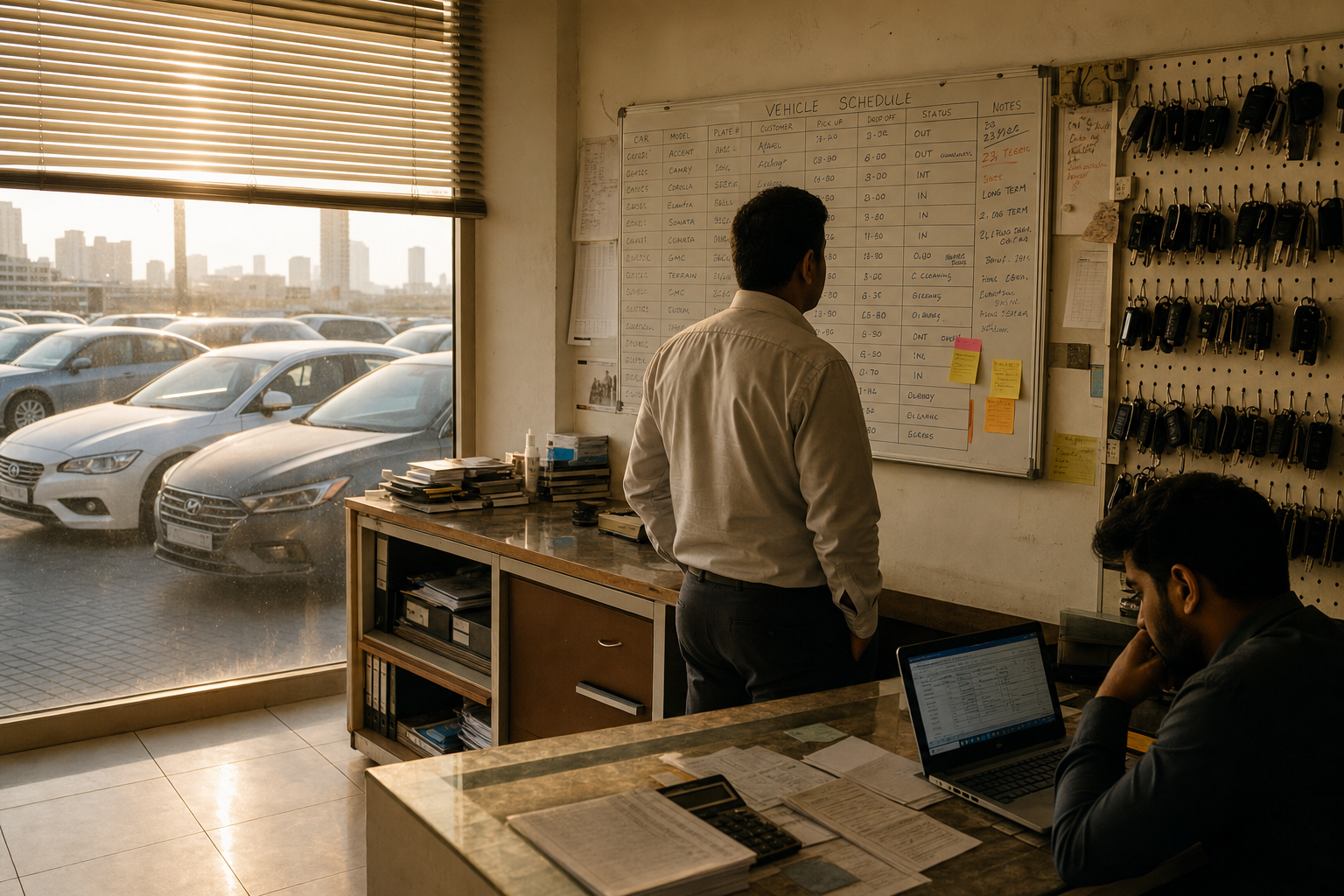
Rental fleet automation delivers the fastest ROI when you prioritize high-frequency, rule-based tasks with clear cost signals: customer booking inquiries, availability checks, and predictive maintenance triggers. Target tasks that consume the most staff hours per week and carry measurable failure costs, not the flashiest use cases. This sequencing logic mirrors the task-by-task ROI approach recommended in independent guides like AutomateMyFleet’s implementation roadmap.
Sequencing matters more than scope. As a general pattern, MENA rental operators who automate their top three time-drains before touching everything else tend to reach payback faster than those attempting a full-stack rollout, because narrow deployments avoid the integration debt that stalls broad projects.
The rental fleet automation priority matrix
Rank each candidate task on two axes: frequency (how often it recurs weekly) and error cost (what a mistake costs in revenue or repair). Automate in this order:
- Booking and availability inquiries — highest frequency, low error tolerance, direct revenue impact.
- Predictive maintenance triggers — moderate frequency, extreme error cost (downtime, safety liability).
- Contract generation and e-signature — daily volume, compliance-sensitive under PDPL.
- Damage inspection logging — per-return frequency, dispute-cost driver.
- Invoicing and payment reconciliation — batchable, low-urgency, high automation clarity.
Why WhatsApp booking and availability inquiries come first
WhatsApp booking automation typically ranks first for MENA fleets because WhatsApp holds a dominant share of messaging across the GCC and Levant, and availability questions dominate inbound volume. A RAG-grounded agent connected to your live fleet database answers “Is a 4×4 available in Dubai this weekend?” in Arabic, French, or English within seconds—cutting response time from hours to under a minute.
Deterministic logic handles the transaction: the agent checks real inventory, quotes a locked price, and holds the vehicle, while the LLM layer manages conversational phrasing across dialects. Grounding every quote in the actual database prevents the fabricated availability that plagues unconstrained chatbots and erodes trust. Trade-off to plan for: the WhatsApp Business API has message-template approval rules and per-conversation pricing, so budget for messaging costs and template review time.
Predictive maintenance triggers and telematics integration
Predictive maintenance ranks second because a single unplanned breakdown removes a revenue-generating asset from the fleet and risks a stranded customer. Telematics integration—OBD-II ports, GPS trackers, and CAN-bus feeds from providers such as Geotab or Wialon—streams mileage, engine-hour, and fault-code data into automated service triggers.
Rule-based thresholds fire the workflow: at a set mileage interval or on a logged diagnostic trouble code, the system auto-schedules service, notifies the workshop, and flags the unit as unavailable. Telematics-driven maintenance is widely reported to reduce repair costs and unplanned downtime versus fixed-interval schedules; the exact figures vary by fleet age and provider, so validate against your own maintenance ledger rather than a vendor’s headline. Deterministic triggers, not probabilistic guesses, keep every intervention auditable and defensible—the same control-logic principle that governs an industrial motion control solution.
Should MENA operators build or buy fleet automation?
As a general rule, MENA operators with fewer than 200 vehicles should buy or self-host modular automation rather than build from scratch. Custom development commonly runs $80,000–$250,000 upfront and 12–18 months to production, while a self-hosted stack on open-source tools can reach break-even far sooner for most SME fleets. These are typical market ranges, not quotes—collect at least three vendor proposals before committing.
Build-versus-buy hinges on fleet size and integration complexity. Commercial SaaS fleet platforms in the GCC broadly charge in the tens of dollars per vehicle monthly, meaning a 100-car fleet pays a recurring annual fee in perpetuity. Self-hosting flips that math: infrastructure and maintenance land materially lower per year once workflows are configured—at the cost of owning uptime, security, and upgrades yourself.
Build-vs-buy cost breakdown
Ranges below reflect typical market pricing observed for GCC SME fleets and should be treated as planning estimates.
| Approach | Upfront Cost | Annual Run Cost (100 vehicles) | Time to Production |
|---|---|---|---|
| Custom build | $80k–$250k | $25k–$50k (dev + hosting) | 12–18 months |
| Commercial SaaS | $2k–$8k setup | $18k–$48k | 2–6 weeks |
| Self-hosted (n8n + Postgres) | $8k–$20k config | $6k–$12k | 4–8 weeks |
The honest trade-off: commercial SaaS (for example, platforms marketed by Scibotix or turnkey systems like Rental Car King’s fleet automation) gets you live fastest with vendor support, but locks you into recurring fees and their data model. Self-hosting is cheaper long-term and keeps data in-region, but you inherit the maintenance and security burden. Choose SaaS if you lack technical staff; self-host if you have (or can hire) an engineer and value data residency.
Self-hosted n8n workflow example
n8n, an open-source workflow automation platform, lets operators wire deterministic fleet processes without per-seat licensing. A common booking-to-dispatch workflow chains five nodes:
- Webhook trigger — receives a new reservation from the booking portal or WhatsApp Business API.
- Availability check — queries the Postgres fleet database for a vehicle matching class, location, and service status.
- Document validation — runs OCR on the customer license and Emirates ID, flagging mismatches for human review.
- Contract generation — populates a bilingual (Arabic/English) rental agreement and dispatches it for e-signature.
- Telematics assignment — pushes the booking to the GPS unit and notifies the branch via a dispatch channel.
Deterministic node logic beats an unsupervised LLM here because contract terms, deposit amounts, and eligibility rules must execute identically every time — a “yes-machine” model that hallucinates a discount or waives a deposit creates direct financial loss. In a typical build, practitioners keep a human-in-the-loop review step on the OCR node, because ID-document extraction accuracy degrades on worn cards, glare, and non-standard formats.
Compliance notes: PDPL data handling
Saudi Arabia’s Personal Data Protection Law (PDPL), enforced from September 2024, governs how rental operators store customer records, licenses, and payment data. Self-hosting can deliver a compliance advantage: data residency stays inside the Kingdom or GCC, supporting PDPL cross-border transfer restrictions that some foreign-hosted SaaS platforms may not satisfy by default. Confirm the specifics with a qualified data-protection advisor—this article is general guidance, not legal advice.
- Data minimization — retain only fields required for the rental contract; purge scanned IDs after the legal retention window.
- Encryption at rest — enable Postgres column-level encryption for national ID and payment tokens.
- Consent logging — record explicit consent timestamps for marketing use, separable from operational processing.
- Access audit trails — log every read of a customer record to support PDPL breach-notification duties.
Operators handling UAE customers should mirror these controls against the UAE PDPL (Federal Decree-Law No. 45 of 2021), which imposes comparable residency and consent obligations.
Frequently Asked Questions
How long does it take to deploy rental fleet automation?
Rental fleet automation typically deploys in 6 to 12 weeks for a mid-sized MENA operator running 50 to 300 vehicles. A phased rollout—telematics integration first, then booking and dispatch automation, then billing reconciliation—reaches production faster than a single big-bang launch, and lets you validate ROI at each stage before committing further budget.
Deployment timelines depend on data readiness. Fleets with GPS trackers already installed and a structured vehicle database often go live in under 8 weeks. Fleets migrating from spreadsheets or paper logs should budget an extra 2 to 3 weeks for data cleanup, which is the single most common source of delay.
Does rental fleet automation work in Arabic?
Yes. Modern rental fleet automation supports Arabic across customer-facing channels, including WhatsApp booking bots, SMS notifications, and driver dispatch instructions. RAG-grounded agents tuned for Gulf and Levantine dialects handle real customer phrasing—not just Modern Standard Arabic—which matters because a large share of MENA rental inquiries arrive through informal messaging channels rather than web forms.
Arabic support extends to backend documents too. Automated systems can parse Arabic-language Emirates IDs, Saudi Iqamas, and driving licenses for identity verification, and generate bilingual (Arabic/English) invoices that satisfy VAT requirements in the UAE, Saudi Arabia, and Qatar. Verify that any vendor handles right-to-left rendering and Arabic dialect NLU before signing—many generic platforms fail here.
What ROI timeline is realistic for fleet automation?
A realistic ROI timeline for rental fleet automation is often 4 to 9 months for SMEs, with break-even most commonly landing around month 6—though this depends heavily on your utilization baseline and how much manual work you displace. Savings come from three levers: reduced idle-vehicle time, lower administrative touch per vehicle, and fewer billing leakages from unlogged extras and late-return fees.
ROI math example (illustrative model): an operator with 100 vehicles at an average daily rate of 150 AED that improves utilization from 62% to 74% recovers roughly 18 additional rental-days per vehicle monthly—on the order of 270,000 AED in annual incremental revenue, assuming the demand exists to fill those days. Against a typical automation spend of 90,000 to 140,000 AED in year one, modeled payback sits inside two to three quarters. Track utilization rate, revenue-per-vehicle, and manual-touch-per-booking as your core KPIs from day one.
The takeaway: Rental fleet automation is no longer an enterprise-only investment—a 100-vehicle MENA operator can realistically approach break-even within roughly six months by automating the three highest-leakage tasks first: utilization tracking, Arabic booking intake, and billing reconciliation. Start with the numbers you already have, run the pessimistic case, and be skeptical of any headline savings figure that lacks a disclosed baseline.
If you want a build-vs-buy assessment and ROI model tailored to your fleet size, reach out to our team.
Sources & References
- AutomateMyFleet — Fleet Automation 101: The Complete Guide to Scaling Your Rental Operation (independent implementation and ROI-by-task guide).
- Scibotix Solutions — Car Rental AI Automation / Fleet Management (vendor page; source of the marketed “reduce costs by 30%” claim, cited as a vendor estimate).
- Rental Car King — Fleet Automation (vendor turnkey fleet automation reference).
- Zillow Rental Listings (cited only to disambiguate vehicle-fleet “rental” intent from real-estate “rental” intent).
About this article: prepared as general topical guidance on rental fleet automation for MENA SMEs. Statistics are labeled by source type—vendor estimate, independent guide, or illustrative model. No client names, certifications, or partnerships are claimed. This is not legal or financial advice; consult a qualified advisor for compliance and investment decisions. Published 19 August 2026.
Last updated: 2026-08-19
Note: This article is for general informational purposes; verify specifics against your own context.
Operators looking to quantify the financial upside should read our breakdown of how AI automation for car rental and fleet management recovers thousands per vehicle in preventable losses.
Fleet operators often lose bookings overnight, which is why after-hours WhatsApp lead qualification and automated callback scheduling can capture demand that would otherwise slip away.
Retailers with lower ticket volumes should also review our comparison of the best intelligent chatbot solution for small online stores to answer buyer questions instantly and reduce lost sales.
When automating rental fleet operations, operators must also meet AI automation compliance requirements in the UAE and Saudi Arabia, including explicit consent and DPIAs.
Rental fleet operators serving Arabic-speaking customers can further improve booking confirmations and reminders when they master Arabic email writing with correct RTL support and tone.