
Agentic AI is artificial intelligence that acts autonomously to complete multi-step tasks without constant human prompting. Unlike traditional AI, which functions like a vending machine — one prompt in, one fixed answer out — an agentic system sets its own next move, calls tools, checks its work, and keeps going until the job is actually done.
Agentic AI is an artificial intelligence system that can accomplish a specific goal with limited supervision by planning, reasoning, calling tools, and adapting until a task is complete, according to IBM. The difference between agentic AI and the ChatGPT-style chatbots most businesses know is the gap between a thermostat and a contractor. One reacts. The other plans, acts, and finishes.
This guide is written for non-technical founders and small-business operators who want a clear, practical explanation of how these systems work under the hood — not enterprise theory. The patterns described below reflect how agentic workflows are commonly built and deployed in practice, drawn from publicly documented industry definitions and widely used open-source orchestration tools. Where we cite a figure, we link to the source so you can verify it yourself.
Quick Summary: What Is Agentic AI and How Does It Work
- Definition: Agentic AI is AI that takes goal-directed action autonomously — planning, calling tools, and adapting until a task is finished, not just responding to a single prompt.
- Core mechanism: It runs a perceive-reason-act loop, pulling in data, deciding what to do, executing actions through tools, then checking results and looping again.
- Key distinction: Generative AI reacts to input and creates output; agentic AI makes decisions and takes action to keep a process going (Shalini Goyal on LinkedIn, Sept 2025).
- Business impact: Agentic systems can scale operations without adding headcount, freeing human work hours for higher-value tasks.
- SME reality: You don’t need an enterprise budget — self-hosted orchestration tools like n8n make agentic automation accessible for small teams.
- Biggest risk: Cost and reliability. Looping, reasoning, and tool calls consume tokens, so deterministic guardrails matter more than raw model power.
Published: June 6, 2026. Last updated: June 6, 2026.
What Is Agentic AI and How Does It Work in Plain English?
Agentic AI is artificial intelligence that takes goal-directed action on its own — planning, calling tools, and adapting until a task is completed, as defined in Agentic.ai’s complete guide. Where a chatbot answers a question, an agent completes a mission.
Picture the difference this way. Ask ChatGPT “what’s a good follow-up email for a lead who went quiet?” and you get text. Ask an agentic system to “re-engage every lead that’s gone cold for 14 days,” and it pulls the lead list from your CRM, drafts personalized emails, checks each contact’s history, sends them, logs the activity, and flags hot replies for a human. One produces words. The other produces outcomes.
Agentic AI consists of AI agents — machine learning models that mimic human decision-making to solve problems in real time, per IBM’s definition. When multiple agents coordinate through an orchestration layer, you get a multiagent system, where one agent might handle research, another writes, and a supervisor agent stitches the work together.
The practical upgrade is autonomy with boundaries. A well-built agent doesn’t run wild — it operates inside guardrails you define. A useful design principle here is deterministic agentic design: the model handles judgment, but hard business rules handle anything that can’t afford to be a coin flip. Curious how this compares to traditional bots? See our breakdown of deterministic AI vs probabilistic yes-machines.
How Does Agentic AI Work Under the Hood: The Perceive-Reason-Act Loop
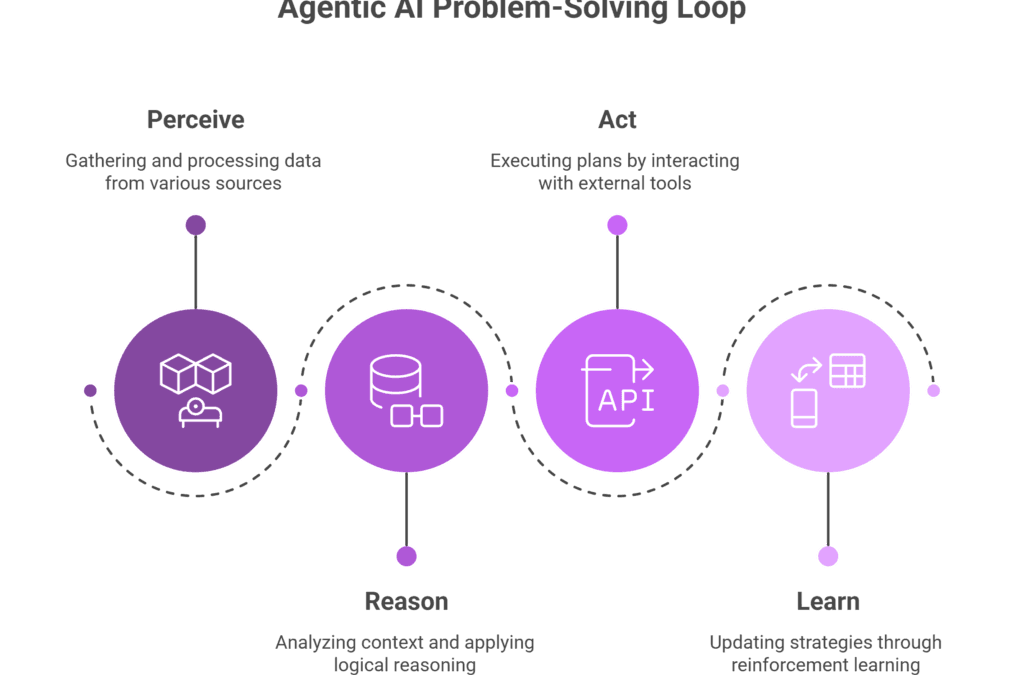
Agentic AI operates through a continuous perceive-reason-act loop. The agent gathers information, reasons about what to do, takes an action, then checks the result and repeats until the goal is met. This loop is what separates agents from one-shot chatbots.
Understanding this loop is the single most useful thing a non-technical founder can learn about agentic AI. Here’s how each stage works in practice:
- Perceive: The agent ingests its current state — a user request, data from your database, an incoming WhatsApp message, or the result of its last action. AI agents can independently determine their next actions based on previous outcomes, like deciding whether to search the web or call an API (r/AI_Agents discussion, Jan 2025).
- Reason: The model plans. It breaks a big goal (“reconcile this month’s invoices”) into steps, decides which tool fits each step, and predicts what should happen next. This is where the large language model does its thinking.
- Act: The agent calls a tool — sends an email, queries a database, posts to an API, updates an ERP record. Tool calling is the muscle behind the brain.
- Reflect and loop: The agent checks whether the action worked. Did the payment process? Did the email send? If something failed, it adapts and tries a different path, looping until success or until it hits a stop condition you’ve set.
A Worked Example: An Invoice-Reconciliation Agent
To make the loop concrete, walk through a typical invoice-reconciliation agent step by step:
- Perceive: The agent reads a list of unpaid invoices from the accounting system and a list of incoming bank transactions for the month.
- Reason: For each transaction, it plans how to find a matching invoice — by amount, reference number, and customer name — and decides which records are confident matches versus ambiguous ones.
- Act: It marks the confident matches as paid in the ERP via an API call, and writes the ambiguous ones to a “needs review” queue instead of guessing.
- Reflect and loop: It verifies each update succeeded, retries on a transient API error up to a fixed limit, and stops when every transaction is either reconciled or escalated.
Notice the trade-off in the third step: the agent is deliberately not autonomous on ambiguous matches. That boundary is a design choice, not a limitation — and it is the difference between a useful agent and a costly one.
The Three Components That Make Agents Tick
Every agentic system runs on three pillars, and skipping any of them produces a brittle bot:
- Reasoning engine (the LLM): Models like GPT-4o, Claude, or Llama provide the decision-making. This is the planner.
- Tools (the hands): APIs, databases, email senders, web search, code execution. Tools let the agent affect the real world instead of just talking about it.
- Memory (the notebook): Short-term memory tracks the current task; long-term memory (often a vector database) stores context across sessions so the agent doesn’t forget what it learned yesterday.
Memory is the part most explainers gloss over. Without it, an agent re-solves the same problem every time, burning tokens and money. With it, your custom AI agent architecture compounds in value — the more it runs, the smarter and cheaper it gets per task.
How Is Agentic AI Different From Generative AI and Chatbots?
Agentic AI makes decisions and takes autonomous action to keep a process going, while generative AI like ChatGPT simply reacts to input and creates output (Shalini Goyal on LinkedIn, Sept 2025). The difference is action versus reaction.
Generative AI is reactive by design. You prompt, it responds, the interaction ends. A customer support chatbot built on pure generative AI answers a question and stops — it can’t actually issue the refund, update the ticket, or notify the warehouse. Agentic AI closes that gap by adding planning, tools, and persistence.
Here’s a direct comparison of the three categories businesses confuse most often:
| Capability | Chatbot | Generative AI | Agentic AI |
|---|---|---|---|
| Responds to questions | Yes (scripted) | Yes (flexible) | Yes |
| Plans multi-step tasks | No | Limited | Yes |
| Calls external tools/APIs | Rarely | No (alone) | Yes |
| Takes autonomous action | No | No | Yes |
| Adapts when something fails | No | No | Yes |
| Remembers across sessions | No | No (by default) | Yes (with memory) |
The practical takeaway for SMEs: a chatbot deflects tickets, but an agent resolves them. Because agentic systems can scale up an operation without adding new employees, they free human work hours that can be redirected to higher-value problems. That’s the line between a cost center and a force multiplier.
One warning worth repeating: more autonomy is not automatically better. An agent that can act on your bank account needs far tighter guardrails than one that drafts blog posts. Match autonomy to consequence.
Why Is Agentic AI Important for Startups and Small Businesses in 2026?
Agentic AI matters for SMEs because it automates entire workflows — not just single tasks — letting small teams operate like larger ones without the headcount or enterprise software costs. The technology that powered large-enterprise automation a few years ago is now accessible to a 5-person startup.
Most coverage of agentic AI targets banks, manufacturers, and global enterprises. That leaves a glaring gap, because the businesses with the most to gain from automation are the ones with the fewest hands. A 4-person agency can’t hire a 24/7 operations team. An agentic system gives them one.
Here’s where SMEs commonly deploy agents today:
- Sales: Agents qualify inbound leads, enrich contact data, schedule meetings, and update the CRM — collapsing a multi-step manual process into seconds.
- Customer support: WhatsApp and web agents resolve common requests end-to-end, escalating only the genuinely complex cases to humans.
- Finance: Agents reconcile invoices, flag anomalies, and chase overdue payments inside your ERP.
- Marketing: Agents draft, localize, and schedule campaigns — including bilingual English/Arabic content across Gulf, Egyptian, and Modern Standard dialects.
- Operations: Agents monitor inventory, trigger reorders, and sync data across disconnected tools.
The cost objection is real and worth naming directly. Every reasoning step, loop, and tool call consumes tokens, so a poorly designed agent can rack up surprising bills. This is exactly why many practitioners favour self-hosted orchestration over per-task SaaS pricing. Running agents on an open-source tool like n8n instead of metered SaaS platforms can substantially reduce recurring automation costs for high-volume workflows while keeping your data in-house. The exact saving depends entirely on your volume and architecture, so before you commit, model the cost per task yourself rather than trusting a headline percentage — our AI automation ROI calculator is one way to do that.
The SME Adoption Curve Is Accelerating
Industry sources widely describe agentic AI as the next evolution of generative AI, with adoption shifting from experimentation toward production deployment. The companies winning aren’t the ones with the biggest models — they’re the ones with the clearest workflows and the tightest guardrails. Agentic AI rewards operational clarity, which is precisely where focused small teams can out-execute bloated enterprises.
What Are the Risks and Costs of Agentic AI?
The main risks of agentic AI are cost unpredictability, reliability failures, and over-autonomy — an agent that loops endlessly or takes a wrong action without oversight. Smart implementation pairs the model’s flexibility with deterministic business rules and human checkpoints.
Let’s be honest about the failure modes, because vendors rarely are:
- Runaway token costs: Reasoning, looping, and tool use all burn tokens. An agent stuck in a retry loop can quietly cost real money. Solution: hard loop limits and budget caps on every agent.
- Sycophancy and hallucination: LLMs sometimes confidently do the wrong thing. An agent that “yes-machines” its way through a financial task is dangerous. Solution: deterministic validation on anything irreversible.
- Over-autonomy: Just because an agent can act doesn’t mean it should act unsupervised. Solution: human-in-the-loop approval for high-consequence actions.
- Security and data exposure: Agents with API access are an attack surface. Solution: least-privilege permissions and self-hosting sensitive workflows.
The U.S. NIST AI Risk Management Framework offers a practical, vendor-neutral structure for governing autonomous systems — worth reading before any production deployment. A sound principle: run every production agent inside transparent guardrails with human oversight on the actions that matter. Autonomy is earned, not assumed.
Actionable Takeaways: How to Start With Agentic AI
Don’t try to automate everything at once. The fastest path to value is one well-scoped agent solving one expensive, repetitive problem. Here’s a sequence practitioners commonly follow:
- Pick a painful, repetitive workflow. Lead follow-up, invoice reconciliation, and first-line support are proven starting points.
- Map the perceive-reason-act loop manually. Write down what data the agent needs, what decisions it makes, and what tools it touches.
- Add deterministic guardrails before autonomy. Define what the agent can never do without human approval.
- Start self-hosted to control costs. Use n8n or a similar orchestrator before reaching for expensive per-task SaaS.
- Measure ROI from day one. Track hours saved, error rate, and token cost per task. If it doesn’t pay back, redesign it.
- Scale into a multiagent system only when one agent proves out. Add orchestration once your first agent earns its keep.
The businesses that win with agentic AI won’t be the ones who adopted first. They’ll be the ones who adopted deliberately — pairing autonomy with accountability, and treating every agent as a teammate that still needs a manager. The vending machine era of AI is ending. The question isn’t whether your operations will run on agents, but whether those agents will be built to follow your rules or someone else’s defaults.
Frequently Asked Questions
What is agentic AI and how does it work in simple terms?
Agentic AI is AI that completes goals on its own by planning, using tools, and adapting until a task is finished. It works through a perceive-reason-act loop: it gathers data, decides what to do, takes action through tools, then checks the result and repeats. Unlike a chatbot that just answers, an agent actually gets work done.
What’s the difference between agentic AI and generative AI?
Generative AI reacts to a prompt and produces output, then stops — like ChatGPT writing an email. Agentic AI takes autonomous action to keep a process going, such as actually sending that email, logging it, and following up. The core distinction is that generative AI creates content while agentic AI completes tasks.
How much does agentic AI cost for a small business?
Costs vary because agents consume tokens for every reasoning step, loop, and tool call. Self-hosting orchestration on an open-source tool like n8n can reduce recurring automation costs versus metered per-task SaaS platforms for high-volume workflows, though the exact saving depends on your volume and design. Always model the cost per task and expected hours saved before deploying.
Is agentic AI safe to use without a technical team?
Yes, if it’s built with deterministic guardrails and human oversight on high-consequence actions. The danger comes from over-autonomy — letting an agent act unsupervised on irreversible tasks like payments. Frameworks like the NIST AI Risk Management Framework help non-technical teams govern agents responsibly, and a hands-on implementation partner handles the architecture.
What is a multiagent system in agentic AI?
A multiagent system is several AI agents coordinated through an orchestration layer, where each agent handles a specialized role and a supervisor agent combines their work. For example, one agent researches, another writes, and a third reviews. Multiagent systems handle complex workflows that a single agent couldn’t manage alone.
Sources & References
- IBM — What is agentic AI?
- Agentic.ai — What Is Agentic AI? A Complete Guide
- Shalini Goyal — Working of Agentic AI Visualized (LinkedIn, Sept 2025)
- r/AI_Agents — Discussion on agentic AI and its types (Jan 2025)
- NIST — AI Risk Management Framework
Editorial note on methodology: statistics in this article are linked to their primary sources where available. Statements framed as “practitioners commonly” or “a typical implementation” describe general patterns in how agentic systems are built and are not first-party performance claims. This article reflects generic topical expertise in AI automation and is not a substitute for tailored technical or legal advice.
Note: This article is for general informational purposes; verify specifics against your own context.