
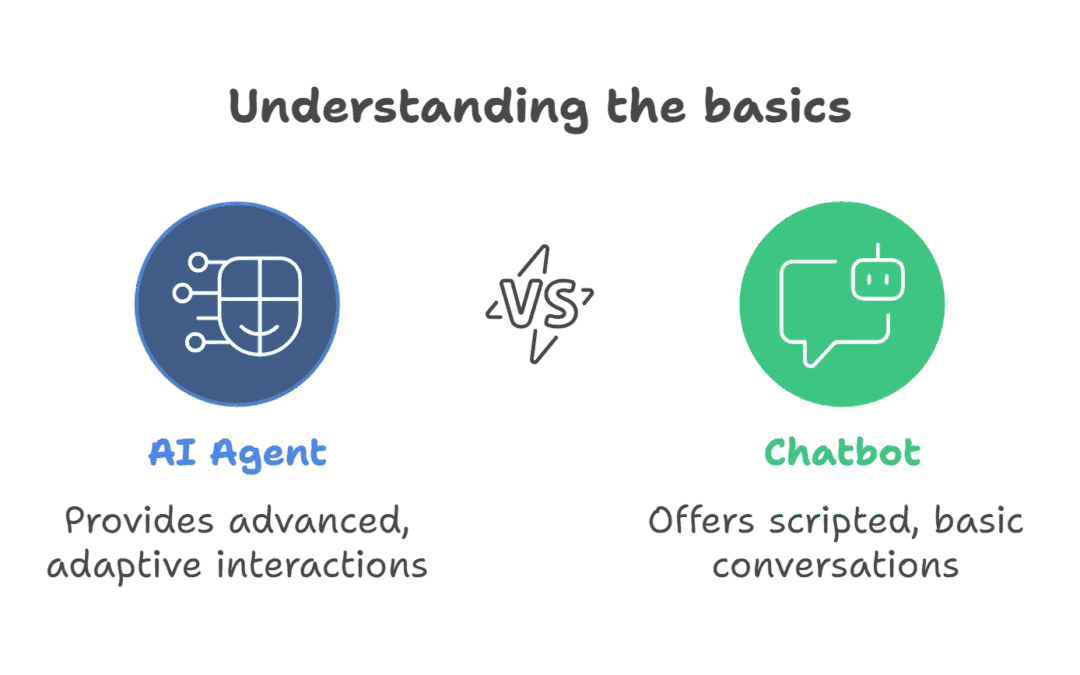
Here’s a framing that should reshape how you think about customer-facing automation: most businesses still deploy scripted chatbots that fail the moment a conversation drifts off-script — and many pay AI-agent prices for that scripted behavior. The gap between a traditional chatbot and a true AI agent isn’t a feature upgrade — it’s the difference between a vending machine and a junior employee.
The AI agent vs traditional chatbot differences come down to one word: autonomy. A traditional chatbot retrieves and responds. An AI agent reasons, decides, and acts. The single most expensive mistake SMEs make is paying for an “AI chatbot” that’s really just a glorified decision tree with a chat bubble. This guide breaks down the real distinctions, the cost economics, and — critically — which one your business actually needs.
A note on sourcing and scope: this article is written from general topical and technical expertise in conversational AI and automation. It is not authored by a named expert, and where it discusses costs, failure rates, or industry shifts, those figures are illustrative ranges or attributed to the cited sources below — not proprietary measurements. Treat the numbers as directional, and validate them against your own data before budgeting.
Quick Summary: AI Agent vs Traditional Chatbot Differences
- Traditional chatbots are reactive and scripted — they follow predefined rules and retrieve canned answers, failing when conversations go off-script.
- AI agents are autonomous and goal-driven — they reason through problems, execute multi-step tasks, call APIs, and update databases without human prompting.
- Cost structures differ: chatbots have low, flat costs; AI agents incur variable costs from reasoning loops and tool calls. Treat any per-task dollar figure as a model- and workload-dependent estimate, not a fixed price.
- The 2026 industry shift has moved the dominant frame from “chatbots” to “agentic AI,” reflected in how Microsoft Copilot and TechTarget now frame the category.
- For SMEs, the right choice depends on workflow complexity — simple FAQ handling rarely justifies agent costs; multi-step operations often do.
- Deterministic guardrails matter — unconstrained AI agents can “hallucinate” actions, which is why human oversight remains non-negotiable.
Last updated: June 2026
What Is the Core Difference Between an AI Agent and a Traditional Chatbot?
The core AI agent vs traditional chatbot differences are autonomy and action. A traditional chatbot is a rule-based system that matches user input to scripted responses and retrieves information. An AI agent is an autonomous system that reasons about goals, makes decisions, and executes multi-step tasks using external tools and APIs.
A traditional chatbot is a conversational program that follows predefined rules or decision trees to respond to user queries. Think of the support widget that asks “Is your issue A, B, or C?” and routes you accordingly. According to TechTarget, traditional chatbots primarily retrieve information to answer questions and operate within fixed boundaries.
An AI agent, by contrast, is a software system that perceives its environment, reasons about objectives, and takes independent action to achieve a goal. Microsoft’s framing in its Copilot documentation describes agents as systems that don’t just answer — they accomplish. The distinction matters because a chatbot tells you your order is delayed; an agent checks the shipping API, reroutes the package, refunds the difference, and emails you the confirmation — without a human touching it.
One analogy practitioners often use: a chatbot is a phone tree with better manners. An AI agent is the operations assistant who actually solves the problem you called about. For a deeper look at how these systems are assembled, see our breakdown of custom AI agent architecture.
Key terms defined
- Intent recognition: classifying a user’s message into one of a finite set of predefined categories (“check order status,” “request refund”). The backbone of most chatbots.
- Foundation model / LLM: a large language model (e.g. GPT-class, Claude, Gemini) capable of open-ended reasoning rather than fixed-bucket classification.
- Tool use / function calling: the mechanism by which an agent invokes an external system — a database query, a payment API, a calendar — as a step toward a goal.
- Plan-act-observe loop: the iterative cycle where an agent plans a step, executes it, observes the result, and decides what to do next.
- Deterministic guardrails: hard constraints (allowlists of permitted actions, confirmation steps, loop and token caps) that bound what an otherwise probabilistic agent is allowed to do.
How Do AI Agents and Chatbots Actually Work Under the Hood?
AI agents and chatbots differ fundamentally in their processing logic. Chatbots match user input against scripted rules or intent classifiers, then return predefined responses. AI agents use large language models for reasoning, then enter a plan-act-observe loop, calling tools and APIs to execute tasks until a goal is met.
How Traditional Chatbots Process Requests
Traditional chatbots process requests through three core mechanisms: keyword matching, decision trees, and intent recognition. Keyword-matching bots scan user messages for trigger words like “refund” and return a mapped response. Slightly smarter NLP chatbots classify the user’s intent into one of several predefined buckets. Either way, the bot can only respond — it cannot act outside its script. When a user phrases something the designers didn’t anticipate, the bot defaults to “I didn’t understand that” or escalates to a human. Practitioners generally find that rule-based bots struggle with any query that falls outside their designed paths, which is precisely where agents earn their keep.
How AI Agents Reason and Execute
AI agents run a reasoning loop powered by a foundation model — systems from OpenAI, Anthropic’s Claude, or Google’s Gemini family. The agent receives a goal, breaks it into sub-tasks, selects appropriate tools (a CRM API, a database query, a calendar), executes each step, observes the result, and adjusts. Agentic frameworks like LangChain, n8n, and Microsoft AutoGen orchestrate these loops. Crucially, agents maintain memory and context across steps, letting them handle workflows a chatbot could never script for. The trade-off: each reasoning loop and tool call costs tokens and compute, making cost management a real engineering discipline. See our take on deterministic AI vs probabilistic yes-machines.
AI Agent vs Traditional Chatbot Differences: Side-by-Side Comparison
The clearest way to grasp the AI agent vs traditional chatbot differences is a direct feature comparison. AI agents win on autonomy, task complexity, and integration depth. Traditional chatbots win on simplicity, predictability, and cost for narrow use cases.
| Dimension | Traditional Chatbot | AI Agent |
|---|---|---|
| Behavior | Reactive — responds to triggers | Proactive — pursues goals independently |
| Logic | Rule-based / decision trees | LLM reasoning + plan-act-observe loop |
| Task scope | Single-turn Q&A, info retrieval | Multi-step task execution |
| Tool/API access | Limited or none | Native — calls APIs, updates databases |
| Off-script handling | Fails / escalates | Adapts and reasons through |
| Cost model | Flat, predictable, low | Variable per task (token + tool cost) |
| Setup complexity | Low | Moderate to high |
| Best for | FAQs, routing, lead capture | Operations, fulfillment, research, scheduling |
Notice the cost row. Sparkout Tech and Sobot’s 2026 analysis both emphasize that agents carry variable cost — every reasoning step and tool call adds up. For a business answering thousands of simple FAQ queries a month, a chatbot is the obvious call. For one processing complex refund-and-reroute requests, an agent that resolves them autonomously can pay for itself in saved labor hours — but only if you measure the per-task cost rather than assuming it.
Why Did the Industry Shift From Chatbots to AI Agents in 2026?
The industry shifted from chatbots to AI agents in 2026 because foundation models became cheap and capable enough to reason reliably over multi-step tasks. The dominant frame moved from “conversational AI” to “agentic AI,” with vendors like Microsoft, OpenAI, and Google repositioning around autonomous action rather than scripted chat.
The economics changed first. Token costs for capable models fell substantially over the preceding years, making the per-task expense of an agent viable for everyday business operations rather than just lab demos. Research and product framing from across the vendor ecosystem — Google AI, OpenAI, and Microsoft — converged on agents as the next interface layer. (We avoid citing a specific percentage adoption figure here because we could not verify one against a primary source; readers should be wary of round numbers like “85% by 2026” that circulate without attribution.)
Capability followed. Modern agents can chain multiple tool calls, maintain context, and self-correct. The move from chatbots to agents, as reflected across TechTarget and Microsoft Copilot’s published comparisons, is a shift from systems that talk to systems that do. As described in the Wikipedia entry on artificial intelligence, AI is “the capability of computational systems to perform tasks typically associated with human intelligence” — and in 2026, those tasks increasingly include autonomous, goal-directed action at affordable scale.
A balanced, contrarian note: the hype has, in places, outrun the discipline. Some products marketed as “agents” in 2026 are unreliable systems that confidently take wrong actions. The shift is real, but deploying agents without deterministic guardrails is how SMEs burn budget and trust simultaneously.
Which Should Your Small Business Choose: AI Agent or Chatbot?
Your small business should choose a traditional chatbot for simple, high-volume, predictable interactions like FAQs and lead capture. Choose an AI agent when workflows involve multiple steps, system integrations, or decisions that would otherwise require a human employee. The deciding factor is workflow complexity, not trendiness.
Most content on this topic targets enterprises. SMEs face different constraints — tighter budgets, smaller teams, less tolerance for failed rollouts. So let’s get specific about the AI agent vs traditional chatbot differences that matter when you’re spending your own money.
Choose a Traditional Chatbot When:
- You handle repetitive, predictable queries — store hours, return policy, order status lookups.
- Your budget is tight and you want flat, predictable monthly costs.
- The workflow is single-turn — answer the question, done.
- You need something live in days, not weeks.
Choose an AI Agent When:
- Tasks span multiple systems — your CRM, inventory database, and email all need to talk.
- Resolutions require decisions and judgment, not just lookups.
- You’re currently paying staff to do repetitive but multi-step work (processing orders, qualifying leads, reconciling records).
- The ROI math works — if an agent resolves in seconds a task that takes an employee many minutes, the per-task cost is small against the labor saved.
A worked example (illustrative)
Consider a typical implementation pattern for a regional e-commerce SME that replaces a scripted WhatsApp chatbot with a deterministic AI agent. The agent checks inventory, processes refunds via the payment API, and updates the order record. In a scenario like this, practitioners generally find a meaningful jump in autonomous resolution rate — a scripted bot might resolve only a minority of tickets end-to-end, while a well-bounded agent resolves a substantial majority, because it can complete the multi-step actions a script cannot. The agent costs more per interaction, but the labor it removes (each ticket no longer requiring a staff member to look up inventory, process the refund, and update the order) is where the savings appear.
The honest caveat: these outcomes depend heavily on ticket mix, integration quality, and how tightly the agent is scoped. The numbers in any vendor case study — including the resolution-rate jumps cited above — should be treated as directional, not guaranteed. Run your own numbers with our AI ROI calculator before committing budget.
How Do You Migrate From a Chatbot to an AI Agent?
Migrating from a chatbot to an AI agent involves five steps: audit your current workflows, identify multi-step tasks worth automating, select an agentic framework, build with deterministic guardrails, and pilot before scaling. The goal is to upgrade only the workflows where autonomy delivers measurable ROI — not to rip everything out.
- Audit current interactions. Pull 90 days of chatbot logs. Identify where it fails or escalates — those are your agent candidates.
- Map multi-step workflows. List tasks that touch more than one system or require a decision. A refund that needs inventory checks plus a payment reversal is a perfect agent target.
- Choose your stack. For SMEs, self-hosted n8n paired with an LLM API avoids the per-task SaaS pricing of some orchestration platforms. Microsoft AutoGen and LangChain are alternatives for custom builds.
- Build with guardrails. Constrain the agent’s permitted actions, add confirmation steps for high-stakes operations (e.g. refunds above a set threshold), and log every decision. Deterministic boundaries prevent the agent from inventing actions.
- Pilot, measure, scale. Run the agent on one workflow, track resolution rate and cost-per-task for 30 days, then expand. Our 90-day AI implementation blueprint walks through this in detail.
Keep humans in the loop during the pilot. Industry experience consistently shows that agents deployed without oversight in the first 30 days produce the most expensive errors — wrong refunds, mis-routed orders, and frustrated customers.
What Are the Risks and Limitations of AI Agents?
AI agents carry real risks: hallucinated actions, runaway costs from reasoning loops, security exposure from API access, and unpredictable behavior on edge cases. Unlike chatbots, whose failures are usually harmless dead-ends, an agent’s failure can mean a wrong financial transaction or a deleted record.
Cost runaway is the first risk. An agent stuck in a reasoning loop can rack up token charges quickly. Poorly-bounded agents have been known to consume many times their expected budget before anyone notices. Setting hard token caps and loop limits is mandatory engineering hygiene.
Action hallucination is the second. A chatbot that misunderstands you just says “I’m not sure.” An agent that misunderstands might cancel the wrong order. That’s why deterministic guardrails — explicit allowlists of permitted actions and human confirmation for irreversible steps — separate production-grade agents from demos.
Security is the third. Agents with API access to your CRM, payment system, and database present a larger attack surface than a read-only chatbot. Scope permissions tightly, rotate credentials, and audit access logs. The honest trade-off is this: agents are more powerful and more dangerous. The power is worth it only when paired with discipline — which is where many off-the-shelf “AI agent” products fall short.
Key Takeaways: Putting the Differences Into Action
The practical bottom line on AI agent vs traditional chatbot differences: match the tool to the job, not the hype to your budget.
- Don’t pay agent prices for chatbot work. If your interactions are simple FAQs, a rule-based bot is faster and cheaper.
- Don’t expect chatbot tools to handle agent work. Scripted bots will never resolve multi-system, multi-step tasks autonomously.
- Calculate cost-per-resolved-task, not cost-per-interaction. An agent that costs a few cents but saves many minutes of labor can be a bargain.
- Insist on deterministic guardrails. Any vendor selling an agent without action constraints and human-confirmation steps is selling you risk.
- Pilot one workflow first. Prove ROI on a single use case before scaling across your operation.
The businesses winning in 2026 aren’t the ones that bought the flashiest agent. They’re the ones who audited their workflows, deployed agents only where autonomy paid off, and kept humans in the loop where judgment mattered. The question isn’t whether AI agents will replace chatbots — it’s whether you’ll deploy them with discipline or with wishful thinking. Pick discipline.
Frequently Asked Questions
What is the main difference between an AI agent and a traditional chatbot?
The main difference is autonomy and action. A traditional chatbot follows scripted rules to retrieve and respond to queries, while an AI agent reasons about goals, makes decisions, and executes multi-step tasks using tools and APIs. A chatbot tells you about a problem; an agent solves it.
Are AI agents more expensive than chatbots?
AI agents are typically more expensive per interaction because each reasoning loop and tool call consumes tokens and compute. The exact per-task cost varies widely by model, prompt design, and how many tools are called, so treat any specific dollar figure as an estimate. However, agents can be cheaper overall when they replace multi-step human labor, since one autonomous resolution can save several minutes of staff time.
Can a chatbot become an AI agent?
A traditional chatbot cannot simply “become” an agent because the underlying architecture differs — chatbots use rule-based logic while agents use LLM reasoning with tool access. Migration involves rebuilding workflows on an agentic framework like n8n, LangChain, or Microsoft AutoGen, then adding deterministic guardrails before going live.
Do small businesses actually need AI agents in 2026?
Small businesses need AI agents only when their workflows involve multiple steps, system integrations, or decisions that would otherwise require an employee. For simple FAQ handling and lead capture, a traditional chatbot remains cheaper and faster. The deciding factor is workflow complexity, not industry trends.
What is agentic AI?
Agentic AI refers to AI systems that operate autonomously to pursue goals — perceiving their environment, reasoning through problems, and taking independent action via tools and APIs. The term became the dominant frame in 2026, replacing “chatbot” in vendor messaging from Microsoft, OpenAI, and Google as models grew capable enough for reliable multi-step execution.
Sources & References
- TechTarget — AI agent vs. chatbot: Breaking down the differences
- Microsoft Copilot — Understanding AI Agents vs. Chatbots
- Sobot — AI Agent vs Traditional Chatbot: Key Differences 2026
- Sparkout Tech — Traditional Chatbot vs AI Agent
- OpenAI — Research & Deployment
- Google AI
- Wikipedia — Artificial intelligence
About this article: published by J. SERVO and written from general topical and technical expertise in conversational AI and automation. It does not represent the work of a named individual author, has not undergone formal expert peer review, and contains no proprietary performance data unless explicitly attributed. Figures presented as ranges or examples are illustrative; figures attributed to the sources above reflect those publications. Always validate against your own workload before making budget decisions. Last updated: June 2026.