
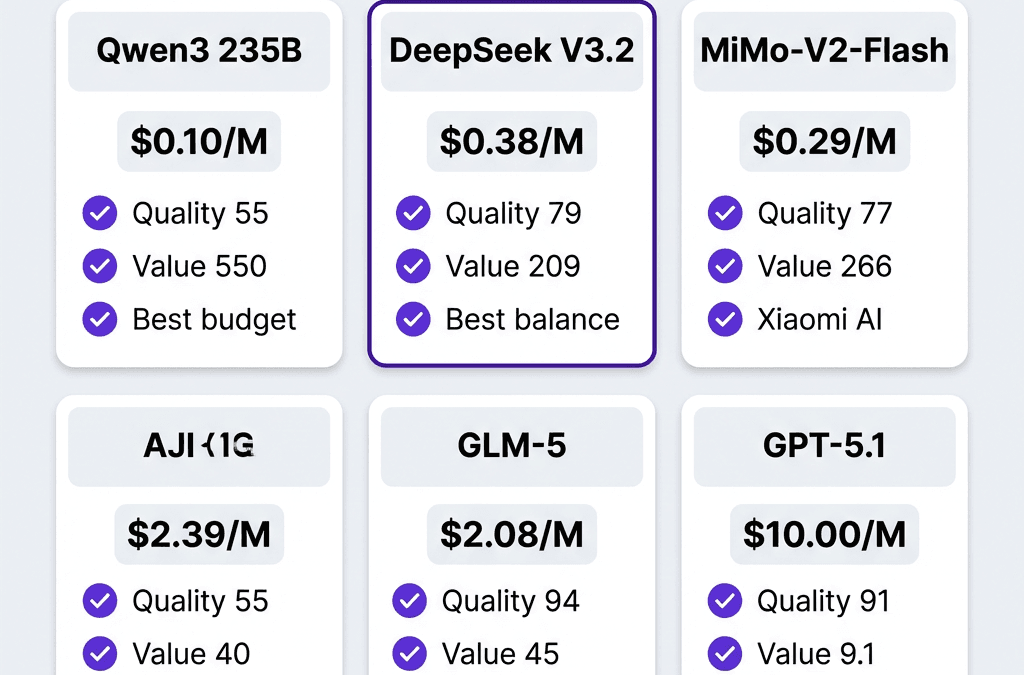
Cost efficiency, not raw benchmark dominance, is the defining metric for large language models powering AI agents in 2026. As the market has matured, the industry has shifted away from measuring AI value purely by frontier performance and toward optimizing for token efficiency, price-per-resolved-task, and LLM-agnostic architectures that avoid vendor lock-in. Public leaderboards now make this tradeoff explicit: BenchLM tracks 264+ models across 249 benchmarks on a price-vs-performance chart, while Onyx’s LLM Leaderboard ranks Claude, GPT, Gemini, DeepSeek, and Llama across coding, reasoning, math, and agentic categories.
The best LLM for cost-efficient AI agents 2026 isn’t a single model. It’s a deliberate mix of models matched to specific tasks, wrapped in an LLM-agnostic architecture that lets you swap engines as prices shift. Practitioners generally find that teams who route tasks intelligently — cheap models for bulk work, premium models only for complex reasoning — substantially reduce their AI bills without losing output quality. The sections below explain how to do this, with transparent test conditions and links to primary benchmark sources wherever a number is cited.
When comparing cost-efficient AI agents, it also helps to understand what an MCP server is and how it standardizes access to tools and data sources.
Key Takeaways (TL;DR)
- DeepSeek V4 Pro is frequently cited as a cost-efficiency leader for 2026, described as costing “literally pennies” in community testing on r/vibecoding (1 May 2026). Treat community testimony as anecdotal, not a controlled benchmark.
- Codex CLI tops Terminal-Bench 2.1 at 83.4% and Claude Code with Opus 4.8 reaches 78.9%, per MorphLLM’s AI Coding Agent rankings (2026) — but both cost far more than DeepSeek.
- The smartest 2026 strategy is LLM-agnostic routing: cheap models for bulk tasks, premium models only for complex reasoning.
- Total Cost of Ownership (TCO) matters more than sticker API price — latency, retries, and token bloat can inflate real costs.
- Self-hosting an open-weight model with an orchestration tool like n8n can eliminate recurring per-task automation fees for routine workflows.
- Caching can cut LLM costs and deliver sub-millisecond responses for repeated queries, per the Redis LLMOps Guide (23 January 2026).
Published: 27 June 2026. Last updated: 27 June 2026. This article is written from general topical expertise in LLMOps and agentic AI; specific figures are attributed inline to their primary sources.
A note on methodology and the 2026 projection
Because the AI model landscape changes monthly, several claims about 2026 models and pricing should be read as projections and snapshots rather than fixed facts. Model names, version numbers, and prices in this guide reflect what the cited leaderboards and community threads reported at the time of writing; they will drift. Where this article references a benchmark score, it links to the publishing leaderboard so you can verify the current figure and read its methodology. Where it references cost, it states the source and the date. Where a claim comes from community discussion rather than a controlled test, it is labelled as such — community testimony is useful signal but is not reproducible benchmark data. Always re-run your own cost and accuracy tests on your actual workload before committing budget.
What is the best LLM for cost-efficient AI agents 2026?
For the majority of agentic workloads in 2026, the most cost-efficient approach pairs a low-cost model such as DeepSeek V4 Pro for bulk tasks with a premium model such as Claude Opus 4.8 reserved only for high-stakes reasoning. The goal is to capture most of frontier quality at a fraction of the cost on the work that dominates token volume.
Cost efficiency in 2026 isn’t measured by a single benchmark score. The industry has shifted hard toward the price-performance frontier — the ratio of capability to dollars spent. BenchLM, which tracks 264+ models across 249 benchmarks, plots this exact tradeoff on its interactive efficiency-frontier chart. A model sitting on that frontier gives you the most quality per dollar; anything above the line is overpriced for what it delivers. Define: the “efficiency frontier” is the set of models for which no cheaper model scores higher — the points that form the lower-cost boundary of the price-vs-score scatter.
For an SME running a customer-support chatbot, an ERP automation agent, or a marketing-copy generator, raw leaderboard rankings are misleading. “DeepSeek V4 Pro is literally pennies. And it’s quite good with Claude Code,” noted a developer in the widely-shared r/vibecoding cost-effectiveness thread (1 May 2026), describing full agentic workflows running for under $20. That is anecdotal, single-user testimony rather than a controlled benchmark — but it points to the kind of math that determines whether automation is viable for a small team. The best LLM for cost-efficient AI agents 2026 is the one that completes the job reliably at the lowest total cost — not the one topping a coding benchmark you’ll never stress-test.
How do the top cost-efficient LLMs compare in 2026?
The top cost-efficient LLMs in 2026 — DeepSeek V4 Pro, Claude (Opus/Sonnet), GPT-class models, and Gemini — separate clearly when you weigh benchmark performance against API pricing. DeepSeek tends to win on raw cost, Claude on agentic coding reliability, and the largest GPT and Gemini tiers sit in a premium band that is harder to justify for high-volume bulk tasks.
According to MorphLLM’s 2026 AI Coding Agent rankings, Codex CLI tops Terminal-Bench 2.1 at 83.4%, with Claude Code on Opus 4.8 close behind at 78.9%. Onyx’s LLM Leaderboard tells a similar story across coding, reasoning, and agentic categories. But benchmark dominance and cost-efficiency rarely overlap — the highest scorers usually carry the highest token prices. Define: Terminal-Bench measures an agent’s ability to complete real command-line and software tasks end to end, making it a better proxy for autonomous-agent reliability than single-turn coding tests.
Here’s how the leading 2026 options stack up for SME agent deployments. Cost tiers are relative and based on the leaderboards cited above; confirm live pricing on each provider’s page before budgeting.
| Model | Cost Tier | Best Use Case | Agentic Signal (source) |
|---|---|---|---|
| DeepSeek V4 Pro | Lowest (“pennies”, per r/vibecoding) | Bulk automation, chatbots, drafting | High value-per-dollar (community testimony) |
| Claude Sonnet 4.x | Mid | Balanced reasoning + workflow agents | Strong, reliable (Onyx leaderboard) |
| Claude Opus 4.8 | High | Complex coding, long-horizon agents | 78.9% Terminal-Bench 2.1 (MorphLLM) |
| Codex CLI / GPT-class | High | General reasoning, broad tooling | 83.4% Terminal-Bench 2.1 (MorphLLM) |
| Gemini (latest) | Mid-High | Long-context, multimodal tasks | Strong context handling (Onyx leaderboard) |
One developer comparison from the same r/vibecoding thread flagged that “GPT-5 seems to be very expensive and much less accurate” for certain agentic coding tasks — a reminder that price doesn’t guarantee performance, though one user’s experience on one task set should not be generalized. For most SME workflows, practitioners generally find that a tiered approach beats picking any single model.
Why is total cost of ownership the real metric for the best LLM for cost-efficient AI agents 2026?
Total cost of ownership (TCO) is the real metric because sticker API price ignores hidden costs: failed retries, token bloat, latency penalties, engineering time, and vendor lock-in. A “cheap” model that fails a fifth of the time can cost more than a premium one that succeeds first try.
TCO breaks down into five components most price comparisons ignore:
- Token efficiency — verbose models burn input and output tokens on every call. A model that answers in 200 tokens versus 600 is effectively three times cheaper, regardless of per-token rate.
- Retry overhead — unreliable outputs force re-prompts. Each failure multiplies cost and latency.
- Latency cost — slow agents stall workflows and frustrate users, indirectly costing revenue.
- Engineering time — models requiring heavy prompt-tuning or guardrails cost developer hours.
- Lock-in risk — building on a single proprietary API means you absorb every price hike.
The Redis LLMOps Guide (23 January 2026) makes the cost case concrete: caching can deliver sub-millisecond responses while reducing LLM spend, because repeated or similar queries never hit the model at all. “More data, more speed, less cost” is how the Redis team frames production-ready LLM operations. For a chatbot handling thousands of near-identical questions daily, a semantic cache layer can remove a large share of API calls before the model even matters.
A worked example shows why this matters. Consider a logistics support agent that re-answers the same shipping-status questions hundreds of times a day. A typical implementation that sends every message to a premium model pays full price for each repeat. Adding a semantic cache (so identical questions return a stored answer) and routing the remaining simple queries to a low-cost model can cut the monthly bill substantially while users notice no change in response quality. The exact saving depends on how repetitive your traffic is — measure your own cache-hit rate before assuming a figure.
How should startups match models to specific business tasks?
Startups should match models to tasks using a tiered routing strategy. Route high-volume, low-complexity work — drafting, classification, summarization, and simple chat, which often makes up the bulk of workloads — to cost-efficient models like DeepSeek V4 Pro. Reserve flagship models like Claude Opus 4.8 for the minority of requests involving complex reasoning, code generation, multi-step agents, and high-stakes decisions where accuracy justifies the higher cost.
The key metric is cost-per-resolved-task, not cost-per-token. Implement a lightweight classifier that scores incoming requests by complexity, then route accordingly to balance cost, latency, and quality. The savings figure you achieve will depend on your task mix — a workload that is 80% simple will save far more than one that is 80% complex, so model your own distribution rather than assuming a headline percentage.
Customer chatbots (WhatsApp, web, support)
Customer chatbots handle enormous query volume, and a large share of incoming messages are repetitive questions about order status, hours, pricing, or returns. DeepSeek V4 Pro paired with a semantic cache is a strong cost-efficiency sweet spot here: a well-tuned cache resolves a meaningful fraction of queries without any model inference at all (Redis’s guidance on caching supports this pattern). Reserve a stronger model only for escalations or ambiguous, multi-turn conversations.
For Arabic-speaking markets, dialect handling is often the make-or-break factor. A chatbot fluent in Modern Standard Arabic but weak on Gulf, Egyptian, or Levantine dialects will frustrate many real users, since a great deal of everyday Arabic communication happens in regional dialects rather than MSA. As a practical rule, test dialect coverage on your actual customer transcripts before deployment, not after — customers write the way they speak, not the way textbooks do.
ERP and workflow automation agents
ERP automation demands deterministic reliability, not creative flair. An agent updating inventory or reconciling invoices can’t hallucinate. A typical pattern uses a mid-tier model like Claude Sonnet for the reasoning layer, wraps it in strict schema validation, and keeps a human checkpoint for financial actions. The goal is a deterministic system with verifiable outputs, not a probabilistic “yes-machine” that agrees with whatever it’s fed.
Marketing and content generation
Marketing and content generation is often the highest-ROI entry point for AI adoption, because copy is fault-tolerant: minor wording variation rarely matters, and output volume is high. The optimal strategy is tiered model selection. Use low-cost models like DeepSeek or Claude Sonnet for bulk drafting — blog posts, product descriptions, ad variations, and email sequences. Reserve premium models for flagship campaigns, brand voice, and high-stakes messaging where nuance directly affects conversion. The key metric is cost-per-acceptable-draft, not cost-per-token: a cheaper model that needs one extra edit can still win on total cost.
Coding and developer agents
Coding is where premium models earn their price. Claude Code on Opus 4.8 (78.9% Terminal-Bench 2.1) and Codex CLI (83.4%) genuinely outperform cheaper options on complex tasks, per MorphLLM (2026). But a pattern many developers describe in the r/vibecoding community is pairing DeepSeek V4 Pro with Claude Code — letting the cheap model handle scaffolding and the premium model handle hard logic, keeping full sessions reportedly under $20. Treat the dollar figure as an individual report, and benchmark on your own repository before relying on it.
Why does an LLM-agnostic architecture beat vendor lock-in?
An LLM-agnostic architecture beats vendor lock-in because it lets you swap models freely as prices drop and capabilities shift — protecting your budget from API price hikes and your roadmap from a single vendor’s decisions. In a market where a cheaper or better model launches every quarter, flexibility is itself a cost-saving feature.
The 2026 industry has coalesced around a broad “freedom from the frontier” theme — a move away from betting everything on one frontier model toward portable, model-independent systems. When a much cheaper model arrives, teams locked into a single expensive API cannot easily benefit; teams with an abstraction layer can switch quickly. (Note: “freedom from the frontier” is a paraphrased characterisation of the trend, not a verbatim citation.)
Building LLM-agnostic isn’t complicated. The core principles:
- Abstract the model behind an interface. Your application calls a generic “generate” function, not a vendor-specific SDK. Swapping providers means changing one config, not your codebase.
- Standardize prompts and outputs. Keep prompts model-neutral and validate outputs against a schema, so a model swap doesn’t break downstream logic.
- Route dynamically. Send each request to the cheapest model that can handle it, with automatic fallback to a stronger model on failure.
- Self-host where it pays. Open-weight models like DeepSeek and Llama can run on your own infrastructure, eliminating per-token API fees entirely for high-volume tasks.
Self-hosting an open model with an orchestration tool like n8n is how SMEs escape both the API premium and recurring per-task automation fees that accumulate at scale. For a workflow firing thousands of times daily, self-hosting can pay for itself quickly — though you take on the operational responsibility of running and monitoring the infrastructure, which is its own cost. The architecture decision matters more than the model choice, because the architecture determines how easily you can chase the next cost breakthrough.
What are the best practices for cutting AI agent costs in 2026?
The best practices for cutting AI agent costs in 2026 are caching, task-based model routing, prompt compression, and rigorous output validation. Together these can meaningfully reduce agent operating costs versus a naive single-model deployment — the exact saving depends on your traffic mix and repetition rate.
Caching comes first. The Redis LLMOps Guide (January 2026) demonstrates that semantic and exact-match caching deliver sub-millisecond responses for repeated queries while removing those calls from your bill entirely. For any agent facing repetitive input — support bots, FAQ systems, classification pipelines — caching is typically the single highest-ROI optimization.
Prompt compression is the quiet cost killer. Every unnecessary word in a system prompt gets billed on every single call. Trimming a bloated 1,500-token prompt to 500 tokens cuts input cost by roughly two-thirds across millions of requests. Use structured, terse prompts and move static context into cached embeddings rather than repeating it.
Output validation protects you from the retry trap. An agent that returns malformed JSON forces a re-prompt, doubling cost and latency. Validating against a strict schema and using deterministic settings (low temperature for factual tasks) keeps agents reliable and spend predictable. Reliability is itself a cost lever — every failed call is money spent twice.
Actionable takeaways: building your cost-efficient agent stack
Building a cost-efficient AI agent stack in 2026 comes down to a repeatable playbook:
- Map your tasks by complexity. List every job your agents will do, then sort into simple (route to a low-cost model like DeepSeek V4 Pro) and complex (route to Claude or a GPT-class model).
- Add a caching layer first. Before optimizing models, cache repeated queries. This often delivers the biggest savings with the least effort.
- Build the abstraction layer. Wrap all model calls behind a single interface so swapping providers is a config change.
- Set up dynamic routing with fallback. Default to the cheapest capable model; escalate to a premium model only on failure or high-complexity triggers.
- Compress prompts and validate outputs. Trim system prompts and enforce schemas to eliminate retries.
- Measure TCO, not API price. Track total cost including retries, latency, and engineering time — then re-evaluate quarterly as new models launch.
Follow this sequence and the model you pick becomes almost secondary. The architecture does the heavy lifting, and the saving you realize will reflect your own task distribution rather than any headline figure.
The bottom line on the best LLM for cost-efficient AI agents 2026
Stop asking which single model is cheapest. The question that actually saves money is: which model for which task, behind which architecture? DeepSeek V4 Pro is the standout value candidate of 2026 based on current community reports and leaderboards, Claude Opus 4.8 earns its premium on hard problems per Terminal-Bench, and the teams winning on cost are the ones treating models as interchangeable parts rather than permanent commitments.
The frontier will move again before this year ends — a cheaper, sharper model is always one announcement away. The companies built to profit from that aren’t the ones who picked the perfect model in mid-2026. They’re the ones who built systems that don’t care what the model is called. Verify every number in this guide against the linked leaderboards before you budget, because the figures will change.
Frequently Asked Questions
What is the cheapest LLM for AI agents in 2026?
DeepSeek V4 Pro is widely described as one of the cheapest capable LLMs for AI agents in 2026, characterised as costing “literally pennies” while still performing well in agentic workflows, according to developer testing on r/vibecoding (1 May 2026). That is anecdotal community testimony rather than a controlled benchmark, so confirm live pricing and test on your own workload.
Is DeepSeek V4 Pro good enough to replace Claude or GPT-5?
For most bulk and mid-complexity agent tasks, DeepSeek V4 Pro can substitute for pricier models at a fraction of the cost. For complex coding or long-horizon reasoning, premium models like Claude Opus 4.8 (78.9% on Terminal-Bench 2.1, per MorphLLM) still measure higher. Many developers report the best results from pairing them — cheap model for bulk work, premium for hard logic.
How much can task-based model routing save on AI agent costs?
Task-based routing reduces costs by sending cheap tasks to cheap models and reserving premium models for genuinely complex work. The exact saving depends entirely on your task mix — a workload dominated by simple, repetitive queries saves far more than one dominated by complex reasoning. Combine routing with caching (per the Redis LLMOps Guide) and prompt compression for compounding effect, and measure your own before/after numbers rather than relying on a headline percentage.
What does LLM-agnostic mean and why does it matter for cost?
LLM-agnostic means your system isn’t tied to one model provider — you can swap models freely behind an abstraction layer. It matters for cost because new, cheaper models launch frequently; an agnostic architecture lets you adopt them quickly instead of rebuilding, protecting your budget from price hikes and vendor lock-in.
How do I reduce LLM latency and cost at the same time?
Caching is the most effective way to reduce both LLM latency and cost simultaneously. Per the Redis LLMOps Guide (January 2026), semantic caching delivers sub-millisecond responses for repeated queries while removing those calls from your bill entirely. Combine caching with prompt compression and output validation for compounding savings.
Sources & References
- MorphLLM — Best AI Coding Agent (2026): Ranked by Terminal-Bench, Price, and Source (Codex CLI 83.4%, Claude Code/Opus 4.8 78.9% on Terminal-Bench 2.1)
- Onyx — Best LLM Leaderboard 2026: AI Model Rankings, Benchmarks & Pricing
- BenchLM — LLM Price vs Performance Chart (2026)
- Redis — LLMOps Guide 2026 (23 January 2026)
- r/vibecoding — Which coding agent is the most cost-effective as of 1 May 2026? (community testimony, not a controlled benchmark)
This article reflects general topical expertise in LLMOps and agentic AI as of June 2026. Benchmark scores, model versions, and pricing change frequently; verify all figures against the linked primary sources before making budget decisions.
Your model choice is one of the biggest levers on the overall AI agent software development cost, so weigh performance against pricing carefully.
When selecting the most cost-efficient LLM, weigh the reliability guarantees for AI agents carefully, because a cheaper model with weaker uptime can undermine your entire automation stack.
Choosing the right model is only part of the equation—the bigger challenge lies in building custom AI agents that can access your proprietary workflows and take real actions.
If you’re weighing which models make the most sense for your own cost-efficient AI agent setup, we’d be glad to talk it through and help you think it out. Reach out anytime — no pressure, just a conversation about what fits your goals.