
General information only, not legal, tax or regulatory advice. Requirements change and differ by country; confirm your obligations with a qualified advisor before acting.
What is the cost of GDPR fines for non-compliant AI chatbots 2026?
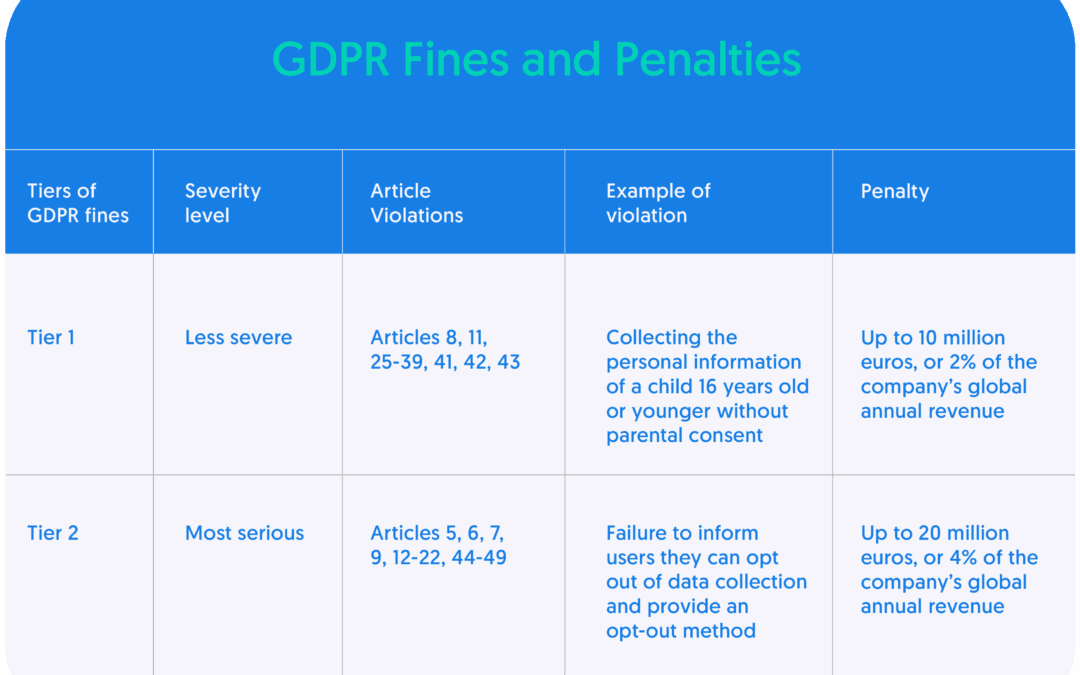
The cost of GDPR fines for non-compliant AI chatbots in 2026 can reach €20 million or 4% of global annual turnover, whichever is higher, under the two-tier structure of Article 83 of the GDPR. Cumulative GDPR enforcement has already exceeded €7.1 billion since 2018 (Improvado, GDPR Fines 2026), and AI chatbots are squarely in regulators’ crosshairs in 2026.
Picture this: a 40-person SaaS startup deploys a slick customer-support chatbot. It quietly logs every conversation, stores IP addresses indefinitely, and makes automated eligibility decisions with zero human oversight. One complaint to a data protection authority, and that company is staring down a fine that could erase a year of revenue. That’s not hypothetical fear-mongering — it is the math written into Article 83, and the enforcement record already shows authorities applying it to organisations of every size.
GDPR doesn’t care that your chatbot is “just a small tool.” Regulators fine based on global turnover, the nature of the data, and how reckless your design was. An AI chatbot that scrapes personal data without a lawful basis is a textbook violation — and in 2026, the EU AI Act stacks a second layer of obligations on top.
This article reflects generic data-protection and AI-engineering topical expertise. It is informational and is not legal advice; for binding interpretation of Article 83 or the EU AI Act, consult a qualified data-protection lawyer or your supervisory authority.
Quick Summary: Key Takeaways
- Maximum GDPR fine: Up to €20 million or 4% of global annual turnover, whichever is higher, under Article 83(5).
- Lower-tier fine: Up to €10 million or 2% of turnover for procedural and security violations under Article 83(4).
- Cumulative enforcement: GDPR fines have surpassed €7.1 billion since 2018, according to Improvado (2026).
- New 2026 layer: EU AI Act transparency rules take effect in August 2026, classifying chatbots by risk level (European Commission).
- The cheapest fix is architecture: Compliance-by-design in a custom chatbot is generally far cheaper than a single fine plus remediation.
- UK businesses: Must satisfy UK GDPR Article 22 on automated decision-making and stay ICO-ready.
Published: August 28, 2026. Last updated: September 20, 2026.
How does the GDPR Article 83 fine structure apply to AI chatbots?
GDPR Article 83 applies a two-tier penalty structure to AI chatbots: a lower tier of up to €10 million or 2% of global turnover for procedural failures, and an upper tier of up to €20 million or 4% of turnover for core data-protection violations like processing personal data without a lawful basis.
AI chatbots trip the upper tier easily because they handle exactly the kind of data regulators protect most fiercely — names, emails, support transcripts, health questions, payment hints, and behavioral signals. Per the RecordingLaw GDPR Fines and Penalties guide (2026), the European Data Protection Board (EDPB) calculates fines using a methodology that weighs the gravity of the violation, the number of affected data subjects, and whether the breach was negligent or intentional.
Here’s the part founders miss: the percentage applies to global annual turnover, not your EU revenue. A startup processing €2 million in revenue still risks proportionate penalties, and the EDPB’s Deutsche Wohnen corporate-liability ruling — analysed in the same RecordingLaw reference — confirmed that companies can be fined directly without proving an individual employee’s fault.
Real enforcement examples worth knowing
Hypotheticals only go so far; practitioners learn faster from documented cases. The GDPR Fines Database 2026 catalogues penalties by company, country, amount and violated article — a useful primary reference for benchmarking your own exposure. Two patterns recur in chatbot-adjacent cases:
- Lawful-basis failures. Conversational and AI-driven services that process personal data without a valid Article 6 basis routinely land in the upper tier. The fines database documents repeated penalties tied specifically to Article 6 and consent failures.
- Corporate-level liability. The Deutsche Wohnen decision is the clearest signal that a controller — not just a rogue employee — bears the penalty, which is why “the chatbot vendor configured it” is not a defence.
When you size your own risk, cross-reference your data practices against entries in the enforcement database rather than relying on a single headline figure.
What chatbot behaviors trigger the upper tier?
Upper-tier GDPR penalties for chatbots are triggered by a small set of recurring violations, each carrying fines up to €20 million or 4% of global annual turnover — whichever is higher:
- No lawful basis: Collecting conversation data without consent or a documented legitimate interest violates Article 6. Consent failures are among the most commonly cited causes in the 2026 fines database.
- No data minimization: Storing full transcripts and metadata you will never use breaches Article 5(1)(c), which requires data to be “adequate, relevant and limited to what is necessary.”
- Automated decisions without oversight: Denying service or making binding decisions via algorithm without human review violates Article 22’s protections against solely automated processing.
- Cross-border transfers: Piping user data to a US LLM API or third country without Standard Contractual Clauses or an adequacy decision violates Chapter V.
- No deletion mechanism: Ignoring the right to erasure under Article 17.
Chatbot operators should audit all of these before deployment. Most off-the-shelf chatbot builders hide these risks behind a friendly UI. The architecture of your AI agent determines your fine exposure far more than your privacy policy ever will.
What is the cost of GDPR fines for non-compliant AI chatbots 2026 compared to compliance investment?
The cost of GDPR fines for non-compliant AI chatbots in 2026 dwarfs the cost of building compliance into the chatbot from day one. A single upper-tier fine can hit €20 million, while a compliance-by-design rebuild for an SME is typically a one-time engineering cost — making non-compliance the most expensive line item a startup can ignore.
Run the brutal arithmetic. A company with €5 million in global turnover faces a theoretical maximum 4% fine of €200,000 — and that’s before legal fees, mandatory breach notifications, customer churn, and the reputational hit. According to the GDPR Fines Database (2026), enforcement isn’t slowing; regulators across the EU continue issuing penalties spanning small operators to billion-euro tech giants.
Now compare that to prevention. A properly architected custom chatbot with consent gating, data minimization, and audit logging is a one-time engineering investment. Practitioners generally find that bolting compliance on after a breach costs materially more than building it in from the first commit, because a post-incident rebuild also carries forensic, legal and notification overheads that a clean-sheet design avoids entirely.
| Scenario | Typical Cost Range (2026) | Recurring? |
|---|---|---|
| Upper-tier GDPR fine | Up to €20M or 4% turnover | Per violation |
| Lower-tier GDPR fine | Up to €10M or 2% turnover | Per violation |
| Breach notification + legal | Varies by incident and jurisdiction | Per incident |
| Customer churn / reputation | Hard to cap | Long-tail |
| Compliance-by-design build | One-time engineering cost | No |
Methodology note: the fine ranges above are the statutory caps in Article 83; actual penalties are set case-by-case by the EDPB methodology and are usually a fraction of the cap. The non-statutory cost rows are directional estimates, not figures from a cited dataset, and will vary widely by jurisdiction and incident severity.
The practical takeaway: many SMEs overpay the “SaaS chatbot tax” for a tool that silently increases their legal liability. A deterministic, self-hosted chatbot stack hands you control over where data lives and how long it persists — which is exactly what Article 5 demands.
How does the EU AI Act change chatbot compliance costs in 2026?
what is the cost of GDPR fines for non-compliant AI chatbots 2026 is one of the most relevant trends shaping 2026.
The EU AI Act adds a second compliance layer on top of GDPR in 2026, with its transparency rules taking effect in August 2026. According to the European Commission’s AI Act framework, the Act classifies systems by risk level and requires that users be clearly informed when they are interacting with an AI chatbot rather than a human.
GDPR governs the data; the EU AI Act governs the system. A chatbot can be GDPR-compliant on data handling yet still violate the AI Act by hiding its non-human nature or failing transparency obligations. Per the European Commission, minimal-risk systems face lighter obligations, but conversational AI generally lands in the transparency-obligated category — meaning disclosure is mandatory, not optional.
Treat transparency as an architectural commitment rather than a checkbox: a chatbot should announce itself, log its decisions, and let a human intervene — three requirements that overlap neatly with GDPR Article 22.
Dual-compliance requirements for a single chatbot
The EU AI Act and GDPR combine into one operational checklist. A typical compliant deployment satisfies these core obligations:
- Disclose AI status at the start of every conversation (AI Act transparency rules; see the European Commission framework).
- Establish a lawful basis before processing any personal data (GDPR Article 6).
- Minimize data collected and retained (GDPR Article 5).
- Enable human oversight for any automated decision producing legal or similarly significant effects (GDPR Article 22 plus AI Act human-oversight expectations).
- Maintain audit logs for both data access and model decisions.
- Honor data-subject rights, including access and erasure requests, within statutory deadlines.
Both frameworks apply simultaneously, so a single non-compliant interaction can raise exposure under each. The companies that win in 2026 treat the two regulations as one engineering spec, not two separate legal headaches. Trying to satisfy them with disconnected SaaS plugins is how compliance gaps — and fines — appear.
Why does chatbot architecture determine your GDPR fine exposure?
Chatbot architecture determines GDPR fine exposure because where data flows, how long it persists, and who can access it are all decided at build time, not in your terms of service. A poorly architected chatbot leaks personal data into third-party APIs, logs, and training sets you don’t control — the exact conditions that generate Article 83 penalties.
Think of your chatbot like plumbing in a house. You can hang a beautiful “we respect privacy” sign on the front door, but if the pipes leak personal data into the basement of some US-hosted database, regulators will find the puddle. Compliance lives in the pipes, not the signage.
Off-the-shelf builders create three structural problems. First, conversation data routes through opaque vendor infrastructure. Second, retention defaults to “forever” because storage is cheap and deletion is engineering work. Third, automated decisions happen with no logged human checkpoint — a direct Article 22 risk.
Custom, deterministic architecture flips every one of those. A self-hosted n8n-based automation layer keeps data on infrastructure you own. Consent gating happens before the first token is processed. Retention policies become code that auto-purges transcripts after a defined window. According to Softomate Solutions (June 2026), a GDPR-compliant AI chatbot in the UK specifically requires lawful basis, data minimization, UK GDPR Article 22 compliance, and ICO readiness — all of which are architectural decisions.
A worked example: tracing one chat message
Consider a single support message — “Hi, my account is locked, my email is jane@example.com.” In a typical SaaS-plugin setup that string may: (1) be sent to a third-party LLM endpoint outside the EU, (2) be retained in vendor logs indefinitely, and (3) feed an automated lock/unlock decision with no human checkpoint. That one message can simultaneously implicate Chapter V (transfers), Article 5 (retention/minimization) and Article 22 (automated decisions).
In a compliance-by-design setup the same message would: be processed on infrastructure you control or via a model with an executed Standard Contractual Clause; be stripped of unnecessary identifiers before storage; be retained only for the configured window; and route any account decision to a human queue with a logged audit trail. Same user message, radically different fine exposure — decided entirely by architecture.
Compliance-by-design checklist for SME chatbots
Compliance-by-design means building privacy and regulatory safeguards into the architecture before deployment rather than retrofitting them later. A practical SME checklist:
- Consent gate: Process no personal data before explicit opt-in.
- Data minimization: Capture only the fields the workflow actually needs.
- Retention policy as code: Auto-delete transcripts on a fixed schedule (e.g., 30, 60, or 90 days).
- Right-to-erasure endpoint: One-click deletion of a user’s data within the statutory window.
- Human-in-the-loop: Define clear escalation paths to a human agent.
- Audit logging: Immutable record of data access and AI decisions.
How do you calculate your specific GDPR fine risk for an AI chatbot?
You calculate GDPR fine risk for an AI chatbot by combining your global annual turnover, the volume and sensitivity of personal data processed, and the severity of any compliance gaps. The EDPB’s methodology starts from the applicable tier cap (2% or 4% of turnover) and adjusts for aggravating and mitigating factors.
The EDPB weighs several factors when setting an actual penalty, per the RecordingLaw 2026 guide: the nature and gravity of the infringement, whether it was intentional or negligent, the categories of personal data affected, the number of data subjects, and any cooperation with the authority. A chatbot handling special-category data — health, biometric, or political opinions — pushes you toward the high end fast.
For a practical estimate, work through these steps:
- Identify your applicable tier. Lawful-basis and data-handling failures sit in the 4% tier.
- Calculate the cap. Multiply global turnover by 4% to find your theoretical ceiling.
- Score your data sensitivity. Special-category data raises severity.
- Count affected subjects. More users mean larger fines.
- Audit your gaps. Missing consent, no deletion, no AI disclosure each add risk.
- Benchmark against real cases. Compare your profile to similar violations in the GDPR Fines Database 2026 to ground your estimate in actual outcomes rather than the statutory maximum.
A €3 million-turnover startup with a chatbot collecting health questions and no consent flow isn’t looking at a slap on the wrist — the theoretical 4% ceiling alone is €120,000, before secondary costs. Remember that the cap is a ceiling, not a default: the EDPB methodology typically lands real fines below it after weighing mitigating factors. Quantify your numbers with a structured risk assessment before deploying, alongside a standard ROI calculation.
Actionable Takeaways: Cutting Your Fine Exposure to Near Zero
what is the cost of GDPR fines for non-compliant AI chatbots 2026 plays a pivotal role in this context.
GDPR and EU AI Act fine exposure for an AI chatbot drops sharply through a handful of architectural moves you can implement before launch — most of them code, not paperwork. GDPR violations carry penalties up to €20 million or 4% of global annual turnover (Article 83(5)), while the EU AI Act adds its own penalty regime layered on top from August 2026 (European Commission). The cheapest compliance is the kind baked into the build.
Start with these, in order:
- Audit your current data flow. Map exactly where every message, IP, and identifier travels. If you can’t draw the diagram, you can’t defend it.
- Add an AI-disclosure opener. Make the chatbot announce it’s an AI on first contact — covers the August 2026 AI Act transparency rule.
- Implement consent gating. Block personal-data processing until the user opts in with a clear, logged action.
- Write retention as code. Auto-purge transcripts after 30, 60, or 90 days — whatever your lawful basis supports.
- Build a deletion endpoint. Satisfy Article 17 with one-click erasure, not a support-ticket scramble.
- Insert human oversight. Route any consequential decision to a person, satisfying Article 22 and the AI Act simultaneously.
None of these require an enterprise legal department. They require treating compliance as a design constraint instead of a disclaimer. That’s the gap between a chatbot that’s a liability and one that’s an asset.
Frequently Asked Questions
What is the maximum GDPR fine for a non-compliant AI chatbot in 2026?
The maximum GDPR fine for a non-compliant AI chatbot in 2026 is €20 million or 4% of global annual turnover, whichever is higher, under Article 83(5). This upper tier applies to core violations like processing personal data without a lawful basis (Article 6), failing to obtain valid consent, ignoring data-subject rights such as erasure, or unlawful cross-border transfers — all of which AI chatbots frequently trigger. The lower tier caps at €10 million or 2% of turnover for administrative failures. For benchmarking against real outcomes, see the GDPR Fines Database 2026.
Does the EU AI Act apply to AI chatbots in 2026?
Yes. The EU AI Act applies to AI chatbots, with its transparency rules taking effect in August 2026, according to the European Commission. Conversational AI must clearly disclose to users that they are interacting with a machine, and this obligation stacks on top of existing GDPR data-protection requirements.
How can SMEs avoid GDPR fines when deploying chatbots?
SMEs avoid GDPR fines by building compliance into the chatbot’s architecture: consent gating, data minimization, retention-as-code, a deletion endpoint, and human oversight for automated decisions. Compliance-by-design is typically a one-time engineering cost that is far cheaper than a single Article 83 penalty plus remediation, and it eliminates most fine triggers before launch.
What’s the difference between GDPR and EU AI Act chatbot obligations?
GDPR governs how a chatbot handles personal data — lawful basis, minimization, erasure — while the EU AI Act governs the system itself, mandating transparency and risk classification. A chatbot can comply with one and violate the other, so dual-compliance must be engineered as a single specification.
How much has GDPR enforcement totaled since 2018?
Cumulative GDPR enforcement has exceeded €7.1 billion in fines since 2018, according to Improvado (2026). Enforcement has continued at pace into 2026, with regulators targeting both large platforms and smaller operators, signaling that AI chatbot data practices face real, ongoing scrutiny.
Sources & References
- European Commission — AI Act: Regulatory Framework (transparency rules effective August 2026)
- RecordingLaw — GDPR Fines and Penalties: Complete Guide (2026), including the Article 83 two-tier structure, EDPB methodology and the Deutsche Wohnen ruling
- PrivacyChecker — GDPR Fines Database 2026 (enforcement tracker by company, country, amount and article)
- Improvado — GDPR Fines 2026 (€7.1B cumulative enforcement)
- Softomate Solutions — GDPR Compliant AI Chatbot UK (2026)
Note on primary sources: this article summarises and links to secondary guides that interpret Article 83 of the GDPR and the EU AI Act. For the binding legal text, readers should consult the official consolidated GDPR and AI Act on EUR-Lex and the published EDPB guidelines directly.
If you’d like to discuss GDPR considerations for your AI chatbot, get in touch for a practical, no-pressure conversation about your compliance approach.