
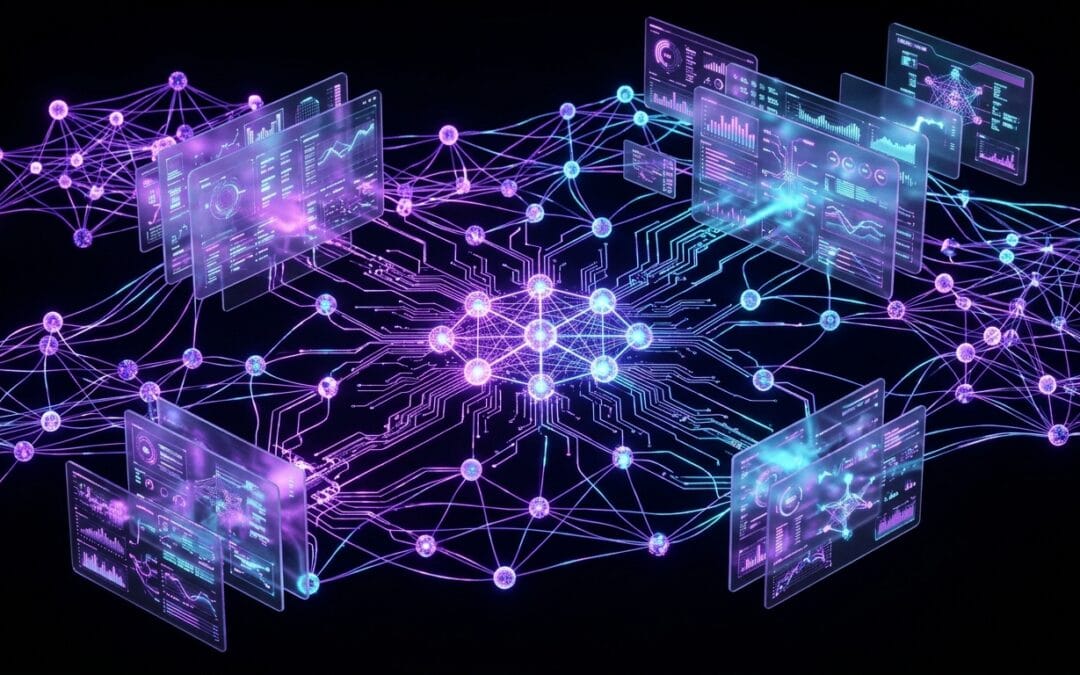
The enterprise AI landscape is currently dominated by centralized monopolies, relying on massive data centers controlled by a handful of tech giants. This centralization leads to exorbitant compute costs, strict API censorship, and single points of failure. However, a massive paradigm shift is underway in 2026: the rise of decentralized P2P AI infrastructure.
At the forefront of this movement is Hyperspace AI, a revolutionary peer-to-peer network designed explicitly for open-source model inference and agentic collaboration. By bypassing centralized servers entirely, Hyperspace is transforming how businesses deploy and scale AI agents.
What is Hyperspace AI?
Hyperspace is a fully decentralized compute network built on the libp2p protocol stack, the same robust networking layer that powers IPFS. Instead of routing your AI requests to a centralized Azure or AWS server, Hyperspace distributes the inference workload across a global swarm of independent nodes.
The network relies on explicit architectural primitives to function securely:
- Hyperspace Community Servers (HCS): These act as the backbone for network coordination and function as routing oracles to organize the swarm.
- Hyperspace Inference Nodes (HIN): These nodes provide the raw computational muscle needed for open-source model execution. Anyone can join the network to contribute their idle GPU or CPU power, forming a borderless, censorship-resistant supercomputer.
How Decentralized P2P AI Infrastructure Works
Deploying AI on a decentralized P2P infrastructure requires solving a critical problem: How do you guarantee the results are accurate if you do not control the hardware?
- GossipSub Protocols: Nodes in the network communicate via high-speed gossip protocols, instantly discovering peers who have the necessary hardware (like high-VRAM GPUs) to process a specific inference task.
- Proof of Intelligence: To prevent bad actors from returning falsified AI responses, Hyperspace utilizes cryptographic consensus mechanisms (such as zkWASM and execution proofs). The network mathematically verifies that a node actually performed the computation correctly before accepting the result.
- CRDT Data Syncing: Conflict-free Replicated Data Types ensure that the state of AI agent workflows remains perfectly synchronized across the decentralized network, enabling sub-second convergence for autonomous agent swarms without a central database.
The Era of Agentic Swarms
Perhaps the most exciting application of Hyperspace is the Hyperspace AGI initiative. Because the infrastructure is peer-to-peer, it is the perfect breeding ground for agentic swarms.
Instead of a single AI chatbot answering a prompt, users can deploy an overarching goal to the network. The decentralized P2P AI infrastructure allows thousands of autonomous agents to instantly spin up, divide the task, run concurrent experiments, and share findings with each other over the network. This distributed hive mind approach drastically accelerates research, coding, and complex problem-solving.
Why SMEs and Enterprises Should Care
For SMEs across the MENA region and globally, decentralized AI infrastructure offers several massive advantages over traditional API wrappers:
- Drastically Lower Costs: By utilizing idle community compute power, inference costs are a fraction of what centralized providers charge.
- Enterprise Data Sovereignty: To maintain privacy, enterprises can deploy private, air-gapped libp2p enterprise clusters inside the corporate perimeter. Alternatively, companies can use local nodes as anonymized orchestrators that strip sensitive IP before dispatching public compute workloads into the public swarm.
- Censorship Resistance: Open-source models deployed on a P2P network cannot be suddenly restricted, rate-limited, or deprecated by a corporate board.
Conclusion
The transition from centralized monoliths to decentralized P2P AI infrastructure is accelerating rapidly. Hyperspace AI is proving that peer-to-peer inference is not just viable, but technically superior for deploying autonomous agent swarms.
If your enterprise is looking to architect secure, cost-effective, and highly autonomous AI workflows, contact J. Servo. Our engineers specialize in building production-grade agent swarms, sovereign local clusters, and connecting decentralized compute to deterministic automation engines via n8n.