Last checked: 23 October 2026.
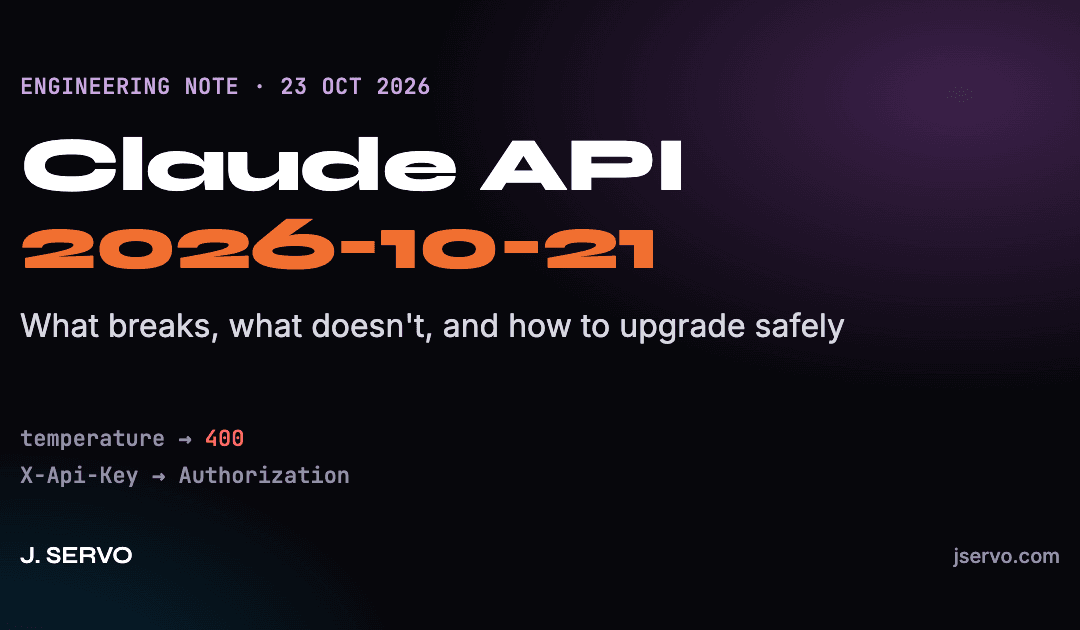
Short answer: On 21 October 2026, Anthropic released Claude API version 2026-10-21, the first new API version since June 2023. Nothing broke that day: requests that send the old 2023-06-01 version keep working. The breakage arrives when you upgrade to the new SDKs (Python 2.0.0, TypeScript 1.0.0 and their siblings), which send the new version by default. On it, temperature, top_p and top_k return a 400 error on every model, and the SDKs send your API key as Authorization: Bearer instead of X-Api-Key.
What changed in Claude API version 2026-10-21?
Anthropic’s version history lists these changes to the Messages API and the SDKs. The Admin and Enterprise Analytics APIs also rename some response fields.
| Change | What happens on 2026-10-21 |
|---|---|
temperature, top_p, top_k | Removed. Sending any of them returns a 400 error on every model, even at the parameter’s default value. |
A document block in an assistant message | 400 error. Send documents in user messages instead. |
A text block with a non-empty citations array in a user message | 400 error. Remove citations from those blocks. |
| How the SDKs send your key | Authorization: Bearer <key> instead of X-Api-Key. The API itself accepts a key in either header. |
| SDK licence | Apache 2.0 instead of MIT, from the new major versions. |
| Amazon Bedrock | The new version works only with Claude 4.7 and later models. |
Did anything break on 21 October?
No. Anthropic preserves the existing input and output parameters of each API version, and earlier SDK releases send anthropic-version: 2023-06-01 with every request. The migration guide even tells you to keep a request on 2023-06-01 if it relies on a non-default temperature.
The risk is the next upgrade. These releases, all from 21 October, are the first to send 2026-10-21 by default:
- Python SDK 2.0.0 (a plain
pip install anthropicnow installs 2.x) - TypeScript SDK 1.0.0 (the
latesttag of@anthropic-ai/sdkon npm is now 1.x) - C# SDK 13.0.0, Go SDK 2.0.0, Java SDK 3.0.0, PHP SDK 1.0.0, Ruby SDK 2.0.0 and the
antCLI 2.0.0
Any project with an unpinned dependency picks up the new version on its next install or container rebuild. That is when an automation that has run quietly for months starts returning 400 errors.
We checked n8n, LangChain and the Vercel AI SDK
J. SERVO builds n8n automations and custom AI agents for businesses in Egypt and the GCC, so on 23 October we read the published code and package metadata of the layers those builds commonly use:
| Component (checked 23 Oct 2026) | Anthropic SDK or header it uses | Affected today? |
|---|---|---|
| n8n 2.44.6 (stable) and n8n’s main branch: the Anthropic Chat Model node | LangChain Anthropic 1.5.6, which depends on TypeScript SDK 0.115.x and sends 2023-06-01 | No |
| LangChain Anthropic 1.6.0 (released 22 Oct) | TypeScript SDK 0.129.x, which sends 2023-06-01 | No |
| Vercel AI SDK Anthropic provider 4.0.87 (released 22 Oct) | Sets anthropic-version: 2023-06-01 and x-api-key itself | No |
Your own Python or Node code with an unpinned anthropic or @anthropic-ai/sdk | Python 2.x or TypeScript 1.x, which send 2026-10-21 | Yes, from the next install |
One detail matters for n8n users. n8n’s Anthropic node already drops temperature, top_k and top_p for newer models such as Claude Opus 4.7 and later and Sonnet 5. It still sends them for Claude 3 models, Sonnet 4.x, Haiku 4.x and Opus 4.6 and earlier when you set them under Options. Those nodes are the ones to clean up before n8n moves to the new SDK.
Five places this will break in practice
- Unpinned installs. A
requirements.txtline that just saysanthropic, or a Dockerfile that runsnpm install @anthropic-ai/sdk, upgrades silently on the next build. - Prompts tuned with a low temperature. Classification, routing and extraction jobs, such as sorting incoming WhatsApp messages by intent, often set
temperatureto 0 for consistent answers. On the new version that request fails. If you simply delete the parameter, Anthropic notes that on models that accept other values, such as Claude Sonnet 4.6, the request loses that effect: “No other setting replaces it.” - Proxies, gateways and firewalls that read
X-Api-Key. Self-hosted LLM gateways, Nginx rules, usage meters and log filters that look for the key inX-Api-Keywill no longer find it. - Code that set or removed
X-Api-Keyon a request. In the new SDKs, settingX-Api-Keyas an extra header no longer replaces the client’s key: both keys go out. - Older models on Amazon Bedrock. Version
2026-10-21works only with Claude 4.7 and later models there. Stay on your current SDK for older models until you switch them.
Upgrade checklist
- Find every caller. List the services, n8n workflows, scripts and serverless functions that call Claude, and how: an SDK, LangChain, the AI SDK or raw HTTP.
- Pin today. Pin
anthropic<2in Python or@anthropic-ai/sdkbelow1.0.0in Node until you have tested the new version, so nothing upgrades by accident. - Remove sampling parameters. Search your code and your n8n node options for
temperature,top_pandtop_k. Where a job depended on a low temperature, test its output without it, or keep that one request on2023-06-01. - Check the key header end to end. Make sure every proxy, gateway, firewall rule and log filter between your code and Anthropic reads
Authorization, or send the key inX-Api-Keyyourself as the migration guide shows. - Fix the two message-shape errors. Move any
documentblocks out ofassistantmessages, and stripcitationsfromtextblocks you send inusermessages. - Read your SDK’s own breaking changes. The new major versions also change some types and remove old features such as Text Completions, whatever API version you send.
- Upgrade one service at a time, on staging first, and watch for 400 errors for a few days.
- Update your licence records if you track them: the new SDKs are Apache 2.0.
If someone else built your automation: five questions to ask
Many businesses in Egypt and the GCC run a WhatsApp assistant, an n8n workflow or a custom agent that a freelancer or AI automation agency built and handed over. Breakage from this change shows up weeks later, on a routine rebuild, often after that developer has moved on. Ask your provider:
- Which of our systems call Claude, and through which SDK, n8n node or gateway?
- Is the Anthropic SDK pinned to a version, or will the next build pick up the latest one?
- Do any of our prompts rely on a low
temperaturefor consistent answers? - Does a proxy or gateway sit between our system and Anthropic, and which header does it read the key from?
- Who will test the upgrade, and how will we know if a request starts failing?
Frequently asked questions
Do I have to migrate to 2026-10-21 now?
No end date for 2023-06-01 appears in Anthropic’s migration guide or version history as of 23 October 2026. Anthropic recommends using the latest API version whenever possible, so plan the move rather than wait for a failure.
Will my outputs change if I remove temperature?
Without the parameter, a request samples with the defaults, including a temperature of 1.0. Claude 4.7 and later models already accept only the defaults, so they behave as before. On older models where you lowered the temperature, answers can become less consistent, so test those jobs.
Does this affect Claude on Amazon Bedrock or Google Cloud?
Version 2026-10-21 is available on the Claude API, Claude Platform on AWS, Microsoft Foundry and both Claude Models on Google Cloud options, including the Anthropic-managed one launched on 22 October. On Amazon Bedrock it is available for Claude 4.7 and later models only.
Is n8n affected?
Not as of 23 October 2026: n8n 2.44.6 and n8n’s main branch still use an SDK that sends 2023-06-01. Remove Sampling Temperature, Top K and Top P from your Anthropic nodes now, so the eventual n8n upgrade is uneventful.
Want a second pair of eyes on your stack? J. SERVO builds AI agents, n8n automations and WhatsApp AI for businesses in Egypt and the GCC, and every project starts with a free technical assessment. Request a free technical assessment or message us on WhatsApp.
ملخص بالعربية
أطلقت Anthropic في 21 أكتوبر 2026 إصدارًا جديدًا من واجهة Claude البرمجية هو 2026-10-21. لم يتوقف أي شيء في ذلك اليوم، فالطلبات التي ترسل الإصدار القديم 2023-06-01 ما زالت تعمل. يظهر الخلل عند تحديث مكتبات Anthropic الجديدة (Python 2.0.0 وTypeScript 1.0.0 وغيرها)، لأنها ترسل الإصدار الجديد تلقائيًا.
في الإصدار الجديد تُرفض المعاملات temperature وtop_p وtop_k بخطأ 400، وتُرسل المكتبات مفتاح API في ترويسة Authorization: Bearer بدلًا من X-Api-Key. حتى 23 أكتوبر لم تتأثر عُقد Anthropic في n8n. ننصح بتثبيت إصدار المكتبة الحالي، وإزالة معاملات الحرارة من الطلبات، والتأكد من أن أي وسيط أو بوابة بين نظامك وAnthropic تقرأ المفتاح من الترويسة الجديدة قبل التحديث.
Sources
- Claude Platform release notes, entries for 21 and 22 October 2026
- Claude API versions
- Migrating to API version 2026-10-21
- n8n source: pnpm-workspace.yaml and the Anthropic Chat Model node
- Package metadata: @langchain/anthropic, @ai-sdk/anthropic, @anthropic-ai/sdk and anthropic on PyPI