General information only, not legal, tax or regulatory advice. Requirements change and differ by country; confirm your obligations with a qualified advisor before acting.
Yes. Egypt PDPL covers AI chatbots and WhatsApp agents that handle customers’ personal data, and its grace period ended on 31 October 2026. The business behind the bot needs a lawful basis such as explicit consent, a license from the Personal Data Protection Center, a registered DPO, 72-hour breach reporting and a legal route for any data that leaves Egypt.
One fact shapes every WhatsApp agent built for Egyptian customers. Meta’s Cloud API cannot keep message data at rest in Egypt: its local storage option offers Bahrain, the UAE and South Africa in this region, not Egypt. So the first hop of every WhatsApp conversation is already a cross-border flow under Egypt PDPL’s own definition, before your model sees a word.
Last checked: 23 November 2026. This guide covers the engineering side of Egypt PDPL. It is not legal advice. Article numbers follow an English translation of Law No. 151 of 2020; the Arabic text published in the Official Gazette is the authoritative one.
In this guide
What Egypt PDPL Requires From a Chatbot
Egypt PDPL protects the personal data of natural persons that is processed electronically, in whole or in part, by any data holder, controller or processor (Article 1 of the issuing law). Personal data is anything that identifies a person directly or through linking, and the definition names voice, image, identification numbers and online identifiers. Read plainly, most of what a WhatsApp agent touches qualifies: the customer’s number, profile name, voice notes, photos and order history.
Under Egypt PDPL, the business that determines how the bot’s data is kept and processed, for a defined purpose, is the controller. A firm that runs processing on the controller’s instructions under a formal agreement is a processor. Both carry duties of their own, set out below. The source is the English text of Law No. 151 of 2020 hosted by Andersen in Egypt.
| Requirement | Article | What it means for your bot |
|---|---|---|
| Lawful basis: explicit consent, or a contract, a legal obligation or a legitimate right | 2, 6 | An order-status reply can rest on the contract; marketing and profiling need consent |
| Declared purpose, accuracy, limited retention | 3 | Collect only what the stated purpose needs and delete chat data when that purpose ends |
| Controller’s data record | 4 | Record data categories, recipients such as Meta and your model provider, erasure methods, transfers abroad and security measures |
| License or permit from the Center | 4, 5, 26 | Controllers and processors each need one; a license runs three years, a permit up to one year, both renewable |
| Data protection officer | 8, 9 | A company appoints a qualified employee, registers them with the Center and discloses the appointment publicly |
| Breach notification | 7 | Notify the Center within 72 hours and affected customers within three working days of that notice |
| Sensitive data | 12 | Health, biometric and financial data, and all children’s data, need a license and written, explicit consent |
| Cross-border transfer | 14 to 16 | Data stored or processed abroad needs an adequate destination and a license, or a listed exception |
| Direct electronic marketing | 17, 18 | Prior consent, a clear sender, an opt-out, and consent records kept for three years after the last message |
| Representative in Egypt | 4, 5 | A controller or processor located outside Egypt appoints a representative in Egypt |
Some processing sits outside Egypt PDPL: data kept for personal use, official statistics, journalism, court proceedings and national security, and data held by the Central Bank of Egypt and the entities it supervises, apart from money transfer and currency exchange companies (Article 3 of the issuing law). A clinic, a retailer, a hotel or a broker running a WhatsApp bot gets no such exclusion.
Key Dates: The Grace Period Is Over
Egypt PDPL dates from 2020, but much of it waited for its executive regulations. They define the license types, the technical standards and the procedures that the articles keep referring to. Here is the timeline, as of November 2026:
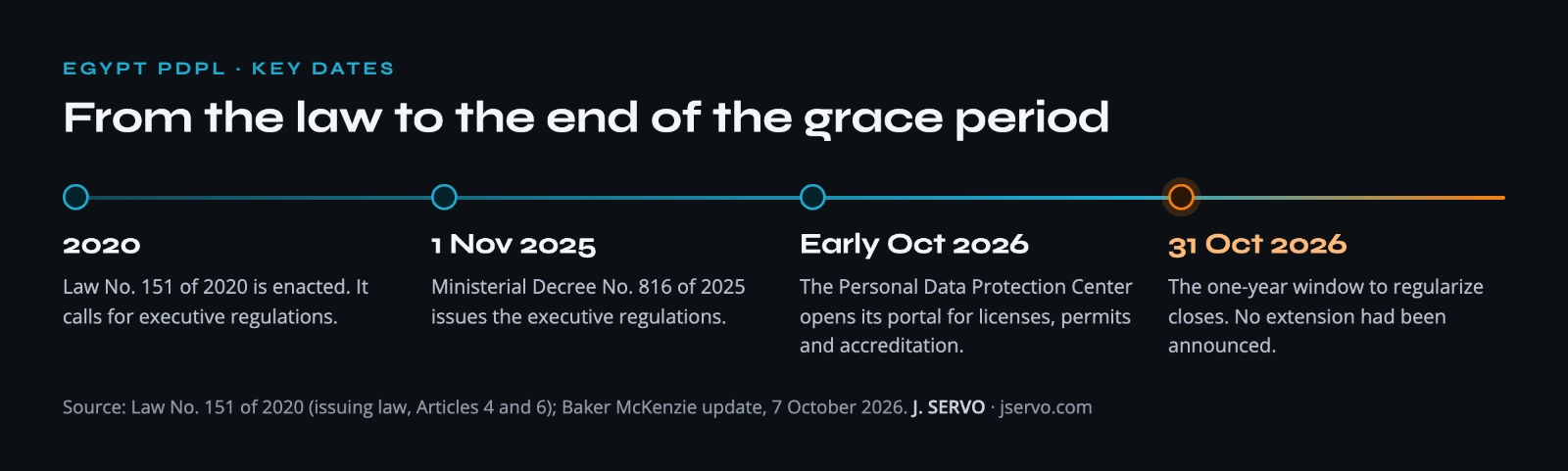
- 2020: Law No. 151 of 2020 enacted. Article 4 of the issuing law asked for executive regulations within six months of it coming into force.
- 1 November 2025: Ministerial Decree No. 816 of 2025 issued the executive regulations, according to Baker McKenzie’s Cairo office.
- Early October 2026: the Personal Data Protection Center launched an electronic portal for license, permit and accreditation applications. Sign-in runs through the Digital Egypt platform with an Egyptian national ID.
- 31 October 2026: the one-year window to regularize, set by Article 6 of the issuing law, closed.
Baker McKenzie’s update of 7 October 2026 mentions no extension. If you are reading this later, check the Center’s portal for anything newer before you plan around these dates.
Where a WhatsApp AI Agent Sends Data
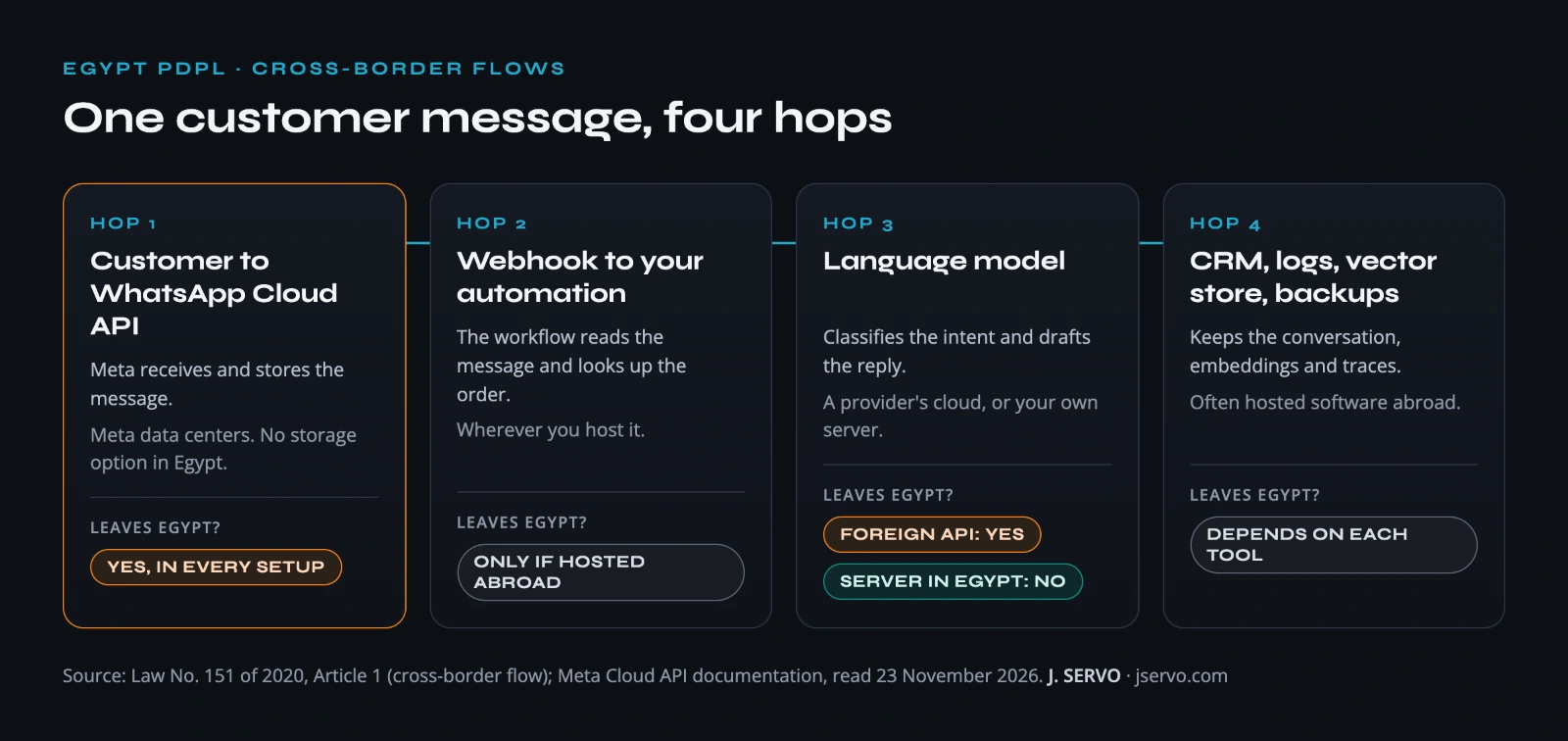
Egypt PDPL defines a cross-border flow broadly: any transfer, storage, circulation, use, display, retrieval or processing of personal data from inside Egypt to outside it, or the reverse (Article 1). Follow one customer message through a typical AI agent and you cross that line more than once.
| Hop | What happens | Where it usually runs | Cross-border under Egypt PDPL? |
|---|---|---|---|
| 1. Customer to WhatsApp Cloud API | Meta receives the message, holds the encryption keys for the business and stores it | Meta data centers; no Egyptian storage option | Yes, in every Cloud API setup |
| 2. Webhook to your automation | The workflow (for example n8n) reads the message, looks up the order, calls the model | Wherever you host it | Only if hosted abroad |
| 3. Language model | Classifies intent and drafts the reply | The provider’s cloud, or your own server | Yes for a foreign API; no for a model on a server in Egypt |
| 4. CRM, logs, vector store, backups | Keeps the conversation, embeddings and traces | Often software-as-a-service abroad | Depends on each tool |
Hop 1: Meta’s Cloud API
Meta’s Cloud API data privacy page says Meta acts as a data processor or service provider for the business, and that Cloud API customers must meet their own obligations under data protection laws. Messages are kept for up to 30 days to support features such as retransmission. Cloud API processes messages on servers in Meta data centers; the page does not say which countries.
Meta’s local storage feature keeps message content at rest in a chosen country. The supported values listed in Meta’s phone number registration documentation for the Middle East and Africa are Bahrain, the United Arab Emirates and South Africa, as of 23 November 2026. Egypt is not on the list, and neither is Saudi Arabia. Even with local storage, content may sit in Meta data centers abroad for up to 60 minutes while in use, and the contact book stays on Meta’s data centers whatever you configure.
For an Egyptian business, then, a WhatsApp agent involves a transfer abroad under Egypt PDPL from the first message. That does not rule WhatsApp out. It means the transfer has to be covered, through a license under Article 14 or Article 16 or one of the exceptions in Article 15, and written into your Article 4 record before launch rather than after a complaint.
Hop 2: Your Automation Server
This is the hop you control fully. If the webhook, the n8n workflows and the conversation database run on a server in Egypt, the working copy of each conversation stays in Egypt. If they run in a European or US cloud region, Egypt PDPL treats that as a second transfer, with the same Article 14 questions, and a second line in your record.
Hop 3: The Language Model
A model API hosted abroad receives the full message text, often with the order details and the customer’s name that the agent adds for context. Zero-data-retention terms shorten what the provider keeps. They do not change the fact that the data was processed abroad, and processing is what the definition counts.
A model running on a server in Egypt removes this hop entirely. For the routing and first-reply work most WhatsApp agents do, that is now practical, as the next section shows.
The Copies People Forget
Chat logs in a shared inbox, embeddings of past conversations in a vector database, traces in an observability tool, error reports and backups. Each one is processing under Egypt PDPL’s definition, each needs a retention rule under Article 3, and each belongs in the Article 4 record with its location.
Cloud Model or Self-Hosted Model Under Egypt PDPL
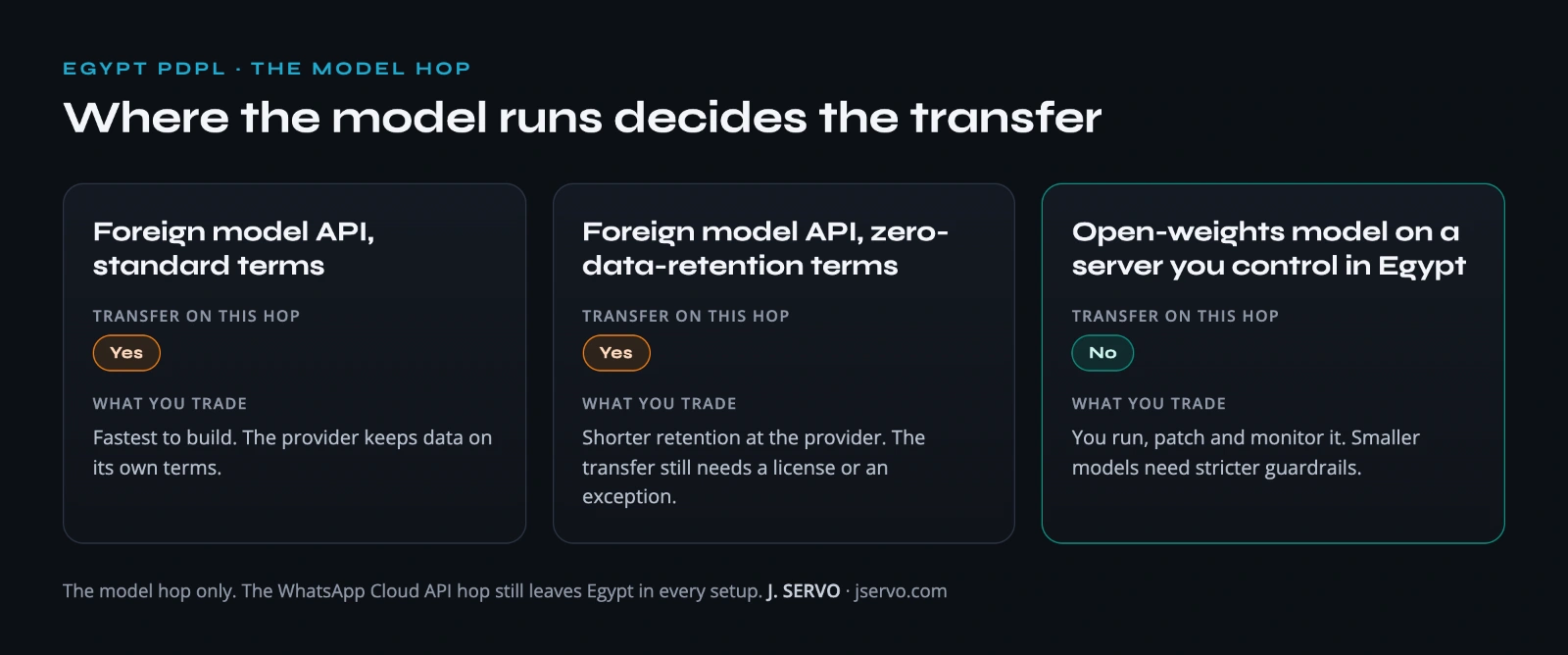
The model hop is the design choice that changes your Egypt PDPL transfer picture the most. The three realistic options compare like this:
| Option | Transfer on the model hop | What you trade |
|---|---|---|
| Foreign model API, standard terms | Yes | Fastest to build; the provider keeps data according to its own terms |
| Foreign model API with zero-data-retention terms | Yes | Shorter retention at the provider; the transfer still needs a license or exception |
| Open-weights model on a server you control in Egypt | No | You run, patch and monitor it; smaller models need stricter guardrails |
Is a self-hosted model good enough for Arabic customer messages? In October 2026 we tested Jais 3, an open Arabic-English model family released under Apache 2.0, on 40 Egyptian and Gulf WhatsApp-style messages, on an Apple M5 Mac with 16 GB of memory. With reasoning on, the 3.7B and 7B models picked the right intent for all 40 messages and replied in the customer’s own dialect 36 and 34 times.
The cost was speed: a median of 20.7 and 28 seconds per message with reasoning on, against 1.5 and 2.5 seconds with it off, where replies in the customer’s dialect fell to 22 and 16. The same test showed the limit that matters for compliance as much as for service. Every model we ran sometimes invented a price or claimed an action it had not taken.
So a self-hosted model on a server in Egypt keeps that hop out of Egypt PDPL’s transfer rules; it does not make the agent truthful. Prices, booking slots and order status must come from your own systems through lookups, and anything the model cannot verify goes to a person. A 40-message test on a 16 GB Mac is a signal, not a benchmark or a production sizing. The point is narrower: a model small enough for hardware you control can already do the routing and first-reply work.
Not sure which hops your current bot uses? We map them, together with the model and hosting options, in a free 30-minute discovery call within 3 business days, followed by fixed-price scoping. Book a free assessment.
Consent and Marketing Inside the Chat
Egypt PDPL starts from consent. Article 2 prohibits collecting, processing or disclosing personal data without the data subject’s explicit consent unless the law authorizes it. Article 6 lists the other lawful grounds: performing or concluding a contract in the customer’s favor, meeting a legal obligation or a court order, and exercising legitimate rights where that does not conflict with the customer’s fundamental rights and freedoms.
Service Replies Versus Marketing Messages
An agent that answers “where is my order 39105” is working on a contract the customer already has. A follow-up that offers a new product is direct electronic marketing. Article 17 allows it only with prior consent, a clearly identified sender with a valid address, a clear statement that the message is marketing, and an easy way to opt out. Article 18 adds that you keep the consent records for three years from the last message sent.
In practice that means four things in the build: a short first-message notice linking to your privacy notice, a separate yes for offers, a stop keyword that really unsubscribes, and the consent event stored with its timestamp in your own database rather than only inside a vendor’s inbox.
Sensitive Data: Clinics, Payments and Children
Under Egypt PDPL, sensitive personal data covers mental, psychological, physical or genetic health, biometric data, financial data, religious beliefs, political opinions and security status, and all children’s data counts as sensitive (Article 1). Processing it needs a license from the Center and written, explicit consent, plus a parent’s or guardian’s consent for children (Article 12).
That puts clinic booking bots, payment and installment questions, and any service that minors use in the strictest tier. Keep these flows narrow: collect the minimum, hand over to a person early, and keep health or card details away from any model you do not host yourself.
Customer Rights and Breach Reporting
Article 2 of Egypt PDPL gives every customer the right to know about, access or obtain their data; to withdraw consent; to have it corrected, updated or deleted; to restrict processing; to be told of a breach; and to object to processing that conflicts with their fundamental rights. Except for breach notification, the customer can be charged a fee for these services, set by the Center and capped at EGP 20,000.
For a WhatsApp agent, a delete request has to reach every copy you hold: the conversation database, the CRM, the vector store, the logs and the backups. Meta keeps Cloud API messages for up to 30 days on its side; your own copies are the ones you have to find. Build that delete path once, before launch, and test it.
Breaches have a short clock. The controller or processor notifies the Center within 72 hours of becoming aware, with the nature, cause and estimated volume of the breach, the DPO’s contact details, the likely consequences and the measures taken, then tells the affected customers within three working days of that notification (Article 7). Someone reading chat logs through a leaked API key is unauthorized access in Egypt PDPL’s sense, so rehearse the steps before you need them.
Egypt PDPL Penalties at a Glance
Egypt PDPL sets fines in Egyptian pounds, and several offenses also carry prison terms. Where a row ends “or either”, the court can impose prison, a fine or both.
| Violation | Article | Penalty |
|---|---|---|
| Processing or transferring data without consent or legal authority | 36 | EGP 100,000 to 1,000,000; with gain or intent to harm, at least six months and EGP 200,000 to 2,000,000, or either |
| Refusing a customer’s rights under Article 2 | 37 | EGP 100,000 to 1,000,000 |
| Collecting data without meeting Article 3 | 37 | EGP 200,000 to 2,000,000 |
| Controller or processor duties, including breach notice (Articles 4, 5, 7) | 38 | EGP 300,000 to 3,000,000 |
| Failing to appoint and register a DPO | 39 | EGP 200,000 to 2,000,000 |
| Sensitive data without consent or legal authority | 41 | At least three months and EGP 500,000 to 5,000,000, or either |
| Cross-border transfer rules (Articles 14 to 16) | 42 | At least three months and EGP 500,000 to 5,000,000, or either |
| Direct electronic marketing rules | 43 | EGP 200,000 to 2,000,000 |
| License, permit or accreditation rules | 45 | EGP 500,000 to 5,000,000 |
The person who actually manages the company faces the same penalties if they knew of the violation and their breach of duty contributed to it (Article 47). Courts also order the judgment published in two newspapers and online at the offender’s cost, and the penalties double for a repeat offense (Article 48).
A 10-Point Egypt PDPL Checklist for WhatsApp Agents
Use this list before launch, and again before any change to the model, the hosting or the tools that store conversations. Each item maps to an Egypt PDPL article cited above.
- Map every hop. Meta, your automation server, the model, the CRM, logs and backups, with the country each one runs in.
- Write the Article 4 record. Data categories, recipients, erasure method, transfers abroad and security measures.
- Pick a lawful basis per flow. Contract for service replies; consent for marketing, profiling and anything sensitive.
- Separate marketing consent. Store it with a timestamp in your own database and keep it three years after the last message.
- File with the Center. A license or permit for processing, and a transfer license where data leaves Egypt and no exception applies, through the Center’s portal.
- Appoint and register a DPO, and publish the appointment.
- Decide the model hop. A foreign API with retention terms you have read, or an open-weights model on a server you control in Egypt.
- Ground the agent. Prices, slots and order status come from lookups into your systems, never from the model’s memory.
- Build the delete path once across the database, CRM, vector store, logs and backups, and test it.
- Rehearse a breach. Name who notifies the Center within 72 hours and who messages customers within three working days.
How J. SERVO Builds for Egypt PDPL
J. SERVO is an AI engineering firm in New Cairo, not a law firm. We build the technical controls that Egypt PDPL asks of a system; your counsel and your DPO own the legal position and the filings with the Center. What we bring to a WhatsApp agent, from how we already work:
- Self-hosted n8n automation, so the agent’s workflows, logs and database run on infrastructure you choose.
- Self-hosted open-weights models inside your own cloud network or on your premises for sensitive workloads, and zero-data-retention terms with model providers when a hosted model is the better fit. Client data is not used to train public models.
- WhatsApp agents on the official WhatsApp Cloud API, connected to your ERP or CRM so the agent quotes your data rather than guessing.
- Systems you own. The workflows and the deployment are yours, not rented from us.
Every project starts with a free technical assessment and a fixed-price scope. See how we build WhatsApp AI agents for Egypt and the GCC, or the full range of AI solutions.
Egypt PDPL FAQ for AI Chatbots
Does Egypt PDPL apply to a small business’s WhatsApp chatbot?
The scope articles of Egypt PDPL set no size threshold. The law covers personal data of natural persons processed electronically by any holder, controller or processor, with listed exclusions such as personal use and entities supervised by the Central Bank. License categories and fees come from the executive regulations, within the caps in Article 26: EGP 2,000,000 for a license and EGP 500,000 for a permit.
Can our chatbot send Egyptian customers’ messages to a US-hosted model API?
Under Egypt PDPL that is a cross-border transfer. Article 14 requires a destination with protection not less than Egypt’s and a license or authorization from the Center; Article 15 lists exceptions that rely on the customer’s explicit consent. Zero-data-retention terms reduce what the provider keeps but do not remove the transfer. Ask your counsel which route fits, or keep that hop in Egypt with a self-hosted model.
Can WhatsApp Cloud API keep our data in Egypt?
Not as of 23 November 2026. Meta’s local storage countries in the Middle East and Africa are Bahrain, the UAE and South Africa, and even with local storage, content can be processed abroad for up to 60 minutes. Treat the WhatsApp hop as a transfer and document it.
We are based in the UAE or Saudi Arabia and serve Egyptian customers. Does it apply to us?
It can. Egypt PDPL reaches beyond Egypt: Article 2 of the issuing law covers a non-Egyptian abroad when the act is also a crime where it was committed and the data concerns Egyptians or foreigners living in Egypt. Articles 4 and 5 require controllers and processors outside Egypt to appoint a representative in Egypt, and the Center’s portal requires Digital Egypt sign-in with a national ID, so that representative files for you.
Do we need a data protection officer just for a chatbot?
The Egypt PDPL duty attaches to the company, not the bot. Under Article 8, any legal entity acting as a controller or processor appoints a qualified employee as its DPO, registers them with the Center and discloses the appointment. If your chatbot processes customer data, your company is a controller.
Build It Once, Correctly
Planning a WhatsApp agent for Egyptian customers, or checking the one you already run? Book a free 30-minute discovery call, held within 3 business days. We map the data flow, recommend the hosting for each hop and give you a fixed-price scope. Book a free assessment.
Prefer to sketch first? Describe the workflow, not your customers’ data, in Dragonfly AI Architect, our free tool for planning an AI agent’s architecture.