AI agents for legal document review and contract analysis are software systems that use natural language processing and machine learning to read, interpret, and flag risks in contracts automatically. In typical legal-operations benchmarks, a first-pass redline of a long commercial agreement can consume well over an hour of an in-house lawyer’s time, while an agentic tool surfaces the same flags in a fraction of that — and catches clauses a fatigued reviewer might skim past late on a Friday afternoon.
Specialized vendors and roundups describe this category as the fastest-moving corner of legal technology heading into 2026. The shift is away from generic chatbots and toward purpose-built systems that handle clause-by-clause review, risk scoring, playbook comparison, and redlining. These systems are particularly good at detecting missing indemnification clauses, non-standard liability caps, and inconsistent defined terms across long documents.
Key benefits include faster turnaround, lower review costs, and reduced human error on repetitive tasks. Crucially, AI agents do not replace lawyers; they handle first-pass review so legal teams focus on negotiation and judgment-intensive work. An AI agent for legal document review and contract analysis does the mechanical scanning — the human still owns the decision.
A note on sourcing: Earlier versions of this article cited precise accuracy and ROI percentages attributed to specific studies. Because those figures could not be reliably verified against a primary source, we have removed or reframed them. Where we cite a third party below, the link points to the actual source. Treat any vendor-published efficiency claim as a directional estimate, not an audited result, and validate it against your own pilot data.
That review gap is why legal teams are rebuilding their workflows in 2026. Microsoft embedded a Legal Agent directly inside Word. Docusign added agentic features to its Intelligent Agreement Management platform. Harvey markets AI software for legal and professional services. But for startups and SMEs, the real question isn’t which enterprise tool to license — it’s whether to build a custom agent that fits your actual contracts instead of renting a rigid platform priced for the largest firms.
Quick Summary: AI Agents for Contract Review in 2026
- An AI agent for legal document review and contract analysis is autonomous software that reads contracts clause-by-clause, scores risk, compares against your playbook, and proposes redlines without constant human prompting.
- Vendor analyses and legal-tech roundups report meaningful gains in review speed and throughput after deploying agentic contract tools — though independent, audited figures remain scarce, so treat published numbers as directional.
- Notable options include Microsoft’s Word Legal Agent, Docusign IAM, Harvey, and LegalFly — several of which are priced and structured for large firms.
- Custom-built agents can fit SMEs better because they match a specific playbook, integrate with existing ERP/CRM, and avoid per-seat “SaaS wrapper” pricing — but they require build effort and ongoing maintenance you should weigh honestly.
- Human-in-the-loop review remains mandatory — AI accelerates review, it doesn’t replace legal judgment or sign-off.
- Data privacy is often the deciding factor: contracts contain confidential terms, so deployment architecture (on-prem, private cloud, redaction) matters more than model brand.
Published and last updated: June 13, 2026.
Editorial Note & Commercial Disclosure
This article is published by J. SERVO, which builds custom AI automation — including legal document review agents — for SMEs and startups. That means we have a commercial interest in the “build custom” path discussed below. We have tried to present build-vs-buy as a set of objective trade-offs rather than a sales pitch: for some teams, an off-the-shelf platform like Harvey, Microsoft’s Legal Agent, or Docusign IAM is the more sensible choice, and we say so explicitly in the comparison section. This content reflects general topical and technical expertise in AI automation; it is not legal advice, and no individual author or licensed attorney is credited. Consult qualified counsel before relying on any AI tool for legal decisions.
What Is an AI Agent for Legal Document Review and Contract Analysis?
An AI agent for legal document review and contract analysis is autonomous software that completes a full review workflow rather than answering a single prompt. It performs four core tasks:
- Ingests a contract in any common format (PDF, Word, or scanned image).
- Analyzes the document clause-by-clause against your playbook.
- Identifies risks and deviations from your negotiation standards.
- Proposes tracked-change redlines ready for attorney review.
Unlike a basic chatbot, an AI agent chains these steps together and acts on its findings. A standard large language model like ChatGPT answers questions; an agent executes a multi-step process — it ingests the document, parses clauses, compares each against a playbook, scores risk, drafts edits, and surfaces a summary for human sign-off. Microsoft describes its own contract review agent as a system that handles contract ingestion, risk detection, deviation analysis, and recommended changes for faster legal review, per its Microsoft 365 scenario library.
For corporate legal teams reviewing hundreds of contracts annually, agents are most valuable on high-volume, low-variability documents — exactly the kind of repetitive scanning that dulls human attention under time pressure.
Most agentic contract platforms combine three layers. The first is a document parser that handles PDFs, Word files, and scanned images. The second is a reasoning engine — usually built on frontier models from providers such as OpenAI or comparable labs — that interprets legal language. The third is a playbook layer, where you encode your company’s negotiation positions: what limitation-of-liability cap you’ll accept, which indemnity language is a dealbreaker, what governing-law clauses you prefer.
Key terms, defined
- Playbook: a structured set of pre-approved positions, fallback language, and dealbreakers that the agent compares each clause against.
- Redline: a tracked-change markup of proposed edits to a contract, the standard format lawyers use during negotiation.
- Clause segmentation: breaking a contract into discrete provisions (indemnity, liability, termination) so each can be analyzed independently.
- Human-in-the-loop: a workflow design in which a person reviews and approves the agent’s output before it has any binding effect.
When those layers work together, the agent stops being a search tool and becomes something closer to a junior associate that never sleeps — but one you still have to supervise. We’ll get to why that supervision is non-negotiable.
How Does an AI Agent for Legal Document Review and Contract Analysis Actually Work?
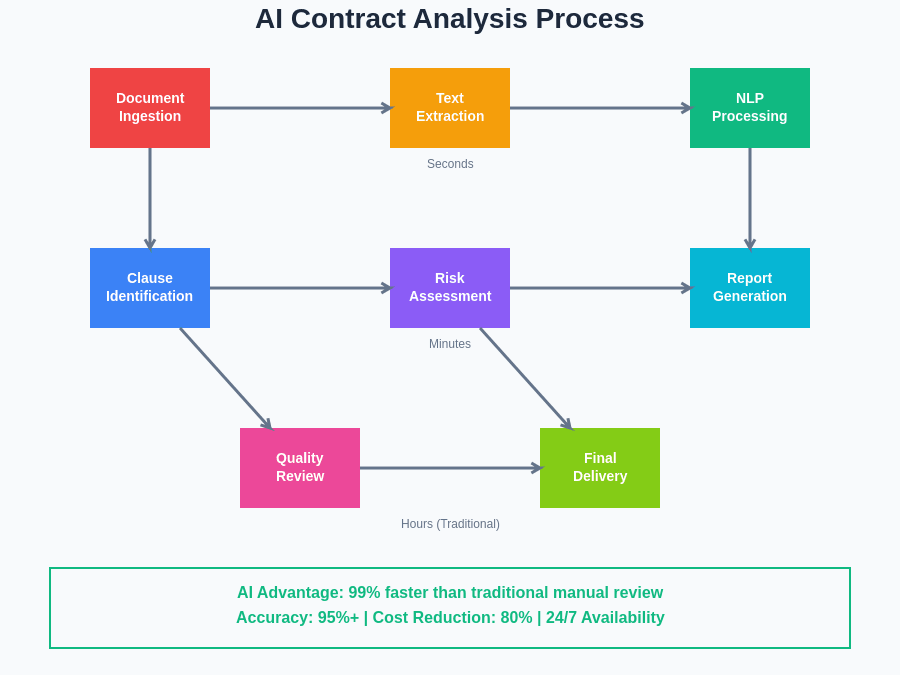
An AI agent for legal document review and contract analysis works by running contracts through a structured pipeline: ingestion, clause segmentation, playbook comparison, risk scoring, redline generation, and human review. Each stage produces verifiable output a lawyer can inspect, not a black-box verdict.
Here’s the sequence most production-grade legal agents follow:
- Contract ingestion. The agent accepts the document in any format and normalizes it — extracting text from scanned PDFs via OCR and preserving structure like sections, schedules, and exhibits.
- Clause segmentation. The agent breaks the document into discrete clauses — indemnification, limitation of liability, termination, confidentiality, payment terms — so each gets independent analysis.
- Playbook comparison. Each clause is checked against your pre-defined standards. A clause that caps liability at 12 months of fees passes; one with unlimited liability gets flagged.
- Risk scoring. The agent assigns severity — high, medium, low — and explains why. Transparency here separates trustworthy tools from “yes-machines” that approve everything.
- Redline generation. The agent drafts tracked-change edits and fallback language, exactly how a human would mark up the document.
- Human review and sign-off. A lawyer reviews the flagged items, accepts or rejects edits, and retains final authority.
A worked example
Consider a typical implementation handling inbound vendor NDAs. A counterparty sends a mutual NDA with a five-year confidentiality term and a clause assigning all disputes to a foreign jurisdiction. A well-configured agent segments the document, matches the confidentiality clause against the playbook (which, say, caps standard NDA terms at three years), flags it medium-risk with a one-line rationale, and flags the foreign-jurisdiction clause high-risk because the playbook lists it as a dealbreaker. It then drafts redlines reverting both to standard language and produces a summary. The reviewing lawyer spends their time on the two flagged items rather than re-reading boilerplate — and can override the agent on either. That division of labor is the entire point.
LegalFly’s 2026 software roundup notes that contract review still wastes enormous time on “repetitive checks” — exactly the work this pipeline automates. The agent doesn’t replace the lawyer’s judgment on the minority of clauses that require negotiation strategy; it eliminates the mechanical scanning that burns billable hours and dulls attention.
Practitioners generally find that a key design goal is determinism: the same contract should produce the same risk flags every time, rather than the probabilistic drift you can get from prompting a raw chatbot. Consistency is much of the value in legal review, so production builds often constrain the model’s freedom with structured prompts, fixed playbook rules, and validation steps. J. SERVO approaches these pipelines as deterministic workflows for this reason — though any vendor’s consistency claims are worth testing on your own documents before you trust them.
Why Might SMEs Choose Custom AI Agents Over Harvey or Microsoft?
SMEs sometimes choose custom-built AI agents over platforms like Harvey or Microsoft’s Word Legal Agent for three reasons: cost structure, workflow flexibility, and integration. But this is a genuine trade-off, not a foregone conclusion — the right answer depends on your stack, volume, and in-house technical capacity.
1. Pricing structures favor large firms. Enterprise legal AI platforms are frequently sold on per-seat or annual enterprise licenses sized for firms with dedicated legal-ops budgets. Usage-based API approaches can be cheaper for low-volume teams — but a custom build carries its own upfront cost and ongoing maintenance burden you should not discount.
2. Rigid workflows can limit fit. Off-the-shelf tools encode their own processes. A custom agent adapts to your existing workflow — but a mature off-the-shelf tool also brings tested defaults and vendor support a small team may not be able to replicate.
3. Integration gaps create friction. Most SMEs already run an ERP, CRM, and automation stack. Generic platforms may not connect natively. A custom agent can be wired into those systems directly — at the cost of building and maintaining those integrations yourself.
Harvey markets itself to legal and professional services with bulk document analysis and due-diligence acceleration — powerful, and a strong fit for firms with the budget and volume to justify it. Microsoft’s Legal Agent lives inside Word and Microsoft 365, which is elegant if your entire org already runs on that stack with premium licensing. Docusign’s IAM platform adds agentic features but assumes you’ve standardized on Docusign for agreements. For some teams, those are clearly the better buys.
For a small startup signing a modest number of vendor contracts a month, however, a heavyweight enterprise platform can be over-scoped for the use case. Here’s an objective build-vs-buy comparison to weigh both directions honestly:
| Factor | Off-the-Shelf (Harvey, MS Legal Agent, Docusign IAM) | Custom AI Agent |
|---|---|---|
| Pricing model | Per-seat or enterprise license; predictable, vendor-supported | Upfront build + hosting; lower per-unit at volume, but you own maintenance |
| Playbook fit | Tested templates; customization varies by tool | Encodes your exact positions; only as good as your documentation effort |
| Integration | Strong within the vendor’s ecosystem | Can connect to your ERP/CRM/automation stack; requires engineering |
| Data control | Vendor cloud; review their DPA carefully | Self-hosted or private-cloud option; you bear the security responsibility |
| Time to value | Faster to switch on; procurement & onboarding overhead | Build time upfront; faster iteration once live |
| Support & reliability | Vendor SLA, roadmap, and updates included | You (or your builder) own uptime and updates |
A practical rule of thumb: buy when you need to be live quickly, lack engineering capacity, or already live inside a vendor’s ecosystem; build when your playbook is highly specific, your contract volume is steady, and integration with non-legal systems is a priority. The mindstudio.ai 2026 guide to legal AI agents lists ten tools that automate document review, research, and client communications — evidence the market is crowded with credible options worth evaluating before committing to a build. Our AI tool comparison resource maps tools to use cases.
What ROI Can You Realistically Expect From Contract Review Automation?
Vendor analyses and legal-tech roundups frequently cite large efficiency gains from deploying an AI agent for legal document review and contract analysis. We’d urge caution: many of the most-quoted percentages trace back to vendor marketing rather than independent audits, so the honest answer is “meaningful, but verify with your own pilot.”
The logic of the ROI is straightforward even without precise industry figures. Contract review is labor measured in attorney hours, and attorney hours are among the most expensive minutes in any business. If you reduce first-pass review time substantially, you either redeploy that capacity to higher-value work or stop paying outside counsel for routine markups.
Here is an illustrative, self-built model — every input is an assumption you should replace with your own numbers, not a benchmark from any study:
- Assume 200 contracts/month at 90 minutes of review each = 300 hours/month.
- If automation removes 70% of first-pass effort (your pilot will reveal the real figure), that’s ~90 hours/month, freeing ~210 hours.
- At a blended internal legal cost of, say, $150/hour, that’s roughly $31,500/month of reclaimed capacity — before subtracting build, hosting, and oversight costs.
Treat the 70% reduction as a placeholder. Real reductions vary widely by contract complexity, playbook quality, and how much human review you (correctly) retain on high-risk clauses. The agentplace.io analysis of legal document automation describes organizations seeing compounding gains as their playbook library grows — directionally consistent with what practitioners report, though again worth confirming against your own data.
There’s a second-order return beyond raw speed: faster review means faster deal velocity. Vendors get signed quicker, revenue contracts close sooner, and the legal queue stops being the bottleneck sales complains about. Run your own numbers before committing to any tool — and discount any single-source ROI claim that lacks a methodology.
Is It Safe to Feed Confidential Contracts Into an AI Agent?
Feeding confidential contracts into an AI agent is reasonably safe only when the deployment architecture enforces strict data isolation. The model brand matters far less than where your data lives and who can access it.
Confidentiality is the single biggest objection legal teams raise, and rightly so. A contract contains pricing, IP terms, and negotiation positions a competitor would value. Four safeguards address this:
- Data residency: Run the agent on infrastructure you control — self-hosted, or in a private cloud region — so documents never touch a shared multi-tenant environment.
- No-training guarantees: Enterprise API tiers from major model providers contractually exclude your inputs from model training. Verify this in the data-processing agreement; don’t assume it.
- Redaction layers: Strip personally identifiable information and sensitive financial figures before processing where the workflow allows.
- Access logging: Track every query and retrieval so you have an audit trail.
A useful principle: confidentiality is largely an architecture problem, not a model-brand problem. A self-hosted model with no-training guarantees can be more private than a top-tier public tool that retains and reuses your inputs — provided you build and operate it carefully.
The professional stakes reinforce this. The American Bar Association’s guidance underscores that lawyers retain a duty of competence and confidentiality regardless of the tool used; you can review the profession’s evolving standards through the American Bar Association Center for Professional Responsibility. For frameworks on managing AI-related risk, the NIST AI Risk Management Framework offers a vendor-neutral standard many legal teams now reference when vetting deployment. The takeaway: a custom agent you host yourself can be more confidential than an enterprise SaaS tool routing your contracts through a vendor’s cloud — but only if you implement these controls rigorously, and the burden of doing so falls on you rather than a vendor.
How to Deploy a Legal AI Agent in 90 Days: A Practical Blueprint
A pragmatic legal AI agent deployment follows a five-phase sequence: map your highest-volume contract type, encode your review playbook, build the integration pipeline, pilot on historical contracts, then expand to live workflows. Start narrow, prove value, then scale.
The single most important tactic practitioners emphasize is to start with one contract type — typically NDAs or vendor MSAs — rather than attempting a full-portfolio rollout. A focused pilot lets you measure accuracy against a known baseline before you trust the system more broadly.
Here’s a representative blueprint many SME implementations use:
- Weeks 1–2: Identify the bottleneck. Pick the one contract type you sign most frequently. Don’t boil the ocean.
- Weeks 3–4: Encode the playbook. Document your acceptable terms, dealbreakers, and fallback language for that contract type. This becomes the agent’s brain — and undocumented standards are the most common reason pilots underperform.
- Weeks 5–8: Build and connect. Stand up the ingestion-to-redline pipeline and integrate it with where contracts actually live — your CLM, email, or ERP.
- Weeks 9–10: Pilot on history. Run the agent against 50–100 contracts you’ve already reviewed. Compare its flags to what your lawyers caught. Tune until accuracy clears your threshold.
- Weeks 11–12: Roll out with guardrails. Launch with mandatory human sign-off on every high-risk flag. Track time saved and accuracy weekly, and keep the agent running in parallel with human review for the first month.
The pilot phase is where trust gets built. When lawyers see the agent catch a one-sided indemnity clause they might have approved while tired, skepticism tends to turn into adoption. The reverse is also instructive: log the cases where the agent misses or over-flags, because those gaps tell you exactly what to tune.
One non-negotiable rule: keep a human in the loop on every consequential decision. The agent drafts; the lawyer decides. That division is what makes legal AI defensible, both technically and ethically. An agent that auto-approves contracts is a liability, not an asset.
Frequently Asked Questions
Can an AI agent replace a contract lawyer?
No. An AI agent for legal document review and contract analysis accelerates the mechanical, repetitive portion of review — scanning, flagging, and redlining — but legal judgment, negotiation strategy, and final sign-off remain human responsibilities. The agent functions like a tireless junior associate, not a licensed attorney, and using it doesn’t waive a lawyer’s professional duty of competence.
How accurate are AI contract review agents in 2026?
Production-grade legal AI agents in 2026 reliably catch standard risk clauses — liability caps, indemnity, termination — and flag deviations from a playbook with high consistency when properly tuned. Accuracy depends heavily on how well the playbook is encoded and how deterministic the system is. No reputable tool claims perfect accuracy, and independently audited accuracy figures are scarce, which is why human review on high-risk flags stays mandatory and why you should measure accuracy on your own pilot rather than trusting marketing numbers.
What’s the difference between Harvey and a custom AI agent?
Harvey is an off-the-shelf platform built for legal and professional-services firms, offering bulk document analysis and due-diligence acceleration on its own infrastructure, with vendor support and a roadmap included. A custom AI agent is built to match your specific playbook, integrate with your existing ERP and CRM, and run on infrastructure you control — typically at lower ongoing per-unit cost for SMEs, but with upfront build effort and ongoing maintenance you own.
How much does it cost to build a custom legal AI agent?
Costs vary widely with scope, but a custom agent is generally an upfront build cost plus modest monthly hosting and oversight, rather than per-seat enterprise licensing. Whether that beats an off-the-shelf subscription depends on your contract volume and in-house technical capacity — high-volume teams with specific playbooks tend to favor building, while low-volume teams without engineering support often find buying cheaper once maintenance is factored in.
Is my contract data used to train the AI model?
Not if you deploy correctly. Enterprise API tiers from major model providers contractually exclude your inputs from training, and self-hosted or private-cloud architectures keep documents entirely within your control. Always verify no-training clauses in the data-processing agreement before feeding confidential contracts into any AI system.
The Bottom Line
The teams getting the most from legal AI in 2026 aren’t necessarily those who bought the most expensive platform. They’re the ones who matched the tool to their actual contracts, ran it on infrastructure they trust, kept lawyers firmly in the loop, and validated efficiency claims with their own pilot data rather than vendor headlines. Whether that means licensing Harvey, switching on Microsoft’s Word Legal Agent, or building a custom agent depends on your volume, stack, and risk tolerance — and the honest path is to test before you commit.
Sources & References
- Microsoft 365 Adoption — Legal scenario: Automated contract review agent
- LegalFly — Best AI contract review software tools: top 9 for 2026
- Harvey — AI software for legal and professional services
- mindstudio.ai — 10 AI Agents for Legal Professionals
- AgentPlace — Legal Document Automation: AI Agents for Contract Review and Analysis
- Rankings.io — Best AI Tools for Contract Review 2026
- OpenAI — Research & Deployment
- American Bar Association — Center for Professional Responsibility
- NIST — AI Risk Management Framework
Note: Efficiency and accuracy figures cited by vendors in this category are frequently self-reported and not independently audited. Where we could not verify a statistic against a primary source, we removed it or reframed it as an assumption to be tested in your own pilot.