

A construction site generates a high volume of unstructured messages per day across WhatsApp AI agent construction workers ERP groups — site photos, voice notes, defect complaints, material requests — and a large share of that data never reaches the system of record. That’s the silent leak draining margins on many projects in 2026.
A WhatsApp AI agent for construction workers ERP is software that reads the chaos inside WhatsApp groups — voice notes, photos, and chats — and converts it into structured, ERP-ready records like compliance logs, defect reports, and progress updates without forcing field crews to learn a new app. As Wentilabs describes it, AI agents now run inside WhatsApp “automating logs, flagging defects, and generating compliance records without new apps or training.” For SMEs in construction, that can be the difference between a foreman typing reports at 9 PM and the data arriving in the ERP automatically by lunch.
WhatsApp AI Agent Construction Workers ERP Integration Summary
- What it is: WhatsApp AI agents for construction workers are software systems that convert informal messages — voice notes, photos, and group chats — into structured ERP data without requiring workers to learn new construction software. The approach meets workers where they already are: WhatsApp is used by over 2 billion people in more than 180 countries, according to its Google Play listing, making it among the most widely adopted messaging platforms on job sites.
- The mechanism: An AI agent ingests voice notes, photos, and group chats, then writes structured records to your ERP via API and webhooks. A worker can report material deliveries, log hours, or flag safety issues by simply sending a message — often in their native language.
- The cost benchmark: One developer documented a production WhatsApp + voice AI agent built in n8n that has run for over a year at under €200/month while handling 90% of inquiries. Treat this as a single self-reported data point, not an industry average.
- The payoff: Lower training overhead, fewer missed defects, faster compliance records, and closer-to-real-time project visibility.
- The vendors: Wentilabs, Banamind, Obrity, Agentzee, and Spinnable are active in the SaaS space — while custom builds tend to win on ERP integration depth.
- The risk: Routing operations through WhatsApp raises GDPR and data-residency questions you should engineer around from day one.
Published: September 2, 2026. Last updated: September 8, 2026.
What Is a WhatsApp AI Agent for Construction Workers ERP?
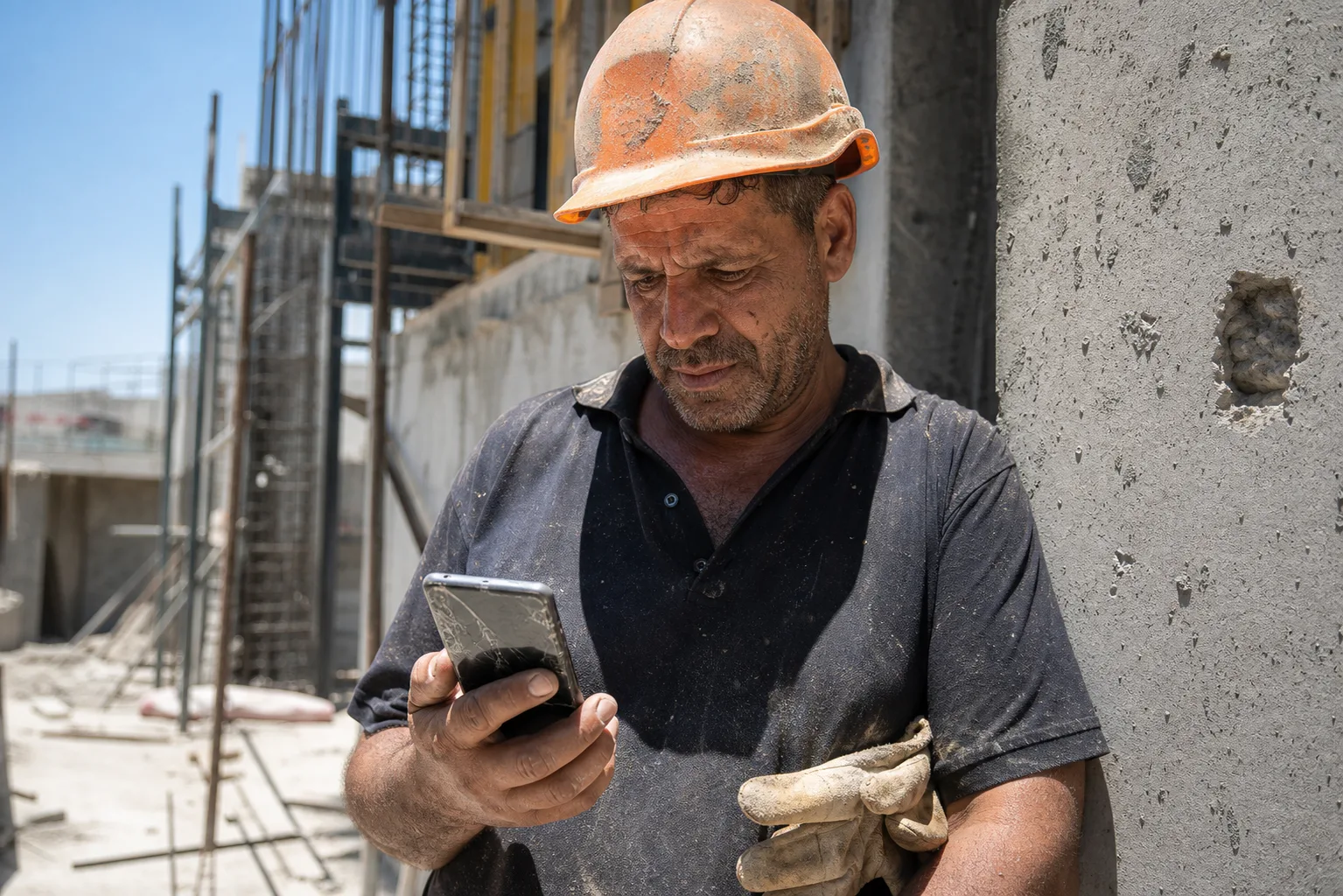
A WhatsApp AI agent for construction workers ERP is an AI system that operates inside WhatsApp and converts the messages crews already send into structured ERP records. It interprets three types of unstructured input:
- Voice notes — spoken progress updates, often in local languages or dialects.
- Site photos — images of completed work, materials, or safety issues.
- Group chatter — informal text updates buried in busy crew threads.
The agent extracts this information and pushes clean, structured records into your ERP or project management platform. The goal is low-friction data capture from the field, with as little manual re-entry as possible.
Construction often has a data-capture problem rather than a software-availability problem. Crews don’t lack tools; they frequently avoid the ones nobody designed for a muddy job site. Wentilabs frames it plainly: AI agents in construction are now “embedded inside WhatsApp” precisely because the alternative — forcing laborers to log into a desktop ERP — often went unused.
WhatsApp is a natural habitat for field workers. Over 2 billion people in more than 180 countries use it (Google Play), and in markets such as MENA and India it is widely used for day-to-day site coordination. Banamind describes the approach as turning “site photos, voice notes and chats into structured project data — without changing how MENA construction crews already work.”
The agent acts as a translator between two worlds. On one side, a plumber sends a 12-second Arabic voice note saying the third-floor pipe is cracked. On the other side, your ERP needs a defect ticket with a location tag, severity rating, trade category, and timestamp. The WhatsApp AI agent for construction workers ERP aims to bridge that gap — transcribing, classifying, and filing the record automatically.
A typical implementation pattern
In a typical implementation, the design principle is consistent: don’t fight where people already work — capture data there. Practitioners generally find that adoption rises sharply when the reporting interface is an app workers already open dozens of times a day, rather than a dedicated portal they must remember to log into.
What problems does it solve?
- Lost field data: Voice notes and photos that would otherwise be buried in group chats become permanent ERP records.
- Delayed reporting: Foremen spend less time re-typing the day’s events into formal logs after hours.
- Compliance gaps: Safety incidents and defects get logged closer to when they’re reported, rather than days later.
- Onboarding friction: New workers need little to no training on the reporting interface — they already know WhatsApp.
The honest caveat: these are mechanisms by which the approach can reduce friction. The actual gain depends heavily on how disciplined your validation and workflow design are. A poorly scoped agent can create as much cleanup work as it saves.
How Does a WhatsApp AI Agent Connect to Your Construction ERP?

WhatsApp AI agents connect to your construction ERP through three components: the WhatsApp Business API, an orchestration layer (typically n8n or a custom backend), and webhook-driven data flows that write structured records into your ERP. The agent listens, interprets, validates, and posts — in near real time.
The architecture is less mysterious than vendor marketing sometimes suggests. Here’s a representative data flow for a WhatsApp AI agent for construction workers ERP integration:
- Ingestion: A worker posts a message — text, voice, or image — into a monitored WhatsApp group or business number.
- Transcription and vision: Voice notes pass through speech-to-text (handling, for example, Gulf, Egyptian, or Modern Standard Arabic dialects); photos run through a vision model that detects defects, materials, or safety hazards.
- Classification: The AI tags the message — defect, material request, progress update, safety incident — and extracts structured fields like location, severity, and trade.
- Validation: A deterministic rules layer checks the data against your ERP schema, rejecting ambiguous entries and asking a clarifying follow-up question where needed.
- ERP write: A webhook posts the validated record to your ERP via REST API — creating a defect ticket, updating a task, or appending a compliance log.
- Confirmation: The agent replies in the group, closing the loop so the worker knows the report landed.
A worked example: suppose a site supervisor sends a photo of cracked tiling with the caption “3rd floor unit 4B.” The vision model flags a likely finishing defect; the classifier assigns the “defect” type and parses “3rd floor unit 4B” into a location field; the validation layer confirms that building/unit exists in the project tree; and only then does the webhook create the ticket. If the unit reference doesn’t resolve, the agent replies asking for clarification rather than guessing — which is exactly the behavior you want.
On cost, one developer documented a WhatsApp + voice AI agent built in n8n that has “been running in production for over a year at under €200/month” while handling 90% of inquiries (r/n8n). This is a single self-reported figure from an individual builder, not a benchmarked study — useful as a sanity check that sophisticated automation need not require a six-figure SaaS contract, but not a guarantee of your own costs.
Obrity takes a platform approach, bundling “CRM, WhatsApp, evidence, reporting, and governed AI agents on real field operations.” The tradeoff is familiar: platforms move fast out of the box but bend less when your ERP has custom fields. We’ve explored related orchestration tradeoffs in our piece on agentic AI startups to watch in 2026 — and the general lesson holds that orchestration you control tends to outlast a recurring SaaS tax.
The role of deterministic validation
Deterministic validation is the rule-based verification layer that checks every AI-generated record against fixed logic before it enters your ERP. In construction, probabilistic AI alone is risky: a model optimized to agree with users — a failure mode sometimes called AI sycophancy — can confidently file a defect ticket in the wrong building. Validation is therefore non-negotiable.
Deterministic validation works by applying explicit pass/fail rules: Does the building ID exist? Is the cost code valid? Does the date fall within the project timeline? Records that fail are rejected or flagged for human review, never silently accepted. The guiding principle: every record touching your ERP should pass deterministic rules first, and probabilistic AI should be used for language and interpretation — not the other way around.
Why Is a WhatsApp AI Agent for Construction Workers ERP Worth the Investment?

A WhatsApp AI agent for construction workers ERP can be worth it because the cost of a single uncaptured field error often exceeds the entire monthly cost of the system. Practitioners in some markets anchor the cost-of-error on a single missed defect at roughly ₹80,000 as a planning figure, while a working agent built on self-hosted orchestration may run under €200/month based on the self-reported n8n deployment above.
Run that math carefully, and treat the inputs as your own assumptions rather than industry constants. If one prevented rework incident saves on the order of ₹80,000 and the system costs roughly €200/month, the agent can pay for itself the first time it catches a defect that would otherwise slip through. The honest framing: these are illustrative anchors. Your real ROI depends on your defect rates, labor costs, and how reliably the agent captures data.
The construction sector has historically been among the least digitized industries, and a recurring root cause is data that simply never gets captured at the source. A WhatsApp AI agent for construction workers ERP attacks that capture gap directly.
Consider the cross-industry signal. Spinnable’s AI workers “join your WhatsApp groups” rather than demanding new tools, with founder Vasco Pedro noting on LinkedIn: “Most AI tools want you to change how you work. We went the other direction.” That philosophy — meeting workers where they are — is a recurring reason these systems can achieve adoption that standalone construction apps struggle to match.
The underlying truth is less about the AI being clever and more about data being captured at all. A foreman who would never open a costly project app may readily send a voice note. The agent’s value is in meeting that behavior rather than trying to replace it.
Where the savings actually come from
- Eliminated re-entry labor: Less office time spent manually typing field reports.
- Faster defect resolution: Real-time logging narrows the gap between problem and fix.
- Reduced rework: Catching errors early helps prevent the high-cost mistakes that compound on construction timelines.
- Compliance audit readiness: Safety reports are timestamped and retrievable rather than buried in chat scroll.
Want to model your own numbers? Run them through our AI automation comparison tool, using the €200/month and ₹80,000 cost-of-error figures as starting assumptions you can replace with your own data.
WhatsApp AI Agent ERP vs Traditional Construction Software: Which Wins?
A WhatsApp AI agent ERP tends to win on adoption and speed, while traditional construction software wins on depth of built-in features. The decisive factor is usually whether your field workers will actually use the tool — on many sites, they won’t open a dedicated app but will reliably reply in WhatsApp.
The comparison below maps the typical tradeoffs to weigh when scoping a WhatsApp AI agent for construction workers ERP project against legacy construction platforms. Figures in the cost and adoption rows are directional planning ranges, not measured benchmarks.
| Factor | WhatsApp AI Agent + ERP | Traditional Construction Software |
|---|---|---|
| Worker adoption | High — uses existing WhatsApp | Often lower on field sites |
| Training required | Minimal | Days to weeks |
| Monthly cost (SME) | Potentially under €200/month (n8n custom build, per self-reported data) | €500–€5,000+/month (varies widely) |
| Voice/photo capture | Native, AI-interpreted | Manual upload, structured forms |
| Multilingual/dialect support | Strong (Arabic dialects, etc.) | Often limited |
| ERP integration depth | Custom builds: very deep | Pre-built but often rigid |
| Offline/poor-signal sites | WhatsApp’s queueing handles it well | Variable |
The vendor landscape splits into two broad camps. SaaS players like Wentilabs, Banamind, Agentzee, and Obrity offer fast deployment with opinionated workflows. Custom builds trade setup speed for control over how the agent maps to your specific ERP schema, dialects, and compliance rules.
Banamind targets MENA crews specifically, turning Arabic voice notes and photos into structured data. Obrity packages WhatsApp into a broader project-control platform. The balanced assessment: if your ERP is standard and your workflows match the vendor’s assumptions, SaaS gets you live faster and with less engineering risk. If you have custom fields, unusual approval chains, or regional dialect needs, a custom WhatsApp AI agent for construction workers ERP integration is more likely to fit — at the cost of a longer build and ongoing maintenance ownership.
The hidden cost of SaaS lock-in
Per-seat or per-project SaaS fees compound over time. As an illustration, a 50-worker site at €15/user/month works out to €9,000/year — recurring indefinitely. A custom-built agent on self-hosted n8n can convert that recurring cost into a one-time build plus lower infrastructure spend. Whether that math favors you depends on your headcount, build complexity, and your tolerance for owning the maintenance burden — self-hosting shifts cost from licensing to engineering time, not to zero.
Is It Safe to Run Construction Operations Through WhatsApp?
Running construction operations through WhatsApp can be done safely when you use the official WhatsApp Business API, encrypt data at rest in your ERP, and engineer for GDPR and regional data-residency rules from the start. WhatsApp provides end-to-end encryption in transit, but overall compliance depends on how you handle data after it arrives.
Security is the question many vendor pages skip. WhatsApp positions itself around “simple, secure, reliable” messaging with end-to-end encryption (WhatsApp), which protects messages in transit. The risk is less the transport layer and more what happens to business data once your agent processes and stores it.
For a WhatsApp AI agent for construction workers ERP deployment, a defensible baseline includes:
- Use the WhatsApp Business API, not a scraped personal account — the latter violates WhatsApp’s terms (Privacy & Terms) and risks account bans.
- Data minimization: Persist only the structured fields your ERP needs, not raw chat history.
- GDPR-aligned consent: Workers and clients should know automated processing is occurring, especially in the EU.
- Self-hosted orchestration: Running n8n on your own infrastructure keeps the data pipeline under your control rather than a third party’s cloud.
- Audit logs: Every ERP write should be traceable for compliance reviews.
Regional rules matter a great deal. A construction firm operating in both the UAE and the EU faces different data-residency obligations, and a one-size-fits-all SaaS configuration may not accommodate both. We discuss the broader theme of responsible deployment in our guide to industrial automation and motion control. None of the above is legal advice — confirm your obligations with a qualified data-protection professional before going live.
Transparency reduces risk. Tell crews what the agent does, keep a human in the loop for high-stakes decisions, and avoid letting a probabilistic model make irreversible ERP changes without deterministic guardrails.
Actionable Takeaways: Deploying Your First WhatsApp AI Agent
Deploying a WhatsApp AI agent for construction workers ERP is best started with one workflow, not a full platform rollout. Pick the single highest-pain data-capture task — usually defect logging or daily progress reports — and automate that before expanding.
A pragmatic sequence many SMEs follow:
- Map your highest-friction field workflow. Where does data leak today? Defects, material requests, and safety incidents are common culprits.
- Set up the WhatsApp Business API through an official provider. Avoid building on a personal account.
- Build the orchestration in n8n. Self-hosting helps control costs and data ownership; the sub-€200/month figure above is one builder’s reported result, not a guarantee.
- Connect transcription and vision models tuned for your languages and dialects.
- Add a deterministic validation layer before any ERP write. This is where reliability is won or lost.
- Pilot with one crew for two weeks, measure capture rate and error reduction, then expand.
Measure carefully. Track how many field events now reach your ERP versus before, the labor hours saved on re-entry, and the rework incidents avoided. If the numbers don’t justify the cost within the first month, the issue is usually fixable workflow design rather than a flaw in the approach itself.
The construction firms that compete well over the next several years are likely to be the ones whose field data actually makes it from the site to the dashboard. A WhatsApp AI agent for construction workers ERP is one credible way to close that gap. The relevant question isn’t whether crews will adopt AI — they already use WhatsApp constantly — but whether your ERP is set up to listen.
Frequently Asked Questions
What is a WhatsApp AI agent for construction workers ERP?
A WhatsApp AI agent for construction workers ERP is software that reads voice notes, photos, and chat messages inside WhatsApp groups and converts them into structured ERP records like defect logs and compliance reports. It lets field crews report data using the app they already know, with minimal training required.
How much does a WhatsApp AI agent for construction cost?
One developer reported running a custom WhatsApp + voice AI agent on self-hosted n8n for under €200/month while handling 90% of inquiries, documented on Reddit’s r/n8n. That is a single self-reported figure rather than an industry benchmark. SaaS construction platforms commonly range from roughly €500 to €5,000+ per month, so custom builds can be cheaper at scale — though they shift cost into engineering and maintenance time.
How does the AI agent connect to my existing ERP?
The agent connects through the WhatsApp Business API, an orchestration layer like n8n, and webhooks that post validated data to your ERP’s REST API. Voice notes are transcribed, photos are analyzed by a vision model, records are validated against your schema, and then written to the ERP.
Is it secure and GDPR-compliant to run operations through WhatsApp?
It can be, when you use the official WhatsApp Business API, minimize stored data, obtain consent, and self-host your orchestration. WhatsApp encrypts messages end-to-end in transit, but full compliance depends on engineering GDPR and regional data-residency rules into how your ERP stores and processes the data. Confirm specifics with a qualified data-protection advisor.
Which WhatsApp AI agent vendor is best for construction?
Wentilabs, Banamind, Obrity, Agentzee, and Spinnable are active SaaS vendors as of 2026, with Banamind focused on MENA Arabic-speaking crews. SaaS generally wins on deployment speed, while a custom build tends to win on ERP integration depth, dialect support, and avoiding recurring per-seat fees over the long term. The right choice depends on how standard your ERP and workflows are.
Sources & References
- Wentilabs — How AI Agents on WhatsApp Are Changing Construction Workflows
- Banamind — How WhatsApp AI agents are reshaping construction site reporting
- Obrity — Construction project management software
- r/n8n — WhatsApp + voice AI agent in n8n handling 90% of inquiries (self-reported deployment)
- Vasco Pedro / Spinnable — LinkedIn post on AI co-workers in WhatsApp groups
- WhatsApp Messenger — Google Play (2B+ users, 180+ countries)
- WhatsApp — Secure and Reliable Messaging
- WhatsApp — Privacy & Terms
Note: This article is for general informational purposes; verify specifics against your own context.
Construction firms managing rented machinery can extend these WhatsApp workflows into full rental fleet automation to track assets and utilization in real time.