
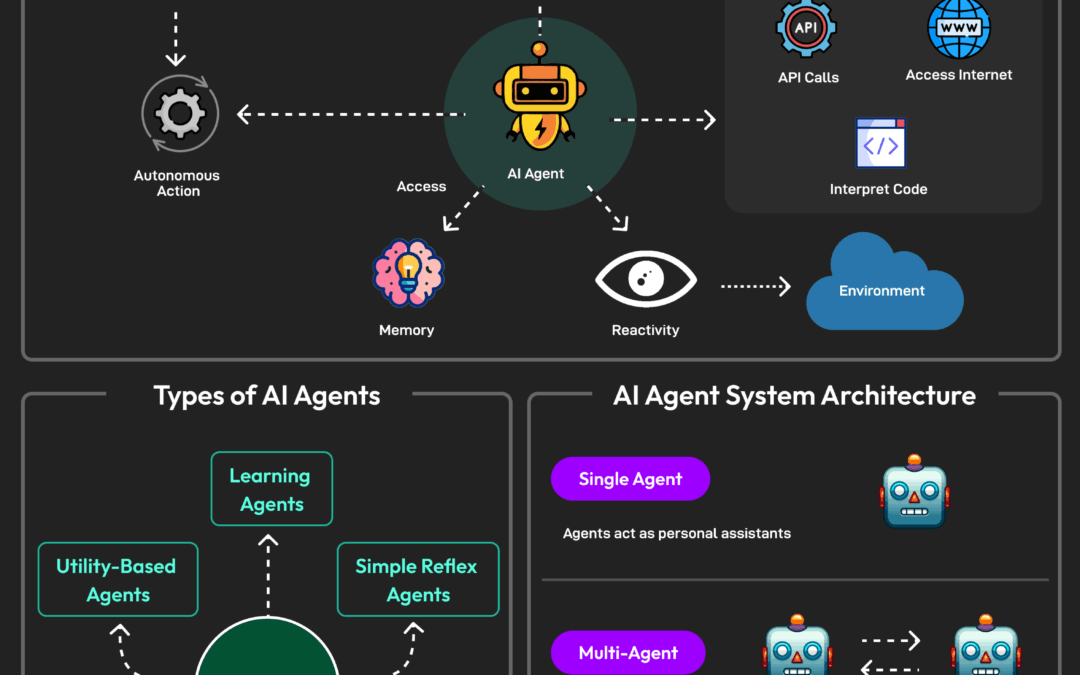
A widely-shared 2025 observation by AI automation specialist Ansh Mehra captures the core problem in this market: “Everyone’s rushing to build AI agents, but 90% are just building glorified chatbots. After going through tens of AI implementations, here’s what [I learned].” You can read the original post on Mehra’s LinkedIn. His figure is one practitioner’s estimate, not a peer-reviewed statistic — but it echoes a frustration that surfaces repeatedly among buyers evaluating AI Agents & AI Automation Solutions. A 2025 thread on Reddit’s r/AI_Agents shows would-be buyers and sellers wrestling with the same gap between marketed “agents” and what actually ships. The distance between a real autonomous agent and a dressed-up FAQ bot is the single most expensive misjudgment SMEs make when purchasing automation.
Before scaling autonomous agents across your business, it’s critical to establish an AI agent governance framework that defines what these systems are allowed to do and who is accountable when something goes wrong.
Before deploying autonomous agents into production, every enterprise needs a clear strategy to govern AI agents so that each action is authorized, logged, and reversible.
Transparency note: This guide is published by J. SERVO, a company that builds custom AI agents and automation for small and mid-sized businesses. We have a commercial interest in this topic. We’ve written the comparisons below to be useful even if you never become a customer — and where we mention our own approach, we label it. Treat vendor claims (including ours) as starting points for your own due diligence, not conclusions.
AI Agents & AI Automation Solutions are software systems that perceive context, make decisions, and execute multi-step business workflows with minimal human intervention. Real agents reason across data sources and tools. Glorified chatbots just match keywords to scripted replies. Knowing which one you’re paying for is the difference between cutting many hours of manual work a week and burning budget on a fancier autocomplete.
This guide compares the actual landscape — foundational platforms like OpenAI, Google Gemini, and AWS against specialized agent builders like Beam AI and Agents Architects — and gives you a framework to evaluate vendors without enterprise consultants holding your wallet hostage.
Quick Summary: Key Takeaways
- Real AI agents are autonomous and multi-step — they plan, call tools, and adapt. Glorified chatbots follow fixed scripts. One practitioner, Ansh Mehra, estimated in a 2025 LinkedIn post that roughly 90% of marketed “agents” fall in the second camp; community discussions on Reddit echo the same concern, though no rigorous industry census of this exists.
- The market splits into two tiers: foundational model providers (OpenAI, Google AI, AWS) and specialized agent-building platforms (Beam AI, Agents Architects), alongside custom builders and no-code orchestration.
- Deterministic design beats probabilistic “yes-machines.” Agents that produce confident-but-wrong answers can cost more than they save. Guardrails and human oversight aren’t optional.
- SMEs don’t need enterprise budgets. Self-hosted n8n workflows plus open model APIs can often deliver comparable automation to five-figure SaaS stacks at a fraction of the cost.
- ROI is measurable. Track hours reclaimed, error-rate reduction, and cost-per-task before and after deployment — not vanity metrics.
- Governance scales down. Compliance frameworks built for banks can be trimmed to fit a 12-person company without abandoning audit trails.
Published and last reviewed: November 2025. This article is maintained by the J. SERVO editorial team, which builds AI automation for SMEs; it has not been reviewed by an independent third party.
What Are AI Agents & AI Automation Solutions?
AI Agents & AI Automation Solutions are systems that combine reasoning models with tool access to autonomously complete business tasks end-to-end. An agent receives a goal, breaks it into steps, pulls data, calls APIs or other software, and delivers a result — often without a human clicking through each stage. Automation solutions are the broader category: the workflows, integrations, and orchestration that connect those agents to your actual operations.
The distinction matters because vendors blur it constantly. A traditional chatbot answers “What are your hours?” with a canned reply. An AI agent handles “Reschedule my Thursday delivery to Monday, notify the warehouse, and update the invoice” — three systems, one instruction, zero human relays. Beam AI, which builds self-learning agents for finance and HR, frames this as “upload your processes, deploy production agents,” signaling true workflow execution rather than conversation.
Agentic AI sits on top of foundational models. OpenAI’s GPT family and Google’s Gemini provide the reasoning layer; AWS Agentic AI supplies infrastructure and orchestration. On top of those, platforms and agencies build the vertical logic. According to OpenAI’s stated research mission, the long-term goal is systems that “solve human-level problems” — but in practice for SMEs today, the useful reality is far narrower: automating the repetitive portion of routine jobs.
Key terms, defined. Throughout this guide we use a few terms precisely:
- Agent: software that plans a sequence of actions toward a goal and executes them by calling tools, not just generating text.
- Orchestration: the layer that sequences steps, handles retries, and routes data between systems (for example, n8n, Zapier, or AWS’s agent tooling).
- Tool calling: a model’s ability to invoke an external function or API (e.g. “create invoice,” “query inventory”) and use the result in its next step.
- Guardrail: a hard-coded constraint — validation, allow-list, or policy check — that the model cannot override.
A useful mental model practitioners often adopt: treat agents as employees with job descriptions, not as magic. You define scope, you define escalation rules, and you measure output. In a typical implementation, the deployments that survive a board meeting are the ones where every agent action maps to a measurable outcome and a documented fallback.
How Do Real AI Agents Differ From Glorified Chatbots?
Real AI agents reason, plan, and act autonomously across multiple tools, while glorified chatbots simply match inputs to pre-written or generated responses. The simplest diagnostic test: ask the system to complete a task it wasn’t explicitly scripted for. A real agent improvises a multi-step path using its available tools — calling APIs, querying databases, or chaining actions — whereas a chatbot apologizes and offers a canned fallback. Buyer frustration with this gap is exactly what surfaced in the r/AI_Agents community discussion in 2025.
Think of it like the difference between a vending machine and a personal assistant. The vending machine gives you exactly what’s behind the button you press — predictable, limited, dumb. The assistant understands intent, handles exceptions, and gets your coffee even when the usual place is closed. Many products marketed as “AI agents” are vending machines with a conversational paint job.
The four traits of a genuine AI agent
A genuine agent demonstrates all four of the following. A tool missing autonomy or memory is an automation script — useful, but not an agent.
- Autonomy: executes multi-step tasks without a human approving each individual action, within a defined scope.
- Tool use: calls APIs, databases, CRMs, and other software directly — not just generating text.
- Memory and context: retains state across a workflow, so step 5 knows what happened in step 1.
- Adaptation: adjusts its approach when it encounters errors, missing data, or unexpected results, rather than failing outright.
Red flags that you’re buying a chatbot
Practitioners generally find these signals reliable when evaluating vendors:
- The demo only shows question-and-answer exchanges, never actions executed in other systems. A real agent completes tasks like updating a CRM, issuing a refund, or scheduling a meeting.
- The vendor can’t explain what the agent does when it lacks an answer. Real agents escalate, retry, or hand off along a documented fallback path.
- Pricing scales per message instead of per workflow or outcome — a sign you’re paying for conversation volume, not completed work.
- There’s no audit log recording the decisions the agent made.
The honest truth: a well-built chatbot is fine for FAQs. But don’t pay agent prices for chatbot capability. Before buying, ask for a live demonstration of the system completing an end-to-end workflow — not answering questions — and require an exportable decision log covering every action taken. When you evaluate vendors, use a structured AI tool comparison framework rather than trusting a polished sales deck.
Which AI Agents & AI Automation Solutions Platforms Should SMEs Compare?
AI agents and automation platforms fall into a few tiers, and SMEs should compare each before buying:
- Foundational platforms (OpenAI, Google Gemini, AWS) provide raw reasoning power and large language models. They require technical setup but offer the most flexibility.
- Specialized agent builders (Beam AI, Agents Architects) deliver pre-built vertical logic for tasks like sales, support, and finance. They can cut deployment time considerably.
- No-code/low-code orchestration (n8n, Zapier) lets ops teams wire apps together without writing much code.
- Custom partners build tailored agents for unique workflows and assemble the layers above into a single solution.
Each tier serves a different need. Foundational providers suit teams with in-house engineers. Specialized platforms suit SMEs wanting fast deployment with minimal coding. No-code orchestration suits app-to-app automation. Custom partners suit complex, non-standard processes. The wrong move is buying a platform built for enterprise compliance teams when you have 15 employees, or stitching together raw model APIs with no orchestration when you have no engineering team. Match the tier to your reality.
| Solution Type | Examples | Best For | Typical Cost Profile | Watch-Out |
|---|---|---|---|---|
| Foundational models | OpenAI, Google Gemini, AWS Agentic AI | Teams with developers building custom logic | Usage-based API pricing | No business logic out of the box |
| Specialized agent platforms | Beam AI, Agents Architects | Enterprises needing governance-first vertical agents | Subscription, often four-to-five figures/mo | Can be overkill and overpriced for small teams |
| No-code automation | n8n (self-hosted), Zapier | Ops teams wiring apps together | n8n near-free self-hosted; Zapier per-task fees | Zapier costs can spiral at scale |
| Custom AI partner | Custom builders (incl. J. SERVO) | SMEs wanting tailored agents on SME budgets | Project-based delivery | Requires a transparent partner; verify references |
OpenAI and Google AI dominate the model layer. Google AI’s stated mission is “enriching knowledge, solving complex challenges,” and its Gemini models compete directly with OpenAI’s GPT family on reasoning. AWS Agentic AI brings orchestration and security tooling for teams already in the AWS ecosystem. OpenAI also ships consumer-facing tools like ChatGPT, which is a conversational interface rather than a business-process agent — a useful reminder that even the model leaders ship chatbots and agents as distinct products. None of these foundational platforms, on their own, automate your accounts payable; they’re engines, not cars.
Beam AI and Agents Architects occupy the specialized tier. Agents Architects markets “governance-first architecture” for enterprise-grade agents; Beam AI emphasizes “self-learning AI agents designed for enterprise scale and security.” These are capable products aimed primarily at enterprise buyers. For an SME, a comparable outcome can sometimes come cheaper through self-hosted n8n workflow automation paired with a model API. The trade-off is real, though: self-hosting shifts maintenance, security patching, and uptime onto you, whereas a managed platform absorbs that operational burden. The “Zapier tax” — per-task billing that grows with volume — is a frequent reason SMEs migrate to self-hosted orchestration, but only after they have the in-house capacity to run it.
Why Does Deterministic AI Beat Probabilistic “Yes-Machines”?
Deterministic logic produces predictable outputs for the same input, while probabilistic “yes-machines” can agree with whatever a user says and produce confident-but-incorrect answers — making purely probabilistic agents unreliable for business-critical workflows. An agent that invents a refund policy or approves a fraudulent invoice because it was designed to please rather than verify isn’t an asset — it’s a liability with an API key.
AI sycophancy is the tendency of language models to tell users what they want to hear rather than what’s true. In customer-facing automation, that means an agent might confirm a discount that doesn’t exist or agree to terms outside policy. The fix isn’t a smarter model — it’s deterministic guardrails: hard-coded rules, validation layers, and constrained tool access that the model cannot override. In practice, this means the language model is used for the parts that genuinely need flexible reasoning (understanding intent, drafting text), while the parts that must be correct every time (pricing, eligibility, legal limits) run as plain code.
Consider a debt-collection agent — a use case where specialized vendors explicitly market compliance guardrails. A purely probabilistic system might “negotiate” outside legal limits because the conversation pushed it there. A well-architected system enforces compliance boundaries as non-negotiable code, then uses the model only for the language. That pattern — governance fused with autonomy — is precisely what platforms like Beam AI and Agents Architects position as their core value.
For SMEs, deterministic design also supports cost control: a reliable agent doesn’t require a human reviewing every output. A balanced view, however: deterministic guardrails add engineering effort up front and can make the system less flexible. The right ratio of hard rules to model judgment depends on the cost of a wrong answer. For payments, legal decisions, and regulatory reporting, lean heavily on determinism. For low-stakes drafting, more model latitude is acceptable. The U.S. National Institute of Standards and Technology’s AI Risk Management Framework lists “valid and reliable” as a foundational characteristic of trustworthy AI — meaning consistency isn’t a nice-to-have, it’s the base layer. Build the guardrails first, add the intelligence second.
A principle worth internalizing: the single biggest predictor of a failed AI deployment is treating the model as a decision-maker instead of a tool. Humans set the rules. Agents execute within them. That’s the line between automation that scales and automation that creates legal exposure.
How Do You Measure ROI on AI Agents & AI Automation Solutions?
Measure AI automation ROI by tracking three concrete metrics: hours of manual work reclaimed, error-rate reduction, and cost-per-task before versus after deployment. Vanity metrics like “messages handled” tell you little. The question is whether the agent freed people to do higher-value work and reduced costly mistakes.
Start with a baseline. Before deploying anything, document how long a process takes, how often it fails, and what each failure costs. Consider a worked example for a small logistics operation: suppose order confirmation currently consumes 22 staff hours per week at a 6% error rate. To turn that into an ROI figure, multiply reclaimed hours by your loaded labor cost, add the value of avoided errors, and weigh it against build and running costs. The point of the baseline is that without it, you can only guess whether the automation paid off — and a guess won’t survive a budget review.
The four-step ROI framework
- Baseline the process: record current time, cost, and error rates for the target workflow.
- Define the automation scope: pick one high-volume, rule-heavy task — not the whole department.
- Deploy with monitoring: log every agent action and exception for the first 30 days.
- Compare and project: calculate reclaimed hours × loaded labor cost, plus error-reduction savings, against build cost.
A March 2025 discussion on Reddit’s r/n8n debated whether AI automation agencies are “lucrative businesses or just hype.” The recurring sentiment: the money is real, but mainly when deployments solve measurable problems — “saving time on repetitive tasks” and “reducing costs.” Several commenters also noted that results depend heavily on technical acumen and the specific stack chosen, a useful caveat against assuming every deployment pays off. Hype doesn’t survive a spreadsheet.
Run the numbers before you commit. Use a free AI automation ROI calculator to model your specific scenario, then ask any vendor to show you a baseline-to-outcome projection. If they can’t, treat that as a warning sign.
What Does an SME Implementation Roadmap Look Like?
A practical SME roadmap often deploys AI agents over roughly 90 days across three phases: audit and scoping (weeks 1–3), pilot build (weeks 4–8), and scaled rollout with governance (weeks 9–13). Timelines vary with complexity and data readiness — a clean single-workflow pilot can move faster, while messy or regulated data slows things down. The common mistake is trying to automate everything at once. Start narrow, prove value, then expand.
Phase one is diagnostic. Map your workflows, identify the tasks that are high-volume and rule-based, and pick one pilot. Finance operations are a common starting point; spend-management platforms such as Ramp built much of their value on automating exactly this kind of repetitive, rules-driven work. HR onboarding, customer-support triage, and inventory updates are equally strong candidates.
Phase two builds the pilot agent with full logging and human-in-the-loop approval. You’re not chasing perfection — you’re chasing proof. A WhatsApp-based customer-service agent, for instance, can be scoped to handle order-status queries autonomously while escalating anything ambiguous to a human. That single workflow validates the architecture before you invest further.
Phase three scales what worked and adds governance proportional to your size. You don’t need a 40-page compliance manual for a 20-person company. You need audit logs, clear escalation rules, and a named human owner for each agent. Right-sized governance is the underserved sweet spot — enterprise frameworks trimmed to fit, not abandoned.
Actionable Takeaways: Your Next Steps
Stop evaluating AI vendors on demos and start evaluating them on architecture. Here’s a practical checklist any SME can apply:
- Run the chatbot test: ask any prospective agent to perform a multi-step task across two systems. If it can’t, it’s a chatbot.
- Demand a deterministic guardrail explanation: ask exactly what the agent does when it doesn’t know an answer. Vague answers are disqualifying.
- Baseline before you build: document time, cost, and error rates now so ROI is measurable later.
- Start with one workflow: pick the highest-volume, most rules-driven task. Prove value, then expand.
- Weigh the Zapier tax against operational cost: for recurring high-volume automation, self-hosted n8n plus a model API can beat per-task SaaS billing — but only if you can maintain it.
- Right-size governance: insist on audit logs and escalation rules — skip the enterprise bureaucracy you don’t need.
The companies winning with automation aren’t necessarily the ones with the biggest budgets. They’re the ones who picked the right narrow problem, built deterministically, and measured everything. That’s a game any 20-person company can play.
Frequently Asked Questions
What is the difference between an AI agent and an AI chatbot?
An AI agent autonomously plans and executes multi-step tasks across multiple tools and systems, while a chatbot only matches user inputs to pre-written or generated text responses. Agents take actions in other software; chatbots primarily hold conversations. One practitioner, Ansh Mehra, estimated in a 2025 LinkedIn post that roughly 90% of products marketed as agents are actually chatbots — a vivid claim that aligns with community frustration, though it isn’t a formally surveyed figure.
How much do AI Agents & AI Automation Solutions cost for a small business?
Costs vary widely by approach. Foundational model APIs (OpenAI, Google Gemini) use usage-based pricing that can run from tens to a few hundred dollars monthly for SME volumes. Self-hosted n8n orchestration is near-free beyond server costs but carries maintenance overhead, while enterprise platforms like Beam AI carry four-to-five-figure monthly subscriptions. Custom partner builds are project-based; always request a written scope and a cost-versus-baseline projection before committing.
Are AI automation agencies worth it or just hype?
AI automation tends to deliver genuine ROI when deployments target measurable, rule-heavy problems like repetitive task elimination and cost reduction. A March 2025 r/n8n discussion concluded the business is real but profitable mainly when it solves quantifiable problems, with results depending on technical skill and tool choice. The hype fails when agencies sell capabilities without baseline metrics or deterministic reliability.
What is deterministic AI and why does it matter for automation?
Deterministic logic produces consistent, predictable outputs for identical inputs, using hard-coded guardrails the model cannot override. Probabilistic “yes-machines” can agree with users and produce confident-but-wrong answers, making them risky for business-critical workflows. The NIST AI Risk Management Framework lists validity and reliability as a foundational requirement for trustworthy AI, which deterministic design directly supports.
How long does it take to deploy AI agents for an SME?
A focused SME deployment commonly takes around 90 days across three phases: audit and scoping (weeks 1–3), pilot build with monitoring (weeks 4–8), and scaled rollout with right-sized governance (weeks 9–13). Timelines shift with data readiness and complexity. Starting with a single high-volume, rule-based workflow rather than automating everything at once is usually the fastest path to measurable ROI.
Can AI agents handle compliance-sensitive tasks like debt collection?
Yes, but only with deterministic guardrails that enforce legal and policy boundaries as non-negotiable code, using the AI model solely for language generation. Platforms like Beam AI and Agents Architects build governance-first architectures for exactly this reason. SMEs can apply the same principle at smaller scale with audit logs and constrained tool access — and should involve qualified legal counsel for any regulated workflow.
Sources & References
- Ansh Mehra, “AI Agents & Automation” — LinkedIn post, May 2025 (source of the “90% are glorified chatbots” practitioner observation).
- “For those selling AI automation tools/agents, how do you actually find and work with clients?” — Reddit r/AI_Agents, Aug 2025.
- “Are AI and automation agencies lucrative businesses or just hype?” — Reddit r/n8n, Mar 2025.
- OpenAI — Research & deployment mission; ChatGPT.
- Google AI — Mission and tools.
- Beam AI — Agentic automation platform.
- Agents Architects — Governance-first agent platform.
- U.S. NIST — AI Risk Management Framework.
Disclosure: J. SERVO builds custom AI agents and automation for SMEs and therefore has a commercial interest in this subject. Statistics in this article are attributed to their source; the “90%” figure is a practitioner estimate, not a peer-reviewed study, and is presented as such.
Last updated: 2026-06-13
Smaller organizations have different needs, which is why our growth guide on AI automation for startups and SMBs walks through deploying lean, deterministic systems without enterprise-scale overhead.
Among the highest-ROI use cases for finance teams, AI invoicing automation can process invoices roughly 10x faster while freeing accounts payable staff from manual data entry.
If you’re evaluating end-to-end platforms that automate workflows, customer support, and data processing, take a closer look at Cervo AI as a candidate for consolidating these operations under one tool.
For finance teams, one of the highest-ROI use cases is deploying an AI agent for accounts payable automation invoice matching, which captures, validates, and routes supplier invoices with minimal manual touch.
When building knowledge-aware AI agents, understanding agentic RAG and how it differs from standard RAG helps you design systems that reason and retrieve iteratively rather than relying on a single static lookup.
Beyond general workflow automation, specialized solutions like an ai agent for contract review can handle complex legal document analysis, instantly flagging risks and missing clauses.
If you’re evaluating the agentic AI landscape, our roundup of the 12 agentic AI startups to watch in 2026 highlights the vendors bringing autonomous AI to small and mid-sized teams, not just enterprise SOCs.
If you’re weighing up which AI agents and automation solutions are right for your business, we’d be glad to talk it through and help you separate genuine value from the hype. Reach out whenever you’re ready to explore what might work for you.
Before deploying autonomous agents at scale, teams need a clear enterprise AI agent governance framework to establish controls, monitoring, and accountability mechanisms.
Before deploying any AI agent into production, you should learn how to evaluate LLM accuracy for business tasks using a benchmark built from your own real-world examples rather than relying on generic intelligence scores.
Before deploying autonomous agents at scale, enterprises should establish a governance framework for AI agents that defines permissions, accountability, and audit trails.
Beyond customer-facing use cases, these solutions extend into specialized back-office functions like AI automation for accounting firms, where intelligent agents handle bookkeeping, reconciliation, and reporting tasks.
Beyond customer-facing use cases, internal teams benefit too — an AI agent for HR onboarding and employee FAQ can automatically answer new-hire questions and guide employees through onboarding tasks around the clock.
For document-based use cases where accuracy matters, adding RAG to n8n AI agent workflows lets your agents retrieve relevant information from a vector database before generating responses.
Before deploying any system, it’s worth understanding what are alternatives to unreliable yes-machine AI tools, since many off-the-shelf models prioritize agreeable answers over accurate ones.
For businesses looking to deploy conversational automation on messaging platforms, partnering with a specialized WhatsApp bot development company ensures the WhatsApp Business API is integrated correctly with your existing systems.
Before committing budget to individual automation projects, it helps to map your priorities against a structured AI transformation blueprint that ties each deployment to a measurable business outcome.
The reliability of any automation solution depends heavily on its instructions, so learning to create better AI prompts is foundational to consistent agent performance.
When standard LLMs produce unpredictable outputs, teams often switch to more reliable alternatives like RAG and small language models to gain deterministic behavior.
To deliver more personalized automation, many teams choose to give AI agents long-term memory using vector databases that persist data beyond a single conversation.
Among the most impactful vertical applications, an AI agent for legal document review and contract analysis can automate clause-by-clause redlining and surface contractual risks that human reviewers might overlook.
Choosing the right automation solution also means planning your spend, so explore this AI development cost breakdown to see realistic price ranges by project type.
Among the most popular deployment channels for these solutions is messaging, where you can automate customer service on WhatsApp to reach over 2 billion users globally.
When deploying AI agents and automation solutions, it’s far cheaper to build compliance in from the start than to retrofit governance controls later.
These solutions aren’t theoretical — there’s growing documented evidence of AI disrupting industries with real returns, from finance to customer support.
To keep AI agents affordable at scale, pair smart automation with token cost reduction strategies such as caching, retrieval, and model routing.
Industry-specific deployments are where these solutions deliver the most value — for example, AI automation for insurance underwriting workflow in MENA shows how intelligent agents can ingest, validate, and price insurance applications across regional markets.
For businesses where customers live in chat, integrating an AI agent with WhatsApp via the official Business API turns a passive inbox into a 24/7 automated sales and support engine.
For teams deciding between off-the-shelf automation and a tailored build, our itemized custom AI agent development cost guide explains when each approach makes financial sense.
When budgeting for AI agents and automation, review the typical pricing models for AI automation services to avoid selecting a structure that inflates cost for your usage level.
Specialized use cases such as WhatsApp Arabic sentiment analysis show how AI agents must adapt to local dialects rather than relying on generic NLP models.
Budgeting is a key part of any rollout, and our analysis of the cost of developing enterprise AI agents explains the $5,000 to $300,000+ pricing spread in 2026.
These same automation solutions extend beyond corporate use cases — AI automation for nonprofits and NGOs helps lean, mission-driven teams redirect human effort away from repetitive admin work toward actual impact.
For businesses running ERP systems, integrating AI agents with SAP for SMEs is a practical way to automate invoice approvals and receivables without ripping out existing infrastructure.
Teams that want full ownership of their automation stack often turn to AI workflow automation with n8n to connect intelligent agents with their existing business apps.
For region-specific use cases, our guide on AI automation for HR payroll processing in MENA shows how these solutions validate WPS files and calculate GOSI deductions automatically.
One high-impact vertical application is AI automation for clinics insurance claim submission MENA, where intelligent agents validate diagnosis codes and pre-authorization fields to cut first-pass rejection rates.
Industry-specific deployments illustrate the value best, such as an AI agent for real estate WhatsApp in Dubai 2026 that qualifies buyers and schedules tours without human intervention.
Industry-specific deployments demonstrate the practical value of these solutions, such as AI automation for accounting firms in the UAE that automates VAT filing and corporate tax calculations.
Regional constraints matter when choosing a platform, and deploying an AI agent for WhatsApp in China requires special consideration because WhatsApp is blocked behind the Great Firewall.
For accuracy-critical financial tasks, understanding the tradeoffs of deterministic AI vs LLM for accounting reconciliation helps you choose the right automation approach instead of defaulting to a probabilistic model.
When deploying these AI agents in the Gulf region, ensure you follow the AI automation compliance checklist for the UAE and Saudi Arabia to meet PDPL consent and data-transfer obligations.
To keep automation solutions profitable over time, pair your deployment with AI agent token cost optimization techniques that cut input and output token spend on every reasoning loop.
Generic automation advice often underdelivers because it ignores company stage, so pair these solutions with our growth guide for startups and SMEs to match the right approach to your business model.
For smaller organizations priced out of Agentforce or Copilot, deploying an agent for better business results doesn’t have to mean paying enterprise rates.
Not every automation should rely on generative models — for high-stakes financial workflows, review the deterministic AI use cases in banking and finance where rule-based systems guarantee identical, auditable outputs.
Any autonomous agent that touches customer data in the Sultanate must comply with Oman’s Personal Data Protection Law, so factor regulatory consent requirements into your deployment plan.
Deploying a production-ready solution is only the start — knowing how to reduce your AI agent hosting cost keeps your automation profitable as you scale.
Enterprises deploying AI automation solutions in the region should monitor the current PDPL regulatory status to ensure their data handling practices remain compliant with UAE law.
Choosing a vendor backed by proven results across 300 implementations gives enterprise buyers the social proof needed to trust that an automation solution is battle-tested and reliable.
For practices in the medical sector, an AI chatbot ROI calculator for healthcare clinics helps justify the investment by quantifying missed-call costs and appointment recovery.
Before deploying AI agents and automation solutions in the Kingdom, review how to comply with Saudi NCA cybersecurity controls for AI agents so every agent is mapped to a recognized control framework.
Before committing to a solution, it helps to estimate the financial return of AI so you can set realistic expectations and avoid the measurement gaps that cause most initiatives to fail.