
AI agents for e-commerce product recommendations are replacing static product grids. These conversational shopping assistants analyze customer intent in real time, then suggest products through natural dialogue rather than fixed widgets.
What this guide covers — and what makes it different — is its focus on startups and small-to-medium businesses (SMEs). Most coverage of recommendation agents assumes a million-SKU catalog and an enterprise budget. This article instead walks through how a store with a few hundred products and a tight margin can evaluate, scope, and deploy a conversational recommendation agent without overpaying.
How AI recommendation agents work, in plain terms:
- They interpret shopper questions and behavior signals.
- They match products to expressed needs, not just past purchases.
- They adjust suggestions instantly as the conversation evolves.
Static grids assume shoppers already know what they want and can describe it in keywords. Conversational agents instead ask, listen, and guide — which is why so many platforms are shifting in this direction. The practical payoff for online retailers is reduced friction, higher average order value, and recovered revenue from product discovery that would otherwise fail silently.
Alibaba is wiring its Qwen AI directly into Taobao so shoppers can describe what they want in plain language instead of guessing keywords. Amazon Web Services, Google Recommendations AI, and specialized vendors like Bitontree and Alhena.ai are building competing solutions. But much of this technology was originally designed for enterprises with very large catalogs and substantial budgets. If you’re a startup or SME with 200 products and a tight margin, the standard advice rarely fits. This guide is written for that gap.
What is an AI agent for e-commerce product recommendations?
An AI agent for e-commerce product recommendations is a conversational AI system that lives across your website, WhatsApp, and Instagram, understands customer preferences through natural language, and recommends matching products from your catalog — then tracks orders, processes returns, and can even fill the cart for checkout. Unlike static recommendation widgets, it acts across the full shopping journey rather than displaying a fixed grid.
Think of the difference like this: a traditional recommendation engine is a vending machine that shows you what others bought. An AI recommendation agent is closer to a knowledgeable salesperson who asks what you need, listens, and walks you to the right shelf. As Bitontree describes the category, these agents are conversational systems that live on your website, WhatsApp, Instagram, and other channels, replacing the rigid “customers also bought” grid with a system that can interpret messy human requests like “a waterproof jacket for hiking under $120, but not bright orange.”
The architecture matters. A working recommendation agent generally combines three layers: a natural-language understanding model (often built on top of large language models from vendors such as OpenAI or Google), a retrieval system that maps customer intent to your actual product catalog, and an action layer that can update carts, trigger order tracking, or escalate to a human. In practice, the retrieval layer — not the chat interface — is where most of the recommendation accuracy is won or lost. A polished chat window over a poorly indexed catalog will still surface the wrong products.
Quick Summary — Key Takeaways
- Definition: An AI agent for e-commerce product recommendations is a conversational system that understands preferences in plain language and recommends, tracks, and helps check out products across the shopping journey.
- The 2026 shift: Major players — Alibaba (Qwen + Taobao), AWS, Google Recommendations AI — are moving from static widgets to agentic, conversation-driven shopping.
- SME gap: Most platforms target enterprises; startups with small catalogs and limited budgets are underserved.
- Build vs. buy: Off-the-shelf tools cost less upfront but often use per-conversation pricing; custom agents cost more to build but avoid recurring per-chat fees.
- Trust matters: Fraud prevention, accountability, and transparency are non-negotiable — even for a 200-product store.
Published: August 26, 2026. Last updated: September 21, 2026.
How does an AI agent for e-commerce product recommendations actually work?
An AI agent for e-commerce product recommendations interprets a customer’s natural-language request, matches it against a product catalog using semantic search, and ranks results by relevance, availability, and business rules — all within a single conversation that can also handle checkout, returns, and order status.
The process breaks down into a clear sequence:
- Intent capture. The customer types or speaks something like “I need a gift for my mom who loves gardening, around $50.” The agent parses budget, recipient, category, and sentiment.
- Catalog embedding. Your products are converted into vector embeddings — numerical representations of meaning — so the agent can match intent, not just keywords. A “gardening gift” can surface a kneeling pad even if the product title never says “gift.”
- Retrieval and ranking. The agent pulls candidate products and ranks them by semantic relevance, stock levels, and margin — letting you prioritize higher-profit items where appropriate.
- Action. The agent adds items to the cart, applies a discount code, or hands off to a human when it hits its confidence ceiling.
- Learning loop. Every accepted or rejected suggestion can feed back to improve future recommendations.
A worked example helps. Suppose a customer asks for “waterproof hiking boots under $150.” The agent extracts three constraints — category (hiking boots), attribute (waterproof), and price ceiling ($150) — converts them into a structured query, runs semantic retrieval across the catalog, filters to in-stock items under the price ceiling, and returns a short, ranked list with a one-line reason for each. The whole exchange typically completes in well under a second, which is why it feels conversational rather than like a search reload.
The critical engineering decision is deterministic guardrails. A pure large-language-model approach can confidently describe a product you don’t actually sell — a behavior commonly called hallucination. In a commerce context, that translates directly into broken trust and refund requests. The common fix is retrieval-augmented generation (RAG): the model is constrained to recommend only from retrieved, real catalog entries, plus hard rules that block out-of-stock or non-existent SKUs. Bigger prompts do not solve this; grounding does. Industry comparisons such as Alhena.ai’s 2026 review of e-commerce AI agents note that the tools worth considering are the ones that move beyond chat scripts to recommend, track, and act against a real catalog.
Why is an AI agent for e-commerce product recommendations worth it for startups and SMEs?
An AI agent for e-commerce product recommendations can be worth it for startups and SMEs because it extends personalized, conversational product discovery to stores too small to staff live chat — effectively combining a 24/7 salesperson, support rep, and merchandiser at a fraction of headcount cost.
A note on the numbers: many articles in this space repeat large revenue-lift percentages without a verifiable source. We are deliberately not citing unverifiable figures here. What can be stated honestly is the mechanism — and you should validate the impact against your own data before committing budget. The relevant question for a small store is not “what lift did Amazon report,” but “what is one additional converted session per day worth to me, and does the agent’s cost stay below that?”
Beyond conversion, SMEs typically gain:
- Support deflection. The agent answers “where’s my order?” and “can I return this?” without a human, cutting ticket volume.
- Catalog discovery. Customers find products buried deep in your store that they’d never have scrolled to.
- Channel reach. One agent deployed to WhatsApp and Instagram meets customers where they already are — particularly relevant in Gulf and Egyptian markets where WhatsApp commerce is widespread.
- Always-on coverage. No timezone gaps and fewer “we’re closed” lost sales.
Here is a practical caution that vendors rarely volunteer: many SMEs don’t struggle because the technology is weak, but because they buy an enterprise platform priced per conversation and watch the bill grow as traffic grows. For a number of small stores, a leaner, owned solution is the better economic fit. The honest first step is to model your own costs and expected returns before signing any contract — guessing here is expensive.
Which AI agent platforms lead the market in 2026?
AI agent platforms for e-commerce product recommendations in 2026 fall into two camps: hyperscaler infrastructure providers and specialized vendors. The frequently named players include Amazon Web Services, Google Recommendations AI, Alibaba’s Qwen-powered Taobao integration, and specialized vendors like Bitontree, Alhena.ai, and Debut Infotech. Each targets a different segment — from hyperscale enterprises to mid-market merchants — with different pricing and lock-in tradeoffs.
According to a May 2026 community roundup on Reddit’s r/AutoAgentAI, the most frequently named providers for product recommendation engines are AWS, Debut Infotech, and Google Recommendations AI. Meanwhile, Alhena.ai’s 2026 comparison of 16 e-commerce AI agents highlights tools that go beyond chatbots to recommend products, handle order tracking, process returns, and even populate carts.
The table below is a directional summary based on how these providers position themselves and how the community describes them. It is not a benchmark; pricing, fit, and capabilities change frequently, so verify current details directly with each vendor.
| Platform | Best For | Strength | Tradeoff |
|---|---|---|---|
| AWS | Large catalogs, high traffic | Scales broadly, deep AWS ecosystem | Steeper setup, AWS expertise required |
| Google Recommendations AI / Gemini | Stores already on Google Cloud | Strong models, retail-tuned | Vendor lock-in, complex configuration |
| Alibaba Qwen + Taobao | Marketplaces, Asian markets | Native agentic shopping flow | Tied to the Alibaba ecosystem |
| Bitontree / Alhena.ai | Mid-market merchants | Multi-channel (web, WhatsApp, IG) | Per-conversation pricing can grow with traffic |
| Custom build | SMEs avoiding recurring per-chat fees | Owned, deterministic, no per-conversation fee | Higher upfront build cost |
The pattern is consistent. Hyperscaler tools are powerful but generally assume you have cloud engineering capacity. Specialized SaaS vendors are easier to start with but often charge per conversation — a model that scales costs with success. A custom-built agent inverts that: you pay to build once, then own and host it. For a store expecting traffic growth, the difference compounds over time, which is exactly why a careful build-vs-buy analysis matters.
How do you handle trust, fraud, and accountability with a recommendation agent?
Handling trust, fraud, and accountability with a recommendation agent rests on four concrete safeguards: ground every output in your real product catalog, log all agent actions for audit, keep a human in the loop for refunds and high-value transactions, and clearly disclose to customers that they’re interacting with AI. Small stores carry the same liability as large ones — accountability can’t be skipped.
The risks are concrete. An ungrounded agent can recommend out-of-stock items, invent discounts, or be manipulated into honoring fake return requests. A 200-product store does not get a pass from these problems just because it’s small; if anything, a single bad interaction is more damaging when your reputation is still being built.
Safeguards that practitioners generally build into a recommendation agent:
- Deterministic catalog grounding. The agent can only recommend products that exist and are in stock — no fabricated SKUs.
- Action logging. Every cart change, discount, and refund recommendation is recorded for audit and dispute resolution.
- Human escalation thresholds. Refunds above a set amount, suspicious patterns, or low-confidence answers route to a person.
- Transparency disclosure. Customers are told they’re chatting with an AI assistant, which is increasingly a regulatory expectation in several markets.
- Fraud checks. Velocity rules and identity verification on returns help prevent the agent from becoming a fraud vector.
A useful principle: the fastest way to lose customer trust is an AI that confidently recommends something you can’t deliver. Transparency here isn’t only a compliance consideration — it can also support conversion, because shoppers who trust that an agent is honest and accurate are more comfortable buying. Where regulation applies, transparency obligations for consumer-facing AI are already part of the landscape, so it is generally wiser to design for disclosure from the start than to retrofit it later.
Should you build a custom agent or buy an off-the-shelf one?
Build vs. buy for AI recommendation agents comes down to one decision: speed-to-launch versus long-term ownership. Buy an off-the-shelf AI recommendation agent when you need to launch quickly with minimal engineering resources, can accept usage-based pricing, and have standard catalog and checkout requirements. Build a custom agent when you want to own the system, avoid escalating per-conversation fees, and integrate deeply with your specific catalog, ERP, and checkout.
Off-the-shelf tools from vendors like Alhena.ai or Bitontree get you live quickly. That speed has a price: many charge per conversation or per resolution, so costs rise as your traffic — and revenue — grows. A store handling thousands of chats a month can, at some point, pay more for the tool than a dedicated build would have cost. The exact crossover depends on your traffic, margins, and pricing tier, which is why it should be modeled rather than assumed.
Custom builds change the cost structure. Using orchestration frameworks (for example, self-hosted n8n) and grounding the agent in your live catalog, you pay a larger one-time build cost and then comparatively low hosting. The break-even point against a SaaS subscription generally arrives sooner the more traffic you handle — but the only reliable way to find your break-even is to run the numbers on your own volumes.
A simple decision framework:
- Low monthly conversation volume and no dev resources? Start with off-the-shelf to validate demand.
- High or rapidly growing conversation volume? A custom build may avoid the compounding per-conversation cost.
- Need deep ERP, WhatsApp, and bilingual Arabic support? Custom usually wins on flexibility.
- Unsure? Model the costs and expected returns before deciding — guessing here is expensive.
Actionable takeaways: launching your recommendation agent in 90 days
Launching an AI agent for e-commerce product recommendations in 90 days is realistic for most SMEs with a clean product catalog, a defined channel strategy, and clear escalation rules. In practice, the biggest delays come from messy product data, not the AI itself.
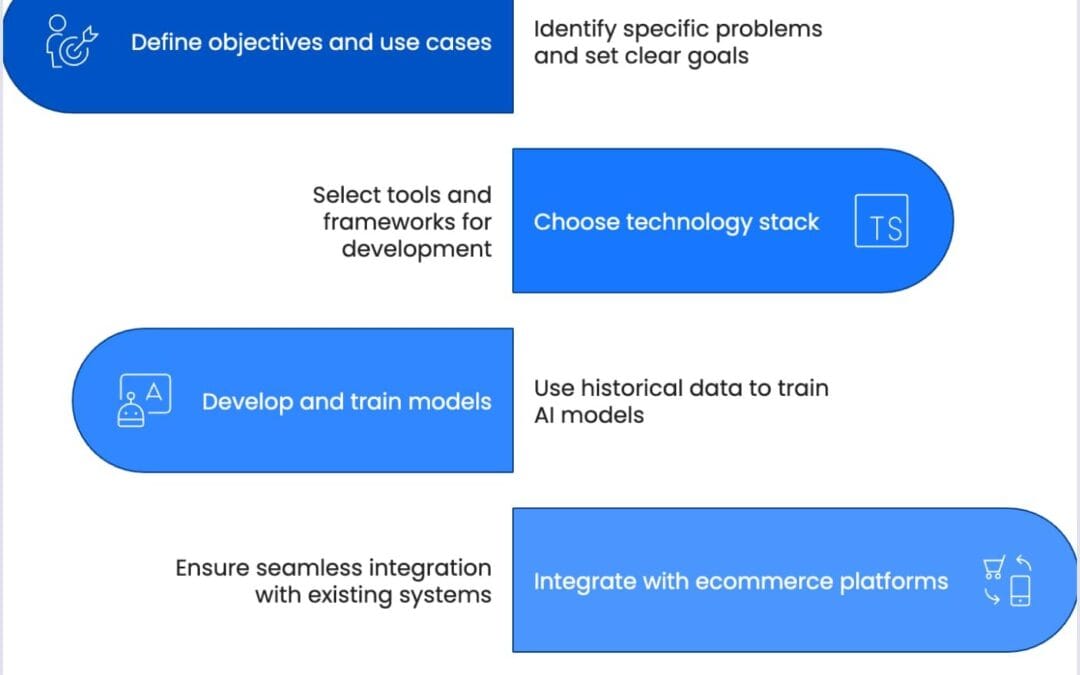
A pragmatic 90-day blueprint:
- Days 1-15 — Clean your catalog. Standardize titles, attributes, stock data, and images. Inconsistent data produces inconsistent recommendations.
- Days 16-30 — Choose your stack. Decide build vs. buy, pick channels (website, WhatsApp, Instagram), and define what the agent can and cannot do.
- Days 31-60 — Build and ground. Embed your catalog, wire up retrieval, add deterministic guardrails, and connect the action layer to cart and order systems.
- Days 61-75 — Test with real shoppers. Run a closed beta, log every failure, and tune ranking against real conversion data.
- Days 76-90 — Launch and measure. Go live, track conversion and support deflection, and iterate weekly.
Measure consistently from day one. Track recommendation click-through rate, conversation-to-purchase rate, average order value, and support tickets deflected. If the agent isn’t moving at least one of these metrics within the first weeks of launch, the problem is usually in your grounding or ranking — diagnose it rather than accept it.
The stores that do well in 2026 are unlikely to be the ones with the flashiest chatbot. They will be the ones whose agent recommends the right product, in stock, at the right price — and never invents a SKU to please the customer. Determinism beats dazzle.
Frequently Asked Questions
How much does an AI agent for e-commerce product recommendations cost?
Off-the-shelf recommendation agents typically run on per-conversation or monthly subscription pricing that scales with traffic, while custom-built agents carry a higher one-time build cost but lower ongoing fees. The right choice depends on your conversation volume and growth trajectory, so model both options against your own numbers before committing.
Can a small store with only a few hundred products use a recommendation agent?
Yes. A small catalog is actually easier to ground accurately, which improves recommendation precision and reduces hallucination risk. Stores with as few as 100-200 products can deploy a conversational recommendation agent and measure conversion and support-deflection results within weeks.
Will an AI recommendation agent recommend products I don’t actually have in stock?
Not if it’s built correctly. A properly engineered agent uses deterministic catalog grounding, meaning it can only recommend products that exist and are currently in stock. Hallucinated or out-of-stock recommendations are a sign of a poorly constrained system, not an inherent limitation of the technology.
Can the agent work on WhatsApp and Instagram, not just my website?
Yes. Modern AI recommendation agents can deploy across website, WhatsApp, and Instagram from a single backend, letting customers discover and buy products in the channel they already use. Multi-channel reach is especially valuable in Gulf and Egyptian markets where WhatsApp commerce is widespread.
How is an AI recommendation agent different from a basic chatbot?
A basic chatbot follows scripted flows and answers FAQs, while an AI recommendation agent understands natural-language preferences, matches them to your real catalog, ranks products by relevance and stock, and can take actions like adding items to the cart or processing returns. The agent acts; the chatbot just talks.
Sources & References
- Alhena.ai — Best AI Agents for Ecommerce in 2026: 16 Tools Compared
- Bitontree — AI Agent for Product Recommendations in Ecommerce
- Reddit r/AutoAgentAI — Best AI Agent Companies for Product Recommendation Engines (May 2026)
- OpenAI — Research & Deployment
- Google AI
Disclosure: This article references third-party vendors and platforms for comparison purposes. Vendor capabilities and pricing change frequently; verify current details directly with each provider before purchasing. Where specific revenue-lift percentages could not be tied to a verifiable source, they have been omitted in favor of describing the underlying mechanism. This content reflects general topical expertise in e-commerce AI implementation and is not a substitute for legal, financial, or compliance advice.
Beyond on-site suggestions, AI automation for subscription box and DTC brands ensures your products get surfaced and cited inside external AI shopping assistants like ChatGPT and Perplexity.
Note: This article is for general informational purposes; verify specifics against your own context.
If you plan to surface recommendations through WhatsApp, check the WhatsApp Business Platform AI provider updates taking effect on January 15, 2026 to avoid unexpected messaging costs.
To reach shoppers in the channel they already use, you can extend these tactics so your WhatsApp AI suggest products based on chat history, surfacing relevant items directly inside ongoing conversations.
If you’re curious how a conversational recommendation agent might fit your store, we’re happy to talk through the options and help you figure out where to start.