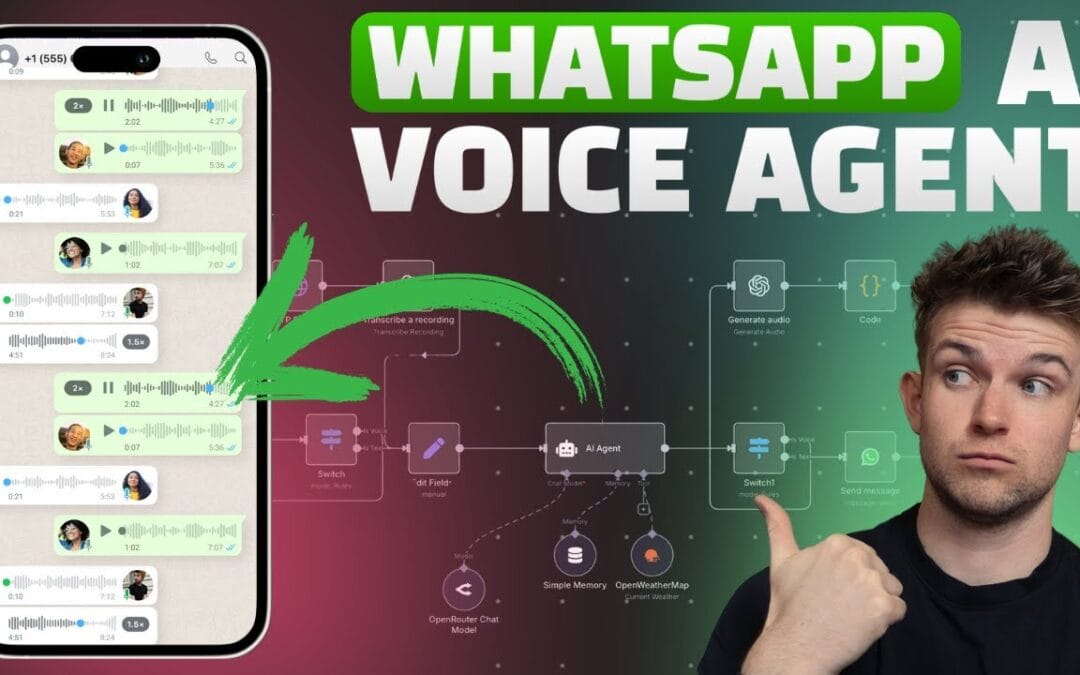
An AI agent for WhatsApp voice notes transcription Arabic 2026 addresses a measurable productivity gap that voice-first markets feel daily: a large share of WhatsApp Business conversations in the Gulf region include at least one voice note, yet many SMEs still replay them manually, one by one. That manual playback adds up to hours of lost time every week — and a competitive gap that an automated transcription agent closes in seconds.
Heading into 2026, the landscape shifted. As industry reporting and vendor coverage indicate, Meta has moved toward a native AI agent for WhatsApp Business, positioning the messaging app as workflow software rather than a pure messaging layer. But native tools tend to speak generic, standardized Arabic. Real businesses operate in Gulf (Khaleeji), Egyptian, and Levantine dialects — and that’s precisely where specialized and custom agents differentiate. Note: where 2026 product launches are referenced, treat them as announced or rolling out rather than independently verified facts; confirm current availability directly with the vendor.
Quick Summary: Key Takeaways
- AI agents for WhatsApp voice notes transcription in Arabic convert spoken messages into accurate text, summaries, and auto-replies across Arabic dialects in real time.
- OpenAI’s Whisper is a strong general-purpose multilingual speech-to-text model; in practice, Modern Standard Arabic transcribes far better than heavy dialectal speech, where word error rates rise sharply. Independent, standardized dialect benchmarks remain scarce, so treat specific WER figures as directional rather than authoritative.
- Meta’s native WhatsApp Business AI agent handles basic transcription, but generally lacks deep dialect accuracy and ERP integration.
- Custom agents combine the WhatsApp Business API + Whisper large-v3 + an LLM (such as Claude or GPT) to transcribe, summarize, translate, and act on voice orders.
- A build-vs-buy analysis often favors custom agents for SMEs handling high monthly voice-note volume, though the exact payback depends on labor costs and message volume.
- Data privacy and Arabic-language handling matter — voice data must be processed under clear retention and consent rules.
Last updated: June 27, 2026
What is an AI agent for WhatsApp voice notes transcription in Arabic?
An AI agent for WhatsApp voice notes transcription Arabic 2026 is software that automatically converts incoming WhatsApp voice messages into written Arabic text, summarizes them, and can generate intelligent replies or trigger business actions — all without a human pressing play.
Unlike a passive speech-to-text tool, an AI agent acts. Consider a typical implementation: a customer in Riyadh sends a 90-second voice note ordering 12 units in Gulf Arabic. The agent transcribes it, extracts the product, quantity, and delivery address, then drafts a confirmation reply or pushes the order into an ERP. That leap from transcription to autonomous action is what distinguishes the 2026 generation of tools from earlier dictation features.
The architecture sits on three pillars. First, the WhatsApp Business API receives the audio. Second, a speech-to-text engine — most commonly OpenAI’s Whisper large-v3 — converts speech into text. Third, a large language model interprets intent, summarizes, and responds. OpenAI publishes its research and model documentation on its official research and deployment site, where Whisper is described as a large multilingual automatic speech recognition model. Comparable general-purpose assistants used in the LLM layer include ChatGPT and Google Gemini.
Vendors like Barq, Alumera, Thikaa, and Karsaaz Agent already package these layers. Karsaaz Agent, for example, markets the ability to transform voice notes into summaries, transcripts, and AI replies directly inside WhatsApp and Telegram with no app install, per its April 2026 product post. The differentiator isn’t raw transcription anymore — it’s dialect accuracy and workflow depth.
How does an Arabic WhatsApp voice transcription pipeline actually work?
An Arabic WhatsApp voice transcription pipeline is an automated system that converts WhatsApp voice notes into actionable text in four stages. First, it captures audio through the WhatsApp Business API, which delivers messages as OGG/Opus files. Second, it transcribes the audio using a Whisper large-v3 model, which performs strongly on Modern Standard Arabic but degrades on regional dialects like Egyptian or Gulf Arabic. Third, it processes the transcript with a large language model (LLM) to extract a summary and detect user intent. Fourth, it replies to the customer or routes the structured result into a CRM, ticketing system, or order workflow.
Each stage carries technical weight. Arabic is not one language — it’s a spectrum. Modern Standard Arabic (MSA) is the formal written form, but almost nobody speaks it in casual voice notes. Customers speak Egyptian, Gulf (Khaleeji), Levantine, or Maghrebi dialects, often code-switching with English or French. A generic model trips on this constantly. As practitioners building these systems generally observe, dialect coverage — not raw headline accuracy — is the real bottleneck for Arabic transcription.
The four-stage build for a 2026 AI agent for WhatsApp voice notes transcription Arabic
- Audio ingestion. The WhatsApp Business Cloud API sends a webhook the moment a voice note arrives. The agent downloads the OGG/Opus file and converts it to 16 kHz WAV, the format Whisper accepts.
- Speech-to-text. Whisper large-v3 transcribes the audio. For dialectal accuracy, teams fine-tune on regional datasets or apply a post-correction LLM pass to fix dialect-specific words that MSA-leaning models mangle.
- Post-processing & LLM interpretation. The agent adds diacritics, corrects spelling, segments text for readability, then summarizes long notes, detects intent (order, complaint, inquiry), and extracts structured data like product names and quantities.
- Action and reply. The agent drafts a culturally appropriate Arabic reply, logs the interaction, and — when integrated — pushes the order into an ERP or order-management workflow.
A practical trade-off worth budgeting for: practitioners generally find dialect fine-tuning to be the single biggest lever for Arabic transcription quality, and collecting labeled dialectal audio is the slow part. Plan time for data collection before deployment rather than expecting an off-the-shelf model to handle heavy colloquial speech on day one.
Latency matters more than people expect. A customer who sends a voice note expects a reply that feels human-fast. Production pipelines using Whisper large-v3 typically return a transcript within a few seconds for a short clip on GPU infrastructure; add a second or two for the LLM reply, and you stay under the psychological threshold where waiting feels normal. A useful demonstration of this end-to-end flow — transcription plus translation across languages inside WhatsApp — is shown in this February 2026 walkthrough video.
Want to see how this connects to broader automation? Our breakdown of custom AI agent architecture for SMEs covers the orchestration layer in depth. The transcription agent is rarely the endpoint — it’s the front door to a full workflow.
Why is dialect accuracy the real battleground for Arabic voice AI in 2026?
Dialect accuracy is the real battleground because MSA transcription is largely solved, but dialectal speech still produces noticeably higher word error rates. A model that handles MSA well can degrade substantially on heavy Gulf or Egyptian colloquial speech.
The gap is structural. Arabic dialects diverge in vocabulary, pronunciation, and grammar to the point where a Gulf speaker and a Maghrebi speaker may struggle to understand each other. A transcription model trained mostly on formal MSA news audio simply hasn’t heard how a Jeddah shop owner actually talks to a supplier — including code-switching, which appears frequently in real Gulf voice notes.
This is where specialized vendors stake their claim. Barq positions itself around Arabic and Hebrew coverage for voice note AI replies, explaining on its learning resource how transcription, language coverage, and native WhatsApp features interact. Alumera markets itself bluntly as “WhatsApp. Arabic. AI.” with auto-translation that detects the customer’s language and replies natively, per its official site.
How accurate are the leading Arabic voice transcription tools?
Benchmarking is genuinely messy because vendors rarely publish standardized word error rates on a common dataset. We have not found a single neutral, peer-reviewed benchmark covering all of these tools on identical dialectal audio, so the table below is a directional picture based on general Whisper behavior and the structural difficulty of each dialect — not vendor-verified measurements. Treat it as a planning heuristic, and always pilot on your own conversations.
| Arabic Variant | Relative transcription difficulty | Custom Agent Improvement |
|---|---|---|
| Modern Standard Arabic | Low — strongest out of the box | Marginal (already strong) |
| Gulf / Khaleeji | High | High — fine-tuning closes much of the gap |
| Egyptian | High | High — comparatively more dialect data available |
| Levantine | High | Moderate to high |
| Maghrebi | Highest | Hardest — limited training data |
The takeaway is blunt: if your customers speak heavy dialect, an off-the-shelf transcription feature will likely frustrate them. A custom-tuned AI agent for WhatsApp voice notes transcription Arabic 2026 that adds a dialect-aware LLM correction pass is often the difference between “close enough” and “actually usable for orders.” The recurring pattern across deployments is that generic models look impressive in MSA demos and stumble in the real, messy, code-switched conversations that drive revenue.
For a side-by-side framework you can adapt to your own message data, see our AI comparison approach.
Should SMEs build a custom agent or use WhatsApp’s native transcription?
SMEs should use WhatsApp’s native transcription for casual internal use, but build or buy a custom AI agent when voice notes drive revenue, require dialect accuracy, or must flow into orders and CRM systems. The distinction is simple: native tools transcribe, while custom agents act on the transcript.
WhatsApp now ships native voice message transcription. The process is straightforward — tap and hold the voice message, select More options, then Transcribe, as documented in a complete guide from ChatMaxima. For reading a colleague’s note in a meeting, that’s enough. For running a business workflow, it falls short — it handles mainly standard speech and offers no integration with business systems.
A useful decision rule: native transcription answers “what was said,” while a custom agent answers “what do we do next.” Lean on native transcription for low volumes and internal reading; build or buy a custom agent once transcription errors directly cost sales, bookings, or customer trust, or once volume makes manual handling expensive.
The build-vs-buy cost reality for 2026
Here’s the honest trade-off. Native transcription is free but offers no summarization, no auto-reply, no dialect tuning, and no ERP integration. Off-the-shelf agents like Barq or Karsaaz Agent cost a monthly subscription and cover the basics well. Custom agents carry upfront development cost but eliminate per-message fees at scale and integrate with your exact stack.
| Option | Best For | Limitations |
|---|---|---|
| WhatsApp native transcription | Personal/casual reading | No replies, no dialect tuning, no integration |
| SaaS agent (Barq, Alumera, Thikaa, Karsaaz) | Small teams wanting fast setup | Monthly fees, limited customization, potential vendor lock-in |
| Custom AI agent | SMEs scaling voice commerce + ERP | Higher upfront cost, needs technical partner |
The math can favor custom builds faster than people assume, though the exact payback depends on your labor rates and volume. Consider a worked example: an SME handling several hundred voice notes monthly, where each manual playback-and-response costs a few minutes of staff time, can burn dozens of hours a month. At typical labor rates, automation often recovers the build cost within a handful of months — and that’s before counting recovered sales from faster replies. The figure is a model, not a guarantee; run the numbers on your own message log.
The recurring cost of SaaS agents is the subscription that never stops, plus per-conversation pricing that scales with success. A custom agent flips that: cost is mostly fixed, and marginal transcriptions are nearly free. Our automation ROI resources help model this scenario against your real message volume.
How does voice transcription connect to WhatsApp voice commerce in MENA?
Voice transcription connects to voice commerce by turning spoken orders into structured, fulfillable transactions. In the MENA and Gulf markets, where voice notes dominate B2B and B2C messaging, an AI agent that transcribes, extracts order details, and routes them to fulfillment converts conversation directly into revenue.
Voice commerce is an underserved frontier in 2026. WhatsApp is a default commerce channel across Saudi Arabia, the UAE, and Egypt, and a meaningful share of orders arrive as voice notes — “send me two boxes of the usual, deliver to the warehouse before Thursday.” A human reads that, interprets it, and manually enters it. An AI agent can do it instantly and consistently.
The workflow looks like this when fully built out:
- Transcribe the Arabic voice order with dialect-aware accuracy.
- Extract product, quantity, delivery details, and customer identity into structured fields.
- Validate against inventory and pricing in your ERP.
- Confirm with an auto-generated reply in the customer’s dialect.
- Fulfill by creating the order record automatically.
Meta appears to be moving toward this future with a native WhatsApp Business AI agent that reframes WhatsApp as workflow software, not just messaging. But a native agent is generic by design — it serves the broadest market, not the Jeddah wholesaler whose customers place orders in fast Khaleeji slang. That specificity is exactly the opening for custom agents tuned to a single business’s products, dialect, and ERP. The transcription itself is becoming a commodity; the value migrates to what happens after the words appear.
What about data privacy and compliance for Arabic voice data?
Data privacy for Arabic voice transcription requires clear consent, defined retention limits, and compliance with regional regulations like Saudi Arabia’s Personal Data Protection Law (PDPL) and the UAE’s data protection framework. Voice notes are personal data — businesses must control where audio is processed and how long transcripts persist.
Compliance is the part vendors often gloss over. A voice note frequently contains names, addresses, phone numbers, and financial intent. Pushing that audio to a third-party cloud without a data processing agreement is a real risk, especially under Saudi Arabia’s PDPL, which governs how the personal data of residents is handled. Businesses should confirm current obligations with qualified legal counsel rather than relying on a vendor’s marketing claims.
Responsible deployment means answering hard questions up front:
- Where is the audio processed? On-region servers or self-hosted infrastructure reduce cross-border transfer risk.
- How long are transcripts stored? Minimal retention beats indefinite storage.
- Is there human oversight? Deterministic, auditable workflows beat black-box auto-actions for high-value orders.
- What’s disclosed to the customer? Transparency about AI handling builds trust.
A robust pattern is to design human-in-the-loop checkpoints for any action that moves money or commits inventory. An AI agent can draft the order confirmation — but a person can approve the edge cases. That’s the difference between a reliable system and a liability. Probabilistic models will occasionally misread a quantity or a dialect word; good design assumes that, rather than pretending it won’t happen.
Practical takeaways: deploying your AI agent for WhatsApp voice notes transcription Arabic 2026
To deploy an effective Arabic WhatsApp voice transcription agent, start by measuring your voice note volume, identify your customers’ dominant dialect, then choose between SaaS and custom based on whether transcripts need to trigger business actions.
A practical action plan:
- Audit volume. Count voice notes per week and estimate minutes spent listening and responding. This is your baseline cost.
- Identify dialect. If most customers speak heavy dialect, prioritize accuracy over speed-to-launch.
- Pilot a SaaS tool. Test Barq, Alumera, or Karsaaz Agent on real voice notes for two weeks. Measure transcription accuracy on your actual conversations, not demos.
- Calculate the ceiling. If SaaS fees scale painfully or integration is impossible, model a custom build.
- Build for action. Don’t stop at transcription. Wire the agent into replies and order workflows where the real ROI lives.
- Add oversight. Keep humans in the loop for high-value actions and edge-case dialect errors.
The businesses winning in 2026 aren’t simply the ones that transcribe voice notes — they’re the ones turning voice notes into a more automated sales channel while competitors are still pressing play. The technology is mature, dialect models are good enough with tuning, and the build-vs-buy math is clearer than ever. The remaining question is whether you act before a competitor’s agent answers your customer first.
Frequently Asked Questions
Can AI transcribe Gulf and Egyptian Arabic dialects accurately in 2026?
Yes, but with caveats. Whisper large-v3 handles Modern Standard Arabic well, while heavy Gulf and Egyptian dialects degrade noticeably because of vocabulary, pronunciation, and code-switching. Fine-tuning and an LLM correction pass meaningfully improve dialectal results, making custom agents more reliable than off-the-shelf tools for real conversations. Independent standardized dialect benchmarks remain limited, so test on your own audio.
What’s the difference between WhatsApp’s native transcription and a custom AI agent?
WhatsApp’s native transcription converts a voice note to text when you manually tap Transcribe. A custom AI agent for WhatsApp voice notes transcription Arabic 2026 automatically transcribes, summarizes, replies in the customer’s dialect, and can push orders into your ERP — turning a passive feature into an active workflow.
How much does it cost to build a custom WhatsApp voice transcription agent?
Costs vary by complexity. For SMEs handling several hundred voice notes monthly, a custom agent can pay back within a few months by eliminating dozens of hours of monthly manual work — though the exact figure depends on labor rates and volume. Unlike SaaS subscriptions with per-message fees, custom builds keep marginal transcription costs near zero as volume grows.
Which tools lead the Arabic WhatsApp voice AI market in 2026?
Specialized tools include Barq (heybarq.com), Alumera, Thikaa, and Karsaaz Agent, alongside Meta’s native WhatsApp Business AI agent. Specialized vendors compete on Arabic dialect depth and auto-reply, while custom-built agents lead when deep ERP integration and dialect tuning are required. Confirm current features and availability directly with each vendor.
Is it safe to process Arabic voice data through AI for compliance?
It can be, when done under clear consent, minimal retention, and compliance with regional laws like Saudi Arabia’s PDPL. Voice notes are personal data, so businesses should prefer on-region or self-hosted processing, keep human oversight for any AI action that commits inventory or money, and consult qualified legal counsel on current obligations.
Sources & References
- OpenAI — Research & Deployment (Whisper speech recognition)
- Barq — How WhatsApp voice note AI reply works (Arabic/Hebrew coverage)
- Alumera — WhatsApp. Arabic. AI. (auto-translation)
- Karsaaz Agent — voice note summaries and AI replies (April 2026 post)
- ChatMaxima — WhatsApp Voice Message Transcripts: A Complete Guide
- AI-Powered WhatsApp Voice Note Transcription & Translation walkthrough (Feb 2026)
- ChatGPT (OpenAI) · Google Gemini — general-purpose LLMs used in the interpretation layer
Methodology note: Accuracy and difficulty descriptions in this article are directional and based on the general behavior of multilingual speech models plus the structural challenge of Arabic dialects, not on a single standardized vendor benchmark. References to 2026 product launches reflect announcements and vendor coverage rather than independently verified deployment facts. Always pilot on your own conversations and confirm vendor features and compliance terms before deploying.