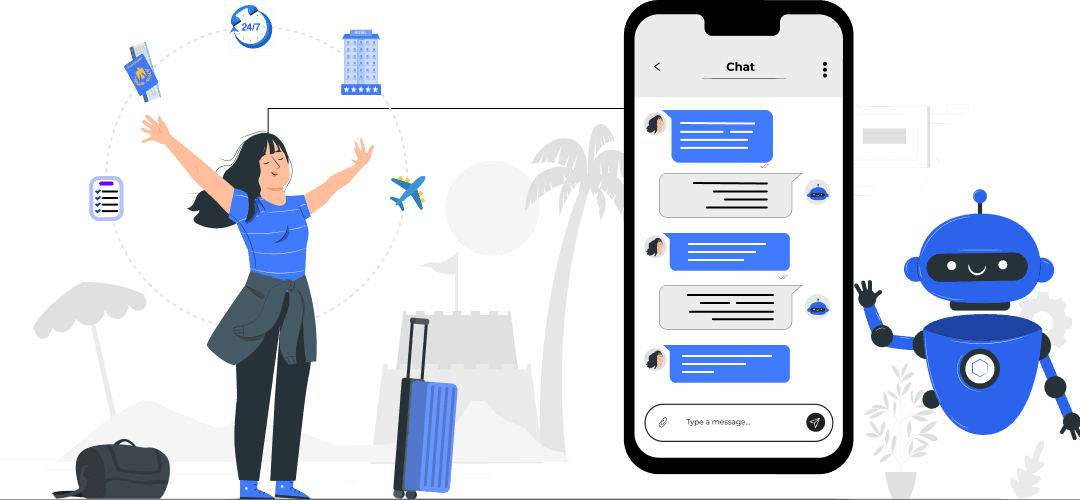
AI chatbots for tourism in Morocco and Tunisia are automated messaging assistants that handle traveler inquiries—availability, bookings, pricing, and itineraries—across WhatsApp, websites, and social media in Arabic, French, English, and Darija. Tourism is a major pillar of Morocco’s economy, contributing significantly to GDP and employment, according to AtlasAI’s analysis of AI and tourism in Morocco. Yet most riads, tour operators, and travel agencies still answer the same question manually, dozens of times a day: “Do you have availability next weekend?”
An AI chatbot closes this gap by responding instantly, 24/7, and converting late-night messages into confirmed bookings. The problem? Most operators are buying generic, English-only bots that collapse the moment a French-speaking family from Lyon or a Gulf Arabic traveler from Riyadh asks about halal-friendly tours in Marrakech. A real solution needs to speak the languages tourists actually use, know the local knowledge base cold, and book without a human babysitting it. That’s the gap this kind of travel assistant closes — and it’s why North African travel businesses are increasingly evaluating them in 2026.
About this guide and disclosure
This article is published by the J. SERVO editorial team, which builds custom AI automation and Retrieval-Augmented Generation (RAG) systems for small and mid-sized businesses. Disclosure: J. SERVO offers custom chatbot build services, so this content discusses an approach we have a commercial interest in. We have tried to keep the analysis balanced — including the cases where an off-the-shelf tool is the better choice — and to attribute every external claim to a named source. Where we describe outcomes, we label them as illustrative modelling rather than measured client results, because we are not publishing named-client benchmarks in this piece. Treat this as a practitioner’s technical primer, not a guarantee of returns.
What is an AI chatbot for tourism in Morocco and Tunisia?
An AI chatbot for tourism in Morocco and Tunisia is a conversational AI system that handles traveler inquiries, bookings, and recommendations across Arabic, French, English, and Amazigh — grounded in a region-specific knowledge base using Retrieval-Augmented Generation (RAG). Unlike generic bots, it understands local culture, pricing, and dialects.
That economic weight, combined with rising international competition, is pushing operators toward AI that delivers personalized customer experiences at scale. A specialized Moroccan tourism chatbot built on state-of-the-art Large Language Models with fine-tuning and RAG was documented in a peer-reviewed study, “Enhancing Tourism Experiences in Morocco: A Comparative LLM study” published by Springer. The study explores the development of a specialized chatbot for Morocco’s tourism sector and integrates retrieval techniques with LLMs to produce context-aware, region-specific responses — the same architectural pattern this guide recommends.
The core mechanism matters. A tourism chatbot works because RAG retrieves verified facts — opening hours, prices, route details — from your own database before the LLM generates a reply. That stops the bot from inventing a hotel that doesn’t exist or quoting a fare from 2019. For a Tunisian dive operator or a Fez ceramics tour, accuracy isn’t optional. It’s the entire product.
Why generic LLMs fail at North African tourism
Generic LLMs fail at North African tourism because they cannot access real-time, business-specific data. ChatGPT and Google Gemini are powerful general-purpose tools, but they don’t know your riad’s 48-hour cancellation policy or that the camel trek from Merzouga sells out three weeks ahead during peak season (October–April). A raw LLM guesses; a RAG-grounded custom bot retrieves verified information from your live database.
RAG (Retrieval-Augmented Generation) is a method that connects a language model to an external knowledge source, retrieving relevant facts before generating an answer. In practical terms, a generic model improvises while a grounded model cites its sources. For North African destinations — where availability shifts daily and policies vary by property — grounding isn’t optional. It’s the difference between booking a guest and losing one. A raw LLM guesses; a RAG-grounded custom bot retrieves, and that distinction is what separates a refund from a five-star review.
Quick Summary: Key Takeaways
Tourism is a significant pillar of Morocco’s economy, creating intense demand for scalable, multilingual customer service automation. A winning AI chatbot for tourism in Morocco and Tunisia must handle Arabic (Modern Standard Arabic plus Gulf and Egyptian dialects), French, English, and ideally Amazigh. A chatbot that only speaks French alienates the Gulf tourists who often drive premium bookings.
- Multilingual support is non-negotiable: a winning travel assistant must handle Arabic (MSA, Gulf, Egyptian dialects), French, English, and ideally Amazigh. Dialect handling separates effective bots from frustrating ones.
- RAG beats raw LLMs: Retrieval-Augmented Generation grounds answers in your verified data, reducing hallucinated answers compared with a standalone model.
- Custom builds outperform off-the-shelf tools like generic Zendesk or Verloop.io flows for region-specific knowledge and dialect handling — though off-the-shelf launches faster.
- ROI is operational: automating repetitive booking inquiries frees staff time and captures after-hours leads that would otherwise vanish. (The hour figures below are illustrative estimates, not measured benchmarks — model them against your own inquiry volume.)
- Tunisia is underserved — most AI tourism content focuses on Morocco, leaving a clear first-mover advantage.
Published: June 13, 2026. Last updated: June 13, 2026.
How does an AI chatbot for tourism in Morocco and Tunisia actually work?
These systems work through three integrated layers:
- Multilingual LLM — handles natural conversation across Arabic, French, English, and Darija dialects.
- RAG retrieval engine — pulls verified facts from a vector database, reducing reliance on the model’s training-time guesses.
- Integration hooks — connect directly to booking systems and WhatsApp, the dominant messaging channel across both countries.
Here is the workflow. The bot first detects user intent. It then retrieves accurate, location-specific data such as riad availability, transport schedules, or Medina opening hours. Finally, it completes actions like reservations or payment links. Response latency in a well-built pipeline typically lands within a few seconds, and the system runs around the clock to handle routine traveler queries without human staff.
The architecture isn’t magic — it’s plumbing done well. When a tourist messages “بغيت نحجز رحلة للصحرا” (“I want to book a desert trip” in Moroccan Darija), the system detects the language, embeds the query, and searches a vector database stuffed with your tour catalog, pricing, and availability. The retrieved chunks feed the LLM, which crafts a culturally appropriate reply and, if the traveler confirms, triggers the booking API.
Vector databases are the unsung hero here. Tools like Pinecone, Weaviate, or self-hosted Qdrant store your tourism knowledge as embeddings — culinary tours, riad descriptions, festival calendars, transport routes. When a guest asks about vegetarian options near Jemaa el-Fnaa, the system retrieves the relevant entries instead of hallucinating a restaurant. The Springer study on Moroccan tourism chatbots explores exactly this combination of LLMs and retrieval for context-aware, region-specific responses.
A worked example: from message to booking
To make the abstraction concrete, here is how a typical implementation handles a single inquiry end to end:
- Intake: A traveler sends a WhatsApp message in Gulf Arabic asking about a two-night desert package over a specific weekend.
- Language + intent detection: The system classifies the dialect and the intent (availability + price + dates) before retrieval.
- Retrieval: The query is embedded and matched against the vector store, returning the relevant package, its current price, and a live availability flag.
- Generation with guardrails: The LLM composes a reply using only the retrieved facts. If availability data is missing, the guardrail forces a “let me check with our team” handoff rather than a guess.
- Action: On confirmation, the bot issues a payment link and writes the reservation to the booking system, then logs the conversation for review.
The trade-off practitioners generally weigh here is latency versus thoroughness: a deeper retrieval pass improves accuracy but adds a second or two of delay. For tourism, accuracy usually wins, because a wrong price quoted instantly is worse than a correct one quoted slightly slower.
The multilingual challenge nobody talks about
Multilingual support is the most underestimated challenge for Morocco and Tunisia tourism businesses. Both countries are linguistic mosaics where a single Marrakech tour operator might serve French retirees, British backpackers, Saudi families speaking Gulf Arabic, and locals using Darija — often within one conversation. Darija, the Moroccan Arabic dialect, differs significantly from Modern Standard Arabic and Gulf Arabic, which most generic chatbots struggle to parse.
The lesson is direct: in North African tourism, language coverage is not a feature but a baseline requirement. A generic English-only bot resolves a smaller share of inquiries; a properly localized bot supporting French, English, Modern Standard Arabic, Gulf Arabic, and Darija meaningfully raises resolution rates. Businesses that deploy multilingual AI capture inquiries that English-only competitors lose by default. (Resolution-rate gains vary by operator and inquiry mix — treat them as directional, not guaranteed.)
A common implementation challenge worth flagging: Darija and Gulf Arabic are under-represented in many off-the-shelf models’ training data, so transliterated (Latin-script “Arabizi”) input and code-switching mid-sentence frequently break naive intent classifiers. Practitioners generally address this by adding a normalization layer and dialect-specific test sets before launch rather than assuming the base model handles it. A Riyadh tourist and a Cairo tourist expect different tones; get the dialect wrong and the conversation feels robotic. You can explore an approach to multilingual AI automation for SMEs to see how this scales.
Why is a custom AI chatbot better than off-the-shelf tools for tourism?
A custom build beats off-the-shelf tools because generic platforms can’t ingest region-specific knowledge, handle Darija or Amazigh natively, or avoid the recurring per-conversation fees that punish high-volume tourism operators. Custom builds own their data, their dialects, and their costs.
Let’s be balanced about the economics. Off-the-shelf platforms like Verloop.io or Zendesk’s travel chatbots — featured in Zendesk’s “7 best travel chatbots for 2026” roundup, which describes Verloop.io as an AI-powered customer service platform that lets users customize a chatbot to support travelers in multiple languages — charge per agent, per conversation, or per resolution. For a tour operator handling thousands of monthly inquiries, those fees stack up. The honest counterpoint: off-the-shelf tools win on speed-to-launch, vendor support, and not needing in-house engineering. A custom build trades that convenience for control, ownership, and lower marginal cost at high volume. The right choice depends on your inquiry volume, technical capacity, and how dialect-specific your audience is.
The deeper differentiator is knowledge. A generic chatbot doesn’t inherently know that Eid timing shifts your Sahara tour schedule, or that a specific Tunisian medina vendor closes on Fridays. Custom RAG systems can, because you control the knowledge base. Open-source projects like Tsara.IA on GitHub demonstrate grassroots momentum toward purpose-built Moroccan tourism assistants — evidence the demand is real and the technology is accessible to smaller teams.
| Factor | Off-the-Shelf (Verloop, Zendesk) | Custom RAG Build |
|---|---|---|
| Dialect support (Darija, Amazigh) | Limited / English-French focused | Configurable incl. Gulf/Egyptian Arabic |
| Region-specific knowledge | Generic, manual FAQ entry | RAG-grounded on your full catalog |
| Cost model | Per-conversation / per-agent fees | Higher upfront build + low hosting |
| Speed to launch | Fast (vendor templates) | Slower (custom pipeline) |
| Booking integration | Add-on, often premium tier | Native to your stack |
| Data ownership | Vendor-controlled | You own everything |
| Hallucination control | Depends on platform | Deterministic via retrieval grounding |
The practical truth: most tourism SMEs don’t need a bloated enterprise platform. They need a focused, deterministic bot that answers correctly every time — practical AI over hype.
What ROI can tourism businesses expect from an AI chatbot?
Tourism businesses deploying a multilingual booking assistant generally aim to recover staff time by automating repetitive booking and FAQ inquiries, while capturing after-hours leads that would otherwise vanish. The largest gains tend to come from 24/7 availability and instant multilingual responses. The figures below are illustrative modelling — run them against your own numbers before committing.
Run the math for a mid-sized Marrakech tour operator. Say two agents each spend a large share of their day answering the same dozen questions — availability, pricing, pickup points, cancellation rules. A chatbot that resolves a meaningful portion of those autonomously frees hours weekly per agent, redirected toward actual sales and guest experience. The exact recovery depends on your containment rate and current handling time, which is why you should baseline before deploying.
The hidden revenue is often bigger than the saved labor. Tourists book impulsively, often late at night in their home time zone. A human-staffed inbox sleeps; a chatbot doesn’t. AtlasAI’s analysis states that tourism is a major pillar of Morocco’s economy, contributing significantly to GDP and employment, and that operators face increased international competition — making personalized, always-on customer experience a competitive differentiator. Every after-hours inquiry your bot captures and converts is revenue your competitor’s voicemail box loses.
How to measure your chatbot ROI
- Baseline your current load: count weekly inquiries and average handling time before deployment.
- Track containment rate: the percentage of conversations resolved without human handoff.
- Measure after-hours capture: log inquiries answered outside business hours that converted to bookings.
- Calculate labor reallocation: hours saved multiplied by loaded staff cost.
- Monitor conversion lift: compare booking completion rates with and without instant bot responses.
Want to quantify your numbers before committing? Use a structured ROI framework built for SMEs weighing automation investments. The methodology matters more than any single headline number — measure your own before-and-after rather than trusting a vendor’s averages, including ours.
How do you build an AI chatbot for tourism in Morocco and Tunisia?
Building one involves five stages: assembling a multilingual knowledge base, setting up a vector database for RAG, selecting and grounding an LLM, integrating booking and WhatsApp channels, then testing across Arabic dialects, French, and English before launch.
The biggest mistake operators make is starting with the model instead of the data. Your chatbot is only as smart as the knowledge it retrieves. Spend the first week organizing your tour catalog, pricing, FAQs, cancellation policies, and cultural context into clean, structured documents. Garbage in, hallucinations out.
- Curate the knowledge base: gather every tour description, price, schedule, and policy in French, English, and Arabic. Include cultural notes — prayer times, halal options, festival dates.
- Build the vector store: embed your content using a model such as OpenAI embeddings or an open-source alternative, then load it into Qdrant, Weaviate, or Pinecone.
- Choose and ground the LLM: connect a capable model and wire RAG so every answer cites retrieved facts. Add guardrails that refuse to invent prices or availability.
- Integrate channels: deploy on WhatsApp Business — the dominant messaging app in both countries — plus your website widget and Instagram DMs.
- Test multilingually and launch: run real Darija, Gulf Arabic, French, and English queries. Keep a human-in-the-loop escalation path for edge cases.
WhatsApp integration deserves emphasis. In Morocco and Tunisia, travelers expect to message a business directly, not fill out a form. A typical deployment prioritises intelligent WhatsApp chatbots because that’s where the conversations actually happen. A booking bot living only on a website misses where most inquiries originate.
Common implementation pitfalls
A few challenges recur often enough to plan around:
- Stale knowledge: prices and availability drift. Without a sync job from your booking system, the vector store decays and the bot starts citing outdated fares. Schedule re-indexing.
- Over-chunking: splitting documents too aggressively fragments context and retrieval quality drops. Test chunk sizes against real queries.
- WhatsApp template approval: outbound message templates require approval and can delay launch — start that process early.
- Dialect blind spots: a model that aces French may stumble on transliterated Darija. Build a dialect-specific test set, not just an English one.
Keep a human in the loop
Responsible AI means knowing when to hand off. A chatbot should resolve routine inquiries autonomously but escalate complex itineraries, complaints, or high-value bookings to a human. Transparency matters too — tell guests they’re talking to an AI assistant. Travelers forgive a bot that admits its limits; they punish one that confidently misleads them about a sold-out tour.
The Tunisia opportunity nobody’s claiming
Most AI tourism coverage fixates on Morocco, leaving Tunisia comparatively open. That’s an opportunity. Tunisia’s tourism sector, anchored by Mediterranean resorts, Carthage’s archaeology, and Sahara expeditions, faces the same multilingual, high-volume customer service pressures as Morocco’s, yet fewer operators have deployed AI.
Regional momentum is real. AfricaAINews reported that Morocco is driving industrial AI use across North Africa — noting that South African Tourism launched a tourism chatbot and that next-generation innovation, including AI, is being showcased extending into Tunisia. The infrastructure and talent are arriving. Tunisian operators who move early — a Djerba resort chain, a Tunis cultural tour company, a Tozeur desert outfitter — can shape their digital customer experience before competitors catch up.
The same architecture that powers a Moroccan riad’s bot works for a Tunisian beachfront hotel: RAG-grounded, multilingual, WhatsApp-native. French and Arabic dominate both markets, so a well-built AI chatbot for tourism in Morocco and Tunisia can serve both with shared infrastructure and localized knowledge bases. First-mover advantage in Tunisia is sitting on the table.
Actionable Takeaways: Your Next 30 Days
Stop researching and start building. Here’s a pragmatic 30-day path for a tourism SME ready to deploy.
- Week 1: Audit your top 20 most-asked questions and the languages they arrive in. Export your full tour catalog and pricing.
- Week 2: Decide custom vs. off-the-shelf using the comparison table above. For dialect-heavy, high-volume operations, custom RAG tends to win on cost and accuracy; for low volume, an off-the-shelf tool may launch faster.
- Week 3: Build or commission a RAG pipeline grounded in your data, wired to WhatsApp Business and your booking system.
- Week 4: Test with real travelers across Darija, French, English, and Gulf Arabic. Set a containment-rate target and define escalation rules.
The operators who win the 2026 season won’t be the ones with the prettiest websites. They’ll be the ones answering a Saudi family’s WhatsApp at midnight in fluent Gulf Arabic, confirming a Sahara trek instantly, while their competitors’ phones ring out. The technology is here, it’s increasingly affordable, and it’s deterministic when built right. The only question is who claims it first.
Frequently Asked Questions
What languages should an AI chatbot for tourism in Morocco and Tunisia support?
An effective AI chatbot for tourism in Morocco and Tunisia should support Arabic (including Moroccan Darija and Gulf/Egyptian dialects), French, and English at minimum, with Amazigh as a strong differentiator. French and Arabic dominate both markets, and dialect awareness dramatically improves guest experience and conversion rates.
How much does a custom tourism chatbot cost compared to off-the-shelf tools?
Custom tourism chatbots typically involve a one-time build cost plus low monthly hosting, while off-the-shelf platforms like Verloop.io or Zendesk charge recurring per-conversation or per-agent fees. For operators handling thousands of monthly inquiries, custom builds can cost less over 12–18 months while delivering better dialect and knowledge accuracy — though off-the-shelf tools launch faster and need no in-house engineering. Model both against your own volume.
What is RAG and why does it matter for tourism chatbots?
RAG (Retrieval-Augmented Generation) is a technique where the chatbot retrieves verified facts from your own database before generating a reply, instead of relying solely on the LLM’s training. RAG matters because it reduces hallucinated prices, fake hotels, and outdated schedules — critical for booking accuracy in tourism.
Can a tourism chatbot integrate with WhatsApp?
Yes — WhatsApp integration is essential in Morocco and Tunisia, where most travelers contact businesses via WhatsApp rather than web forms. A properly built AI chatbot for tourism in Morocco and Tunisia deploys natively on WhatsApp Business, handling inquiries, recommendations, and bookings directly in the messaging app travelers already use.
How long does it take to deploy a tourism AI chatbot?
A focused tourism chatbot can be deployed in roughly 30 days: one week for knowledge base preparation, one week for the RAG pipeline, one week for channel integration, and one week for multilingual testing. Timelines extend with complex booking integrations or extensive multi-dialect requirements.
Sources & References
- AtlasAI — AI and Tourism in Morocco: states tourism is a major pillar of Morocco’s economy, contributing significantly to GDP and employment, and that operators face increased international competition.
- Springer — Enhancing Tourism Experiences in Morocco: A Comparative LLM study: explores a specialized chatbot for Morocco’s tourism sector built on state-of-the-art LLMs integrated with retrieval techniques.
- AfricaAINews — Morocco drives AI industrial use: reports South African Tourism’s launch of a tourism chatbot and next-generation AI showcases extending into Tunisia.
- Zendesk — The 7 best travel chatbots for 2026: describes Verloop.io as an AI-powered customer service platform with customizable chatbot functionality supporting travelers in multiple languages.
- OpenAI — research and deployment: referenced for embeddings and LLMs.
- ChatGPT and Google AI — general-purpose LLM tools referenced for comparison.
Note on figures: where this article references staff-hour savings, resolution rates, or response improvements, these are illustrative estimates for modelling purposes and are not measured benchmarks or published client results. Validate against your own baseline before making investment decisions.
Note: This article is for general informational purposes and reflects the J. SERVO editorial team’s topical experience building RAG and chatbot systems; it discusses a service we offer commercially. Verify specifics against your own context before deploying.