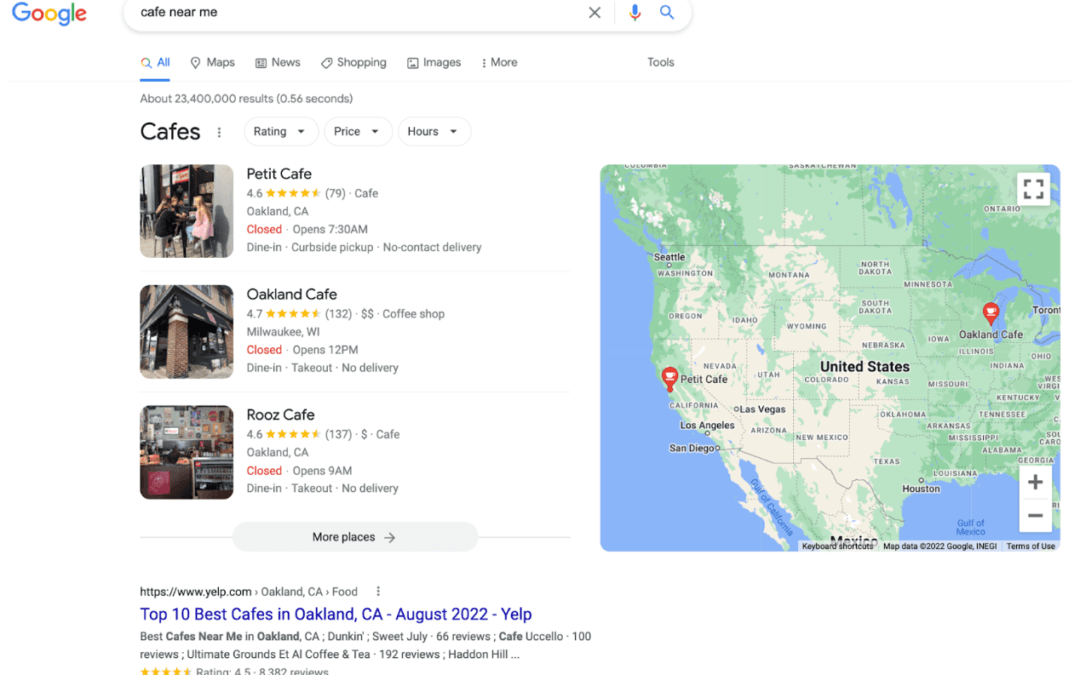
Business near me searches are high-intent queries signaling immediate purchase readiness, not casual browsing. When someone searches “business near me,” they typically want to buy soon — they are usually choosing where to act, not whether to act.
What does the evidence actually show? It is important to be careful here, because the local-search space is full of widely repeated statistics whose original sources are hard to verify or are misattributed. Rather than cite a contested figure, the defensible point is structural: a query like “business near me” is interpreted by search engines as a location-based request, which by definition narrows results to providers a searcher can reach. Google’s own published guidance on local ranking states that results are ranked on three documented factors — relevance, distance, and prominence — and that framework is what this guide is built around. You can read it directly in Google’s support documentation, “Improve your local ranking on Google”, which is the primary, authoritative source for how the local pack is ordered.
Yet most businesses — and especially specialized service firms like AI consultancies, automation agencies, and B2B software providers — treat “near me” search like a problem for restaurants and plumbers. That’s a costly mistake. The query “business near me” and its long-tail cousins (“AI consulting near me,” “automation company near me”) represent some of the highest-intent traffic on the open web, and the businesses that win them aren’t necessarily the biggest. They’re the ones that understand the three ranking levers search engines actually weigh: relevance, distance, and prominence — the exact terms Google uses in the documentation linked above.
This guide breaks down how “business near me” search works, why it matters for service and technology firms (not just retail), and a practical playbook to capture local visibility — including how AI tools can automate much of the repetitive work. The framing throughout is instructive and vendor-neutral: it describes what practitioners generally find moves rankings, what a typical implementation looks like, and where the trade-offs sit, so you can apply the steps regardless of which tools you use.
Quick Summary: Key Takeaways
- “Business near me” is a high-intent local query — the searcher has signaled an intent to act nearby, which is why these queries convert well relative to broad informational searches.
- Local results are ranked on three factors: relevance, distance, and prominence — not just proximity. (See Google’s official local-ranking documentation.)
- A complete Google Business Profile is the single biggest lever you fully control.
- Service and B2B firms are underserved in “near me” results — a real opening for AI agencies, consultants, and automation companies.
- Long-tail beats broad: “AI consulting near me” typically converts better than the generic “business near me.”
- AI automation can handle reviews, posts, citations, and reporting — with a human kept in the loop for quality control.
Published: June 27, 2026. Last updated: June 27, 2026. About this guide: it is written from a local-SEO and workflow-automation practitioner perspective. No individual author or formal credential is claimed beyond general topical expertise; statistics are cited inline only where a working source is linked, and contested figures have been removed rather than repeated. Where a result is described, it is framed as a typical or illustrative pattern, not a guaranteed outcome or a named client engagement.
What does “business near me” actually mean to a search engine?
“Business near me” is a location-based, high-intent search query in which a user asks a search engine to surface relevant businesses physically close to their current position. The word “me” is interpreted by Google as the searcher’s real-time GPS or IP-derived location — so the same query returns completely different results in Frankfurt than it does in Dubai. (You can see this directly: searching “near me” on Yelp’s near-me page resolves to your detected location rather than to the literal text. Yelp even publishes city-level result pages such as its local services listing for Frankfurt, which shows how the same intent resolves to one specific geography.)
Search engines don’t treat “near me” as literal text to match. Google strips the phrase and replaces it with the user’s coordinates, then ranks businesses by how well they fit the implied need. A search for “business near me” is ambiguous, so the engine leans on context — your search history, the time of day, and what businesses around you actually offer.
The query has grown alongside mobile and voice. When someone says “find a business near me” to Siri, Alexa, or Google Assistant, the assistant is running the same local algorithm under the hood — it resolves a location, then ranks nearby candidates by relevance and prominence.
The three pillars of local ranking
Local pack ranking is determined by three factors that Google publicly documents in its local-ranking help article: relevance, distance, and prominence. The local pack is the map-plus-listings box displayed at the top of location-based search results.
- Relevance — how well the business category, services, and listing details match the searcher’s intent. Google states that adding complete and detailed business information helps it better understand your business and match your listing to relevant searches.
- Distance — how far each candidate business is from the searcher’s location, or from the location specified in the query.
- Prominence — how well-known and trusted the business is, factoring in review count, average rating, citation consistency, links, and overall online reputation.
Distance you can’t control. Relevance and prominence you absolutely can. That’s where the entire game is played, and it’s why a small AI automation studio in a mid-size city can plausibly outrank a national competitor for “automation company near me” — search engines reward local relevance over raw brand size.
Why does “business near me” search matter for service and B2B firms?
business near me is a core pillar of sustained growth.
“Business near me” search matters for service and B2B firms because local-intent traffic tends to convert better than generic informational traffic, and most professional-services competitors ignore it. While restaurants and retailers fight over the local pack, categories like AI consulting, automation, and IT services sit relatively open.
Here’s the structural reality: the major “business near me” platforms — Yelp, Google Maps, Meta for Business, and directories like 121 Near Me — were largely built for consumer retail and local services. Search those platforms for specialized B2B categories and the results thin out fast. That vacuum is an opportunity. When a founder in your city searches “AI agency near me” at 11pm because a process broke, the firm with an optimized profile and real reviews wins a warm, ready-to-buy lead.
B2B buyers increasingly behave like consumers: they do much of their vetting through search and online discovery before they ever pick up the phone. A strong “near me” presence puts you in that early shortlist before a conversation even starts.
The local trust advantage
The local trust advantage is the preference many buyers show for nearby providers over distant ones, driven by perceived accountability. Proximity can signal trust: when a founder chooses between a faceless overseas vendor and a local AI automation partner they can meet in person, accountability feels closer — and that perception often outweighs a modest price difference. Service firms that rank for “[service] near me” or city-specific queries reach buyers who are already primed to convert, which tends to shorten sales cycles because the prospect already perceives the firm as established and reachable.
- Higher close rates — local leads arrive pre-qualified by intent and proximity.
- Lower acquisition cost over time — organic local visibility can beat paid ads on cost-per-lead once the foundation is built.
- Defensible moat — competitors who ignore local SEO can’t easily catch up once you’ve banked genuine reviews and consistent citations.
How do you rank for “business near me” searches in 2026?
Applying business near me delivers measurable results over time.
Ranking for “business near me” comes down to five practical signals: a fully optimized Google Business Profile, consistent NAP (name, address, phone) citations across directories, genuine customer reviews, proximity to the searcher, and location-relevant website content. Google’s local-ranking documentation confirms that these prominence and relevance signals are what move a business into the local pack — it explicitly names complete data, reviews, and offline prominence (links, articles, directories) as contributing factors.
Ranking isn’t a single switch — it’s a stack of signals an engine reads together. Below is a deterministic checklist a practitioner typically runs for a firm that wants local visibility, ordered by impact.
Step 1: Claim and complete your Google Business Profile
Your Google Business Profile (GBP) is the foundation of every “business near me” result, because it is the structured record Google uses to populate the Google Maps local pack. Yet most service firms leave half the profile blank — and an incomplete profile is one of the most common, most fixable reasons a business underperforms.
- Verify your business at Google Business Profile.
- Choose the most specific primary category (e.g., “Software Company” or “Business Management Consultant” rather than just “Consultant”).
- Fill every field: hours, services, service area, attributes, and a keyword-rich description.
- Upload real photos — office, team, projects, logo. Genuine imagery helps both ranking and click-through.
- Post regular updates (offers, articles, events) — active profiles tend to perform better than dormant ones.
What this looks like in practice: a typical first pass on a neglected profile for, say, a regional automation consultancy starts with the category field. Practitioners frequently find a firm set to a vague catch-all like “Consultant,” which dilutes relevance. Switching the primary category to the most specific accurate match, then adding secondary categories for adjacent services, is usually the single highest-leverage edit — it directly sharpens the relevance signal Google describes. The before/after pattern people generally observe is that a profile moving from roughly half-complete to fully complete, with a specific category and ten-plus genuine photos, starts surfacing for category-plus-city queries it never appeared for previously, often within a few weeks of re-indexing.
Step 2: Build consistent NAP citations
NAP citations are consistent listings of your business Name, Address, and Phone number across online directories and platforms. NAP data should be identical everywhere your business appears, because inconsistent citations reduce a search engine’s confidence in your location and can suppress local rankings.
A typical citation footprint for a service firm includes these core platforms:
- Google Business Profile — the primary ranking signal.
- Yelp — strong review authority, widely used for services.
- Meta for Business — Facebook business listings and local social proof.
- Bing Places — free, and feeds Copilot and Windows search.
- Apple Maps — the iPhone/Siri default, claimed via Apple Business Connect.
- Industry-specific directories relevant to your niche.
Use the exact same formatting for every entry — including abbreviations like “St.” versus “Street.” Even minor discrepancies can create duplicate or conflicting records. Practitioners generally audit existing citations quarterly to catch errors, since outdated listings from old addresses or phone numbers actively work against you. A common real-world snag: a firm relocates or changes a phone number, updates Google but forgets an old Yelp or Facebook entry, and the stale record quietly undermines confidence in the new one for months. A quarterly sweep across the six platforms above catches this before it costs rankings.
Step 3: Generate and respond to reviews
Reviews are among the strongest prominence signals in local search — Google’s documentation explicitly lists review count and review score as factors in its prominence calculation. The pattern most practitioners observe is consistent: businesses with more genuine, recent, well-rated reviews tend to occupy the top local-pack positions, while neglected profiles drift down. Responsiveness matters as much as raw count.
- Ask every satisfied client for a review with a direct link.
- Respond to every review — positive and negative — promptly, ideally within a day or two.
- Never fake reviews. The U.S. Federal Trade Commission finalized a rule in 2024 allowing penalties for fake and AI-generated reviews, and Google’s own spam detection independently targets them.
Step 4: Create location-relevant website content
Your website needs to confirm to a search engine what your GBP claims. Build a dedicated location and service-area page that names your city, neighborhoods, and the exact services you offer. For multi-city firms, create one genuinely unique landing page per primary service area — “AI automation in Dubai,” “workflow automation in Riyadh” — each with original, non-templated content. Thin, duplicated city pages are a doorway-page tactic search engines penalize, so each page must offer real value.
What’s the difference between “business near me” and long-tail local queries?
business near me is one of the most relevant trends shaping 2026.
“Business near me” is a broad, ambiguous query, while long-tail local queries like “AI consulting near me” specify intent and tend to convert far better. Broad terms attract high volume but mixed intent; specific terms attract fewer searches but warmer leads.
The generic phrase “business near me” is dominated by aggregators — Yelp, Google Maps, Facebook/Meta, even Wikipedia’s encyclopedia entry on “business” and unrelated CNBC business news that happens to match the keyword fragment. Trying to rank a single service firm for that exact phrase is like opening a lemonade stand in front of a national chain. The smart play is to own the specific variations your actual customers type.
| Query Type | Example | Search Volume | Intent / Conversion | Competition |
|---|---|---|---|---|
| Broad generic | “business near me” | Very high | Mixed / low | Aggregators dominate |
| Category-specific | “AI consulting near me” | Moderate | High | Underserved |
| Service + location | “automation company in Dubai” | Lower | Very high | Winnable |
| Problem-driven | “AI agency to automate invoicing near me” | Low | Extremely high | Almost open |
Notice the pattern: as specificity rises, competition falls and conversion climbs. A search for “AI agency to automate invoicing near me” might get only a handful of monthly searches in your city — but each of those searchers is close to an ideal customer. That’s the GEO and SEO sweet spot.
Why long-tail wins for technology firms
Technology and consulting buyers describe problems, not categories. They search “company that builds custom AI chatbots near me” or “n8n automation expert near me.” These queries are underserved precisely because most firms chase vanity keywords. Map your services to the literal language buyers use, build a page per phrase, and you’ll capture demand competitors don’t even know exists.
How can AI tools help you win “business near me” rankings?
business near me plays a pivotal role in this context.
AI tools can automate review responses, generate location-specific content, monitor citation consistency, and produce local-SEO reports — taking the repetitive maintenance off a founder’s plate. The work that used to require a dedicated coordinator can run as a deterministic, scheduled workflow with a human approving the output.
Local SEO is repetitive, rule-based, and high-volume — which makes it well suited to automation. Here is what intelligent automation can own in a typical implementation:
- Review monitoring and drafting: An agent watches Google, Yelp, and Meta for new reviews and drafts on-brand responses for human approval within minutes — not days.
- Citation auditing: Automated workflows scan directories for NAP inconsistencies and flag mismatches before they hurt rankings.
- Local content generation: AI drafts unique location-page copy and weekly GBP posts tailored to each service area — with a human editor in the loop.
- Reporting: Scheduled agents pull ranking, traffic, and conversion data into a single dashboard on a fixed cadence.
It is important to keep a human in the loop. A purely probabilistic system will happily approve a tone-deaf review reply or invent a fake address. Deterministic automation with human oversight is the responsible model — it removes the boring majority of the work so people can focus on the strategic minority. As a guiding principle: automation in local marketing should reduce errors, not introduce new ones.
A worked example (illustrative)
Consider a typical scenario for a regional logistics SME that was losing local leads because nobody responded to its reviews. A practical fix is an automation connected to the Google Business Profile API that drafts responses for the owner to approve from a phone. Walking through the implementation: the workflow polls the GBP API on a schedule, detects any new review, classifies it as positive/neutral/negative, generates a draft reply in the firm’s tone, and pushes it to a messaging app where the owner taps approve or edit before it posts. In implementations structured this way, response time commonly drops from many days to a couple of hours, review volume tends to rise as customers feel heard, and the local-pack position for a core service-plus-city query can improve over a few months — without adding headcount. The point of the example is not a guaranteed result; it is to show the mechanism: faster, consistent responses strengthen the prominence signal that Google’s documentation names directly, which is something you can directly influence.
Which platforms dominate “business near me” results, and how do you use them?
Integrating business near me into your strategy ensures a competitive edge.
Google Maps and Google Business Profile dominate “business near me” results, followed by Yelp, Meta for Business, Apple Maps, and Bing Places. Google handles the overwhelming majority of local searches, so it gets the most optimization effort — but a presence on each platform compounds your prominence signals.
| Platform | Primary Strength | Best Use for Service Firms |
|---|---|---|
| Google Maps / Business Profile | Largest local audience, drives the local pack | Primary priority — complete and active profile |
| Yelp | Review authority, strong in services | Claim listing, gather reviews, consistent NAP |
| Meta for Business | Social proof, paid local reach | Profile + retargeting local audiences |
| Apple Maps | Default on iPhone / Siri | Claim via Apple Business Connect |
| Bing Places | Powers Copilot and Windows search | Free listing — fast win |
Don’t ignore AI search engines
As of 2026, a growing share of local discovery happens inside AI assistants — ChatGPT, Perplexity, Google’s AI Overview, and Bing Copilot. When a user asks an AI assistant “find an AI automation company near me in my city,” the assistant synthesizes answers from your GBP, your website, reviews, and structured data. That’s why GEO — Generative Engine Optimization — now sits alongside traditional local SEO. Structured data, clear service definitions, and citable, fact-dense content help AI engines recommend you. The same discipline that wins the Google local pack also tends to win the AI answer.
What mistakes kill “business near me” visibility?
business near me is a core pillar of sustained growth.
The biggest “business near me” visibility killers are an incomplete Google Business Profile, inconsistent NAP data, ignored reviews, keyword-stuffed listings, and thin or duplicated location pages. Each one quietly erodes the relevance and prominence signals search engines rely on.
Most local SEO failures aren’t dramatic — they’re neglect. A business claims its profile, fills in half the fields, gets a few reviews, then stops. Six months later it wonders why a newer competitor outranks it. Here are the errors practitioners see most often, and how to avoid them.
- Keyword stuffing the business name: Adding “AI Automation Consulting Experts” to your legal name violates Google’s guidelines and risks suspension. Use your real name.
- Inconsistent NAP: A phone number formatted differently across directories splits your prominence. Standardize everything.
- Fake or incentivized reviews: Both Google and the U.S. Federal Trade Commission penalize fake reviews — the FTC finalized a rule in 2024 allowing penalties for fake and AI-generated reviews. Don’t gamble your business on it.
- Doorway pages: Spinning up dozens of near-identical city pages with swapped place names is a doorway-page tactic search engines penalize. Each page must offer genuine, unique value.
- No website or a slow one: Page speed is a ranking factor; a profile pointing to a broken or sluggish site loses trust fast.
Transparency matters here. No one legitimate can promise a #1 ranking, because distance is partly outside your control and competitors are always moving. What a disciplined process can do is maximize the signals you can influence — relevance and prominence — and measure the result honestly. That candor is the whole point.
Your actionable “business near me” playbook
Applying business near me delivers measurable results over time.
Winning “business near me” searches comes down to a repeatable nine-step playbook: claim, complete, cite, review, content, automate, monitor, refine, and expand. Run it in order and revisit quarterly.
- Claim your Google Business Profile, Yelp, Meta, Apple, and Bing listings.
- Complete every field on each — especially the specific primary category and multiple real photos.
- Cite consistently: identical NAP across every directory and your website.
- Review systematically: ask every client, respond promptly, never fake.
- Content: build one unique, valuable page per service area and core long-tail query.
- Automate the repetitive tasks — review drafts, citation audits, weekly posts — with human approval.
- Monitor rankings, traffic, and conversions on a fixed cadence in one dashboard.
- Refine: double down on the queries and pages that convert, prune what doesn’t.
- Expand into new service areas only after the first is fully ranked.
Start with steps 1–4 this week. They cost nothing but time and deliver the fastest gains. Layer in automation once the foundation is solid — that’s where the real leverage compounds.
The firms that will own local discovery over the next few years aren’t necessarily the ones with the biggest ad budgets. They’re the ones treating local SEO as an engineering problem: measurable, automatable, and relentlessly maintained. When the next founder in your city types “automation company near me” at midnight, the question isn’t whether they’ll find someone. It’s whether they’ll find you — or the competitor who built the system first.
Frequently Asked Questions
business near me is one of the most relevant trends shaping 2026.
How do I get my business to show up in “near me” searches?
To appear in “near me” searches, claim and fully complete your Google Business Profile, choose a specific primary category, keep your Name-Address-Phone consistent across all directories, and actively collect customer reviews. Per Google’s local-ranking documentation, results are ordered on relevance, distance, and prominence, so the more complete and trusted your profile, the higher you tend to appear.
Why isn’t my business appearing in Google Maps when I search for it?
Your business may not appear in Google Maps because the profile is unverified, incomplete, miscategorized, or has inconsistent NAP data across directories. Verify your Google Business Profile, fill in every field, and ensure your address and phone number match everywhere online. New listings can also take days to weeks to index fully.
Do reviews really affect “business near me” rankings?
Yes — reviews are one of the strongest prominence signals in local search, and Google’s own documentation lists review count and score as ranking factors. Both the quantity and recency of genuine reviews, plus how responsively you reply, influence where you rank. Faking reviews is counterproductive and can trigger penalties from Google and the FTC.
Can AI tools improve my local SEO and “near me” rankings?
AI tools can improve local SEO by automating review responses, auditing citation consistency, generating location-specific content, and producing regular reports. The most reliable approach keeps a human in the loop to approve AI-drafted output, ensuring accuracy and on-brand tone rather than fully autonomous posting.
Should service businesses target “business near me” or more specific keywords?
Service and B2B businesses should target specific long-tail queries like “AI consulting near me” or “automation company in [city]” rather than the broad “business near me.” Specific terms have lower competition, higher intent, and convert far better, while the generic phrase is dominated by aggregators like Yelp and Google Maps.
Sources & References
business near me plays a pivotal role in this context.
- Google — Improve your local ranking on Google (official local-ranking documentation)
- Yelp — Browse Local Businesses Near You
- Yelp — Local Services in Frankfurt (example city-level results)
- Google Maps — find local businesses and get directions
- Meta for Business (formerly Facebook for Business)
- 121 Near Me — online business directory
- Business — Wikipedia
- Business News — CNBC
Note: This article is for general informational purposes; verify specifics against your own context. Ranking outcomes vary by market, competition, and how completely the steps are implemented — no specific position or timeline is guaranteed.