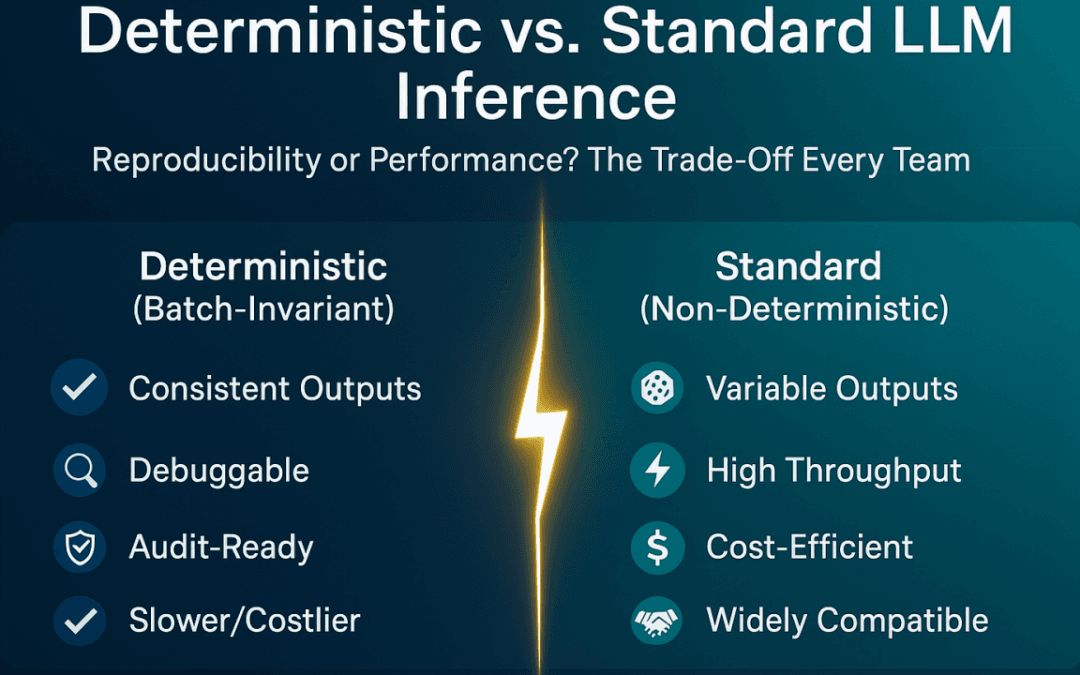
Deterministic AI and LLMs serve fundamentally different roles in financial markets, and the distinction between deterministic AI vs LLM for stock trading and portfolio management has become critical to system design. A trading algorithm that returns a different answer every time you run it isn’t a strategy — it’s a slot machine. Yet that’s exactly what happens when teams plug a raw LLM into portfolio decisions and skip the deterministic scaffolding underneath. In practice, deterministic systems produce identical outputs for identical inputs by design, while large language models can generate divergent recommendations across runs — even at temperature 0, where token-sampling, floating-point non-associativity on GPUs, and load-dependent batching still introduce run-to-run drift. The practical architecture is hybrid: deterministic rules-based engines handle execution, risk limits, and position sizing, while LLMs assist with unstructured tasks like earnings-call sentiment and news summarization. This debate has moved past hype and into hard architecture decisions that determine whether your backtest is valid or worthless.
Deterministic AI vs LLM for stock trading and portfolio management describes the choice between rule-based systems that produce identical outputs for identical inputs, and probabilistic large language models that generate adaptive but non-reproducible reasoning. Deterministic systems guarantee reproducibility for backtesting and position sizing. LLMs lower the barrier to strategy creation but introduce variance that breaks rigorous quant workflows. The right answer for most SMEs is a hybrid that uses each where it’s strong.
Quick Summary: Key Takeaways
- Deterministic AI produces identical outputs for identical inputs — positioned as the foundation of valid backtesting, confidence calibration, and position sizing in ARIA Analyst’s deterministic-vs-LLM scoring comparison.
- LLMs excel at converting natural language into testable, deployable trading configurations, lowering the technical barrier to strategy creation, per NexusTrade’s 2025 LLM testing.
- Reproducibility is non-negotiable in quantitative finance — a strategy you can’t reproduce is a strategy you can’t trust with real capital.
- Hybrid architectures win for most SMEs: LLM agents interpret messy inputs, deterministic engines score and execute with auditability.
- Academic interest is growing — a 2025 Frontiers in Artificial Intelligence review synthesized 84 studies on LLM equity applications from 2022 to early 2025.
- Governance and auditability matter more than raw intelligence in regulated financial environments.
Published: June 27, 2025. Last updated: June 27, 2025.
This article reflects general topical expertise in AI architecture and quantitative-finance workflows. It is educational and is not investment advice; consult a licensed financial professional before deploying capital.
What is the difference between deterministic AI and LLMs for stock trading and portfolio management?
Deterministic AI is a rule-based system that produces the exact same output every time you feed it the same input, while an LLM is a probabilistic model that generates varied responses based on statistical patterns. For trading, that distinction decides whether your backtest is scientifically valid or simply a lucky run you can never reproduce.
Deterministic scoring engines form the backbone of rigorous quantitative finance. A deterministic value-momentum score for Apple stock on a given date returns the same number whether you run it today, tomorrow, or in a year — assuming the underlying data is fixed. Reproducibility “is not a nice-to-have, it is the foundation of every backtest,” according to ARIA Analyst’s deterministic-versus-LLM scoring comparison. Without it, confidence calibration and position sizing collapse into guesswork.
LLMs operate differently. Ask GPT-4 or Claude to score the same stock twice and you’ll often get two different narratives, two different conviction levels, sometimes two different recommendations. That variance is a feature when you’re brainstorming. It’s a catastrophe when you’re sizing a leveraged position. The core of deterministic AI vs LLM for stock trading and portfolio management is this tension: adaptive intelligence versus auditable consistency.
Why “temperature 0” does not guarantee determinism
A common misconception is that setting an LLM’s sampling temperature to 0 makes it deterministic. It reduces sampling randomness, but it does not eliminate run-to-run variance. Practitioners generally observe three remaining sources of drift: (1) floating-point operations on GPUs are non-associative, so the order in which a kernel sums values can change the last bits of a logit; (2) inference servers batch requests dynamically, and batch composition can alter those reduction orders; and (3) model or infrastructure version changes silently shift outputs over time. The result is that an LLM scorer can flip a borderline buy/hold decision between otherwise identical runs — a property that is fatal for confidence calibration. A deterministic engine, by contrast, is reproducible because its arithmetic path is fixed and version-controlled.
Why does reproducibility matter so much in quantitative finance?
Reproducibility is the foundation of credible quantitative finance. A backtest you cannot reproduce is statistically meaningless: you have no way to separate genuine edge from random chance. Position sizing, risk modeling, and regulatory audits all depend on the ability to re-run identical inputs and get identical results.
Three core functions depend on bit-for-bit reproducibility:
- Position sizing — identical inputs must yield identical risk estimates before capital is allocated.
- Risk modeling — Value-at-Risk (VaR) and stress tests require deterministic outputs to be trusted across recalculations.
- Regulatory audits — frameworks such as the EU’s MiFID II and the SEC’s Market Access Rule (Rule 15c3-5) require firms to reconstruct and justify past automated decisions.
Consider what a backtest actually proves. You run a strategy across 10 years of historical data and it returns 14% annualized. For that number to mean anything, you must be able to re-run the same logic and get 14% again. If an LLM-based scorer returns 14% on Monday and 9% on Tuesday on identical data, you’ve learned nothing about the strategy and everything about the model’s sampling behavior.
A reproducible mini-backtest you can actually run
To make this concrete, here is a minimal, reproducible backtest configuration of the kind a practitioner would use to demonstrate determinism. It is intentionally simple — the point is that anyone re-running it with the same data and seed gets the same equity curve, every time.
- Universe: S&P 500 constituents as of the test-window start date (survivorship-bias note: use a point-in-time membership list, not today’s index).
- Signal: rank by 12-month minus 1-month price momentum; go long the top decile, equal-weighted.
- Rebalance: monthly, on the first trading day, at the next day’s open.
- Costs: fixed 5 basis points per side; no leverage.
- Determinism controls: pin the data snapshot (e.g., a frozen CSV with a recorded checksum), fix the random seed if any sampling is used, and record library versions in a lockfile.
Run that twice and the annualized return, Sharpe, and max drawdown match to the last decimal. Now swap the momentum rank for an “ask an LLM which stocks look strong” step and re-run: the holdings — and therefore the equity curve — can change between runs. That divergence, not the headline return, is the variable that matters when you decide whether to trust the result with capital. Measuring it directly (run the same prompt N times, count how often the decile membership changes) is far more honest than quoting an unverifiable blanket “variance figure.”
Deterministic systems make several critical workflows possible:
- Valid backtesting — identical inputs produce identical historical performance, so measured edge reflects strategy, not noise.
- Confidence calibration — you can statistically map a score of 0.8 to an actual win rate because the score means the same thing every time.
- Position sizing — Kelly criterion and risk-parity math require stable, reproducible signals.
- Compliance and audit trails — regulators and auditors can verify exactly why a trade fired.
The 2025 Frontiers in Artificial Intelligence review of 84 studies confirmed that while LLMs show promise in market prediction and sentiment analysis, reproducibility and evaluation rigor remain open challenges across the field. Translation: the academy is excited about LLMs and honest about their reliability gaps. For SMEs deploying real capital, that honesty should set your priorities.
When are LLMs actually better than deterministic AI for trading workflows?
LLMs outperform deterministic trading systems in three specific scenarios: interpreting unstructured language, synthesizing news and filings, and translating plain-English intent into structured strategy specifications. LLMs lower the technical barrier to strategy creation dramatically — that’s their real superpower.
The core advantage is accessibility. Deterministic systems require explicit coded rules, while LLMs let traders describe strategies in natural language — a strategy that once took days to code can be prototyped in minutes. Use LLMs when the task involves:
- Unstructured data — parsing earnings calls, SEC filings, or breaking news.
- Intent translation — converting “buy oversold tech stocks” into defined RSI thresholds.
- Rapid prototyping — testing strategy ideas without writing code from scratch.
NexusTrade’s 2025 testing of every major LLM for algorithmic trading found that the strongest models reliably convert natural-language descriptions like “buy tech stocks when momentum is strong and sell when RSI exceeds 70” into testable, optimizable, deployable configurations. A non-coder describes a strategy in English; the LLM produces the executable rules. That collapses weeks of developer time into minutes.
LLMs shine in these specific roles:
- Natural-language strategy authoring — turning founder intent into structured, parameterized rules.
- News and filing synthesis — reading 10-Ks, earnings calls, and headlines faster than any analyst.
- Sentiment extraction — quantifying tone across thousands of articles or social posts.
- Explanation and reporting — narrating why a portfolio shifted, in language a stakeholder understands.
Kiplinger noted in its coverage of LLMs and investing that embracing the technology “has the potential to significantly impact an investor’s approach to portfolio management” — primarily through research speed and accessibility, not through autonomous execution. That framing is correct. LLMs are research accelerants and interpreters, not trade-execution oracles.
Here’s the trap, though. The same flexibility that makes LLMs great at interpretation makes them dangerous at decisions. An LLM will confidently state a quarterly revenue figure that is wrong, tend to agree with whatever bias is embedded in the prompt — a pattern often called sycophancy — and rarely signal genuine uncertainty. Use them for what they’re genuinely good at, and wall them off from anything that touches position sizing without a deterministic check. Our guide to deterministic AI vs probabilistic yes-machines breaks down exactly where that wall belongs.
How do hybrid systems combine deterministic AI and LLMs for portfolio management?
Hybrid systems combine deterministic AI and LLMs by assigning each component a strict role: the LLM interprets unstructured inputs and drafts strategies, while a deterministic engine routes every scoring and execution decision through reproducible, auditable logic. The LLM handles language; the deterministic core handles money. That division is the single most important design principle in deterministic AI vs LLM for stock trading and portfolio management.
This division matters because LLMs produce non-deterministic outputs, which makes them unsuitable for direct trade execution under regulations such as MiFID II and SEC Rule 15c3-5, both of which assume that an automated decision can be reconstructed exactly. A useful mental model among practitioners: the LLM proposes, the deterministic layer disposes. A probabilistic model should never touch capital allocation directly.
A well-built hybrid architecture works like a newsroom with a fact-checker. The LLM is the fast, creative reporter — it reads everything, drafts the story, proposes angles. The deterministic engine is the rigorous editor that verifies every claim against fixed rules before anything goes to print. Neither replaces the other.
A typical hybrid stack for a financial workflow looks like this:
- LLM intake layer — converts a founder’s plain-English strategy or a news feed into a structured specification.
- Deterministic scoring engine — applies fixed, version-controlled formulas to produce reproducible scores for every asset.
- Risk and sizing module — deterministic position sizing based on calibrated scores, with hard limits.
- LLM explanation layer — narrates the deterministic decision back to humans for review.
- Human-in-the-loop approval — a person signs off before capital moves.
A concrete worked example: suppose a news headline reads “Chipmaker X cuts full-year guidance on weak data-center demand.” The LLM intake layer extracts a structured event — {ticker: X, event: guidance_cut, polarity: negative, magnitude: material} — but it does not decide to sell. That structured event becomes one input into a deterministic rule, e.g. “if a material negative guidance event coincides with a momentum score below the 30th percentile, flag for a 25% trim, subject to human approval.” The LLM read the language; the fixed rule made the call; the log records both. Re-run the same headline and the same trim flag appears every time.
The deterministic core means every trade can be reproduced and audited. The LLM layer means non-technical operators can actually use the system. A common implementation pattern is to orchestrate these handoffs with self-hosted n8n workflow automation — avoiding the per-task “Zapier tax” that quietly inflates automation costs as volume grows.
Compliance teams favor this architecture for a reason. When an auditor asks “why did the system recommend selling this position on March 4th?”, a pure LLM answer is unverifiable. A hybrid answer points to a specific deterministic rule, a specific input, and a logged score. That’s the difference between defensible and indefensible AI in a regulated environment.
Deterministic AI vs LLM for stock trading and portfolio management: a side-by-side comparison
Deterministic AI and LLM-based AI serve different roles in stock trading and portfolio management. Deterministic AI wins on reproducibility, auditability, and position sizing; LLM-based AI wins on flexibility, research speed, and handling unstructured input. The table below maps each dimension so SMEs can decide which capability each workflow actually requires.
| Dimension | Deterministic AI | LLM-Based AI |
|---|---|---|
| Reproducibility | Guaranteed — identical inputs, identical outputs | Variable — outputs can differ between runs |
| Backtest validity | High — results are scientifically meaningful | Low without controls — noise contaminates results |
| Natural-language input | None — requires explicit coded rules | Excellent — converts plain English to strategies |
| News & sentiment analysis | Limited to predefined keyword rules | Strong — synthesizes unstructured text |
| Auditability | Full — every decision traces to a rule | Weak — reasoning is opaque and non-stable |
| Position sizing reliability | High — stable signals enable Kelly/risk-parity math | Dangerous alone — unstable scores break sizing |
| Hallucination risk | None | Present — can fabricate figures confidently |
| Best role | Scoring, execution, risk, compliance | Interpretation, drafting, explanation, research |
Notice the pattern. Every cell where real money or real regulators are involved favors deterministic systems. Every cell where human language or unstructured data is involved favors LLMs. The comparison doesn’t crown a winner — it crowns a division of labor. Our AI comparison finder tool helps you map your specific financial workflows to the right approach instead of guessing.
One more consideration worth weighing: NexusTrade’s 2025 benchmark found meaningful performance gaps between major LLMs on the same trading-configuration tasks, meaning model selection alone introduces another layer of variance. Deterministic engines have no such problem — the formula is the formula. For SMEs without a quant team, that stability is often worth more than marginal intelligence gains.
How should an SME or startup choose between deterministic AI and LLMs for finance?
SMEs should map each financial workflow to its core requirement: if the task demands reproducibility, auditability, or position sizing, choose deterministic; if it demands language interpretation or research synthesis, choose an LLM; for end-to-end systems, build a hybrid. Start from the requirement, not the technology.
Many founders get this backwards. They pick a shiny LLM tool first, then try to force-fit their reproducibility needs around it. The disciplined approach inverts that order. Use this practical decision sequence:
- Audit the workflow’s failure cost. If a wrong, non-reproducible output costs real capital or triggers compliance risk, default to deterministic.
- Identify the unstructured inputs. Wherever the input is messy human language, news, or filings, an LLM earns its place.
- Separate interpretation from decision. Let the LLM interpret; never let it autonomously execute trades without a deterministic gate.
- Demand an audit trail. If you can’t explain a decision to an auditor, the architecture isn’t ready for regulated capital.
- Keep a human in the loop. A person should approve any position change above a defined threshold.
Actionable takeaway: build the deterministic core first, then bolt the LLM on as an interpretation and explanation layer. Teams that do it in reverse generally spend months untangling non-reproducible results before they can deploy real capital. A reliable heuristic across real implementations is that the projects which scale cleanly are the ones that treat the LLM as a translator, never as the source of truth.
Avoid the opposite extreme too. Some quant purists reject LLMs entirely and force every non-technical operator to write code — paying in human hours what a well-walled LLM could save. The pragmatic middle, governed by transparency and human oversight, tends to beat both ideologies.
Frequently Asked Questions
Can LLMs be used alone for stock trading without deterministic checks?
LLMs should not be used alone for live trading because their outputs are non-reproducible, which invalidates backtesting and makes position sizing unreliable. An LLM may return different recommendations for identical inputs, and it can hallucinate financial figures with full confidence. For real capital, pair every LLM with a deterministic scoring and execution layer.
Is deterministic AI more accurate than LLMs for portfolio management?
Deterministic AI is not necessarily more accurate, but it is more reliable and reproducible, which matters more for valid backtesting and risk management. Accuracy depends on the underlying formulas, while reproducibility is guaranteed by design. LLMs may surface insights deterministic rules miss, but their variance makes them unsuitable as the sole basis for sizing decisions.
What is a hybrid AI architecture for trading?
A hybrid AI architecture for trading uses an LLM to interpret unstructured inputs and draft strategies, then routes every scoring and execution decision through a deterministic engine for reproducibility and auditability. The LLM handles language and research; the deterministic core handles money and compliance. This pattern delivers both accessibility and rigor.
How much academic research supports LLMs in stock investing?
Academic interest is substantial and growing — a 2025 Frontiers in Artificial Intelligence review synthesized 84 research studies on LLM applications in equity markets from 2022 to early 2025. The research shows promise in market prediction and sentiment analysis, but consistently flags reproducibility and evaluation rigor as open challenges that deterministic systems address.
Does setting temperature to 0 make an LLM deterministic?
Not fully. Temperature 0 removes most sampling randomness, but outputs can still vary between runs because GPU floating-point arithmetic is non-associative, inference servers batch requests dynamically, and model or library versions change over time. For a workflow that requires bit-for-bit reproducibility — backtesting, position sizing, audit reconstruction — a deterministic engine with a fixed, version-controlled arithmetic path is the appropriate tool.
The next frontier isn’t choosing between deterministic AI and LLMs — it’s governing the handoff between them. As regulators sharpen their focus on AI-driven trading, the firms that win likely won’t be the ones with the smartest model. They’ll be the ones who can prove, line by line, exactly why every dollar moved.
Sources & References
- ARIA Analyst — Deterministic vs LLM Stock Scoring: Why Reproducibility Matters
- NexusTrade — I Tested Every Major LLM for Algorithmic Trading
- Frontiers in Artificial Intelligence (2025) — Large Language Models in equity markets: applications, review of 84 studies (2022–2025), DOI: 10.3389/frai.2025.1608365
- Kiplinger — AI and Your Portfolio: How LLMs Can Boost Your Investments