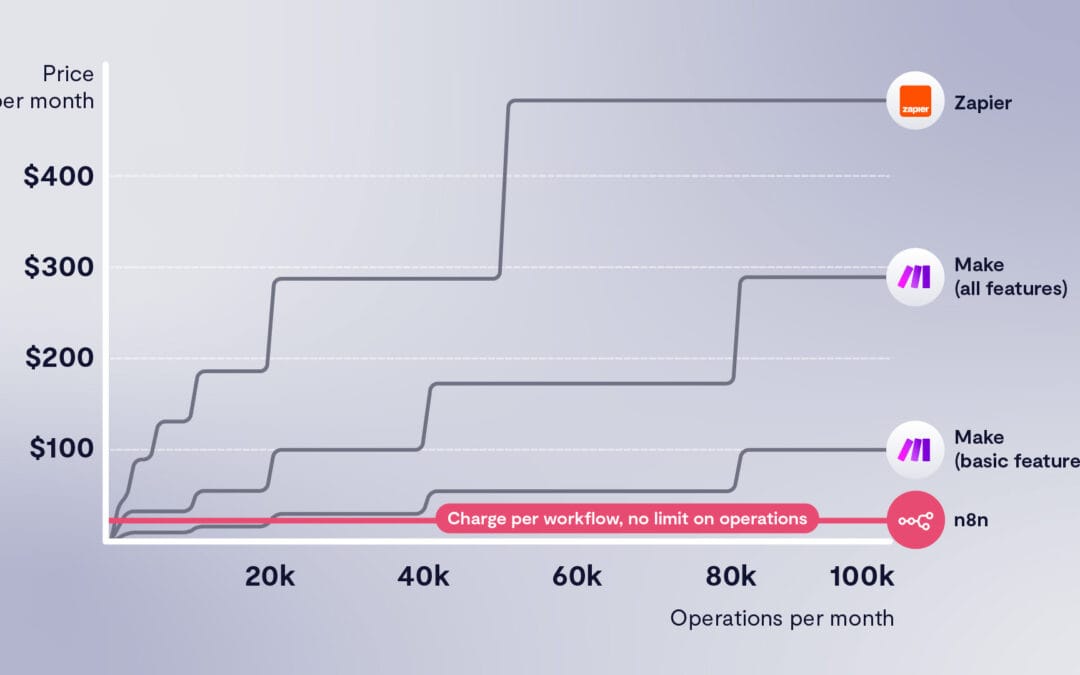
Consider a mid-sized SaaS company running 2 million tasks a month on Zapier. At the per-task rates published on Zapier’s pricing pages, a workload like that lands in the thousands of dollars per year. After migrating to a self-hosted n8n instance on a low-cost VPS, the recurring software bill can drop to little more than the server cost. That kind of swing is why the n8n vs Zapier for cost savings debate has become the loudest argument in workflow automation for 2026 — and why the data broadly supports the open-source challenger when volume scales.
But sticker price lies. Zapier’s per-task model is predictable and brutal at scale. n8n’s self-hosting is cheap on paper but carries hidden costs — server upkeep, security patching, developer hours — that most comparison articles conveniently ignore. The honest answer is messier than “n8n saves 90%,” and the goal of this guide is to give you the framework to model your own numbers rather than trust a headline percentage.
This guide breaks down the real total cost of ownership, names the exact thresholds where each tool wins, and gives non-technical founders a path to n8n’s savings without an engineering team. Every cost figure below links back to a primary source you can verify yourself.
About This Comparison and How to Read It
This article is published by J. SERVO, a workflow automation consultancy that builds and manages n8n deployments for small and mid-sized businesses. That is a commercial relationship you should know about up front: we make money when clients choose managed n8n. We have tried to keep the editorial analysis below honest and balanced — including the cases where Zapier or n8n Cloud is the better choice — and to clearly separate that analysis from any mention of our own services. Where we recommend our offering, we say so explicitly. No author byline, certification, partnership, or third-party expert review is claimed here beyond general topical expertise in workflow automation.
Methodology note: The cost ranges in this article are illustrative models, not audited results from a specific named client. Pricing changes frequently, so always confirm current rates on the official n8n pricing and feature pages and Zapier’s own pricing page before committing budget. Third-party benchmark figures (such as the widely cited “90% cost gap”) originate from tech-insider.org, an independent comparison site; we cite it as a secondary source and recommend cross-checking its claims against the primary vendor pages, since we cannot independently verify its testing environment.
Quick Summary: n8n vs Zapier Cost Savings at a Glance
- n8n uses execution-based pricing, while Zapier charges per task — meaning a single multi-step workflow costs one execution in n8n but multiple tasks in Zapier. This is confirmed on Contabo’s in-depth comparison (24 Sept 2025).
- Self-hosted n8n can cut automation costs substantially at high volume — third-party benchmarks from tech-insider.org cite up to a 90% gap, tested across 30+ workflows in 2026. Treat this as a ceiling, not an average.
- Zapier offers roughly 7,000 app integrations versus n8n’s 400+ (per n8n’s official GitHub repository), making Zapier the safer pick for niche SaaS connections.
- Hidden n8n costs include server infrastructure, maintenance hours, security responsibility, and developer dependency — confirmed in a real one-year self-hosting cost breakdown on the n8n community forum (11 Apr 2026).
- The break-even point typically lands between 50,000 and 100,000 tasks per month — below that, Zapier’s convenience often wins.
- Non-technical SMEs can capture n8n savings through a managed partner (J. SERVO offers this — see the disclosure above), avoiding the engineering burden entirely.
Published: June 13, 2026. Last updated: June 13, 2026. Pricing figures should be re-verified against vendor pages at the time of reading.
What Is the Real Difference Between n8n and Zapier?
n8n is an open-source, fair-code workflow automation platform that prices by execution and can be self-hosted, while Zapier is a fully managed cloud service that prices per task. That single pricing distinction drives nearly every cost-savings argument in 2026.
Zapier counts every individual action as a “task.” A workflow that pulls a lead from a form, enriches it, adds it to a CRM, and sends a Slack alert burns four tasks per run. n8n counts that same workflow as one execution, regardless of how many steps fire inside it. At 10,000 monthly runs, that’s the difference between 40,000 billable units and 10,000 — a 4x gap before you even discuss subscription tiers.
According to n8n’s official site at n8n.io, the platform combines code-level flexibility with no-code speed and ships with 400+ native integrations plus 70+ AI nodes. Zapier counters with roughly 7,000 app connections — the broadest integration library in the market.
The trade is clear. Zapier sells convenience and breadth. n8n sells control and economics. As one Reddit user in r/automation put it on February 24, 2026: “n8n is open-source, way cheaper, and customizable, with execution-based pricing that is sensible. Zapier is pricey, and task limitations add up.” It is worth reading the full thread — several commenters in it defend Zapier specifically for the predictability and support that self-hosting sacrifices.
Execution-Based vs Per-Task Pricing Explained
Execution-based and per-task pricing are the two dominant billing models for workflow automation platforms. Execution-based pricing charges once per workflow run, regardless of how many actions occur inside it. Per-task pricing charges separately for every individual action within that run.
The cost difference compounds quickly for data-heavy automations. A single complex workflow — such as lead enrichment, multi-channel notifications, or ERP synchronization — typically consumes 8–12 tasks per execution in a per-task model. That means one workflow run can cost up to roughly 12x more than its execution-based equivalent.
For example, a business processing 10,000 monthly workflow runs at 10 tasks each would be billed for 100,000 tasks under per-task pricing, versus just 10,000 executions under execution-based pricing — a 10x difference in billable volume. Contabo’s analysis reaches the same conclusion, noting that n8n’s per-operation (self-hosted) and per-execution (cloud) models are “generally more cost-effective than Zapier.”
The nuance practitioners generally recognize: execution-based pricing is more cost-effective for complex, multi-step automations, while per-task pricing can actually be cheaper for simple, single-action workflows that run infrequently. If most of your automations are one trigger and one action, the per-task math is not nearly as punishing as the headline comparisons suggest.
How Does n8n vs Zapier for Cost Savings Actually Break Down?
n8n can deliver cost savings on the order of 70–90% over Zapier once you cross roughly 50,000 tasks per month, primarily because self-hosting removes per-task fees entirely. Below that volume, Zapier’s predictable pricing and zero-maintenance setup often costs less in total when you factor in your time.
Let’s put real numbers on it — but verify them yourself, because both vendors revise pricing regularly. Zapier’s pricing scales steeply with task volume; the current tiers are published on Zapier’s pricing page. Tech-insider.org benchmarked a Zapier Team plan at $448/month against a free self-hosted n8n instance, documenting the headline 90% cost gap at scale across 30+ tested workflows in its 2026 comparison. We reproduce that figure as a third-party claim, not as our own measurement.
Here’s where most comparisons stop — and where they mislead. Self-hosted n8n isn’t free. The software license is free (fair-code), but you’re paying for a server. A VPS capable of handling moderate workflow volume typically runs in the low tens of dollars per month. Per Contabo’s analysis published September 24, 2025, n8n is “effectively free, excluding hosting” — and that exclusion is the whole game.
| Cost Factor | Zapier | n8n (Self-Hosted) | n8n (Cloud) |
|---|---|---|---|
| Pricing model | Per task | Server cost only | Per execution |
| Software license | Subscription | Free (fair-code) | Subscription |
| Setup time | Minutes | 2–8 hours | Minutes |
| Maintenance burden | None | Ongoing (you) | None |
| Integrations | ~7,000 | 400+ | 400+ |
| Security responsibility | Zapier | You | n8n |
The 90% figure is real in the cited benchmark, but it’s a ceiling, not an average. It applies to high-volume operations that have already absorbed the setup and maintenance overhead. For a 5-person startup running 8,000 tasks a month, the savings might be a few dollars — not worth a weekend of server configuration. The honest one-year breakdown on the n8n community forum (11 Apr 2026) makes this point well: the author still preferred n8n, but only after weighing the lower cost against the added flexibility and the more technical community needed to support it.
The Hidden Costs Nobody Calculates
Self-hosting n8n carries four categories of hidden cost the sticker price conceals. We present these as a planning framework — the dollar ranges depend heavily on your hourly labor rate and uptime requirements, so model your own.
- Infrastructure: A reliable VPS with automated backups and adequate RAM (n8n’s documentation recommends a minimum of a couple of GB). This is the small, obvious line item — typically the low tens of dollars per month.
- Maintenance labor: Roughly 2–5 hours monthly for updates, monitoring, and debugging. At a blended hourly rate this is usually the largest hidden cost — often dwarfing the server bill, as the community cost breakdown above repeatedly emphasizes.
- Security and compliance: You own data residency, encryption, and patching. This matters acutely for GDPR or SOC 2 environments where an unpatched vulnerability becomes your liability, not the vendor’s.
- Developer dependency: When a workflow breaks at 2 a.m., there’s no managed support ticket. Someone technical has to fix it. This is the cost that most often surprises non-technical teams.
Factor those in honestly, and the real break-even shifts upward. The trustworthy way to compare is to add server cost plus a realistic estimate of maintenance hours plus developer time to n8n’s free license before placing it next to Zapier’s bill — because a comparison that ignores maintenance hours isn’t a comparison, it’s marketing.
When Does Self-Hosting n8n vs Zapier for Cost Savings Make Sense?
Self-hosting n8n makes financial sense when monthly task volume exceeds roughly 50,000–100,000, you have technical resources or a managed partner, and your workflows are complex enough that per-task pricing compounds painfully. Below those thresholds, Zapier or n8n Cloud usually wins on total cost.
Decision-making here shouldn’t be ideological. A responsible analysis will sometimes talk a founder out of self-hosting because their volume doesn’t justify it. The right tool depends on four variables: task volume, workflow complexity, technical capacity, and compliance requirements.
- Estimate your real task volume. Count every action, not every workflow. A “simple” 5-step Zap at 3,000 runs is 15,000 tasks.
- Assess workflow complexity. Multi-step, data-heavy automations favor n8n’s execution model dramatically.
- Audit your technical capacity. No engineer and no managed partner? Self-hosting will cost you in downtime and frustration.
- Check compliance needs. Regulated industries needing data residency lean toward self-hosted n8n for control.
- Calculate true TCO. Add server, maintenance hours, and developer time to n8n’s free license before comparing.
A useful analogy: Zapier is a furnished apartment — you pay a premium, but everything works and someone else fixes the plumbing. Self-hosted n8n is buying a house — cheaper per square foot at scale, but you’re now the landlord, plumber, and security guard. The house wins economically only if you’re staying long enough and large enough to justify the responsibility.
The Three-Way Decision: Self-Host vs Cloud vs Zapier
The three-way decision between self-hosting, n8n Cloud, and Zapier is not binary, despite most coverage framing it that way. n8n Cloud splits the difference: it uses execution-based pricing without the server maintenance burden of self-hosting. Confirm current n8n Cloud tiers on the official n8n site before budgeting, as plans and execution limits change.
Here is the clearest way to decide:
- Self-host if you have DevOps capacity and run high-volume workflows; you save the most but own all maintenance.
- n8n Cloud if you want most of the cost advantage while offloading hosting, updates, and uptime to n8n.
- Zapier if you prioritize the largest app-integration library and have no technical resources.
For SMEs that want savings without becoming infrastructure managers, n8n Cloud delivers much of the cost advantage with near-zero operational overhead. Per the comparison at tech-insider.org, n8n Cloud captures most of the cost benefit while offloading maintenance to n8n — a sensible stepping stone before committing to full self-hosting.
What About Integrations, AI, and Reliability?
Zapier wins on raw integration count with ~7,000 apps versus n8n’s 400+, but n8n leads on AI workflow capabilities, custom code flexibility, and deterministic control. Cost savings mean nothing if the tool can’t connect to your stack.
Integration breadth is Zapier’s strongest defense. If your business depends on a niche CRM or an obscure SaaS tool, Zapier likely supports it natively while n8n may require a custom HTTP request node. For most SMEs, though, the core stack — Gmail, Slack, HubSpot, Stripe, Google Sheets, OpenAI — is fully covered by both.
On AI, n8n pulls ahead. The platform ships with 70+ AI nodes and native support for building agentic workflows, according to n8n’s official GitHub repository and the platform’s published features page. That matters in 2026, when AI-powered automation is no longer optional. Practitioners often choose n8n for AI agents precisely because its code flexibility lets them enforce deterministic logic — avoiding the “yes-machine” behaviour that can plague bolt-on AI features.
Reliability is the counterargument. Zapier’s managed infrastructure provides uptime you inherit for free. Self-hosted n8n is only as reliable as your server and your monitoring. A misconfigured VPS can mean silent failures — workflows that stop firing without an alert. A sound deployment wires in health checks and fallback logging for exactly this reason. Cost savings that produce broken automations aren’t savings at all.
How Can Non-Technical SMEs Capture n8n Savings Without Engineers?
Non-technical SMEs can capture n8n’s cost savings by hiring a managed deployment partner who handles hosting, maintenance, and security, converting the engineering burden into a predictable monthly service fee. You get execution-based economics without becoming a sysadmin.
Here’s the gap the market ignores. Every “n8n saves 90%” article silently assumes you have a developer who enjoys configuring Docker containers. Most founders don’t. That assumption quietly disqualifies the exact audience that needs the savings most — bootstrapped startups and lean SMEs watching every dollar.
The managed model solves this. A partner provisions the server, deploys n8n, builds your workflows, handles security patching, and monitors uptime — so you get execution-based economics without execution-based headaches. The math works because a managed monthly fee typically lands below Zapier’s per-task bill at moderate-to-high volume, though the exact crossover depends on your task count.
Disclosure repeated for clarity: J. SERVO, the publisher of this article, offers exactly this managed n8n service, so the following is a description of our own commercial offering rather than neutral editorial analysis. A common pattern: a business paying a high monthly Zapier bill moves to a managed n8n setup at a fraction of the cost, with the partner maintaining the workflows. If that fits your situation, you can explore our managed automation services. If you have in-house engineering capacity, self-hosting n8n directly will be cheaper than any managed option — we’d rather you know that.
What This Looks Like in Practice
A managed migration from Zapier to n8n generally follows four stages:
- Discovery: Map current Zapier workflows and count true task volume — the hidden driver behind Zapier bills, since each multi-step Zap can consume several tasks per run.
- Migration: Rebuild those automations in n8n using execution-based logic, where you pay per workflow execution rather than per task.
- Hosting: Deploy n8n on a hardened, monitored server with automated daily backups and clear uptime targets.
- Maintenance: Ongoing updates, security patches, and support — handled so the team focuses on operations rather than infrastructure.
The result is deterministic, reliable automation that costs a fraction of per-task pricing — without a single line of code touching your plate. The savings are most pronounced for scaling teams whose Zapier costs grow linearly with usage; for low-volume teams, the managed fee may not beat staying on Zapier, and we’ll say so.
Security and Compliance: A Cost Most People Forget
Self-hosted n8n gives you full data residency and compliance control, but transfers all security responsibility to you — a hidden cost for regulated industries that Zapier absorbs as a managed provider. For GDPR, HIPAA, or SOC 2 environments, this trade cuts both ways.
Regulated SMEs face a genuine dilemma. Self-hosting n8n means your data never leaves your infrastructure — a powerful advantage for European companies bound by GDPR’s data residency rules, or healthcare firms under HIPAA. You control where data lives and who touches it.
The flip side is liability. With Zapier, the provider maintains its own compliance certifications, runs penetration tests, and patches vulnerabilities. Self-host n8n, and that entire burden becomes yours. A missed security update on your server is your breach, your fines, your reputational damage. As the n8n community’s honest cost breakdown (April 2026) reflects, the ongoing technical responsibility is the real recurring cost — not the server bill.
For most non-regulated SMEs, this is manageable with basic security hygiene. For regulated ones, it’s a board-level decision. A managed partner who maintains compliance standards can bridge this gap — delivering data residency control without leaving you exposed — but you should always confirm a provider’s actual security practices in writing rather than taking marketing claims (including ours) at face value.
Key Takeaways and Action Plan
The n8n vs Zapier for cost savings decision comes down to one question: does your task volume and complexity justify the responsibility of self-hosting? Use this checklist to decide in the next 30 minutes.
- Pull your Zapier task count from the last three months. Multiply complex workflows by their step count to find true volume.
- If you’re under 30,000 tasks/month, stay on Zapier or test n8n Cloud — self-hosting won’t pay off yet.
- If you’re over 50,000 tasks/month, model self-hosted n8n with a real TCO that includes maintenance hours.
- No technical team? Don’t self-host alone. Use n8n Cloud or a managed partner.
- Regulated industry? Weigh data residency benefits against your capacity to own security.
- Run the numbers honestly — server cost plus maintenance time, not just the free license — and verify current prices on the official vendor pages.
The smartest operators in 2026 aren’t asking “n8n or Zapier?” They’re asking “what’s my true cost of ownership at my actual volume?” Answer that, and the choice makes itself.
One forward-looking thought: as AI agents take over more workflow logic, the per-task pricing model starts to look like billing for breathing. When a single AI agent run might trigger dozens of micro-actions, execution-based platforms like n8n won’t just be cheaper — they may be the only economically sane way to automate at scale. The companies migrating now aren’t only chasing a discount; they’re positioning ahead of how AI-driven automation changes billing math.
Frequently Asked Questions
Is n8n really cheaper than Zapier?
Yes, n8n is significantly cheaper than Zapier at scale — third-party benchmarks from tech-insider.org cite up to 90% cheaper for high-volume operations. The savings come from n8n’s execution-based pricing and free self-hosting option, but you must factor in server and maintenance costs, which can erase the advantage at low volume. Verify current rates on the official n8n and Zapier pricing pages.
What is the break-even point between n8n and Zapier?
The break-even point typically falls between 50,000 and 100,000 tasks per month. Below that volume, Zapier’s predictable per-task pricing and zero maintenance usually cost less in total when you account for your time. Above it, self-hosted n8n’s savings become substantial and clearly justify the setup effort.
Do I need to be a developer to use n8n?
You don’t need to be a developer to use n8n’s cloud version, which works like a no-code tool similar to Zapier. Self-hosting, however, requires technical skills for server setup, security, and maintenance. Non-technical SMEs can capture n8n’s savings by using a managed partner (such as J. SERVO, the publisher of this article) that handles all infrastructure.
How many integrations does n8n have compared to Zapier?
n8n offers approximately 400+ native integrations plus 70+ AI nodes, per its official GitHub repository, while Zapier provides roughly 7,000 app connections. Zapier wins on breadth for niche SaaS tools, but n8n covers most core business apps and lets you connect anything else via custom HTTP requests and code nodes.
Is self-hosted n8n secure for regulated industries?
Self-hosted n8n can be more secure for regulated industries because your data never leaves your own infrastructure, supporting GDPR data residency and similar requirements. However, you assume full responsibility for security patching, monitoring, and compliance — a burden Zapier handles as a managed provider. A managed deployment partner can bridge this gap, but confirm their practices in writing.
Should I use Zapier, n8n Cloud, or self-hosted n8n?
Use Zapier if you need maximum integrations and zero maintenance at low volume. Use n8n Cloud for execution-based savings without server management. Choose self-hosted n8n for maximum cost savings and data control at high volume — ideally with technical resources or a managed partner to handle infrastructure.
Sources & References
- n8n — AI Workflow Automation Platform (official site)
- n8n — Workflow Automation Features (official)
- n8n-io/n8n — Official GitHub repository (400+ integrations, AI capabilities)
- Contabo Blog — n8n vs. Zapier vs. Make: An In-Depth Comparison (24 Sept 2025)
- r/automation — Why do people still pick Zapier over n8n? (24 Feb 2026)
- n8n Community — My honest cost breakdown after 1 year of self-hosting (11 Apr 2026)
- tech-insider.org — n8n vs Zapier 2026 (30+ workflow benchmarks, secondary source)
- tech-insider.org — n8n vs Zapier 2026: 8K Apps vs 90% Cost Gap (secondary source)
tech-insider.org is an independent third-party comparison site; its benchmark figures are cited as secondary sources and should be cross-checked against the primary vendor pricing pages above.