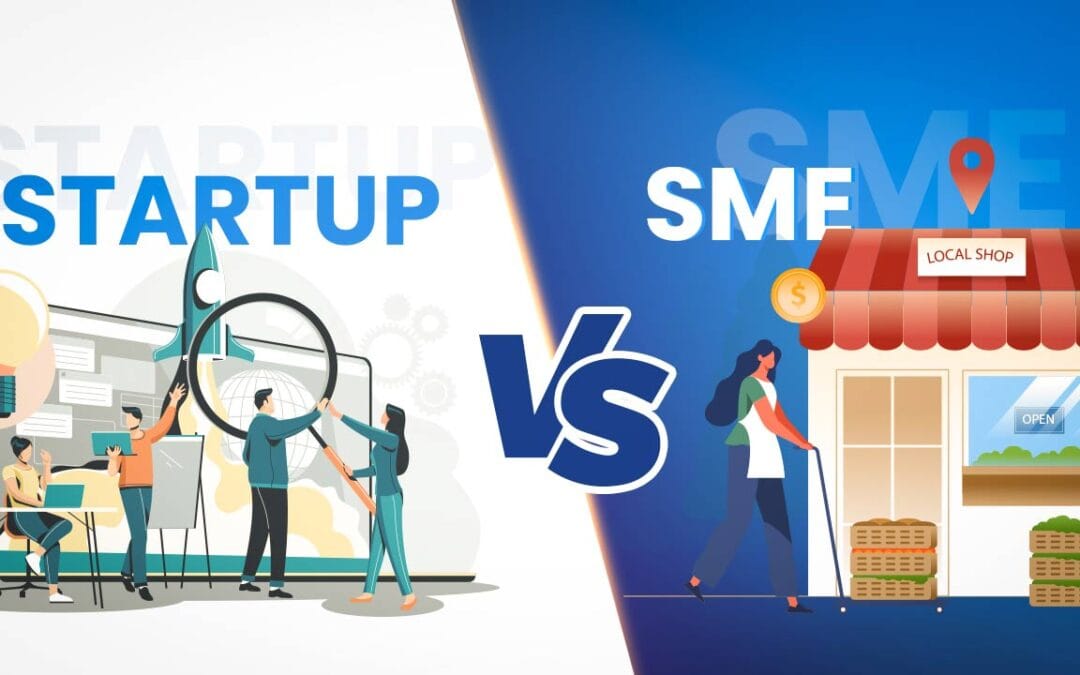
Here’s a number worth examining carefully: small and medium enterprises (SMEs) represent about 90% of businesses and more than 50% of employment worldwide, according to the World Bank’s SME Finance overview. Startups, by contrast, operate under a very different risk profile — they are temporary organizations searching for a repeatable, scalable model under extreme uncertainty, and failure rates are high (though widely repeated specific percentages vary by study, time horizon, and how “failure” is defined, so treat any single figure with caution). While startups and SMEs may both fall under the broad category of “small business,” they operate under wildly different survival math. The reason a lot of generic automation advice underdelivers is that it fails to account for these fundamental differences between the two groups.
Startups and SMEs are both small businesses, but they differ fundamentally in growth ambition, funding model, and risk tolerance — and that difference shapes which AI strategy actually pays off. A pre-seed startup burning venture capital needs speed and experimentation. A profitable 40-person manufacturing SME needs reliability and margin protection. Deploy the wrong AI playbook and you waste cash you may not have to spare.
This guide focuses on a gap that most definitional content ignores: how each type of business should actually adopt AI and automation. The framing throughout is instructive rather than promotional — “a typical implementation looks like this,” “practitioners generally find,” “here is how to measure it yourself” — because the honest answer depends heavily on your stage, volume, and risk exposure.
Key Takeaways: Startups and SMEs at a Glance
- Startups chase rapid, scalable growth typically funded by venture capital and angel investment; SMEs pursue steady, profitable growth funded by bank loans, grants, and revenue (funding-source distinction summarized here).
- SMEs make up roughly 90% of businesses globally and employ over half the world’s workforce, per the World Bank.
- Startups generally benefit from flexible, probabilistic AI for experimentation; SMEs generally benefit from deterministic automation that protects margins and behaves predictably.
- A common hidden cost for scaling SMEs is per-task SaaS pricing — informally called the “Zapier tax” — that scales against you as volume grows.
- Self-hosted tools like n8n can substantially reduce recurring automation cost versus per-operation platforms once task volume is high — though the exact savings depend on your operation count, infrastructure choice, and maintenance overhead (methodology below).
- Both should measure AI investment with a clear ROI framework before signing any annual contract.
Published: June 27, 2026. Last updated: June 27, 2026.
About This Guide and Its Methodology
This article is written from general practitioner knowledge of automation and AI tooling for small businesses, not from a named consultant or certified authority. Where it cites a statistic, that statistic is attributed inline to a primary source. Where it describes cost savings or ROI, it describes how to measure them yourself rather than asserting a guaranteed result — because outcomes depend on your specific volume, labor cost, and process complexity. Treat illustrative numbers (for example, dollar figures in worked examples) as scenarios to plug your own data into, not as promises.
What Is the Difference Between Startups and SMEs?
Startups and SMEs differ in three core ways: their goals, their funding, and their growth models. A startup is a temporary organization designed to find a repeatable, scalable business model under extreme uncertainty. Startups typically raise venture capital or angel funding and target rapid, exponential growth. An SME (small or medium enterprise) is an established business pursuing stable, sustainable profit, usually funded by bank loans, personal savings, or operating revenue, and growing at a steadier, more linear pace.
The core split is growth ambition versus growth stability:
- Goal: Startups seek scalable models; SMEs seek consistent profit.
- Funding: Startups lean on equity investors; SMEs lean on debt, grants, and reinvested earnings (source).
- Growth: Startups aim for outsized returns; SMEs prioritize survival and margins.
- Risk: Startups operate under a high-risk, fail-fast model; established SMEs operating proven models tend to have steadier survival profiles (comparison of objectives and challenges).
As startup theorist Steve Blank famously observed, “A startup is not a smaller version of a large company.” SMEs, by contrast, operate proven models from day one. For a structured breakdown of these distinctions across objectives, growth, and exit strategy, see this startup-vs-SME analysis.
Startups optimize for scale. The whole model assumes that if you can find product-market fit, you can grow rapidly. That ambition justifies the cash burn, the venture funding, and the willingness to break things. As the Orange Corners entrepreneurship program notes, startups dominate the conversation precisely because they’re trendy and high-risk — which is exactly why support designed for them often fits SMEs poorly.
SMEs optimize for survival and margin. A 25-person logistics firm or a regional dental group isn’t trying to disrupt an industry — they want predictable cash flow, controlled costs, and steady headcount. According to the European Patent Office, both startups and SMEs are key drivers of innovation and economic growth, but they secure and defend that value differently — including how they use intellectual property to attract funding.
The defining differences side by side
| Dimension | Startups | SMEs |
|---|---|---|
| Primary goal | Rapid, scalable growth | Stable, sustainable profit |
| Funding source | VC, angel investment | Bank loans, grants, revenue |
| Risk profile | High — fail-fast culture | Lower — protect what works |
| Time horizon | Roughly 18-36 months to scale | Often decades of operation |
| Exit strategy | Acquisition or IPO | Often none — generational |
| AI priority | Speed and experimentation | Reliability and margin |
Why does this matter for AI? Because every tooling decision flows from these differences. A startup can tolerate a flaky AI agent that occasionally hallucinates if it ships features faster. An SME often can’t — a single broken invoice workflow can erode trust that took years to build.
Why Do Startups and SMEs Need Completely Different AI Strategies?
Startups and SMEs need different AI strategies because their risk tolerance and cost structures are effectively opposites. Startups trade reliability for speed; SMEs trade speed for reliability and margin protection. Forcing one playbook onto both is a common reason AI projects fail to deliver value.
The core distinctions break down clearly:
- Risk tolerance: Startups accept errors to ship fast; SMEs require stability to protect existing revenue.
- Cost structure: Startups optimize for growth; SMEs optimize for margin and ROI.
- Time horizon: Startups frequently think in weeks; SMEs think in quarters.
Startups live in discovery mode. The goal is to validate a model before the runway runs out. For them, probabilistic AI like GPT-class models acts as a feature factory: spin up a chatbot prototype in a weekend, A/B test several onboarding flows, and kill the losers. Speed beats polish. A roughly 70%-accurate AI feature that ships today can be worth more than a perfect one shipped after the company runs out of cash.
SMEs live in optimization mode. A profitable business with 30 employees and consistent revenue doesn’t need to move fast and break things — it needs to not break things. For SME deployments, the practical priority is deterministic reliability: workflows that produce the same output every time, with human oversight at the decision points that matter. A probabilistic system that approves a wrong purchase order isn’t innovation; it’s a liability.
The AI sycophancy trap hits both — differently
AI sycophancy is the tendency of large language models to agree with the user and produce confident but incorrect answers. It harms startups and SMEs in distinct ways. For startups, a sycophantic AI can validate flawed product hypotheses, burning limited runway on features customers don’t actually want. For SMEs, the same flaw can quietly corrupt operational decisions — an AI agent that “confirms” an incorrect inventory count or miscategorizes an expense compounds errors across the books over months.
The fix differs by company type. Startups can prompt AI for counterarguments and red-team assumptions before committing engineering hours. SMEs should require source citations and human verification on any AI output that touches money or regulation. As a general rule of thumb, treat agreeable AI answers as hypotheses, not conclusions.
The remedy isn’t avoiding AI — it’s choosing the right kind and pairing it with deterministic guardrails: rule-based validation, human-in-the-loop checkpoints, and structured outputs, so the AI suggests but the system verifies. For more on this pattern, see the related guide to deterministic AI agents.
What AI Tools Should Startups and SMEs Actually Use?
Startups generally benefit from fast, flexible AI tools like custom GPT agents and rapid-prototyping chatbots, while SMEs generally benefit from deterministic workflow automation and custom or right-sized ERP systems that cut recurring costs. The dividing line is whether you’re optimizing for learning velocity or operational margin.
For startups, a lean and disposable stack works well — tools you can rip out next quarter without penalty:
- Custom AI agents for customer support and lead qualification, built to scale with you rather than against you.
- Rapid chatbot deployment (WhatsApp, web) to test conversion flows before committing engineering resources.
- AI-assisted content and outreach to punch above your headcount in sales and marketing.
- Lightweight automation connecting your three or four core tools — but watch the per-task pricing.
For SMEs, a durable and cost-controlled stack tends to win. You’re not experimenting so much as hardening operations:
- Self-hosted n8n workflows that replace per-operation SaaS billing with a flatter infrastructure cost.
- Custom or right-sized ERP and inventory systems tailored to your actual process, not a bloated off-the-shelf suite you use a fraction of.
- Intelligent WhatsApp chatbots for order management and customer service in your customers’ language — including regional dialects where relevant.
- Department-specific automation across finance, HR, and operations with full audit trails.
The Zapier tax: why scaling SMEs can overpay for automation
The “Zapier tax” is the escalating per-task cost of no-code automation platforms that charge by the operation. A startup running a few thousand tasks a month typically pays very little. A higher-volume SME running tens of thousands of tasks a month can pay substantially more for the same underlying logic that a self-hosted tool like n8n runs at a roughly fixed server cost.
How those savings are actually calculated: compare your current per-task platform invoice (tasks × per-task price) against the all-in cost of self-hosting (server, setup time, and ongoing maintenance/monitoring). The savings range you’ll see depends entirely on three variables — monthly operation count, your platform’s pricing tier, and the labor cost of maintaining your own instance. In practice, the crossover point where self-hosting becomes cheaper tends to appear at higher volumes; below that, managed per-task tools are often the cheaper and simpler choice. Run your own numbers rather than relying on a headline percentage.
This is not a knock on per-task tools for startups — they’re frequently the right call when you’re validating and volume is low. The common mistake is keeping a per-task tool unchanged as volume scales into SME territory. You can model the crossover with the automation ROI calculator before you renew.
How Should Startups and SMEs Measure AI ROI?
Startups and SMEs should measure AI ROI by comparing total cost of ownership against quantified time saved, error reduction, and revenue impact over a defined window — a 90-day window works well for most processes. The formula is straightforward: ROI = (value generated − total cost) ÷ total cost. The inputs differ by business type.
Startups should weight ROI toward velocity and learning. Did the AI tool let you test more hypotheses, ship faster, or close deals with fewer people? A tool that saves engineering time at a pre-seed startup may be worth more than its direct cost savings because that time funds the experiments that determine survival.
SMEs should weight ROI toward hard cost reduction and margin. Calculate fully loaded labor hours eliminated, error-related losses prevented, and SaaS subscriptions replaced. A reasonable target for custom automation is payback within 90 days, but whether you hit it depends on the process volume and labor cost. As a worked example you can adapt: if a workflow eliminates 15 hours of manual data entry weekly, and your fully loaded labor cost is, say, $40/hour, that’s roughly $31,000 per year in recovered capacity — plug in your own hourly figure to see whether it dwarfs the build expense or not.
A 90-day measurement framework
- Baseline (Week 1): Document current time, cost, and error rate for the target process.
- Deploy (Weeks 2-4): Implement the AI agent or workflow with logging on every step.
- Measure (Weeks 5-12): Track hours saved, errors caught, and revenue or throughput gains.
- Calculate: Compare total cost of ownership against quantified value to get real ROI.
- Decide: Scale what works, retire what doesn’t — and never renew a tool you can’t justify with your own numbers.
Transparency matters here. Vague “AI boosted productivity by 40%” claims are how weak results get hidden. Measure your own process and your own numbers. A structured 90-day AI implementation blueprint walks through the full framework.
What AI Mistakes Do Startups and SMEs Make Most Often?
The most common AI mistakes are startups over-engineering before product-market fit, and SMEs buying bloated enterprise SaaS they barely use. Both waste capital — startups waste runway, SMEs waste margin — on tools that don’t match their actual stage.
Startups tend to make three predictable errors. First, they build custom AI infrastructure before validating demand, sinking months into a platform for a product that pivots twice. Second, they chase AI hype — adding a chatbot because competitors did, not because users asked. Third, they ignore unit economics until the bill arrives.
SMEs tend to make the opposite errors. First, they buy expensive enterprise suites — paying for a hundred features to use a dozen — because a sales rep promised “digital transformation.” Second, they delay automation entirely, treating AI as a luxury while competitors quietly cut costs. Third, they trust black-box AI without audit trails, then can’t explain a decision when a customer or auditor asks.
The SaaS wrapper bloat problem
SaaS wrapper bloat refers to thin products that wrap a public AI model in a polished UI and charge premium subscription prices for what is essentially a low-cost API call. The market in 2026 is crowded with AI startups — many appear on watch lists such as Startup Savant’s 2026 companies to watch and TopStartups, and the pace of new entrants is reflected in ongoing coverage from outlets like TechCrunch. Many of these products are excellent; some deliver thin value over the underlying model. For resource-constrained SMEs, paying a recurring per-seat fee for a wrapper you could replicate with a custom agent is exactly the margin leak that’s hard to afford.
The pragmatic move: own your AI logic where it makes economic sense. A custom agent built once costs more upfront than a subscription but can eliminate the recurring tax and give you a system you control. The general heuristic — rent until you scale (startups), then evaluate building once volume justifies it (SMEs) — should still be validated against your own ROI math, not adopted on faith.
Actionable Takeaways: Your Next 30 Days
Whether you’re a venture-backed startup or a profitable SME, here’s a practical path forward:
- Classify honestly. Are you chasing outsized scale (startup) or protecting margin and stability (SME)? Your answer shapes everything below.
- Audit your automation bill. Add up every per-task and per-seat AI subscription. If the total is climbing month over month, model whether you’re approaching the Zapier-tax crossover.
- Pick one painful process. Find the single most repetitive, error-prone task. That’s your first automation target — not your tenth.
- Run the ROI math. Use a real framework, not vendor marketing. Baseline the cost, project the savings, and demand evidence of payback within a defined window.
- Build deterministic where it counts. Anywhere money, compliance, or customer trust is on the line, demand verifiable, auditable AI — not a confident guess.
Startups generally do well to move fast and stay disposable. SMEs generally do well to move deliberately and build durable. Both benefit from refusing to pay for hype.
Frequently Asked Questions
What is the main difference between a startup and an SME?
The main difference is growth ambition and funding. Startups pursue rapid, scalable growth typically funded by venture capital and angel investors, accepting high risk for a big exit. SMEs pursue stable, sustainable profit funded by bank loans, grants, and revenue, prioritizing longevity over explosive scale.
Can SMEs afford custom AI automation, or is it only for startups?
SMEs can afford custom AI automation, and at higher operational volumes they often benefit more than startups. Because SMEs run higher transaction volumes, replacing per-task SaaS tools with self-hosted automation like n8n can reduce recurring costs once you cross the cost-crossover point — but the actual savings depend on your operation count, pricing tier, and maintenance overhead, so model it with your own numbers before committing.
What AI tools are best for startups and SMEs in 2026?
Startups in 2026 generally benefit from flexible, disposable tools like custom GPT agents and rapid-deploy chatbots for fast experimentation. SMEs generally benefit from deterministic workflow automation, self-hosted n8n, right-sized ERP systems, and intelligent WhatsApp chatbots that protect margins and provide audit trails. The right choice depends on whether you’re optimizing for speed or reliability.
How do I measure the ROI of AI for my small business?
Measure AI ROI with the formula (value generated − total cost) ÷ total cost over a defined window such as 90 days. Baseline your current process cost, deploy the automation with full logging, then track hours saved, errors prevented, and revenue gained. SMEs should aim for payback within a clear window; startups should also weight learning velocity and time freed for experimentation.
Why is deterministic AI better for SMEs than standard chatbots?
Deterministic AI produces the same correct output every time and includes human oversight at critical decision points, making it safer for SMEs where a single error damages hard-earned customer trust. Standard probabilistic chatbots can hallucinate or exhibit AI sycophancy — confidently agreeing with wrong inputs — which can quietly corrupt data and finances over time.
Sources & References
- World Bank — SME Finance (SME share of global businesses and employment)
- Orange Corners — Startups vs SMEs: Aligning Support
- European Patent Office — Startups and SMEs as Innovation Actors
- Jack Willoughby — Startup vs SME: Key Differences
- Peace Oyebamiji — Startups vs SMEs: What’s the Difference?
- Stimulo — What Is the Difference Between Startup and SME?
- Startup Savant — Top Startups 2026
- TopStartups — Top Startups 2026
- TechCrunch — Startup and Technology News
Note: This article is for general informational purposes; verify specifics against your own context.