
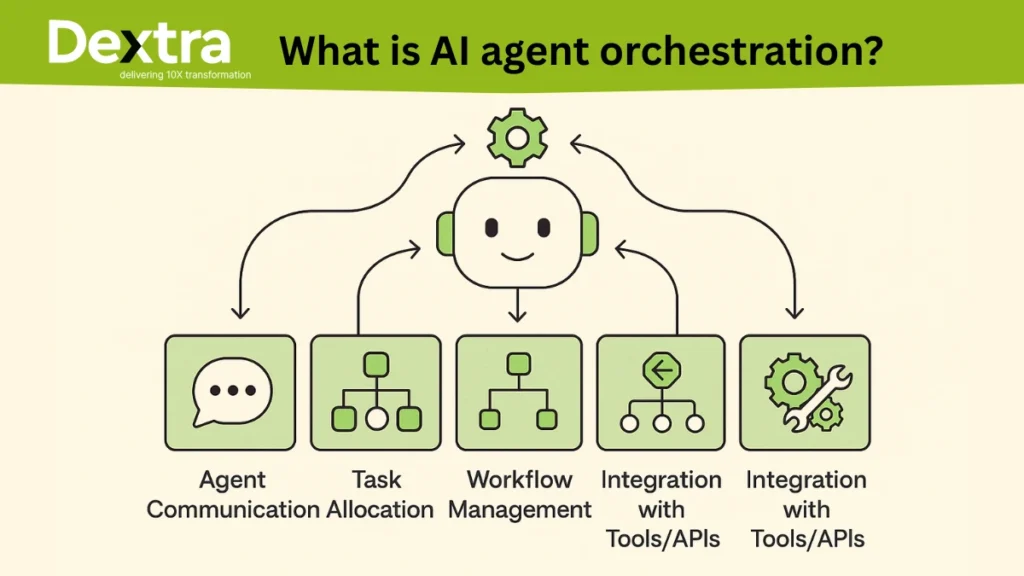
Agent orchestration is the control layer that coordinates multiple AI agents so they work as a unified system rather than competing, redundant bots. In practice, it assigns tasks, manages shared context, and governs which agent has the authority to act and when a decision needs human review. The fix for chaotic AI tooling isn’t more agents — it’s agent orchestration, the control layer that turns a disorganized swarm of AI tools into a disciplined team.
Published: June 8, 2026. Last updated: August 30, 2026.
What does agent orchestration mean in AI automations?
Agent orchestration in AI automations is the control layer that coordinates multiple specialized AI agents so they work together safely, predictably, and at scale. Orchestration defines how work moves between agents, which agent has authority to act, and how decisions get reviewed — ensuring automation stays inside your business rules instead of going rogue.
Think of it like a kitchen during dinner rush. You’ve got a prep cook, a grill chef, a saucier, and a plater. Each one is skilled, but without a head chef calling the passes, you get cold food, wrong tickets, and chaos. Agent orchestration is the head chef. As GitHub’s engineering resource on the topic puts it, AI agent orchestration is “the control layer that coordinates multiple AI agents to work safely and predictably at scale.” IBM frames it similarly: orchestration coordinates “multiple specialized AI agents within a unified system to efficiently achieve complex goals.”
What does agent orchestration mean in AI automations for a five-person startup versus a 5,000-person enterprise? The mechanics are identical — the cost discipline is not. A common pattern practitioners observe is that small teams without orchestration pay twice for the same work: two or more agents independently re-fetch the same context and re-reason the same problem, inflating token spend. Orchestration addresses this by routing each task to exactly one accountable agent and sharing context so nothing gets recomputed.
Quick Summary: Key Takeaways
- Agent orchestration is the coordination layer that makes multiple AI agents act as one accountable team, not a disconnected swarm.
- Orchestration differs from basic automation because it adds governance, shared context, and execution control — not just linear task execution.
- The five core orchestration patterns are sequential, concurrent, group chat, handoff, and magentic, per Microsoft’s Azure Architecture Center.
- SMEs can run orchestration affordably using self-hosted open-source tools (such as n8n) instead of paying enterprise platform licenses or per-task automation fees.
- Uncoordinated agents create a “token trap” — redundant calls and re-reasoning that erode small-business AI ROI.
- A supervisor/conductor model with human oversight on high-stakes actions keeps automation deterministic and audit-ready.
How is agent orchestration different from basic automation?
Agent orchestration differs from basic automation in three core ways: decision-making, adaptability, and governance. Basic automation executes a fixed, linear sequence of predefined tasks. It follows a script. Orchestration manages a team that can improvise — but only within boundaries you set.
Zapier draws the line clearly: traditional automation is “if this, then that,” while orchestration is about coordinating AI agents to streamline workflows and drive better outcomes. A basic automation fires when an email arrives and copies data to a spreadsheet. An orchestrated system fields the email, classifies intent, drafts a contextual reply, checks inventory through a second agent, flags pricing exceptions to a human, and logs everything — all while sharing context between agents.
Here’s the distinction that matters for budgets. Basic automation breaks the moment reality deviates from the script. Orchestration absorbs ambiguity. When a customer asks something off-pattern, a single rigid automation fails silently. An orchestrated multi-agent system routes the edge case to a specialist agent or escalates to a person.
| Dimension | Basic Automation | Agent Orchestration |
|---|---|---|
| Logic | Fixed if-this-then-that rules | Adaptive reasoning within guardrails |
| Agents involved | Single task or single bot | Multiple specialized agents |
| Context sharing | None — each step is isolated | Shared memory across agents |
| Decision authority | Predefined branches only | Agent-level authority + human review |
| Handles edge cases | Fails or stalls | Routes, escalates, or adapts |
| Typical cost driver | Per-task pricing | Token usage (controllable) |
A common trade-off practitioners weigh when moving SMEs off per-task SaaS automation stacks onto self-hosted orchestration: per-task pricing compounds with volume, while a well-orchestrated self-hosted setup charges only for the compute and tokens actually used. You can compare both approaches with our AI comparison tool. The right answer depends on your volume — low-volume workflows can be cheaper to keep on a managed automation tool, so it’s worth modelling before migrating.
What are the main agent orchestration patterns in AI automations?
Microsoft’s Azure Architecture Center identifies five fundamental orchestration patterns: sequential, concurrent, group chat, handoff, and magentic. Each pattern defines how work and authority move between agents, and the right choice depends entirely on your workflow’s structure (see Azure Architecture Center).
Picking a pattern is one of the most consequential decisions in any orchestration project. Choose wrong and you’ll either over-engineer a simple pipeline or under-coordinate a complex one. Here’s how each pattern works in plain language.
Sequential pattern
Sequential orchestration is a multi-agent design pattern that passes work from one agent to the next in a fixed, predefined order, like an assembly line. Agent A completes its task and hands its output to Agent B. A typical invoice workflow looks like this: an extraction agent reads the PDF, a validation agent checks the numbers against your ERP, and an entry agent posts it. Sequential is the cheapest and most deterministic pattern — ideal for budget-conscious SMEs running predictable ERP workflows.
Concurrent pattern
Concurrent orchestration is a multi-agent pattern that runs two or more agents in parallel on the same task, then merges their outputs through a coordinator agent. For example, a pricing query can simultaneously hit a discounts agent and an inventory agent, with a coordinator combining outputs. Concurrent slashes latency but multiplies token costs, so practitioners generally reserve it for high-value, time-sensitive decisions.
Group chat and handoff patterns
Group chat orchestration lets multiple agents discuss a problem together, moderated by a manager agent — useful for complex reasoning where agents debate options. Handoff orchestration transfers full control from one agent to another based on context, like a sales agent passing a technical question to a specialist. Handoff is the backbone of intelligent WhatsApp chatbots for service businesses, where one routing agent must hand off cleanly to a specialist agent without losing conversation context.
Magentic pattern
Magentic orchestration, introduced in Microsoft’s framework, uses a lead agent that dynamically plans, delegates, and re-plans as new information arrives. Magentic suits open-ended, research-style tasks where the path isn’t known upfront. For most SMEs, magentic is overkill — a practical progression is to start sequential, graduate to handoff, and only reach for magentic when genuine complexity demands it.
Why is agent orchestration important for SMEs and startups?
Agent orchestration matters for SMEs because it converts unpredictable, token-hungry AI experiments into deterministic, cost-controlled business systems with measurable ROI. Without orchestration, small teams risk burning budget on agents that duplicate work, contradict each other, and produce results no one can audit.
The most common cost leak for small businesses that skip orchestration is the “token trap” — uncoordinated agents that re-fetch the same context, re-reason the same problem, and chain calls no human ever reviews. Orchestration plugs that leak by enforcing one accountable agent per task and shared context so nothing gets re-computed.
Consider a worked example of a small e-commerce brand running four separate AI tools — one for support, one for order routing, one for refunds, one for restocking alerts. Because each tool operates in isolation, they can issue conflicting actions: a refund tool may process a return for an item the restocking tool has already re-listed. Consolidating those four into a supervised team with a single conductor agent removes the contradictions, because the conductor sees all four contexts and resolves conflicts before any action executes. The measurable wins to track are monthly token spend, the rate of contradictory or duplicated actions, and time-to-resolution per ticket — instrument these before and after so the ROI is verifiable rather than assumed.
Orchestration also delivers the governance that auditors, customers, and your own finance team demand. Every agent action gets logged, every high-stakes decision routes to a human, and every output traces back to a rule. That transparency is increasingly important for any business that wants to scale AI without scaling risk. The honest caveat: orchestration adds engineering and maintenance overhead, so it pays off most clearly once you have more than one or two AI workflows interacting.
How does the supervisor model work in agent orchestration?
The supervisor model — also called the conductor or orchestrator model — uses one lead agent to coordinate specialized worker agents, assign tasks, resolve conflicts, and route decisions for human review. The supervisor holds authority; the workers execute within their lanes.
The analogy echoed across IBM and Microsoft documentation is a human team reporting to a manager. The supervisor agent doesn’t do the specialized work itself — it decides which worker handles what, merges their outputs, catches contradictions, and escalates anything outside policy. This conductor pattern is widely adopted because it maps cleanly onto how real organizations operate.
What makes the supervisor model powerful for deterministic automation is authority boundaries. You define exactly what each agent may do autonomously and what requires sign-off. A refund agent might auto-approve refunds under a set threshold but route anything higher to a human. A pricing agent might suggest discounts but never publish them without review. The supervisor enforces these rules consistently — which is precisely where probabilistic, single-agent AI tends to fail, because a lone agent has no external check on its own reasoning.
A supervisor-model design is a sensible default for nearly every custom AI agent system, because it gives founders something they actually need: predictable behavior they can trust and explain. A clever agent that occasionally hallucinates a large refund is worse than no agent at all.
How can a small business implement agent orchestration affordably?
SMEs can implement agent orchestration affordably by self-hosting open-source tools like n8n, choosing the simplest viable pattern, and enforcing strict token controls instead of paying enterprise platform licenses. You don’t need Azure, UiPath, or Salesforce pricing to orchestrate effectively for a small team.
Here’s a budget-conscious blueprint, step by step:
- Map the workflow before adding agents. Document every task, decision point, and exception. Most businesses discover they need three well-coordinated agents, not ten loose ones.
- Pick the simplest pattern that works. Default to sequential. Add handoff only where genuine routing decisions exist. Avoid magentic until complexity forces it.
- Self-host the orchestration layer. Run n8n on a modest cloud server. Self-hosting eliminates per-task automation fees and gives you full control over data and token routing.
- Assign one accountable agent per task. No overlap. Shared context, single owner. This is what closes the token trap.
- Set authority limits and human-review gates. Define dollar thresholds, approval steps, and escalation paths up front.
- Instrument everything and measure ROI. Track token spend, error rates, and time saved per workflow from day one.
Self-hosted orchestration shifts your cost base from fixed per-task fees to variable compute and token usage, which is usually cheaper at moderate-to-high volume but carries setup and maintenance effort you should budget for. Model your own numbers with our comparison tool before committing — including the hidden cost of your own time to run a self-hosted stack.
Actionable Takeaways: Your Orchestration Starting Point
If you’re an SME founder or ops leader ready to move past disconnected AI tools, consider these four steps this quarter:
- Audit your current AI tools for overlap. Any two tools doing similar work are likely contradicting each other and wasting tokens.
- Start with one orchestrated workflow, not ten. Pick your highest-volume, most-rule-bound process — invoice processing, lead routing, or support triage.
- Default to the sequential pattern and a supervisor model with human-review gates on anything involving money or customer-facing commitments.
- Self-host on n8n to escape per-task fees and keep token costs transparent and controllable — once your volume justifies the setup effort.
Orchestration done right turns AI from an unpredictable expense into a deterministic, auditable team member. The businesses winning with AI aren’t the ones with the most agents — they’re the ones whose agents actually coordinate.
Frequently Asked Questions
What does agent orchestration mean in AI automations, in one sentence?
Agent orchestration in AI automations is the coordination layer that manages multiple specialized AI agents so they work together safely, predictably, and within defined business rules. It controls how work moves between agents, which agent has authority to act, and how decisions get reviewed before execution.
What is the difference between AI agent orchestration and a single AI agent?
A single AI agent handles one task or domain on its own, while agent orchestration coordinates many specialized agents as a supervised team. Orchestration adds shared context, conflict resolution, and authority boundaries that a lone agent can’t provide, making multi-step business workflows reliable and auditable.
How much does agent orchestration cost for a small business?
Cost depends on volume and tooling. A self-hosted setup using open-source tools like n8n shifts your spend from fixed per-task fees to variable server and token usage, which is typically cheaper than enterprise platforms such as Azure AI Agents, UiPath, or Salesforce Agentforce at moderate volumes — but it requires setup and maintenance effort you should factor in.
What are the five agent orchestration patterns?
The five core orchestration patterns identified by Microsoft’s Azure Architecture Center are sequential, concurrent, group chat, handoff, and magentic. Sequential passes work in order, concurrent runs agents in parallel, group chat lets agents collaborate, handoff transfers control by context, and magentic dynamically plans and re-plans complex tasks.
Is agent orchestration only for large enterprises?
No. Agent orchestration is accessible to startups and SMEs using affordable open-source tools like n8n and simple patterns like sequential orchestration. Small teams can benefit notably, because orchestration eliminates the token waste from uncoordinated agents and turns AI into a measurable, auditable system rather than a runaway cost.
Sources & References
- What is AI agent orchestration? — GitHub
- What is AI agent orchestration? — IBM
- AI Agent Orchestration Patterns — Azure Architecture Center (Microsoft)
- What is AI agent orchestration + how does it work? — Zapier
- Microsoft — AI, Cloud & Productivity
Note: This article is for general informational purposes; verify specifics against your own context.
When orchestrating multiple agents that process external data, you must also learn how to prevent prompt injection attacks in AI agents, since a compromised agent can hijack the entire workflow.
When orchestrating multiple agents, it’s critical to understand the difference between deterministic vs probabilistic systems so you can route tasks that require exact, repeatable answers to the right component.
Before orchestrating multiple agents, it helps to understand how much does it cost to build a custom AI agent so you can budget realistically for the reasoning loops and tool integrations involved.
If you’re curious about how agent orchestration could bring order to your own AI workflows, we’d love to talk it through with you. Reach out anytime to explore what a coordinated approach might look like for your team.
Orchestrating multiple agents introduces compounding risk, making reducing AI hallucinations a critical part of any reliable agent pipeline.
As you scale agent orchestration across departments, it becomes critical to implement AI agent security and data privacy for enterprises to manage the explosion of non-human identities running with broad permissions.
Before orchestrating agents to handle regulated decisions, review AI agent compliance with the EU AI Act 2026 to ensure your automation does not fall foul of the high-risk obligations and €35 million penalty regime.
Orchestrating multiple AI agents often involves a RAG architecture so each agent can retrieve authoritative context before acting on a task.
A practical example of agent orchestration is a finance workflow where multiple agents extract, validate, and approve documents — exactly how teams automate invoicing with AI from end to end.
Because orchestrating rule-based agents avoids unpredictable compute charges, it’s worth reviewing how much deterministic AI tooling typically costs to set realistic budget expectations.