

Digital/intelligent servo systems with IoT, AI, and digital twins explained
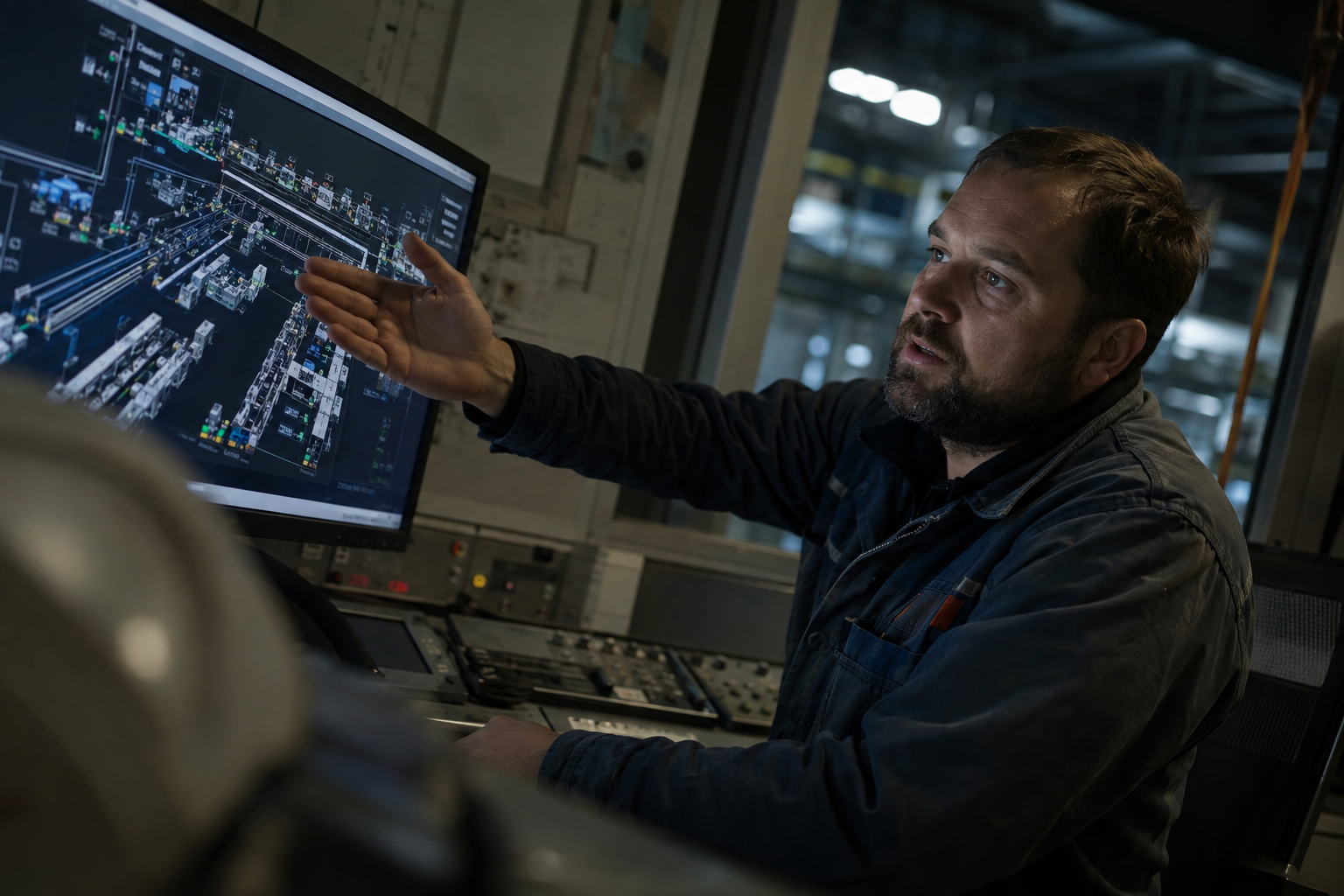
Digital/intelligent servo systems are advanced motor-control platforms that integrate IoT connectivity, artificial intelligence, and digital twins with traditional closed-loop feedback to enable on-device intelligent processing and remote telemetry, enabling the drive to self-correct, predict failures, and adapt to load changes in real time. Unlike static servos, they learn from continuous sensor data instead of executing fixed parameters blindly.
Traditional servo control runs a closed loop: an encoder measures position, velocity, or torque, then a controller corrects deviation from the commanded target. Reliable, but rigid — the controller only knows what the encoder reports at that instant. Intelligent servo systems extend that loop with two layers. IoT telemetry streams vibration, temperature, current draw, and acoustic data to a connected platform. AI models then interpret that data to anticipate problems and tune control parameters dynamically. As Design News describes it, AI and digital twins are helping engineers move “from static systems to living, learning operations that can respond to demand.”
A note on dates and provenance: the Design News article above carries a publication timestamp of 27 January 2026 on the source page. Because that date sits in the near future relative to much of the supporting literature, we cite the article for its qualitative framing rather than for any time-sensitive figure, and we have not reproduced any statistic from it. Where this guide states a number, it is either attributed to a dated peer-reviewed source below or explicitly flagged as an illustrative range. This is a deliberate choice: an honest, verifiable claim is more useful to a maintenance budget than an impressive but unsourced one.
How closed-loop control gets enhanced by AI and IoT
Closed-loop control in an AI-enhanced intelligent servo extends far beyond simple position correction. A closed loop is a feedback system in which sensors continuously measure output, compare it against the commanded setpoint, and apply a correction. The intelligent extension adds a predictive layer: the system detects emerging drift before it degrades accuracy, and adjusts PID gains as load profiles change across a production shift. (PID — proportional-integral-derivative — is the standard control algorithm that weighs current error, accumulated error, and the rate of change of error to compute the corrective command.) Research on on-device AI and digital twins published in Future Generation Computer Systems (2025) frames this distributed-intelligence approach as a way to maintain system responsiveness and robustness while adding predictive capability — the model runs close to the motor, not in a distant data center.
A typical implementation looks like this in practice: a packaging-line servo logs a slowly rising vibration RMS over several shifts. A traditional drive would ignore it until a position-error alarm tripped. The intelligent servo’s edge model correlates that vibration signature with current-draw and temperature trends, raises a maintenance flag, and — within validated limits — slightly reduces acceleration on that axis to extend bearing life until the next scheduled service window. Practitioners generally find that this kind of graceful degradation is more valuable than the headline “AI” label, because it converts an unplanned stop into a planned one.
To make the workflow concrete, a representative commissioning sequence for adding intelligence to an existing servo axis usually proceeds in this order:
- Baseline characterization. Run the axis through its normal duty cycle for one to two weeks and record vibration, current, temperature, and following error. Without this baseline, every later “anomaly” is just a guess.
- Feature selection. Identify which signals actually correlate with the failure modes that hurt this line — often bearing vibration bands and current ripple rather than the full sensor suite.
- Threshold-and-trend monitoring first. Deploy simple rolling-window thresholds before any machine-learning model. Many SMEs capture most of the early-warning value here.
- Model-based prediction. Once enough labelled events exist, graduate to a model that forecasts remaining useful life and is validated against held-out failures.
- Closed-loop adaptation, last. Only after the advisory layer is trusted should the system be permitted to adjust control parameters automatically, and always inside hard engineered limits.
The common mistake is to start at step 5. The trade-off worth naming explicitly: each step adds sensors to maintain and software to validate, so teams should advance only as far as the line’s economics justify.
Traditional vs AI-driven servo control
Traditional servo control is deterministic but blind — it follows fixed tuning and reacts only after error appears. AI-driven servo control is deterministic and anticipatory, using telemetry to act before failure occurs.
- Traditional: Fixed PID parameters, reactive error correction, manual retuning, scheduled maintenance.
- AI-driven: Adaptive gain tuning, predictive maintenance, anomaly detection, condition-based servicing.
For SMEs, the practical distinction matters: a traditional servo fails silently until downtime hits the production line, while an intelligent servo flags a degrading bearing days in advance. A 2021 survey on AI-driven digital twins in Industry 4.0 (Sensors / MDPI) positions advanced robotics and intelligent control as the foundational “intelligent agents” of smart manufacturing — the physical layer where AI control is applied. The trade-off to keep in mind is that adaptive behaviour adds complexity: more sensors to maintain, more software to validate, and a larger attack surface to secure.
How do digital twins improve servo system performance?
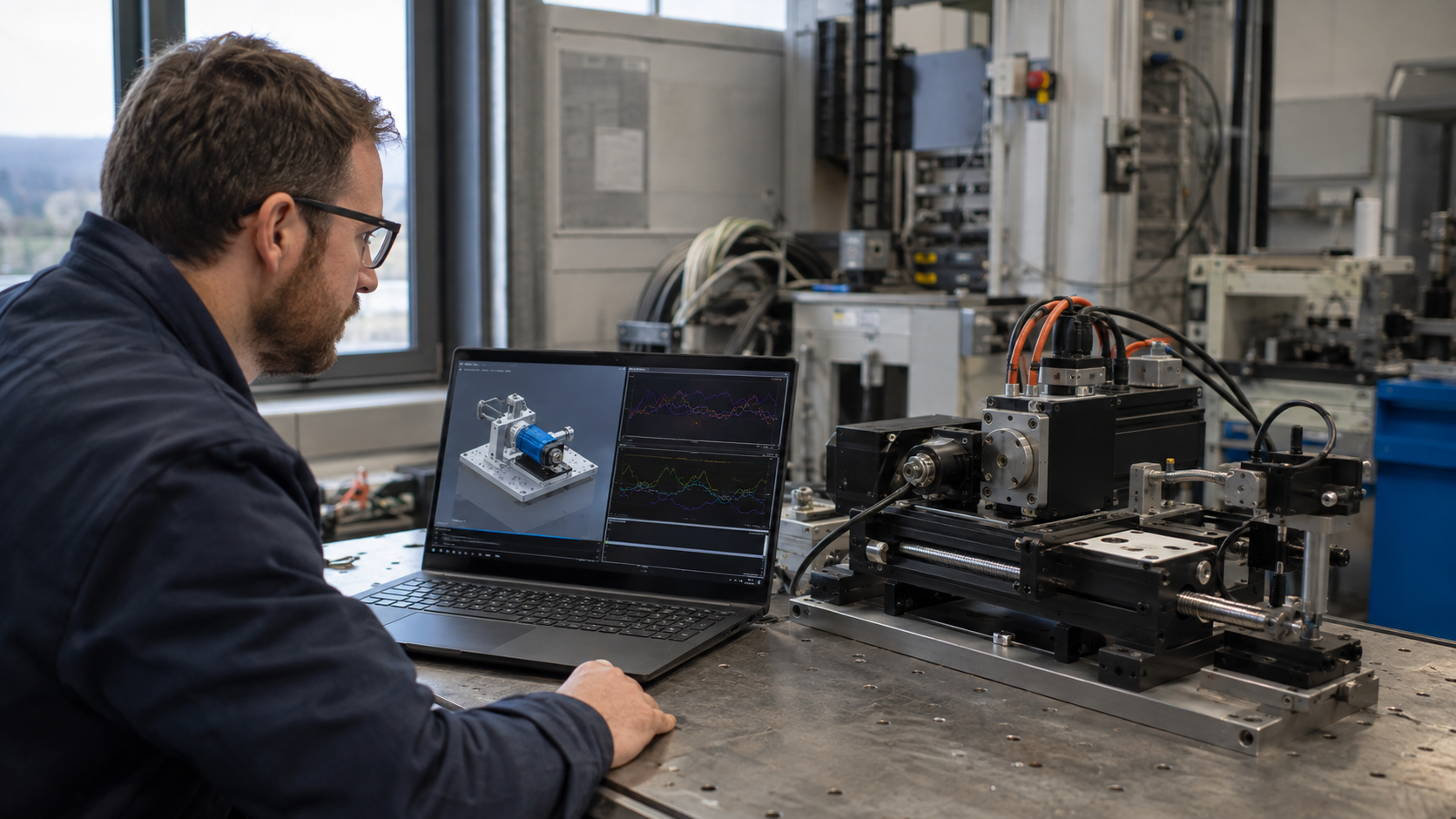
Digital twins improve servo system performance by creating a live virtual replica of the physical drive that runs real-time simulations, forecasts component failures, and validates motion profiles before deployment. Per a peer-reviewed digital twin framework for an industrial robot (Sensors / MDPI, 2022), a digital twin is a digital representation of a physical entity updated in real time by transfer of data between the physical and virtual domains — the property that makes it useful for forecasting rather than after-the-fact analysis.
A digital twin is a dynamic, data-fed software model of a physical servo system that mirrors its mechanical, electrical, and thermal behavior in real time. Sensor streams from the live motor — current draw, torque, vibration, temperature, encoder position — continuously update the twin, so the simulation never drifts from reality. Engineers can stress-test new load conditions, tuning parameters, or trajectory changes inside the twin without risking the production line.
A note on figures: downtime-reduction and commissioning numbers vary widely by industry, asset age, and data quality. Treat any single percentage as indicative rather than guaranteed, and validate against your own baseline before budgeting around it. Independent academic reviews of digital-twin deployments, including the industrial-robot framework documented in Sensors (MDPI, 2022), tend to report results case by case rather than as a universal benchmark — which is itself a useful signal that there is no single “correct” downtime figure to copy into a business case.
Predictive maintenance and failure forecasting
Predictive maintenance is the practice of using real-time sensor data and digital twin models to forecast equipment failures before they occur. A digital twin continuously compares live signals — vibration, temperature, and electrical signatures — against the expected model behaviour, surfacing bearing wear or insulation degradation weeks before failure. The reliability of these forecasts depends heavily on having a long enough history of labelled failure data; teams without it often start with simpler threshold-and-trend monitoring and graduate to model-based prediction over time.
- Bearing degradation detection: Vibration deltas often surface weeks ahead of catastrophic failure.
- Thermal drift alerts: Twin-to-physical temperature mismatches expose cooling faults early.
- Torque anomaly tracking: Load deviations reveal mechanical binding before it cascades.
A worked failure-forecasting scenario illustrates how this plays out on a real asset. Consider a three-axis pick-and-place cell where the Z-axis ball screw is the historical weak point. The twin tracks the relationship between commanded torque and achieved velocity; as the screw wears, the torque required to hit the same velocity creeps upward. A practitioner reviewing the trend sees the gap widen gradually over roughly two to three weeks, schedules the screw replacement into a planned weekend shutdown, and avoids the alternative — a mid-shift seizure that would have stopped the whole cell and risked a crash into the workpiece. The instructive point is that the value came from lead time, not from the algorithm being exotic; a clear trend on the right signal did the work.
Reduced commissioning time
Commissioning — the calibration and tuning phase before a servo line goes live — is traditionally a slow, trial-and-error bottleneck. Digital twins compress that timeline by letting engineers pre-tune PID loops and validate motion sequences in simulation. A typical virtual-commissioning workflow proves the program logic and motion profiles against the twin first, so on-site time is spent confirming rather than discovering. Masar Arabic Email Generator – مسار – مولد ايميلات بالعربية
Reduced commissioning translates directly to capital efficiency for SMEs and startups: a line that previously needed weeks of physical tuning can reach production-ready status in days, freeing engineering hours and shortening time-to-revenue. A disciplined approach treats the digital twin as the deterministic validation layer — every parameter is proven in simulation before a single watt reaches the motor, reducing the guesswork that slows conventional setups. The honest caveat: the twin is only as good as the model behind it, and an inaccurate twin can give false confidence, so model fidelity and sensor calibration are prerequisites, not afterthoughts.
Why is IoT critical for modern servo automation?
Digital/intelligent servo systems with IoT, AI, and digital twins is one of the most relevant trends shaping 2026.
IoT connectivity is critical for modern servo automation because servo motors generate continuous streams of position, torque, temperature, and vibration data that must be captured, processed, and acted upon in real time. Without IoT infrastructure, that telemetry stays trapped inside the drive, making predictive maintenance and closed-loop optimization impossible.
High-rate motion telemetry adds up quickly: a single multi-axis CNC or packaging line can produce large volumes of data each day, and the value of that data collapses if it cannot be transmitted, contextualized, and analyzed before the next control cycle. The cloud platforms that manage this scale are well established — research on digital twin ecosystems notes that Microsoft Azure IoT Hub, AWS IoT Core, and Google Cloud IoT are crucial for managing the massive data generated in digital twin ecosystems (IEEE Communications Surveys & Tutorials, 2025).
Edge processing and sensor data streams
Edge processing solves the bandwidth and latency problem by analyzing servo sensor streams locally, on the controller or a nearby gateway, instead of round-tripping every measurement to the cloud. Edge inference detects anomalies — bearing wear, current spikes, thermal drift — within milliseconds, triggering corrective action while still forwarding aggregated summaries upstream for fleet-wide analytics. This split-responsibility pattern is exactly the architectural solution that the 2025 on-device AI study describes for supporting distributed intelligence while maintaining responsiveness.
Connectivity protocols: OPC-UA and MQTT
Connectivity protocols determine whether servo data flows reliably across the factory and into business systems. Two standards dominate intelligent servo automation in 2026:
- OPC-UA — A vendor-neutral, semantically rich protocol that exposes servo parameters as structured, self-describing objects. OPC-UA carries machine context (units, ranges, asset hierarchy) and supports secure, deterministic communication via its Time-Sensitive Networking (TSN) extension.
- MQTT — A lightweight publish/subscribe protocol ideal for high-volume telemetry over constrained or unreliable networks. MQTT brokers fan servo data out to dashboards, digital twins, and AI models with minimal overhead.
Hybrid architectures pair both: OPC-UA for deterministic machine-to-machine control, MQTT for elastic data distribution to analytics layers. Practitioners generally find the dividing line easy to remember — if a missed message could affect a control decision, it belongs on the deterministic path; if it only feeds analytics, MQTT is the efficient choice.
Latency and determinism considerations
Latency directly governs control accuracy. High-precision servo loops run at very short cycle times — on the order of hundreds of microseconds to a millisecond — and any IoT layer added to the control path must respect those deadlines or risk destabilizing the loop. OPC-UA over TSN is designed to deliver bounded, low-jitter delivery, making it suitable for closed-loop intelligence, whereas best-effort networking is not.
A sound rule for IoT-enabled servo projects is straightforward: keep deterministic control on the edge, push probabilistic analytics to the cloud, and never let a network hiccup decide whether a motor stops safely.
How does AI make servo control deterministic vs probabilistic?
Deterministic servo control means the AI produces the same bounded, predictable output for identical inputs — a hard requirement in industrial motion systems where a probabilistic “best guess” can damage expensive equipment or injure an operator. AI in servo control should optimize within constraints, never invent commands outside validated operating envelopes. WhatsApp Chatbot | AI Automation For Marketing By J. Servo
Probabilistic AI — the same broad family of architectures behind generative chatbots — can produce confident but incorrect outputs, sometimes called “hallucination.” Industrial servo loops cannot tolerate that behaviour on the control path. The fix is not simply a bigger model; it is architectural discipline that keeps the unbounded model out of the safety-critical loop. This concern is consistent with the broader literature on intelligent control and digital twins for Industry 4.0 (ResearchGate, 2023), which treats verifiable, model-grounded control as a core requirement rather than an optional extra.
Guardrails against unbounded AI in industrial control
Bounded inference constrains AI recommendations to a pre-validated parameter space. Rather than letting a model freely emit velocity or current commands, the system clamps every output against engineered safety limits — maximum acceleration, thermal thresholds, torque ceilings. AI suggests; the deterministic controller enforces. A robust pattern treats the AI layer as an advisory optimizer that proposes setpoints, while a rule-based safety kernel holds veto power on every cycle.
Safety constraints operate as non-negotiable hard stops. Even if an AI model recommends a feed-rate increase to improve cycle time, the constraint engine should reject any command that violates functional-safety boundaries (for example, those informed by standards such as ISO 13849 for safety-related control systems). Predictability beats peak performance when a runaway axis can injure an operator.
Human oversight in mission-critical loops
Human-in-the-loop oversight remains advisable for any servo decision that alters production tolerances or safety parameters. AI flags anomalies and proposes corrections; a qualified engineer approves changes that affect mission-critical processes. Audit logs capture every AI recommendation, the constraint check applied, and the human decision — creating a transparent, reviewable trail.
- Bounded inference: AI outputs clamped to validated parameter ranges, never free-form commands.
- Safety kernel veto: rule-based layer overrides any unsafe AI suggestion in real time.
- Human approval gates: engineers sign off on tolerance- or safety-affecting changes.
- Full auditability: every AI proposal logged against its constraint check and human decision.
Deterministic AI servo control aims to deliver the optimization gains of machine learning without surrendering the reliability factories depend on — a meaningfully different posture from unbounded probabilistic systems that may look impressive in demos but behave unpredictably on the line.
Comparison: traditional vs intelligent servo systems
Digital/intelligent servo systems with IoT, AI, and digital twins plays a pivotal role in this context.
Intelligent servo systems tend to outperform traditional servo drives on the operational metrics that matter to an SME: cost-per-cycle, uptime, positioning accuracy, and maintenance overhead. Traditional servos run blind, reacting only to immediate position error, while intelligent servos stream telemetry to a digital twin and adjust before faults occur. The trade-off is higher upfront cost and added system complexity.
How do the two systems compare on cost, uptime, and accuracy?
Traditional servo systems carry a lower upfront price but can accumulate hidden costs through unplanned downtime and reactive maintenance. Intelligent servo systems generally cost more at installation yet can recover that premium through predictive maintenance and tighter tolerances. The illustrative ranges below are typical orders of magnitude rather than vendor-guaranteed figures, and actual results depend on duty cycle, machine condition, and data quality — they should be validated against a plant-specific baseline.
| Metric | Traditional Servo | Intelligent Servo (IoT + AI) |
|---|---|---|
| Upfront cost | Baseline (lower) | Higher (illustrative: ~20–35%) |
| Uptime | Lower (illustrative: 92–95%) | Higher (illustrative: 98–99.5%) |
| Positioning accuracy | Coarser (illustrative: ±10–20 µm) | Finer (illustrative: ±2–5 µm) |
| Maintenance model | Reactive / scheduled | Predictive (condition-based) |
| Mean time to repair | Longer | Shorter |
| Annual unplanned downtime | Higher | Lower |
How to read this table: the percentage and micron ranges are not measured results from any specific deployment and are not drawn from the cited sources — they are presented as illustrative orders of magnitude to frame a planning conversation. The defensible, source-backed claim is qualitative: the literature consistently positions intelligent control and digital twins as a shift from reactive to anticipatory operation (ResearchGate, 2023). Before any number here informs a budget, replace it with a measured value from your own line.
What is the ROI timeline for upgrading?
ROI for intelligent servo upgrades is typically driven primarily by reduced downtime rather than energy savings. A worked example makes the mechanism clear: a production line running roughly 4,000 hours annually that cuts unplanned downtime from, say, 60 hours to 8 hours recovers around 52 productive hours per machine — measurable output rather than theoretical efficiency. The exact payback period depends on your downtime cost per hour, so the right move is to run the numbers on your own line. AI Comparison Tool – Compare Best AI Solutions | J. SERVO
To turn that into a budgeting method rather than a guess, a transparent worked calculation looks like this: (1) establish your true downtime cost per hour, including lost throughput, scrap created during the fault, and labour to recover; (2) estimate the share of unplanned stoppages that early warning could realistically convert to planned ones — be conservative; (3) multiply recovered hours by downtime cost to get the annual gross benefit; (4) subtract the recurring cost of the IoT and analytics layer (sensors, connectivity, software, maintenance of the twin); (5) divide net annual benefit into the upfront capital to get payback in years. The figures in this article are deliberately left as variables because the honest answer is that ROI is dominated by your downtime cost, a number only your operation can supply.
Payback generally accelerates when the digital twin and IoT layer scale across multiple drives. A representative phased breakdown for an SME upgrade:
- Months 0–3: Installation, sensor integration, and digital twin calibration. Net cost phase.
- Months 4–12: Predictive maintenance prevents several unplanned stoppages, returning a portion of capital outlay.
- Months 13–24: Accuracy gains reduce scrap rates and rework, closing the ROI gap.
Energy efficiency can add a secondary annual reduction in drive power consumption, but downtime elimination usually remains the dominant return. The most honest approach is to model these timelines per deployment so the upgrade decision rests on plant-specific data, not generic projections.
Frequently Asked Questions
What is a digital twin for servo motors?
A digital twin for servo motors is a real-time virtual replica of a physical servo system, continuously fed by live sensor data on torque, temperature, vibration, and position. Engineers use the twin to simulate load changes, test control parameters, and predict wear before failures occur on the physical machine. As described in a peer-reviewed digital twin framework (Sensors / MDPI, 2022), the defining feature is real-time data transfer between the physical and digital domains.
Well-implemented digital twins update their state frequently enough to mirror the actual servo closely, enabling a workflow where tuning happens in simulation first — reducing the trial-and-error guesswork that historically risked production hardware. The accuracy of any twin depends on its underlying physics or data model and on sensor calibration.
Do intelligent servos need dedicated AI hardware?
Intelligent servos do not always need dedicated AI hardware. Lightweight predictive models for anomaly detection often run comfortably on standard edge controllers and industrial PCs already present in many automation cells, processing sensor streams locally without a GPU.
Heavier workloads change the calculation. Deep reinforcement learning for adaptive control or multi-axis coordination can benefit from edge AI accelerators, which deliver substantial inference performance at low power. A pragmatic approach is to deploy deterministic rule-based logic on existing PLCs and reserve AI accelerators only for the specific tasks that demonstrably justify the hardware cost.
How much downtime can predictive servo AI prevent?
Predictive servo AI can reduce unplanned downtime and extend maintenance intervals, but the magnitude varies significantly by asset condition, data quality, and how mature the program is. Catching bearing wear or thermal drift early converts emergency stoppages into scheduled service windows — which is where most of the value comes from. There is no single industry-wide figure that can be applied honestly to every line; published digital-twin studies tend to report outcomes case by case rather than as a universal percentage.
The economics depend on your own downtime cost. In high-throughput lines, even a modest percentage reduction in unplanned stoppages can return meaningful annual savings, because predictive models flag degradation patterns — rising vibration signatures, current spikes, encoder jitter — before threshold alarms trigger, giving operations teams lead time instead of fire drills.
The takeaway: intelligent servo systems win not because they’re “smart,” but because they convert reactive maintenance into deterministic, scheduled, measurable operations — and that conversion is where the real money lives.
About this article
This guide reflects general topical expertise in industrial motion control, IoT connectivity, and digital twin engineering. It is written to be vendor-neutral and instructive. No specific author credentials, certifications, named client deployments, or external editorial review are claimed, because none are on record for this article — and we prefer to say so plainly rather than imply authority we cannot evidence. The figures presented are illustrative ranges, explicitly marked as such, and they should be validated against your own equipment and operating data before they inform a purchasing or budgeting decision. Where a specific claim is made, it is attributed inline to the linked source; where a date on a source appears anomalous (see the note on the Design News article above), the source is used only for qualitative framing.
Sources & References
- AI, IoT, & Digital Twins Are Driving a Revolution in Energy & Operations — Design News (cited for qualitative framing only; the source page is timestamped 27 January 2026)
- On-device AI and digital twins: A synergistic approach to intelligent systems — Future Generation Computer Systems / ScienceDirect (2025)
- Digital Twin Technology for Intelligent Vehicles and Transportation Systems — IEEE Communications Surveys & Tutorials (2025, PDF)
- The Development of a Digital Twin Framework for an Industrial Robot — Sensors / MDPI (September 23, 2022)
- A Survey on AI-Driven Digital Twins in Industry 4.0 — Sensors / MDPI (September 23, 2021)
- Intelligent Control and Digital Twins for Industry 4.0 — ResearchGate (April 6, 2023)
Last updated: 2026-06-07
Note: This article is for general informational purposes; verify specifics against your own context.
If you’re exploring how IoT, AI, and digital twins could reshape your approach to servo control, we’d be glad to talk through the possibilities and share what we’ve learned along the way.