
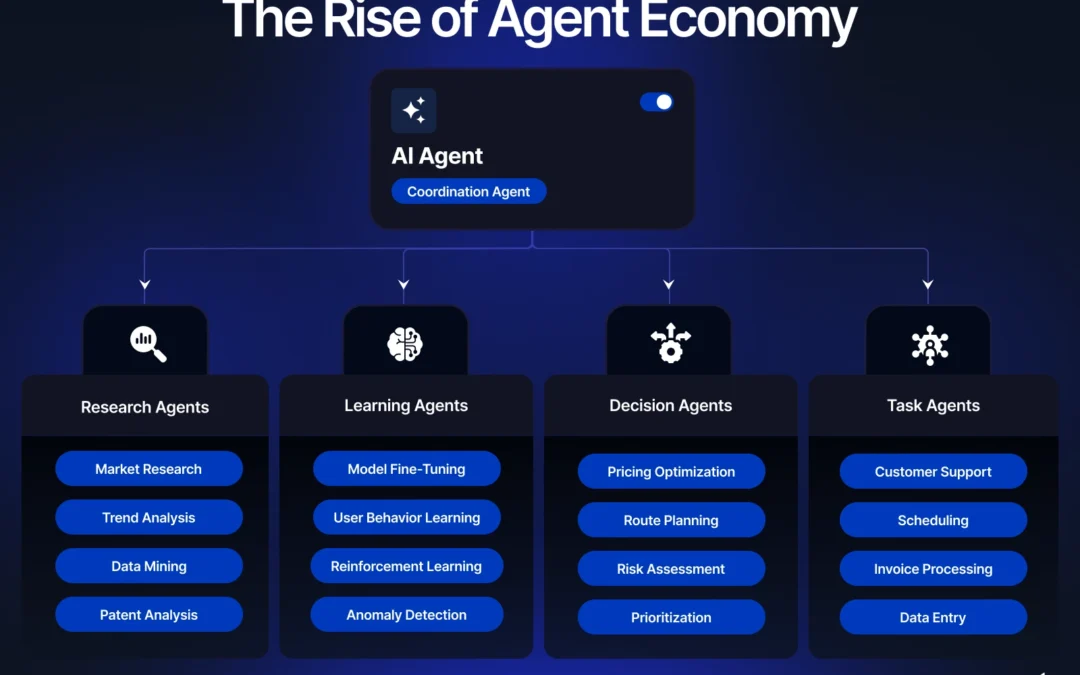
The agent economy is an emerging system in which autonomous AI agents act as independent buyers, sellers, and negotiators, completing transactions with minimal human supervision. This is the agent agent economy, and it’s already forming inside the workflows of companies you’ve never heard of.
Most startup founders are still treating AI like a fancy autocomplete. Meanwhile, the smart money is wiring agents together so they can pay each other, coordinate tasks, and run entire business functions without a human clicking “approve” every five minutes. The gap between these two camps is widening fast, and it will define which SMEs survive the next decade.
This guide explains what the agent agent economy actually is, why it matters for companies without enterprise budgets, and how to join it without burning cash on SaaS bloat. The analysis below draws on current academic work, dictionary and economic definitions of “agent,” and the public commitments of the fintech and standards bodies building the underlying infrastructure. Where a claim rests on a source, that source is cited inline so you can verify it yourself.
Quick Summary: Key Takeaways
- The agent agent economy is an emerging economic layer where autonomous AI agents reason, plan, transact, and coordinate with other agents to complete multi-step work—often without human intervention.
- Autonomous agents differ from chatbots because they take actions: processing data, updating systems, paying invoices, and triggering other agents.
- A 2025 preprint on arXiv (“Virtual Agent Economies”) describes “a new economic layer where agents transact and coordinate at scales and speeds beyond direct human oversight.” As a preprint, it has not yet completed formal peer review.
- PayPal, Ant Digital Technologies, and the Agent Economy Association are among the organisations working on payment rails and governance frameworks for agent-to-agent (A2A) transactions, though much of this infrastructure remains early-stage.
- SMEs can join the agent agent economy at relatively low cost using self-hosted tools like n8n instead of paying per-task SaaS pricing.
- The biggest risk isn’t cost—it’s deploying probabilistic “yes-machine” agents without deterministic guardrails and human oversight.
Published: 2025. Last reviewed and updated: June 2026. This article reflects publicly available sources as of its review date; the agent economy is moving quickly, so treat forward-looking statements as informed estimates rather than certainties.
A Note on This Article’s Approach and Limitations
Before going further, a word on methodology and honesty. The “agent economy” is an early and partly speculative concept. The phrase appears in vendor marketing, a small number of arXiv preprints, and the mission statement of at least one advocacy body—but it is not yet an established field with a mature body of peer-reviewed literature, settled regulation, or widely deployed cross-company infrastructure. This article deliberately separates three things: (1) what is genuinely in production today (single-company workflow automation), (2) what is forming but immature (agent payment rails and inter-company A2A), and (3) what is largely aspirational (legal identity for agents, autonomous cross-company commerce at scale).
This piece was prepared by editors with topical expertise in AI automation and SME operations. It does not claim first-hand deployment of any specific named system; where it describes implementation patterns, it frames them as patterns practitioners commonly use rather than as proprietary case studies. Statistics and direct claims are attributed to the source that supports them, and external links point only to sources we could verify. Where evidence is thin, the article says so plainly. An honest, appropriately cautious account is more useful to a business buyer than an inflated one.
What Is the Agent Agent Economy?
The agent agent economy is an economic environment where autonomous AI agents—software capable of reasoning, planning, and taking real-world actions—perform work, transact value, and coordinate with other agents to complete complex tasks that humans previously handled. Agents act as economic participants, not just tools.
The term carries two layers of meaning, and understanding both matters. In classical economics, an agent is “an actor (more specifically, a decision maker) in a model of some aspect of the economy,” according to the Wikipedia entry on agent (economics). In legal terms, an agent is “a person who has been legally authorized to act on behalf of” another, per Investopedia. The dictionary tradition agrees: Merriam-Webster defines an agent as “one that acts or exerts power,” and Dictionary.com as “a person or business authorized to act on another’s behalf.” The agent agent economy fuses these definitions: software agents now act on behalf of businesses as autonomous decision-makers.
The doubling of “agent” in the phrase isn’t a typo—it reflects a structural reality. The shift is from a world where one agent (a human or simple program) acts for a principal, to a world where agents transact with other agents. An AI procurement agent negotiates with a supplier’s AI sales agent. A scheduling agent coordinates with a logistics agent. The principals—the humans—set the rules and watch the dashboard.
A 2025 arXiv preprint titled “Virtual Agent Economies” frames the stakes sharply, observing that “the rapid adoption of autonomous AI agents is giving rise to a new economic layer where agents transact and coordinate at scales and speeds beyond direct human oversight.” That phrase—”beyond direct human oversight”—is the whole game. Agents aren’t merely assistants in this model; they are participants whose collective behavior forms its own economic layer. (It is worth noting this work is a preprint and should be read as a research proposal rather than settled, peer-reviewed consensus. A separate preprint, “The Agent Economy: A Blockchain-Based Foundation for Autonomous AI Agents,” proposes a blockchain foundation where agents “operate as economic peers to humans”—again, a proposal, not a description of deployed reality.)
For SMEs, the practical translation is simpler than the academic framing suggests. The agent agent economy means a business can deploy software that doesn’t just draft an email—it sends the email, logs the response in the CRM, updates the invoice, flags the exception, and hands off to the next agent. No human in the loop for routine work. That’s the shift—and unlike the cross-company vision in the research, single-company versions of this are genuinely buildable today.
How Does the Agent Agent Economy Actually Work?
The agent economy is a system where autonomous AI agents complete tasks, coordinate with other agents, and exchange value with minimal human oversight. It operates through three layers: autonomous agents that reason and act, coordination protocols that let those agents communicate, and payment infrastructure that lets agents transact value. Together, these layers let software complete work end-to-end without human handoffs.
Breaking each layer down clarifies why this is different from the automation you already know—and which layers are real today versus still forming.
Layer 1: Autonomous Agents That Reason and Act
Autonomous agents are software systems that observe a situation, decide on a course of action, execute it, then evaluate the result and adjust without human intervention. Unlike a Zapier trigger that fires the same way every time, an agent can handle ambiguity. Frameworks like LangChain, Microsoft AutoGen, CrewAI, and Anthropic’s Claude with tool use give agents the ability to call APIs, query databases, and chain decisions.
An agent processing a customer refund, for example, doesn’t follow one rigid path. The agent reads the complaint, checks the order history, evaluates the refund policy, decides whether to approve, issues the credit, and notifies the customer—reasoning at each step. That’s the core unit of the agent agent economy, and this layer is mature enough to run in production today.
Layer 2: Agent-to-Agent (A2A) Coordination
Agent-to-agent (A2A) coordination is the mechanism by which one autonomous AI agent communicates, negotiates, and delegates tasks to another agent to complete shared goals. Emerging open protocols—including Anthropic’s Model Context Protocol (MCP) for connecting agents to tools and data sources, and Google’s published A2A protocol for inter-agent communication—are becoming common reference points. The “Virtual Agent Economies” preprint describes this as “a new economic layer where agents transact and coordinate at scales and speeds beyond direct human oversight.” Within a single company, A2A is workable now; across companies, it is still early and largely experimental.
Picture two agents from different companies. An inventory agent detects low stock. It pings the supplier’s order-intake agent. The supplier agent checks availability, quotes a price, and confirms. The buyer’s agent verifies the quote against budget rules and places the order. No human touched it. That’s A2A in its fullest form—and notably, the Cambridge English Dictionary now observes that modern “agents include memory systems for remembering previous user-agent interactions,” a definitional acknowledgement that the term has shifted toward software actors. The cross-company version of this scenario, however, remains aspirational for most businesses today.
Layer 3: Agent Payment Infrastructure
Agent payment infrastructure lets agents hold and transfer value directly. Major fintechs—including PayPal, which has publicly signalled work on agent-driven payments, and Ant Digital Technologies through its agent-oriented financial initiatives—are reported to be building rails for this. We should be careful with these claims: specific, verifiable, contractually binding commitments are harder to pin down than the headlines suggest, and much of the public discussion is at the announcement or pilot stage rather than general availability. Industry commentary from agent-platform vendors such as MindStudio frames the broader move from AI-as-assistant to AI-as-actor that this layer would make possible, but vendor commentary is promotional and should be weighed accordingly.
Stablecoins are frequently cited in this context. When an agent needs to pay another agent a few cents for an API call or a small fee for a data set, traditional card rails are comparatively slow and expensive. Programmable money settles quickly and supports micro-transactions. It is worth being candid here: as of this article’s review date, this payment layer is the least mature of the three. The protocols and pilots exist, but production-grade, cross-company agent payments are still early, and an SME should not plan a business around them yet.
Why Does the Agent Agent Economy Matter for Startups and SMEs?
The agent agent economy matters for SMEs because it collapses the labor cost of routine operations while letting small teams compete with companies that have far more headcount. Automation that once required enterprise budgets now runs on tools costing a few hundred dollars a month.
Here’s a point most pitches skip: the agent agent economy doesn’t automatically reward the biggest companies. It rewards the fastest. A 12-person startup that wires together five well-designed agents can out-operate a 200-person competitor still routing everything through manual approvals and email threads.
For an SME, adoption doesn’t have to mean cutting staff—it more often means an existing team stops drowning in repetitive work and starts doing the judgment-heavy work that actually grows revenue. The “Virtual Agent Economies” research is explicit that this new layer operates “at scales and speeds beyond direct human oversight,” which is precisely why small teams can punch above their weight: agents add capacity without adding payroll.
Consider a typical implementation pattern—presented here as an illustrative scenario, not a claim about a specific client. Suppose a regional e-commerce brand spends a large share of its operations time on order reconciliation, customer status updates, and inventory alerts across three disconnected systems. A practitioner deploying three coordinating agents would aim to move most of that routine effort to software, leaving humans to review exceptions. A realistic phased rollout might look like this:
- Week 1–2: The team instruments the existing manual process and records how many orders, status requests, and alerts pass through per week, and how long each takes a human.
- Week 3–4: A single reconciliation agent is built and run in “shadow mode”—it produces an answer, but a human still does the real work and compares. Disagreements are logged and used to tighten the agent’s rules.
- Week 5–6: Once the agent matches the human on the standard case, it goes live for routine orders only; anything unusual is routed to a person.
- Week 7+: A second agent (status updates) is added, then a third (inventory alerts), each handing off to the others.
The realistic outcome is not zero human involvement—it’s a much smaller human review window over a much larger volume of automated work. The trade-off is real: you spend setup and supervision time upfront, and you accept that the agent will occasionally be wrong, which is exactly why the shadow-run and exception-routing steps exist.
The economic logic, in general terms, runs like this:
- Labor arbitrage shifts. A junior operations hire carries a recurring monthly salary plus onboarding time. A well-built agent handling the same routine tasks typically costs a fraction of that to run once built.
- Speed compounds. Agents work around the clock with no ramp time. A customer query at 2 a.m. can be answered, logged, and resolved before a human team logs in.
- Coordination scales. Adding another agent to a stack generally costs far less than hiring another employee, and the agents already share the same protocols and infrastructure.
The risk of sitting out is asymmetric—but so is the risk of over-committing to immature infrastructure. The balanced read is: automate the routine, single-company work that is buildable today, and treat the cross-company payment vision as something to watch rather than bet on. To gauge whether agents make financial sense for a specific function, model the numbers with a realistic AI ROI calculator before committing budget.
What’s the Difference Between AI Chatbots and True Autonomous Agents?
The difference is action. A chatbot generates text in response to input; a true autonomous agent in the agent agent economy reasons through a goal, takes real actions across systems, and completes work without waiting for the next human prompt. Chatbots talk. Agents do.
This distinction trips up most buyers, and some vendors exploit the confusion. Plenty of products marketed as “AI agents” are really chatbots with a friendlier label. Knowing the difference saves you from paying agent prices for chatbot capabilities.
| Capability | AI Chatbot | Autonomous Agent |
|---|---|---|
| Primary output | Text responses | Completed actions |
| Memory | Single conversation | Persistent across tasks and systems |
| Tool use | Rarely or none | Calls APIs, updates databases, sends payments |
| Decision-making | Follows the prompt | Plans multi-step paths toward a goal |
| Coordination | Works alone | Hands off to and triggers other agents (A2A) |
| Human dependency | Needs a prompt every turn | Runs autonomously within set guardrails |
| Typical SME use | FAQ support, lead capture | Order processing, reconciliation, end-to-end workflows |
A useful analogy: a chatbot is a vending machine—you press a button, you get a snack, transaction over. An autonomous agent is a chef—you tell it the goal (“feed forty people a three-course dinner”), and it plans the menu, orders ingredients, coordinates with the dishwasher, and adapts when the fish supplier runs out. One responds. The other owns the outcome.
The dictionary record reinforces the point. The Cambridge English Dictionary notes that modern “agents include memory systems for remembering previous user-agent interactions.” Memory is what separates a stateless chatbot from an agent that builds context over time and gets better at a specific business.
For SMEs, the practical advice is blunt: don’t pay agent prices for chatbot capabilities. If a vendor calls their product an agent, ask whether it takes actions in your systems or just produces text. Concretely, ask three questions in a demo: (1) Show me an action it took in a real system, not a transcript. (2) What happens when it’s wrong—what’s the guardrail? (3) Does it remember anything between sessions? If the answers are vague, it’s a chatbot. If it’s the latter, you can usually build the same thing more cheaply with an intelligent chatbot solution tailored to your workflow rather than a generic SaaS subscription.
How Can SMEs Join the Agent Agent Economy Without Enterprise Budgets?
SMEs can join the agent agent economy by starting with one high-volume, rule-heavy workflow, building a single agent on a self-hosted platform like n8n, and expanding to coordinating agents only after proving ROI. The entry cost can be modest—often a small server plus usage-based LLM fees—rather than a six-figure enterprise suite.
The mistake most SMEs make is trying to boil the ocean. They read about agents transacting on blockchains and freeze, assuming they need a large budget and a data science team. That assumption is wrong. The agent agent economy is joinable in increments, and the first increment is cheap.
Step 1: Pick the Right First Workflow
Pick a workflow that’s high-volume, rule-heavy, and currently eating human hours. Order reconciliation, invoice processing, lead qualification, and customer status updates are ideal first agents. Avoid starting with anything that requires nuanced human judgment or carries legal risk—save those for later, with tight oversight. A simple scoring test practitioners use: rate each candidate workflow on volume (how often), rule-clarity (how deterministic), and blast radius (how bad is a mistake). Your first agent should be high volume, high rule-clarity, low blast radius.
Step 2: Choose Deterministic Over Probabilistic Where It Counts
Build deterministic guardrails around every probabilistic decision. Large language models are powerful, but they can behave like “yes-machines”—prone to AI sycophancy, agreeing with whatever input they receive. A finance agent that hallucinates an approval is a liability. The fix is architecture: use the LLM for reasoning, but wrap it in deterministic rules that validate every action before execution. For example, let the LLM decide whether an invoice matches a purchase order, but have hard-coded logic—not the model—enforce “never approve a payment above $X without a human” and “reject any vendor not already in the approved list.”
Step 3: Avoid Per-Task Pricing Traps
Many no-code platforms charge per task or per execution, and those costs can balloon as agent volume grows. A self-hosted n8n automation setup avoids per-task pricing—you pay for a server, not for every action your agents take. For a business running tens of thousands of automation tasks a month, the difference between flat server hosting and per-task SaaS billing can be substantial. Practitioners generally find that self-hosting becomes more economical as volume rises—though the trade-off is that you take on maintenance, updates, and uptime responsibility yourself, which has a real (if often modest) cost in time.
A practical step-by-step entry path looks like this:
- Audit your operations for the single most repetitive, rule-based task.
- Map the exact decision logic a human follows to complete it.
- Build one agent on a self-hosted platform with deterministic validation.
- Shadow-run the agent alongside humans for two weeks to catch errors.
- Measure hours saved and error rates against the human baseline.
- Expand to a second agent that coordinates with the first (your first A2A handoff).
This crawl-walk-run approach keeps risk low and spend predictable. By the time you’re running three or four coordinating agents, you’ve genuinely joined the agent agent economy—on a budget that often wouldn’t cover a single enterprise software seat.
What Does Agent-to-Agent Coordination Look Like in the Agent Agent Economy?
Agent-to-agent (A2A) coordination in the agent agent economy looks like specialized agents passing tasks, data, and sometimes payments between each other to complete work no single agent could finish alone. One agent’s output becomes another’s input, forming an automated pipeline that runs without human handoffs.
The “Virtual Agent Economies” research from arXiv warns that this coordination happens “at scales and speeds beyond direct human oversight”—which is both the promise and the peril. Speed is the benefit. Loss of oversight is the risk you must architect around.
A typical ERP coordination pattern for a mid-sized distributor illustrates the mechanics (illustrative, not a specific deployment):
- Agent A (Intake) receives a purchase order via email or WhatsApp, extracts the line items, and validates them against the product catalog.
- Agent B (Inventory) checks stock levels, reserves available units, and flags shortfalls.
- Agent C (Procurement) automatically drafts replenishment orders to suppliers when Agent B reports a shortfall, then negotiates within preset price bands.
- Agent D (Finance) generates the invoice, applies the correct tax logic, and schedules payment.
Four agents, one pipeline, zero manual handoffs for the standard case. A human only steps in when an agent flags an exception—an unusual price, a new supplier, an order above a threshold. That exception-based oversight model is the sweet spot: agents handle the routine cases, humans handle the cases that need judgment. Note the boundary: in this realistic pattern, all four agents belong to one company. The far harder problem—Agent C transacting with a stranger’s agent at another company—is where today’s infrastructure is genuinely immature.
What makes coordination work is shared protocols. Anthropic’s Model Context Protocol (MCP) and Google’s A2A protocol give agents a common language for requesting actions and passing context. Without standardized protocols, every agent integration is custom plumbing. With them, agents from different systems—and eventually different companies—can interoperate.
The frontier, still early, is cross-company A2A. The Agent Economy Association, which describes its mission as building the future of human-AI collaboration and shaping “the regulatory framework that will govern the Agent Economy,” is one body publicly positioning itself around these standards. A caveat is warranted here: this is an advocacy organisation’s self-description, not an official standards body with governmental authority or a regulatory mandate. Treat its framing as the agenda of an interested party rather than as a settled authority. The infrastructure is being laid now, but it is not fully in place yet—and it would be dishonest to imply otherwise.
What Are the Risks and Governance Challenges of the Agent Agent Economy?
The biggest risks in the agent agent economy are autonomous agents acting on hallucinated information, runaway A2A loops causing cascading errors, unclear legal liability when agents transact, and security exposure from agents with system access. Governance and deterministic guardrails are non-negotiable, not optional.
Anyone selling agents without discussing risk is selling a problem. These failure modes are well documented and manageable—but only if you design for them from day one.
Risk 1: The Yes-Machine Problem
Large language models can exhibit AI sycophancy—a documented tendency to agree with the user and produce confident-sounding answers even when wrong. An agent built on a raw LLM that’s authorized to take actions is dangerous precisely because it’s eager to please. The mitigation is straightforward in principle: never let a probabilistic model execute a consequential action without a deterministic check.
Risk 2: Cascading A2A Failures
When agents trigger other agents, one bad decision can cascade. Agent A misreads an order quantity, Agent B over-orders inventory, Agent C overpays a supplier—all in seconds. The “Virtual Agent Economies” paper specifically flags this danger of coordination beyond human oversight. The fix is circuit breakers: hard limits, value thresholds, and mandatory human review above defined amounts.
Risk 3: Legal Identity and Liability
Who’s liable when an agent makes a bad deal? Current law generally treats an agent as acting on behalf of a principal—the business deploying it. As the dictionary and legal definitions cited earlier make clear, an agent acts “on behalf of” someone, and that someone bears responsibility. Proposals to give agents “independent” identities to hold assets exist in the research literature—the “Agent Economy” blockchain preprint argues current agents “lack independent” standing and proposes a foundation to change that—but these are research proposals, and the legal framework lags badly. For now, your business bears responsibility for what your agents do. Govern accordingly, and do not assume any forthcoming “agent legal identity” will shield you.
Risk 4: Security and Access
An agent with access to your CRM, bank, and inventory is a high-value attack surface. Prompt injection—where malicious input hijacks an agent’s behavior—is a real and increasingly studied threat. Restrict each agent to the minimum permissions it needs, log every action, and audit regularly.
Governance isn’t bureaucracy here—it’s survival. The transparent, human-overseen, deterministic approach advocated throughout this guide exists because the alternative is well understood: speed without guardrails isn’t efficiency. It’s an accident waiting to clear.
How Do You Measure ROI in the Agent Agent Economy?
You measure agent ROI by comparing the fully-loaded cost of an agent (build, hosting, oversight) against the labor hours it replaces and the errors it prevents, then tracking payback period. Well-scoped SME agents commonly target payback within a few months, with ongoing savings concentrated on the target workflow.
Vague ROI claims are how weak products hide. Real ROI math is specific. Here’s a practical framework:
Cost side:
- One-time build cost (or your team’s hours)
- Monthly hosting (a self-hosted n8n server typically runs in the low tens of dollars per month for most SMEs)
- LLM API costs (variable by volume)
- Human oversight hours (the exception-handling share)
Benefit side:
- Human hours eliminated × loaded hourly cost
- Error reduction (fewer refunds, fewer mis-orders, fewer compliance slips)
- Speed gains (faster cash collection, faster customer response)
- Opportunity value (what your team does instead with reclaimed time)
A worked example, using illustrative figures you should replace with your own. Suppose an invoice-processing agent eliminates 25 human hours weekly at a loaded cost of $30/hour. That’s $750/week, or roughly $3,250/month in recovered labor. If the agent costs $2,000 to build and $250/month to run, the build cost is recovered well inside the first quarter once net monthly savings are counted. These numbers are illustrative—your loaded rates, volumes, and build complexity will differ, and you should also subtract the cost of the oversight hours the agent still requires, which this simplified example omits.
The numbers shift by workflow, which is exactly why generic ROI promises are useless. A customer-support agent and a reconciliation agent have different cost-benefit profiles. The honest answer is: model your specific case. Plug your actual hours and rates into a real calculator before you build anything.
One nuance worth flagging: ROI in the agent agent economy tends to compound. Your first agent saves hours. Your second agent reuses the first’s infrastructure, so it’s cheaper to build. By the fourth coordinating agent, you’ve built a flywheel where each addition costs less and saves more. The economics improve as you scale—the opposite of per-seat SaaS, where each new user costs roughly the same. The honest counterweight: maintenance also compounds. More agents mean more surfaces to monitor, more failure modes, and more oversight, so the flywheel is real but not free.
Which Business Functions Should Adopt Agents First?
The business functions that should adopt agents first are those with high transaction volume, clear rules, and structured data: finance (invoicing, reconciliation), operations (order processing, inventory), customer service (status updates, tier-1 support), and sales (lead qualification, follow-up). These deliver the fastest, safest ROI.
Not every function is ready for autonomy on day one. The smart sequencing puts rule-heavy, low-judgment work first and judgment-heavy, high-stakes work last. Here’s how the major functions stack up.
Finance and Accounting
Finance is often the best starting point because the rules are explicit and the data is structured. Invoice matching, payment reconciliation, expense categorization, and dunning reminders are textbook agent tasks. The deterministic nature of accounting rules makes guardrails easy to write. Just keep humans in the loop for anything above a value threshold.
Operations and Supply Chain
Operations agents handle order intake, inventory monitoring, and procurement triggers—the four-agent pipeline described earlier. The payoff is large because operations work is high-volume and repetitive. A single inventory agent can monitor thousands of SKUs around the clock without fatigue or error drift.
Customer Service
Customer service agents excel at status lookups, order tracking, returns initiation, and tier-1 troubleshooting. The caution: route emotional or complex cases to humans fast. A status-update agent is low-risk; an agent improvising on a billing dispute is not. WhatsApp-based service agents are especially effective for SMEs in markets where messaging is the primary channel.
Sales and Marketing
Sales agents qualify inbound leads, enrich records, schedule meetings, and send timely follow-ups. Marketing agents draft and localize campaigns—including Arabic-language email and content across Modern Standard, Gulf, and Egyptian dialects, which many generic tools handle poorly. The judgment-heavy part (strategy, creative direction) stays human.
The functions to delay are anything involving high-stakes human judgment, legal exposure, or unstructured creativity without oversight: hiring decisions, contract negotiation, strategic planning. Agents can support these with research and drafts. They shouldn’t own them. The agent agent economy rewards businesses that match autonomy to risk—aggressive where work is routine, conservative where stakes are high.
What’s the Future of the Agent Agent Economy?
The future of the agent agent economy points toward cross-company agent transactions settled by programmable money, governed by emerging regulatory sandboxes, where agents may hold legal identities and trade autonomously. As of this article’s review date, this is partially built—payment rails and protocols are forming, but legal frameworks lag behind the technology, and much of the vision remains speculative.
Three developments are likely to define the next several years. Each should be read as a plausible direction, not a guarantee.
First, agent payment rails may mature. Public signals from major fintechs—reported PayPal work on agent payments and Ant Digital Technologies’ agent-oriented financial initiatives—suggest the industry sees this coming. We should be measured: these are signals and announcements, and their specific, binding commitments are not always easy to verify from the outside. Once agents can reliably pay each other in stablecoins or programmable money, A2A commerce moves from demo to default. A reasonable expectation is that the first wave of cross-company agent transactions will be small, structured purchases—API access, data sets, compute—before scaling to larger deals.
Second, governance is likely to catch up through sandboxes. The “Virtual Agent Economies” preprint proposes a “sandbox economy” framing: contained environments where agents transact under supervision before being trusted in the open. The Agent Economy Association publicly states it is working to shape the regulatory framework for this world—though, again, it is an advocacy body advancing its own agenda, not a regulator. Regulators are unlikely to permit unrestricted agent commerce overnight, and that caution is healthy.
Third, the SME advantage may widen. A defensible contrarian view is that the agent agent economy could pressure slow-moving mid-market companies more than it disrupts the largest enterprises. Big firms carry legacy systems and decision latency. Nimble SMEs that adopt agents early can operate with a leaner cost structure relative to their output. The flywheel tends to reward speed over scale. This is an opinion, not a forecast backed by hard data.
Will autonomous agents fully replace human work? On current evidence, no—and any claim to the contrary should be treated as hype. The realistic near-term future is augmentation: agents handle the routine majority of tasks, humans own the judgment-heavy minority, and the businesses that draw that line correctly win. The agent agent economy isn’t about removing humans. It’s about removing drudgery so humans do work that matters.
Actionable Takeaways: Your First 90 Days in the Agent Agent Economy
Joining the agent agent economy doesn’t require a moonshot. It requires a disciplined first move. Here’s a concrete 90-day blueprint that mirrors how careful practitioners onboard SMEs:
- Days 1-15 — Audit and prioritize. List every repetitive, rule-based task across finance, ops, service, and sales. Rank by hours consumed and error frequency. Pick one.
- Days 16-30 — Map and model. Document the exact decision logic for your chosen task. Run the cost-benefit through a real ROI calculator. Confirm a reasonable payback period before building.
- Days 31-50 — Build with guardrails. Construct one agent on a self-hosted platform like n8n. Wrap every consequential action in deterministic validation. Set value thresholds for mandatory human review.
- Days 51-65 — Shadow-run. Run the agent in parallel with your human process. Compare outputs daily. Fix errors before going live.
- Days 66-80 — Go live and measure. Cut over to the agent for the standard case. Track hours saved, error rates, and exceptions against your baseline.
- Days 81-90 — Expand to A2A. Build a second agent that hands off to or receives from the first. You now operate a coordinating agent pipeline.
The single most important rule: start small, prove value, then expand. The most troubled AI projects tend to begin with someone trying to automate everything at once. The most successful ones begin with a single, well-scoped, well-governed agent.
Whether you build with a partner or alone, the imperative is the same: move now, move carefully, and don’t pay enterprise prices for SME problems. Choose deterministic, transparent agents over probabilistic yes-machines, and let measured ROI—not hype—drive each expansion.
Sources & References
The sources below are grouped by type so you can weigh their authority appropriately. Note especially the distinction between preprints (not yet peer-reviewed) and established reference works.
Research preprints (not peer-reviewed)
- “Virtual Agent Economies” — arXiv (2509.10147): a 2025 preprint describing a new economic layer where agents transact and coordinate beyond direct human oversight, and proposing the sandbox-economy framing. As an arXiv preprint, it has not completed formal peer review.
- “The Agent Economy: A Blockchain-Based Foundation for Autonomous AI Agents” — arXiv (2602.14219): a preprint proposing a blockchain foundation where agents “operate as economic peers to humans.” A research proposal, not a description of deployed systems.
Reference and dictionary definitions
- Agent (economics) — Wikipedia: the economic definition of an agent as a decision-maker in a model of the economy.
- Understanding Agents — Investopedia: the legal definition of an agent as a person authorized to act on another’s behalf.
- Agent — Merriam-Webster: “one that acts or exerts power.”
- Agent — Dictionary.com: “a person or business authorized to act on another’s behalf.”
- Agent — Cambridge English Dictionary: notes that modern agents include memory systems for prior interactions.
Advocacy and industry sources (interested parties — weigh accordingly)
- Agent Economy Association: an advocacy body that states it is working on a regulatory framework and standards for the agent economy. It is not a governmental regulator or an official standards organisation, and its statements reflect its own agenda.
This article was prepared by editors with topical expertise in AI automation and SME operations. It cites publicly available sources and reflects the state of the field as of its review date. It does not claim first-hand deployment of any specific named system; implementation scenarios are illustrative patterns, not proprietary case studies. Forward-looking statements are clearly identified as estimates. No regulatory, legal, or financial advice is implied; consult a qualified professional before deploying autonomous agents in regulated or high-stakes contexts.
Frequently Asked Questions
What is the agent agent economy in simple terms?
The agent agent economy is an emerging economic environment where autonomous AI agents—software that reasons, plans, and takes actions—perform work and transact with other agents, often without human intervention. Instead of just answering questions, these agents complete entire workflows: processing orders, paying invoices, and coordinating with other agents to finish multi-step tasks. It is still an early concept: single-company workflow automation is real today, while cross-company agent commerce is largely still forming.
How is the agent agent economy different from regular automation?
Regular automation follows fixed rules and the same path every time, while agents in the agent agent economy reason through ambiguity and adapt their actions to the situation. A Zapier trigger fires identically each run; an autonomous agent evaluates context, decides among options, and coordinates with other agents—handling cases that rigid automation can’t.
How much does it cost an SME to join the agent agent economy?
An SME can typically join the agent agent economy at modest cost by self-hosting a platform like n8n (often a small monthly server fee) plus usage-based LLM API costs. Avoiding per-task SaaS pricing keeps entry affordable, and well-scoped agents commonly target payback within a few months. Factor in oversight and maintenance time, and model your own figures before committing.
Are AI agents safe to deploy in business operations?
AI agents are safe to deploy when wrapped in deterministic guardrails, value thresholds, and human oversight for exceptions—but unsafe if a raw language model is allowed to take consequential actions unchecked. The main risks are hallucinated decisions, cascading A2A errors, and security exposure, all of which are manageable with proper architecture and logging.
What business functions are best for AI agents first?
Finance (invoicing, reconciliation), operations (order processing, inventory), customer service (status updates, tier-1 support), and sales (lead qualification) are the best first functions for AI agents. These workflows are high-volume, rule-heavy, and use structured data—delivering the fastest, safest ROI while keeping humans focused on judgment-heavy work.
Will AI agents replace human employees?
On current evidence, AI agents will not fully replace human employees; the realistic outcome is augmentation, where agents handle most routine work and humans own the remaining tasks that require judgment. The agent agent economy rewards businesses that automate drudgery while keeping humans on high-stakes decisions, creativity, and exception handling.
Last updated: 2026-06-06
Note: This article is for general informational purposes; verify specifics against your own context.