
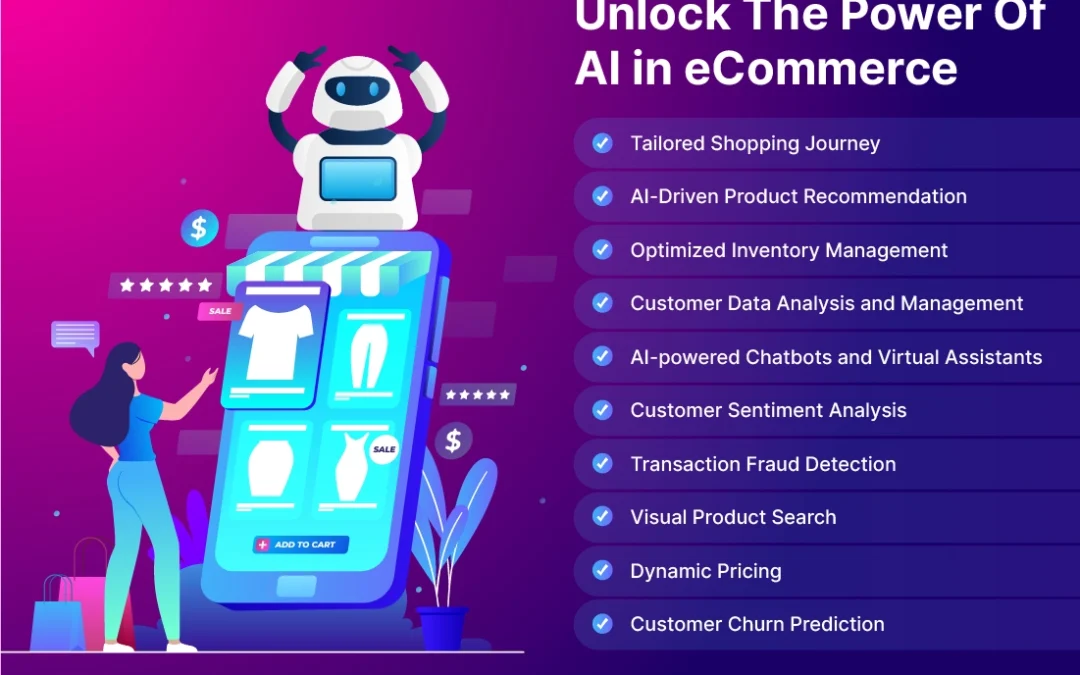
Online stores running on AI automation can cut order-processing time substantially and recover a meaningful share of abandoned carts that would otherwise vanish into thin air. Yet most e-commerce founders are still drowning in manual tasks — updating inventory by hand, answering the same five customer questions at 2 AM, and praying their email blasts convert.
AI automation for e-commerce stores is the use of artificial intelligence and software to handle repetitive store tasks — customer support, inventory tracking, product recommendations, marketing, and order fulfillment — with minimal human intervention. According to IBM, e-commerce automation “streamlines repetitive tasks and workflows for online stores,” freeing operators to focus on growth instead of grunt work.
Here’s the uncomfortable truth: the generic “26 best tools” listicles flooding your search results rarely tell you when to build versus buy, or how to actually calculate ROI. This guide focuses on those decisions. The patterns described below reflect how automation projects typically unfold across small and mid-sized stores — where off-the-shelf SaaS quietly bleeds margins, and where custom AI agents can pay for themselves at scale.
Transparency & Disclosure
This article is published by J. SERVO, which builds custom AI automation agents and tools for businesses. That means we have a commercial interest in the “build custom agents” path discussed below. We’ve tried to keep the analysis honest — including the cases where buying off-the-shelf SaaS is genuinely the better choice — but you should read the build-vs-buy section with that commercial relationship in mind. Statistics are attributed to their sources where available; figures we cannot source to a named, dated reference are presented as general patterns rather than precise claims, and we flag them as such.
Quick Summary: Key Takeaways
- AI automation for e-commerce stores handles support, inventory, marketing, and fulfillment — reducing manual workload on predictable tasks.
- AI chatbots can resolve a large share of routine customer queries without a human, though exact deflection rates vary widely by store and configuration.
- Abandoned cart recovery automation is frequently cited as one of the highest-ROI use cases.
- Build vs buy matters: SaaS subscriptions stack into a hidden “per-task tax”; custom agents eliminate recurring per-task fees at scale.
- A practical, incremental rollout beats waiting for a perfect autonomous store — start with one workflow, measure, expand.
- ROI must be quantified before adoption: track time saved, cart recovery rate, and support cost per ticket.
Published: December 2025. Last updated: December 2025.
What is AI automation for e-commerce stores?
AI automation for e-commerce stores refers to deploying artificial intelligence to run repetitive operational tasks — customer service, inventory updates, personalized recommendations, email campaigns, and order processing — automatically and at scale. The goal is to remove human bottlenecks from predictable workflows while keeping people in charge of judgment calls.
IBM defines e-commerce automation as “the use of technology, software and AI to streamline repetitive tasks and workflows for online stores” (IBM, 23 October 2025). That definition matters because it draws a line: automation isn’t about replacing your team — it’s about deleting the busywork that consumes hours every week across a typical small store.
Modern AI automation spans two layers. The front end faces customers: chatbots, product recommendations, dynamic pricing, and personalized email. The back end runs operations: syncing inventory across Shopify and warehouses, flagging fraud, generating product descriptions, and updating your ERP. Most competitor articles obsess over the front end. The back office — where margins actually leak — stays under-covered. Inriver’s guide to AI for e-commerce covers the breadth of these tools and how they automate and personalize the shopping experience.
Foundational providers like OpenAI anchor the ecosystem with the language models powering these tools, while specialized platforms layer e-commerce logic on top. The catch? Stacking five SaaS subscriptions to mimic one custom agent gets expensive fast. We call that the SaaS wrapper tax — and it’s avoidable.
How does AI automation work for e-commerce stores?
AI automation for e-commerce stores is the use of AI models and workflow engines that connect to your store’s data — orders, inventory, customer messages, and browsing behavior — to trigger actions automatically. When a cart is abandoned, a customer asks a question, or stock runs low, the system responds without waiting for a human.
The mechanism is deterministic at its best. A trigger fires (“customer added to cart, then left for 1 hour”), a condition is checked (“order value over $40, no purchase completed”), and an action executes (“send personalized recovery email with the exact items left behind”). Tools like n8n, Make, and Zapier orchestrate these flows, while AI models handle the judgment-heavy parts — writing the email copy, classifying the support ticket, or predicting which product to recommend.
Key term — large language model (LLM): the type of AI behind tools like ChatGPT that generates and interprets human language. As Wikipedia’s overview of artificial intelligence explains, these systems “perform tasks typically associated with human intelligence, such as learning [and] reasoning.” In commerce, an LLM is the reasoning component; the workflow engine is the plumbing that connects it to your real data and executes actions reliably.
The four core automation engines
- Conversational AI — chatbots on your site and WhatsApp that resolve FAQs, track orders, and qualify leads 24/7.
- Predictive AI — recommendation engines and demand forecasting that anticipate what customers want and what to restock.
- Generative AI — auto-written product descriptions, ad copy, and email campaigns at volume.
- Workflow AI — back-office automation syncing inventory, processing returns, and updating your ERP.
Here’s where reliable practice diverges from the hype crowd. A probabilistic “yes-machine” chatbot that hallucinates shipping policies costs you trust and refunds. The more robust pattern is to build deterministic AI agents with guardrails — they pull real order data, follow defined logic, and escalate to humans when uncertain. Reliability beats raw capability in commerce, where a wrong answer carries a direct financial cost.
What are the best AI automation use cases for e-commerce stores?
The highest-ROI AI automation use cases for e-commerce stores are abandoned cart recovery, customer support chatbots, inventory management, personalized product recommendations, and AI-generated content. These five tend to deliver measurable returns within weeks rather than vague “efficiency gains.” CommercePundit’s 15 AI automation ideas catalogs a similar set of front- and back-office use cases.
A note on figures: you’ll see headline claims like “chatbots resolve 80% of queries” or “recover 30% of carts” repeated across vendor blogs. Treat these as best-case marketing ranges, not guarantees — actual results depend heavily on traffic quality, product category, average order value, and how well the automation is configured. Below, where a number is widely cited but not traceable to a single named study, we say so.
1. Abandoned cart recovery
Abandoned cart recovery is the automated process of re-engaging shoppers who add items to an online cart but leave before purchasing. A typical implementation sends a sequence of timed emails or WhatsApp messages referencing the exact abandoned items. Smart sequencing (for example, 1 hour, 24 hours, and 72 hours) with dynamic discount logic generally outperforms a single generic blast. Worked example: a store with $10,000/month in abandoned-cart value that recovers a conservative 15% recaptures roughly $1,500/month — a figure that often exceeds the automation’s monthly cost.
2. Customer support chatbots
AI support agents handle “where’s my order,” return requests, and product questions instantly. The best ones connect to your order system so answers are real, not guessed. Web and WhatsApp chatbots can deflect a large share of tier-one tickets while routing complex cases to humans — avoiding robotic dead-ends. Trade-off: the more autonomy you give the bot, the more rigorously you must ground it in real data and test its escalation rules.
3. Inventory management
AI demand forecasting predicts likely stockouts and can auto-reorder based on sales velocity. For stores juggling hundreds of SKUs across channels, this reduces both overselling and dead stock. Practitioners generally find forecasting accuracy improves once the model has several months of clean sales history to learn from.
4. Personalized recommendations
Recommendation engines surface relevant products based on browsing and purchase behavior. Vendors widely cite large revenue contributions from recommendation systems at major retailers; specific percentages vary by source and are difficult to verify independently, so treat them as directional. Even SMEs can deploy recommendation features through their store platform or a dedicated app.
5. AI content generation
Generative tools write product descriptions, meta tags, and ad copy at scale. A store launching 200 SKUs can generate first-draft descriptions in minutes instead of weeks — though human editing still matters for brand voice and accuracy. RedTrack’s roundup of AI tools for e-commerce lists current options by category.
Should you build or buy AI automation for e-commerce stores?
You should generally buy off-the-shelf AI tools for standard, low-volume tasks and build custom AI agents when per-task SaaS fees stack up or your workflows are unique. The tipping point commonly arrives when monthly subscriptions climb into the hundreds of dollars and you’re paying for features you don’t use. (Reminder: as a builder of custom agents, we have a commercial stake in this recommendation — the thresholds below are guidelines, not universal rules.)
The market is saturated with SaaS lists — RedTrack’s “26 Best AI Tools for Ecommerce for 2026” and CommercePundit’s “15 AI Automation Ideas” are typical. These tools are genuinely useful for getting started. But the math changes at scale: every Zapier task, every per-seat chatbot license, every “premium” tier compounds. For growing stores this per-task tax can quietly become one of the larger line items in the operations budget.
| Factor | Buy (SaaS Tools) | Build (Custom Agents) |
|---|---|---|
| Upfront cost | Low ($0-99/mo) | Higher (project-based) |
| Cost at scale | High (compounding fees) | Low (no per-task fees) |
| Setup speed | Hours to days | Days to weeks |
| Customization | Limited to vendor roadmap | Fully tailored |
| Data ownership | Vendor-hosted | Self-hosted option (n8n) |
| Best for | Early-stage, standard tasks | Scaling stores, unique flows |
An honest take: start with buy, plan for build. A new store should validate demand with Shopify apps and a hosted chatbot before investing in custom development. Once you hit consistent volume — and the subscriptions multiply — migrating high-frequency workflows to self-hosted n8n and custom agents can reduce recurring cost. Self-hosting n8n alone can replace several paid automation tools at a fraction of the price, though it does require technical setup and ongoing maintenance, which is a real cost in time or staff.
How do you measure ROI on AI automation for e-commerce stores?
You measure ROI on AI automation for e-commerce stores by tracking three metrics: hours of manual labor saved, revenue recovered (cart abandonment, upsells), and cost reduction per task (support tickets, content production). Multiply time saved by your hourly cost, add recovered revenue, and subtract automation spend.
Too many founders adopt AI on vibes. “Everyone’s using chatbots” is not an ROI model. The discipline is straightforward: define a baseline before you deploy, then compare against it after. If you can’t measure it, you can’t defend the spend — and you can’t tell a tool that’s working from one that just looks busy.
The ROI formula for store automation
- Baseline your manual cost. Count hours spent weekly on support, content, and inventory. Multiply by loaded hourly wage.
- Estimate recovered revenue. Apply a conservative 15% cart recovery rate to your monthly abandoned cart value.
- Calculate task-cost reduction. If support tickets cost $4 each and AI deflects 60%, multiply your monthly ticket volume accordingly.
- Subtract total automation cost. Include subscriptions, build cost amortized over 12 months, and maintenance.
- Divide net gain by cost. A return above 3x in year one is generally considered strong for SME automation.
Try modeling your own numbers with our ROI calculator tooling before committing to any tool. Using the worked example above, a store recovering even 15% of a $10,000 monthly abandoned-cart pool gains roughly $1,500/month — often dwarfing the automation’s cost. Run the math with your real numbers rather than borrowed benchmarks.
How do you implement AI automation for e-commerce stores incrementally?
You implement AI automation for e-commerce stores most reliably by sequencing one high-impact workflow at a time — starting with cart recovery, then support, then inventory — rather than attempting a full autonomous store overnight. Focus and measurement beat ambition.
The autonomous-store hype is loud right now. A widely shared December 2025 video, “How I’d automate an e-commerce business in 14 days with AI” (7 December 2025), promotes near-hands-off operations. The direction is real, but the path is incremental. Trying to automate everything at once is how projects stall.
A staged rollout
- Days 1-3: Audit current workflows. Identify the three most time-consuming repetitive tasks and your biggest revenue leak.
- Days 4-7: Deploy abandoned cart recovery — often the fastest ROI win. Connect your store, set timed sequences, write personalized copy.
- Days 8-11: Launch a support chatbot wired to real order data. Define escalation rules so humans handle anything sensitive.
- Days 12-14: Add inventory alerts and one back-office automation (order tagging, returns routing). Measure baseline vs. results.
Keep humans in the loop throughout. The fastest way to erode customer trust is an unsupervised AI issuing wrong refunds or inventing policies. Transparency matters too — tell customers when they’re talking to a bot. After a focused two-week pilot you’ll have data, not guesses, to decide what to scale next.
What are the risks and limits of AI automation for e-commerce?
The main risks of AI automation for e-commerce are hallucinated responses, over-automation that erodes customer trust, hidden SaaS cost creep, and data privacy exposure. Every benefit carries a trade-off worth planning for honestly.
Hallucination is real — language models can confidently state things that aren’t true. In commerce, a chatbot that confirms a refund policy it invented creates costly disputes. The fix isn’t avoiding AI; it’s grounding agents in your real data and adding deterministic guardrails plus human escalation.
Over-automation is the subtler danger. Customers still want a human for high-value or emotional issues — a damaged order, a wedding-day delivery. Strip out all human touch and you may save pennies while losing loyal buyers. As Inriver frames it, the goal is to use automation to augment rather than fully replace human judgment.
Cost creep deserves repeating. SaaS tools that look cheap at launch can grow expensive as your task volume rises. Audit your automation spend quarterly. And mind data privacy — feeding customer data into AI systems can trigger GDPR and similar obligations. Choose vendors and architectures that keep you compliant and, ideally, keep your data under your control. We’re not lawyers; consult a qualified advisor for your jurisdiction.
Actionable Takeaways
- Start with cart recovery. It’s commonly the highest-ROI automation and recovers a meaningful share of lost revenue quickly.
- Wire chatbots to real data. Never let an AI guess your policies — ground it and add human escalation.
- Buy first, build at scale. Validate with SaaS, then migrate high-frequency flows off the per-task tax to custom agents.
- Measure everything. Track hours saved, revenue recovered, and cost per task before and after every deployment.
- Roll out incrementally. One workflow at a time over two weeks beats a stalled full-store overhaul.
- Keep humans in the loop. Automate the predictable; reserve people for judgment and emotion.
Frequently Asked Questions
What is the cheapest way to start AI automation for an e-commerce store?
The cheapest entry point is a self-hosted n8n instance combined with free-tier AI APIs, which can replace several paid SaaS subscriptions at a fraction of the cost — though it requires technical setup. For non-technical owners, a single Shopify app for abandoned cart recovery — often under $50/month — delivers the fastest measurable ROI with minimal setup.
Can AI automation fully run an e-commerce store without humans?
No fully autonomous store is reliably hands-off today, despite the “14-day autonomous business” content circulating since late 2025. AI excels at predictable, high-volume tasks like cart recovery and FAQ support, but human oversight remains essential for refunds, quality control, brand voice, and emotional customer issues. Augmentation works; full replacement risks trust and revenue.
How much can AI automation save an e-commerce business?
Savings depend heavily on your store’s size, category, and how well the automation is configured, so treat any single percentage as directional. Cart recovery offers a concrete example: a store with $10,000/month in abandoned carts that recaptures a conservative 15% recovers around $1,500/month — frequently exceeding the automation’s cost within the first quarter. Baseline your own numbers before assuming a benchmark applies.
Is it better to build custom AI agents or buy SaaS tools for e-commerce?
Buy off-the-shelf tools for standard, low-volume tasks and early-stage stores; consider building custom agents when SaaS subscriptions stack into the hundreds of dollars per month or your workflows are unique. Custom agents can eliminate compounding per-task fees and give you full data ownership, while SaaS offers faster setup and lower upfront cost for getting started.
What e-commerce tasks should you automate first with AI?
Automate abandoned cart recovery first — it generally has the fastest, most measurable ROI. Follow with a support chatbot connected to real order data, then inventory forecasting and back-office workflows. Sequencing one high-impact workflow at a time produces results you can measure rather than a stalled, over-ambitious overhaul.
Sources & References
- IBM — What is e-commerce automation? (23 October 2025)
- Inriver — AI for e-commerce: a guide to tools, automation & personalization
- RedTrack — 26 Best AI Tools for Ecommerce for 2026
- CommercePundit — 15 AI Automation Ideas for Ecommerce Businesses in 2026
- OpenAI — Research & Deployment
- ChatGPT
- Wikipedia — Artificial intelligence
- “How I’d automate an e-commerce business in 14 days with AI” (7 December 2025)
About This Article
This guide was prepared by the J. SERVO team, which designs and builds custom AI automation agents, chatbots, and workflow tools for businesses. Because J. SERVO offers custom-built automation as a commercial service, sections recommending custom agents reflect that business focus; we’ve aimed to present the buy-side case fairly alongside it. The article draws on publicly available vendor documentation, industry guides, and general topical expertise in e-commerce automation and AI workflow design rather than any proprietary or unverified data. Where statistics could not be tied to a named, dated source, they are described as general patterns or best-case ranges rather than precise claims.
Note: This article is for general informational purposes; verify specifics against your own context.