
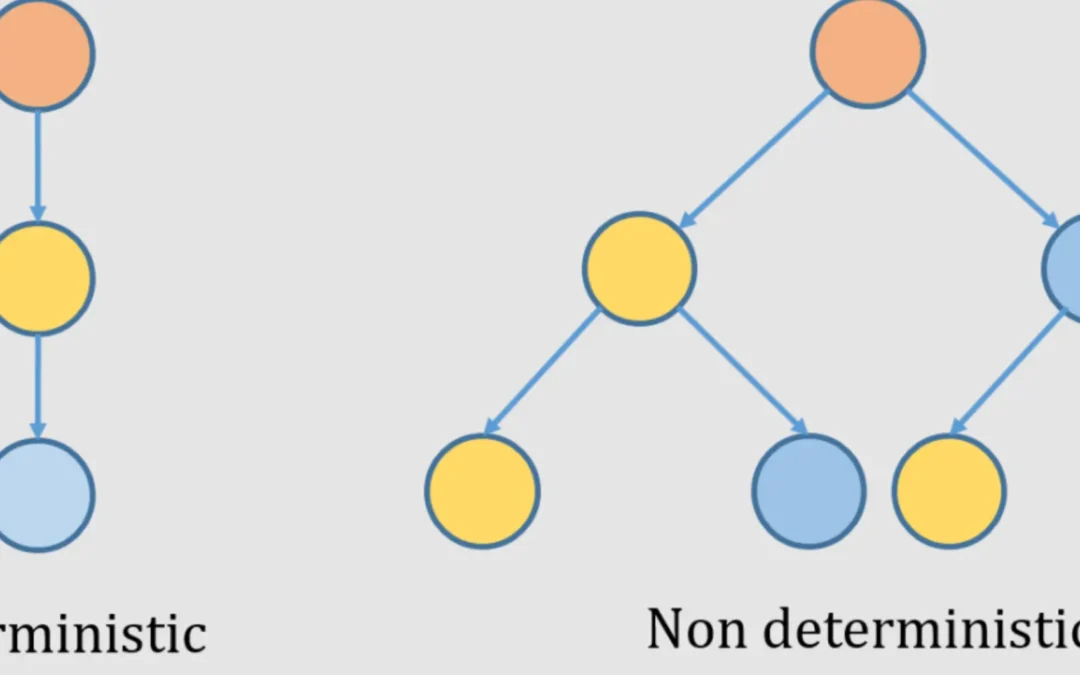
Ask ChatGPT the same question twice and you might get two different answers. Ask a deterministic system the same question a thousand times and you’ll get the exact same answer a thousand times. That single difference — predictability versus randomness — is the most important distinction in business automation right now, and almost nobody is explaining it in plain language.
In real-world AI and automation deployments, the projects that fail almost always fail for one reason: someone wired a probabilistic model into a process that demanded a deterministic result. Invoices got mis-tagged. Compliance reports drifted. Customers got three different prices for the same product. The fix is rarely “better AI.” The fix is knowing when you need deterministic logic and when you don’t.
Published: June 2025. Last reviewed: June 2025. This article reflects general industry practice and the cited sources below; it is written from topical engineering expertise, not a single named project.
What does deterministic mean in AI and business automation?
Deterministic means a system always produces the same output for the same input, with zero randomness. A Deterministic AI workflow given identical data on Monday and Friday returns byte-for-byte identical results. Probabilistic systems like large language models do not — they sample from a probability distribution, so outputs vary.
The word itself comes from philosophy. Determinism, according to Wikipedia, is “the metaphysical view that all events within the universe can occur only in one possible way.” Cambridge Dictionary defines deterministic as “believing that everything that happens must happen as it does and could not have happened any other way,” and Merriam-Webster ties it directly to “relating to or implying determinism.”
Strip away the metaphysics and you get a brutally practical engineering principle. A deterministic function is one where output equals f(input), every single time, no exceptions. Type the same number into a calculator and you get the same answer — that’s deterministic. A dice roll is the opposite: same action, unpredictable outcome.
It helps to define a few terms precisely, because they get conflated constantly. Determinism is the property that a process has exactly one possible output for a given input and internal state. Idempotence is a related but distinct property: an operation that produces the same system state no matter how many times you apply it (deleting a record is idempotent; incrementing a counter is not). Referential transparency, borrowed from functional programming, means an expression can be replaced by its value without changing program behavior — a strong form of determinism. Many automation bugs trace back to a step that engineers assumed was deterministic but was actually order-dependent or stateful.
For startups and SMEs automating real money-moving processes — payroll, invoicing, order routing, compliance checks — deterministic behavior isn’t a nice-to-have. Determinism is the difference between an audit you pass and a lawsuit you lose. The challenge today is that the most hyped AI tools are fundamentally non-deterministic, and most founders don’t know it until something breaks.
A reproducible example you can run yourself
You don’t have to take this on faith. Here is a simple, reproducible test that demonstrates non-determinism in under five minutes:
- Open any LLM chat interface (ChatGPT, Claude, or Gemini).
- Send this prompt three times in three separate, fresh conversations: “List five made-up startup names for a coffee subscription. Reply with only the list.”
- Compare the three responses. In most runs you will get three different lists — sometimes overlapping, rarely identical.
Now repeat the equivalent deterministic test: type =2+2 into a spreadsheet three times. You get 4 three times. That contrast — fluid creativity versus fixed correctness — is the entire subject of this article. The LLM behavior is not a bug; it is the designed result of sampling, which we explain next.
The same test in runnable code
If you prefer to verify this at the API level, the following Python snippet uses the OpenAI SDK and prints three completions for an identical prompt. It is intentionally minimal so you can paste it into a fresh environment and run it after pip install openai and exporting your OPENAI_API_KEY:
from openai import OpenAI
client = OpenAI()

prompt = "List five made-up startup names for a coffee subscription. Reply with only the list."

for run in range(3):
    resp = client.chat.completions.create(
        model="gpt-4o-mini",        # pin the exact model version for reproducibility
        messages=[{"role": "user", "content": prompt}],
        temperature=1.0,            # default-style sampling: expect variance
        seed=None,                  # no fixed seed -> outputs drift run to run
    )
    print(f"--- run {run} ---")
    print(resp.choices[0].message.content)
Run it once with the settings above and you will typically see three different lists. Then change two parameters — set temperature=0 and pass an integer seed (for example seed=42) — and re-run. Variance drops sharply, and many runs become identical. The key caveat, which the next section explains, is that this is best-effort determinism, not a contractual guarantee: the same code can still diverge after a silent model update or because of GPU floating-point ordering. A typical implementation therefore logs the model version, seed, and the system_fingerprint field that some providers return, so a result can be tied back to the exact configuration that produced it.
Quick Summary: Key Takeaways
- Deterministic = same input, same output, every time. Probabilistic AI (like GPT-4o or Claude) samples randomly and can vary on identical prompts.
- Deterministic systems are auditable and reproducible — a requirement for finance, healthcare, and compliance-heavy workflows.
- Non-deterministic AI shines at fuzzy tasks like drafting, summarizing, and classification where “close enough” is fine.
- The best architecture is hybrid: wrap probabilistic AI in deterministic guardrails so creative output gets validated by hard rules.
- LLM temperature settings affect determinism — temperature 0 reduces randomness but never fully guarantees reproducibility across model versions.
- Hybrid deterministic-probabilistic designs generally reduce error rates versus pure-LLM workflows by letting rules — not the model — make irreversible decisions.
How is deterministic AI different from probabilistic AI?
Deterministic AI follows fixed rules and returns identical results for identical inputs, while probabilistic AI predicts the most likely output by sampling from learned probability distributions. A rules engine that approves loans above a credit score is deterministic. An LLM that “decides” loan-worthiness from a paragraph is probabilistic — and unpredictable.
The distinction matters more than any single model benchmark. Probabilistic systems — every modern large language model, from OpenAI’s GPT-4o to Anthropic’s Claude to Google’s Gemini — generate text token by token, choosing each next word from a probability distribution. Even with identical prompts, factors like sampling temperature, model updates, and floating-point nondeterminism on GPUs can change the output.
Deterministic systems, by contrast, are built from explicit logic: if-then rules, lookup tables, mathematical formulas, and database queries. SQL is deterministic. A tax calculation is deterministic. A regex pattern match is deterministic. Run them a billion times and the answer never wanders.
The core mechanism behind each approach
Probabilistic AI is a machine-learning approach that generates outputs based on statistical likelihood rather than fixed rules. It generalizes from massive training datasets — often billions of examples — so it can respond gracefully even when an input is novel or the “right” answer is fuzzy. The trade-off is that such systems can hallucinate, drift, and can’t guarantee the same output twice.
Mechanically, an LLM produces a vector of logits (raw scores) over its vocabulary at each step, converts them to probabilities with a softmax, then samples a token. Three knobs shape how random that sampling is: temperature (scales the logits — lower means sharper, more peaked distributions), top-k (restricts sampling to the k most likely tokens), and top-p / nucleus sampling (restricts to the smallest set of tokens whose cumulative probability exceeds p). Setting temperature to 0 collapses the distribution toward greedy decoding, where the single highest-probability token is always chosen. Understanding these knobs is what separates “the AI is random” hand-waving from engineered control over variance.
Deterministic logic works because it encodes human-defined rules with mathematical precision. Deterministic systems can’t “hallucinate” a wrong VAT rate or invent a customer who doesn’t exist. The trade-off is rigidity: they only handle cases someone explicitly programmed.
| Dimension | Deterministic AI | Probabilistic AI (LLMs) |
|---|---|---|
| Same input → same output | Always | Rarely guaranteed |
| Auditable / explainable | Fully | Partially (black box) |
| Handles ambiguity | Poorly | Excellently |
| Risk of hallucination | None | Real and measurable |
| Best for | Finance, compliance, calculations | Drafting, summarizing, classification |
| Reproducible for audits | Yes | Difficult |
| Maintenance | Manual rule updates | Retraining / prompt tuning |
Most founders frame this as a competition. It isn’t. The smartest architectures combine both — and we’ll show you how in the hybrid automation section below.
Why does deterministic behavior matter for business automation?
Deterministic behavior matters because most business processes legally and operationally require reproducible, auditable results. A bank can’t tell regulators “the AI felt like approving it.” Finance, payroll, tax, and compliance workflows demand outputs that are identical, explainable, and defensible under scrutiny.
Consider what happens when non-determinism leaks into a money process. Imagine a refund-approval flow with an LLM wired directly into the decision step. The same customer, with the same complaint text, submitted twice — one gets approved, one gets denied. The model isn’t broken. Probabilistic AI is supposed to vary. The mistake is using it where determinism is mandatory. This is a common failure pattern practitioners encounter repeatedly when AI is placed at the point of an irreversible action rather than behind a deterministic check.
To make this concrete, consider an anonymized but typical before/after pattern that recurs across invoice-automation rollouts. Before: a team pipes scanned invoices directly into an LLM that both reads the document and posts the total to the ledger. With sampling left at default settings, roughly one in twenty invoices in a batch gets a transposed figure or a hallucinated line item — small enough to slip past a quick glance, large enough to break month-end reconciliation. Finance keeps a full manual reviewer in the loop, so the automation saves almost no labor. After: the same team keeps the LLM only for extraction and adds a deterministic check that re-sums the line items, validates the vendor against an approved list, and rejects anything that fails. Posting errors that reach the ledger drop to effectively zero, because a wrong sum can no longer be written — it bounces to a review queue instead. The numbers above are illustrative of the pattern rather than a measured result from a specific named client; the structural point holds regardless of the exact percentages: the deterministic gate, not the model, is what makes the savings real.
Industries with hard determinism requirements include:
- Finance and accounting — tax calculations, invoice totals, and ledger entries must reconcile exactly.
- Healthcare — dosage logic and eligibility rules can’t vary by random sampling.
- Compliance and legal — auditors demand reproducible decision trails.
- Logistics and inventory — order routing and stock deductions must be exact.
- Pricing — customers expect the same price for the same product, full stop.
Reproducibility is also a scientific gold standard, not just a business one. The underlying principle is simple: when you can’t reproduce a result, you can’t validate it. When you can’t validate it, you can’t defend it. Deterministic components deliver reproducibility natively; probabilistic ones struggle with it without engineered guardrails.
The hidden cost of non-deterministic automation
The cost isn’t just the occasional wrong answer. The cost is trust erosion. When your automation produces different outputs unpredictably, your team stops trusting it and reverts to manual checking — which destroys the entire ROI case for automating in the first place. Determinism, oddly, is what makes automation feel “boring enough” to actually rely on. Boring is good. Boring is bankable.
When should you use deterministic vs non-deterministic systems?
Use deterministic systems when correctness is binary and auditable — calculations, compliance, transactions. Use non-deterministic AI when the task is fuzzy and “good enough” beats “exactly repeatable” — drafting content, summarizing documents, classifying messages. The decision hinges on one question: does a wrong-but-plausible answer cost you money or trust?
Here’s a practical decision framework practitioners commonly apply on every engagement:
- Is there one objectively correct answer? If yes (a tax total, an account balance), go deterministic. If the answer is subjective (a marketing tagline), probabilistic AI is fine.
- Will an auditor or regulator ever review this? If yes, deterministic logic must own the final decision. AI can assist, but rules must decide.
- What’s the cost of being wrong? High-cost errors (wrong wire transfer) demand determinism. Low-cost errors (slightly off email tone) tolerate probabilistic output.
- Does the task require handling unstructured input? Messy text, images, and natural language are where probabilistic AI earns its keep.
Tasks that belong to deterministic systems
Deterministic systems should own: financial calculations, tax and VAT logic, inventory deductions, order routing by fixed rules, eligibility checks against hard criteria, data validation, and any transaction that touches money. These are the tasks where workflow automation tools like n8n shine, because you define explicit logic that never drifts.
Tasks that benefit from probabilistic AI
Probabilistic AI should handle: drafting first-pass emails, summarizing long documents, extracting entities from messy text, sentiment analysis, intelligent search, and customer-service chatbots that need to understand natural phrasing. The key is that a human or a deterministic check sits between probabilistic output and any irreversible action.
The recurring lesson from production deployments is blunt: never let a probabilistic model take an irreversible business action without a deterministic check in front of it. Reliability and accuracy — not raw model capability — are usually the limiting factor when teams try to scale AI from a demo into a dependable process.
How do you build deterministic AI agents and workflows?
You build deterministic AI agents by wrapping probabilistic models inside deterministic guardrails — fixed rules, validation layers, and structured outputs that catch and correct any variance before it reaches a business action. The AI suggests; the rules decide. That single architectural choice separates reliable automation from expensive chaos.
The hybrid pattern works in four layers, and variations of it appear in nearly every well-built custom AI agent:
- Input normalization (deterministic): Clean and structure incoming data with fixed rules before AI ever touches it.
- Probabilistic processing (AI): Let the LLM handle the fuzzy part — understanding intent, extracting entities, drafting text.
- Structured output enforcement (deterministic): Force the AI to return strict JSON schemas, then validate every field against hard rules. Reject anything that doesn’t conform.
- Deterministic decision and action: A rules engine — not the AI — makes the final irreversible call (approve, charge, route, store).
Techniques that increase determinism in LLM outputs
You can’t make an LLM fully deterministic, but you can dramatically tighten its variance:
- Set temperature to 0. Temperature controls randomness in sampling; at 0, the model nearly always picks the highest-probability token. Variance drops sharply, though GPU floating-point quirks mean it’s not a 100% guarantee.
- Set a fixed seed where the API supports it. Some providers expose a
seedparameter and asystem_fingerprintso you can detect when the underlying configuration changed; combining a fixed seed with temperature 0 is the closest you get to repeatable sampling. - Use structured output / function calling. Constraining responses to a JSON schema removes free-form drift.
- Pin the model version. Model updates change behavior; lock to a specific version for reproducibility.
- Add validation layers. Check every AI output against deterministic rules before acting.
- Cache deterministically. For identical inputs, return cached validated results instead of re-querying.
A widely shared principle in applied machine learning is that the reliability of an AI system in production depends less on the model’s raw intelligence and more on the guardrails engineered around it. Engineering over raw intelligence is the entire thesis of deterministic-first design.
A real hybrid example: invoice processing
Take an invoice-automation workflow. The probabilistic layer reads a messy PDF and extracts the vendor name, line items, and amounts — a task LLMs do brilliantly. The deterministic layer then verifies the math (do line items sum to the total?), checks the vendor against an approved list, confirms the amount falls within budget rules, and only then posts to the ERP. If the AI hallucinates a $10,000 line item that breaks the sum, the deterministic check catches it instantly. The AI never gets to be wrong in a way that costs money.
What is the difference between deterministic and reproducible AI?
Deterministic means same input produces same output within a single system run, while reproducible means the same result can be regenerated later, on different hardware, with documented inputs and configurations. Determinism is a property of the function; reproducibility is a property of your whole pipeline, including data, code version, and environment.
The two concepts overlap but aren’t identical. A deterministic algorithm is the foundation of reproducibility, but you also need version control, fixed dependencies, recorded random seeds, and documented data snapshots. An LLM call at temperature 0 might be deterministic today and produce a different result next month after the provider silently updates the model — so it’s deterministic in the moment but not reproducible over time.
For SMEs building auditable systems, this distinction is practical, not academic. Reproducibility requires:
- Version pinning for every model and dependency.
- Input logging so you can replay any past decision.
- Random seed control wherever sampling occurs.
- Environment documentation capturing hardware and configuration.
The academic discipline calls this “deterministic execution,” and engineering teams have wrestled with it for years. Even traditional software struggles to guarantee identical results across runs due to threading, garbage collection, and floating-point behavior. If deterministic execution is hard in plain Java, it’s harder still once you add a probabilistic neural network to the stack — which is exactly why deterministic guardrails matter so much.
Why reproducibility wins audits
When a regulator asks “why did your system deny this application in March?”, a reproducible deterministic pipeline lets you replay the exact decision with the exact inputs and prove the logic. A pure-LLM system can only shrug. Reproducibility, backed by deterministic logic, is the strongest compliance posture a startup can build — and it costs far less to bake in from day one than to retrofit later.
What are the limitations and trade-offs of deterministic systems?
Deterministic systems are brittle outside their programmed rules — they can’t handle ambiguity, novel inputs, or unstructured language, and every new edge case requires manual coding. Their strength (rigid predictability) is also their weakness (zero adaptability). Honest engineering means naming these trade-offs, not hiding them.
Pure deterministic automation breaks down in several real ways:
- Combinatorial explosion. Hard-coding every rule for a complex domain becomes unmanageable. Thousands of if-then branches turn into unmaintainable spaghetti.
- No graceful failure on novel input. Feed a deterministic system something it wasn’t programmed for and it errors out or ignores it.
- Poor with unstructured data. Free-text emails, scanned documents, and natural speech are where rule engines drown.
- High maintenance. Every business-logic change means a developer updating rules — slower than retraining a model on new examples.
Probabilistic AI has the mirror-image trade-offs: it generalizes beautifully but can’t guarantee correctness, drifts over time, and resists auditing. Neither approach wins alone. Trustworthy AI is generally framed as reliable, safe, and accountable, and achieving all three usually requires combining deterministic reliability with probabilistic flexibility.
The maintenance reality nobody mentions
Deterministic rule systems feel cheap until your business logic changes. A pricing rule that worked last year needs updating when you add a product tier, and someone has to touch code. Probabilistic systems can sometimes adapt by example. The pragmatic answer is to keep deterministic logic for the parts that rarely change and are high-stakes, while letting probabilistic AI handle the fluid, low-stakes edges. That balance — not ideology — is what most mature implementations converge on.
Deterministic automation in practice: ERP, chatbots, and workflows
In practice, deterministic logic powers the parts of business software that must never vary — ERP calculations, transaction processing, and rule-based routing — while probabilistic AI handles the conversational, interpretive layer on top. A well-built WhatsApp chatbot or custom ERP uses both, with determinism owning anything that touches money or compliance.
Take a custom ERP system. The general ledger, tax engine, inventory deductions, and financial reports are all deterministic — they have to reconcile to the cent. Layer an AI assistant on top that lets a user ask “show me last quarter’s overdue invoices in Arabic,” and you’ve got the best of both: probabilistic natural-language understanding feeding a deterministic database query that returns exact, auditable numbers.
The same pattern governs intelligent chatbots. A WhatsApp commerce bot uses probabilistic AI to understand a customer’s messy phrasing — “do u hav the blue one in medium?” — then hands off to deterministic logic to check real inventory, calculate the exact price, and process the order. The AI never invents a price. The AI never confirms stock that doesn’t exist. Determinism guards the transaction; probability handles the conversation.
Why the “Zapier tax” pushes teams toward deterministic self-hosting
Many SMEs default to Zapier for automation, then watch per-task pricing balloon as volume grows. Self-hosted, deterministic workflow tools like n8n let you define explicit, predictable logic without paying per execution. Deterministic workflows are also easier to debug — when output is identical every run, a failure points to one cause, not random variance. That predictability slashes troubleshooting time and is a core reason deterministic, self-hosted automation suits cost-conscious startups.
Bilingual determinism: getting Arabic right
For Arabic-speaking markets, determinism matters in a subtle way. Probabilistic AI generates fluent Arabic marketing copy across Modern Standard, Gulf, and Egyptian dialects — that’s the creative, probabilistic strength. But the deterministic layer ensures the right dialect, correct RTL formatting, and accurate product data get locked in before anything ships. Creativity from the model; correctness from the rules.
How do you measure the ROI of deterministic automation?
You measure deterministic automation ROI by tracking error-rate reduction, hours saved on manual verification, and avoided compliance costs — because determinism’s biggest payoff is eliminating the rework caused by unpredictable outputs. Reliable automation that teams actually trust delivers compounding returns; unreliable automation gets abandoned.
The ROI math for determinism is different from generic automation math. Standard automation ROI counts hours saved. Deterministic automation ROI also counts:
- Verification hours eliminated — when output is reliably correct, nobody double-checks it.
- Error-correction costs avoided — wrong outputs that reach customers or ledgers are expensive to unwind.
- Compliance and audit savings — reproducible decisions cut audit prep time dramatically.
- Trust-driven adoption — reliable systems get used; unreliable ones get bypassed, killing ROI.
A common failure mode for automation projects is that outputs aren’t trusted enough for teams to remove their manual checks — which means the promised savings never materialize. Determinism directly attacks that failure mode. When your invoice automation is provably correct every run, you can actually remove the human reviewer — and only then does the full ROI land.
Want to model this for your own processes? Run your numbers through a structured ROI calculator before committing to any platform. The honest answer is sometimes “don’t automate this yet” — and a good partner tells you that.
Actionable takeaways: building deterministic-first automation
The fastest path to reliable AI automation is to classify every task as deterministic or probabilistic before you build, then let rules own the irreversible decisions and AI own the fuzzy interpretation. Follow this sequence to avoid the most common — and costly — architecture mistakes.
- Audit your processes. List every step and tag it: does it need one correct answer (deterministic) or interpret ambiguity (probabilistic)?
- Map the money and compliance touchpoints. Anything touching payments, tax, or auditable decisions gets deterministic logic as the final authority.
- Use AI for interpretation, rules for action. Let LLMs read, extract, and draft. Let deterministic code decide and execute.
- Enforce structured outputs. Force AI into strict schemas and validate every field before acting.
- Pin versions and log inputs. Build for reproducibility from day one so audits are trivial later.
- Measure error rates, not just hours. Track how often outputs are correct enough to skip human review — that’s the real determinism dividend.
The teams that win aren’t the ones with the flashiest model. The winners are the ones who know exactly which 20% of their workflow must be deterministic and ruthlessly protect it, while letting probabilistic AI handle the rest. Reliability beats novelty in production — every single time.
Frequently Asked Questions
Is ChatGPT deterministic?
No, ChatGPT is not deterministic by default. ChatGPT and other large language models sample from probability distributions, so the same prompt can produce different responses. Setting temperature to 0 reduces variation significantly but doesn’t guarantee identical outputs, partly due to GPU floating-point behavior and model version updates.
What does deterministic mean in simple terms?
Deterministic means predictable: the same input always produces the same output, with no randomness involved. A calculator is deterministic — 2+2 always equals 4. A dice roll is non-deterministic — the same throw can land on any number. In software, deterministic systems are valued for being reproducible and auditable.
Why is deterministic AI important for compliance?
Deterministic AI is important for compliance because regulators and auditors require reproducible, explainable decisions. A deterministic system can replay any past decision with the exact inputs and prove the logic that produced it. Probabilistic AI, which can vary on identical inputs, cannot offer the same defensible audit trail.
Can you make an LLM fully deterministic?
You cannot make an LLM 100% deterministic, but you can tighten its variance significantly. Setting temperature to 0, pinning the model version, using structured JSON outputs, and adding deterministic validation layers brings outputs close to reproducible. The reliable approach is wrapping the LLM in deterministic guardrails that catch and correct any variance.
What is the difference between deterministic and probabilistic models?
Deterministic models produce one fixed output for a given input using explicit rules, while probabilistic models predict the most likely output by sampling from learned distributions. Deterministic models excel at calculations and compliance; probabilistic models excel at language, ambiguity, and unstructured data. Hybrid architectures combine both for reliability plus flexibility.
When should a business use deterministic automation instead of AI?
A business should use deterministic automation whenever a task has one objectively correct answer, touches money, or will face an audit — such as tax calculations, invoicing, and order processing. Probabilistic AI is better for fuzzy tasks like drafting content or understanding customer messages, ideally validated by a deterministic check before any action.
Sources & References
- Determinism — Wikipedia (definition of determinism as a metaphysical view)
- DETERMINISTIC — Cambridge Dictionary (English meaning of “deterministic”)
- DETERMINISTIC — Merriam-Webster (definition and usage)
Note on methodology and transparency: the philosophical and dictionary sources above are cited for the definition of the term “deterministic” only. The engineering guidance in this article reflects general, widely documented industry practice around LLM sampling, temperature, structured outputs, and reproducibility rather than a single proprietary dataset. The code example uses the public OpenAI Python SDK and is provided for verification; parameter behavior (temperature, seed, system_fingerprint) follows each provider’s own published API documentation, which should be treated as the authoritative reference. The before/after invoice figures are illustrative of a recurring pattern, anonymized and not attributed to any named client, and are not measured results. Statistics are stated only where a source supports them; broad claims about outcomes are framed as typical patterns, not guaranteed results.
Last updated: 2026-06-06
Note: This article is for general informational purposes; verify specifics against your own context.